

Commission, February 13, 2019, No M.8941
EUROPEAN COMMISSION
Decision
EQT / WIDEX / JV
Subject: Case M.8941 - EQT / Widex / JV
Commission decision pursuant to Article 6(1)(b) of Council Regulation No 139/2004 (1) and Article 57 of the Agreement on the European Economic Area (2)
Dear Sir or Madam,
(1) On 9 January 2019, the European Commission received notification of a proposed concentration pursuant to Article 4 of Council Regulation (EC) No 139/2004 (the “Merger Regulation”). This notification concerns the creation of a full function joint venture between the following undertakings: Sivantos Pte. Ltd. (“Sivantos”, Singapore), controlled by Equity VI Limited and EQT Fund Management S.à r.l. (together referred to as “EQT”); and Widex A/S (“Widex”, Denmark), controlled by T&W Medical A/S (formerly Widex Holding) (“T&W Medical”, Denmark). T&W Medical and EQT acquire, within the meaning of Article 3(1)(b) and 3(4) of the Merger Regulation, joint control over a newly created entity (the “JV” or the “Merged Entity”), combining the activities of Widex and Sivantos (the “Transaction”). The concentration is accomplished by way of purchase of shares in a newly created company constituting a joint venture. (3) (EQT and T&W Medical are designated hereinafter as the “Notifying Parties” or “Parties”).
1. THE PARTIES
(2) EQT is a private equity company controlling numerous investment funds. The EQT funds’ portfolio companies are active in a variety of industries, including the healthcare, Telecommunications, Media & Technology services, consumer and industrial technology sectors amongst others.
(3) Sivantos is a privately held company controlled by EQT, with headquarters in Singapore, which manufactures hearing aids and complementary accessories and develops fitting software, smartphone apps and diagnostics workflow solutions. Sivantos manufactures and assembles hearing aids both in Europe (in Germany and Poland), as well as at various sites around the world. Sivantos offers hearing aids under the brands Siemens, Signia, Audio Service, Rexton, and A&M. In addition, Sivantos is active in Germany, France and the Netherlands through its online affiliate audibene which refers potential customers to partner audiologists.
(4) Widex is a privately held company controlled by T&W Medical, with headquarters in Denmark. Widex manufactures and assembles hearing aids and complementary accessories, fitting software and smartphone apps. T&W Medical is ultimately jointly controlled by descendants of the two founders of Widex, Christian Tøpholm and Erik Westermann. (4) In Europe, Widex has manufacturing activities in Estonia (subassembly), Poland (refurbishment and repair) and Denmark (chip production, moulding, final assembly and programming), and subassembling activities at various sites around the world. Widex offers hearing aids under the brands Widex and Coselgi.
2. THE OPERATION
(5) On 15 May 2018, the Notifying Parties signed transaction documents including the “Combination Agreement” and the “Shareholders’ Agreement” in which they agreed the implementation conditions, and respectively the management conditions for the JV.
(6) Pursuant to the transaction documents, EQT and T&W Medical will contribute the businesses of Sivantos and Widex to the JV, which will be jointly controlled by the Notifying Parties following several operations, whereby EQT will ultimately own 53% of the JV’s shares and T&W Medical will own the remaining 47%. Post-Transaction, the JV will be the parent company of both Sivantos and Widex.
3. THE CONCENTRATION
(7) The Transaction constitutes a concentration within the meaning of Articles 3(1)(b) and 3(4) of the Merger Regulation.
3.1. Joint control
(8) EQT and T&W Medical will jointly own the JV, EQT owning 53% (through three acquisition vehicles) and T&W Medical owning 47% of the shares issued by the JV.
(9) Pursuant to the Shareholders’ Agreement, EQT and T&W Medical will have equal voting rights in the JV and equal rights to appoint the board of directors in charge of the JV management. Specifically, EQT and T&W Medical will each have the right to separately appoint four (out of eight) members of the board of directors. (5) The board of director decides on matters that are of material importance to the JV.
(10) Pursuant to the transaction documents, the voting procedures grant (negative) control to both T&W Medical and EQT. Decisions of the board of directors are taken by simple majority. (6) The quorum rules applicable to board of directors’ decisions imply the presence (or representation) of at least one director appointed by T&W Medical and one director appointed by EQT. (7) Furthermore, neither EQT nor T&W Medical have a casting vote in case of deadlock.
(11) In addition, a number of strategic matters (8) require the approval of each Party. At board level, strategic matters require the consenting vote of at least one director nominated by T&W Medical and one director nominated by EQT. Similarly, at general meetings of the JV shareholders, decisions on strategic matters require the consenting vote of both T&W Medical and one of the EQT shareholders. As a result, both Parties have veto rights related to such strategic matters, which include the JV’s budget, business plan, and the appointment of senior management. (9)
(12) Consequently, the JV will be jointly controlled by the Notifying Parties.
3.2. Full functionality
(13) The JV will combine the existing customer-facing businesses of Sivantos and Widex. The JV will in particular take on the existing manufacturing, wholesale and retail distribution operations of Sivantos and Widex, funding itself from such activities. The JV will have an autonomous presence on the market, benefitting from Sivanto and Widex’s management teams, resources, financing, personnel and tangible and intangible assets. As parent company of Sivantos and Widex, the JV will be in control of these resources. The JV is incorporated for an indefinite period and intended to operate on a long-lasting basis. The Transaction will therefore lead to the creation of a full function joint venture.
4. EU DIMENSION
(14) The undertakings concerned have a combined aggregate world-wide turnover of more than EUR 5 000 million (10) (EQT: EUR […] million; T&W Medical: EUR […] million). Each of them has an EU-wide turnover in excess of EUR 250 million (EQT: EUR […] million; T&W Medical: EUR […] million), but they do not achieve more than two-thirds of their aggregate EU-wide turnover within one and the same Member State.
(15) The Transaction therefore has an EU dimension pursuant to Article 1(2) of the Merger Regulation.
5. RELEVANT MARKETS
(16) Both Parties are primarily active in the manufacture and wholesale distribution of hearing aids globally.
(17) The Parties are also active in the distribution of audiology diagnostic equipment, including audiometers, otoscopes, and tympanometers. The Parties do not manufacture audiology diagnostic equipment and act as mere resellers. Their activities as distributors of audiology diagnostic equipment do not give rise to any horizontally or vertically affected market in the EEA and will therefore not be further assessed in the present decision. (11)
5.1. Introduction – General characteristics of hearing aids
(18) Hearing aids are medical devices designed to improve a patient’s ability to hear by amplifying acoustic signals. The severity of a hearing loss is specific to every patient and hearing aids are prescribed for addressing the complete range of hearing loss, from mild to profound. (12)
(19) Although there is no minimum threshold of hearing loss required for an individual to start using hearing aids, practitioners typically do not prescribe hearing aids unless the deficit exceeds 30dB. (13) In certain EEA countries, the hearing threshold is a benchmark for determining the entitlement to reimbursement by social security systems of the costs of a hearing aid (for e.g. in Belgium, only patients with a hearing loss of at least 40dB are eligible for
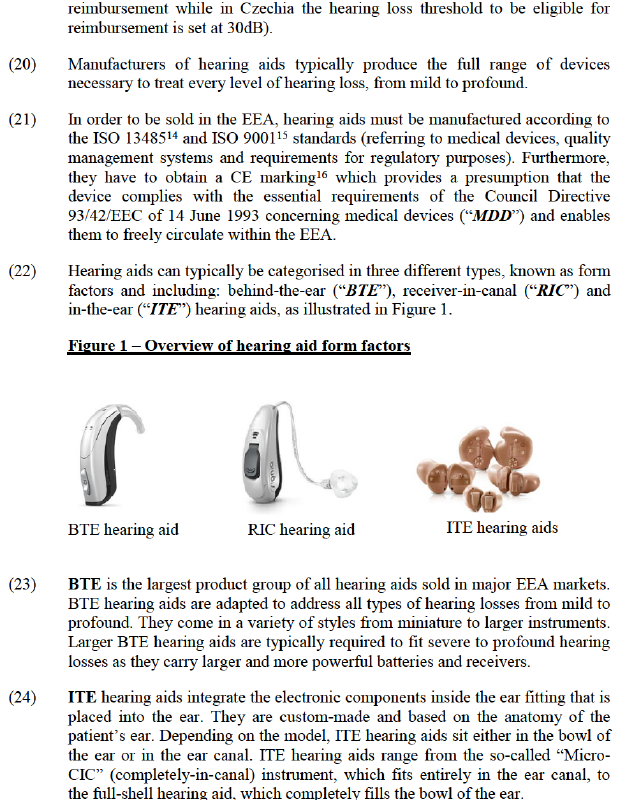
(25) RIC hearing aids are an intermediate solution between BTE and ITE hearing aids. Unlike in traditional BTE hearing aids, the loudspeaker of a RIC model sits inside the ear canal, meaning that fewer components need to fit inside the hearing aid shell that is placed behind the ear.
(26) The manufacturing of hearing aids is based on well-established technologies. The production of most components can easily be outsourced to third-party suppliers. In general, the manufacturing steps differ slightly according to the form factor of the hearing aid, although the majority of electric components contained within the different form factors are identical. Thus, for example, RIC hearing aids (see Figure 2) have the following components: (1) microphones (pick up the sound from the environment), (2) mini-chip (processes the acoustic signal according to the individual hearing needs) (3) receiver (delivers the sound), (4) battery (powers the hearing aid), and (5) program switch / volume control.
(27) By contrast, BTE hearing aids integrate all five components inside the shell which is placed behind the ear and transmits the sound via a sound tube into the ear. While the shell of ITE hearing aids are custom-made in order to fit a patient’s ear, the basic components (including the chip, microphones and some of the electronics) are the same as for BTE and RIC devices.
(28) Hearing aids have significantly evolved over the last couple of decades, with one of the main changes being the move from analogue to digital signal processing. Nowadays, nearly all hearing aids sold on the market are digital. Since this disruptive technological change took place, subsequent improvements have been incremental, focusing in particular on miniaturisation, the introduction of additional features (e.g. connectivity with smartphones, Bluetooth connectivity, directional hearing), improvements to sound quality and the introduction of rechargeable battery solutions.
(29) Irrespective of recent innovations, the basic principle behind every hearing aid remains the same. A microphone picks up the sound signal, a processor converts and treats it, and the receiver plays it back into the ear. A hearing aid can then be outfitted with additional software for extra features (e.g. connectivity, machine learning, rechargeability, etc.). Ultimately, the final price of a hearing aid is primarily linked to its technology level.
(30) Hearing aids must be distinguished from (i) cochlear implants and bone conducting systems, that are surgically implanted to treat hearing impairment, (ii) personal sound amplification products (“PSAPs”), which are wearable electronic devices designed to amplify sounds for non-hearing impaired users (amplification of sounds up to 30dB) and are sold over-the-counter, and (iii) assistive listening devices (“ALDs”), which are devices used to bring distant sound signals directly into the wearer’s ear and to eliminate background noise. Neither of the Parties manufacture cochlear implants, bone conducting systems, PSAP or ALD devices.
(31) The typical route to obtaining a hearing aid (although, this is not the case in every EEA country) involves the patient making an appointment with an ear, nose and throat specialist doctor (“ENT”), who diagnoses their hearing loss and prescribes a hearing aid. The patient then goes to an audiologist to be fitted with a hearing aid device. Audiologists can work either in independent private practices (or as part of a larger chain) or at public clinics and hospitals.
(32) Depending on the EEA country, manufacturers of hearing aids sell their products (either directly or via third-party distributors) to public health services, private retailers or a combination of the two (market for the manufacture and wholesale distribution of hearing aids, see section 5.2.1). In turn, public health authorities and private retailers dispense hearing aids to patients (market for the retail distribution of hearing aids, see section 5.2.2). In some EEA countries, certain hearing aid manufacturers are vertically integrated and also sell hearing aids directly to patients in their retail stores.
(33) On the private part of the wholesale distribution, competition between hearing aid manufacturers focuses on winning business from audiologists such as independent retail stores or large chains. There are significant variations between EEA countries in terms of the downstream retail structure of the hearing aid market, with large multinational chains (and/or optical chains that have expanded into audiology) having a much more significant presence in some EEA countries than others.
(34) On the public part of the wholesale distribution such as in Denmark, Finland, Ireland, Latvia, Malta, Norway, Sweden, or the United Kingdom, competition between hearing aid manufacturers typically arises during tenders for specific product categories, although the precise procurement system largely depends on the national public authorities. Such tenders typically specify a set of technical criteria that hearing aid products must meet. Generally, pricing plays a more significant role in public tenders than on the private wholesale market. (17)
(35) The price of hearing aids significantly varies between EEA countries, both at the wholesale and retail levels. The price charged generally depends on the product itself, its technical features, bilateral negotiations with retailers, tender procedures, as well as other market characteristics in each EEA country (e.g. reimbursement and income levels, presence and size of retail players, etc.). Even if most EEA countries offer some form of financial support to patients for the purchase of hearing aids, the generosity and structure of these reimbursement systems considerably vary between EEA countries. In some countries, the public health system is involved directly (e.g. by sourcing hearing aids through public tenders and distributing them to patients), whilst in others there are private and/or public health insurance providers that offer fixed levels of reimbursement, with the patient usually paying some part of the retail price.
5.2. Product market definition
(36) Manufacturers of hearing aids operate along the hearing aid distribution chain at two levels. At the upstream level, hearing aid manufacturers offer their products at wholesale level to private retailers and public procurement authorities. At the downstream level, manufacturers vertically integrated into retail (along third- party retailers) supply hearing aids and related services directly to end users, i.e. patients suffering from hearing loss. In examining the Transaction, it is appropriate to maintain that distinction.
5.2.1. Upstream: Manufacture and wholesale distribution of hearing aids
(37) Manufacturers of hearing aids generally sell their products (at the wholesale level), either directly or via third-party distributors, to (i) public authorities and/or (ii) private retailers.
5.2.1.1. Precedents
(38) The Commission has not in the past assessed the market for the manufacture and wholesale distribution of hearing aids.
(39) Several national competition authorities examined concentrations in the hearing aids industry in the EEA and consistently identified a single market for the manufacture and wholesale distribution of all types of hearing aids. In particular, in its 2015 decision relating to the acquisition by William Demant of the retailer Audika, the French competition authority identified a market for the manufacture and wholesale commercialisation of hearing aids. (18) In its 2007 decision relating to the planned merger between Phonak (Sonova) and GN, the German competition authority also identified a single product market for the manufacture of hearing aids and their sale to hearing aid retailers, finding in particular that there should be no separate markets depending on the form factors, technology (analogue or digital), or price of hearing aids. (19) Similarly, in its 2016 decision relating to the acquisition by Sonova of the retailer Audionova, the Dutch competition authority identified a market for the manufacture and (wholesale) supply of hearing aids. (20)
5.2.1.2. The Parties’ view
(40) The Parties submit that the overall market for the manufacture and wholesale distribution of hearing aids is the relevant one to assess the Transaction, without the need for further segmentation. In particular, the Parties exclude the existence of separate relevant product markets with respect to the following differentiations: (i) depending on the form factor and/or performance level of hearing aids, (ii) based on the distribution channel, (iii) based on hearing aids’ prices, (iv) between manufacturer-branded products and private label hearing aids, (v) between hearing aids for adults and children, or (vi) between hearing aids and their accessories and services.
5.2.1.3. The Commission’s assessment
(41) Despite providing clear indications that the hearing aid market is highly differentiated, the market investigation generally supported the Parties’ view of a single overall product market encompassing all types of hearing aids as well as related accessories and services. The market investigation also indicated that further segmentations of the hearing aid market is not necessary for the purpose of the present case.
No distinction depending on the form factor, performance level or price of hearing aids
(42) Multiple parameters determine a patient’s requirements when procuring hearing aids. Such parameters include mainly the severity of the hearing loss, as well as the shape of the patient’s ear canal, the patient’s dexterity, or the presence of wax in the ear canal. There are significant overlaps across hearing aids of different form factors to meet each patient’s specific requirements. Most fundamental features of modern hearing aids (software, algorithm, sound processing, amplification etc.) are generally available across all form factors, as these are included in the digital chip that is used by manufacturers across all hearing aid models of a specific generation/platform. In particular, BTE and RIC hearing aids form part of a continuum in terms of performance, with no clear distinction in terms of suitable use for patients. Only a small number of patients cannot use a specific form factor. Most notably, ITE hearing aids are not suitable for patients with profound hearing losses, (21) patients with small or irregularly shaped ear canals, or with excessive amounts of ear wax.
(43) In addition, patients’ awareness about hearing aids, including about form factors, models, prices or brands, is typically very limited, in particular for non- returning patients, which represent the majority of sales. (22) Patients may have some preference between various form factors, designs, or features, in particular for the most discrete models. However, they typically follow the recommendations of ENTs and/or audiologists, which prescribe the most adapted hearing aids to the patient’s requirements. Retailers and ENTs, as trusted professionals, usually act as gatekeepers of the hearing aids market. (23)
(44) The market investigation confirms that retailers of hearing aids typically purchase and offer all types of hearing aids, regardless of their form factor, price or technical performance. (24) They do so in order to offer a full range of hearing aid solutions, which comprises products for all levels of hearing loss severity and addresses patients’ needs and/or preferences. In particular, the market
investigation reveals that the vast majority of customers (retailers, (25) large retail chains, (26) and public procurement authorities (27)) consider it important to dispense a full range of form factors and performance levels of hearing aids, to accommodate all possible patients’ requirements and wishes. Offering a full range of hearing aids even is a legal requirement in some EEA countries, such as Germany. (28)
(45) To reflect demand, most hearing aid manufacturers, in particular every major player, offer hearing aids of all possible form factors, price and performance levels, treating all levels of hearing loss severity, for both adults and children. (29)
No distinction between adults’ and children’ hearing aids
(46) Hearing aids for children are based on the same technology, have the same chip and come in the same variety of form factors as those for adults. However, like all types of hearing aids, solutions for children may integrate specific features due to age-specific requirements. For instance, hearing aids for children typically include a clip and a string to attach the device to a child’s clothes, and a battery door lock to prevent children from swallowing the battery. Consequently, all hearing aid manufactures offer hearing aids for children. A distinction between adult and paediatric hearing aids is thus irrelevant for the purposes of assessing the Transaction.
No separate product markets between manufacturer-branded products and private label hearing aids
(47) The market investigation indicates that branded products and private label products, offered by retailers under their own brand, form part of the same relevant product market. Large retailers, which offer private label products overall confirm that hearing aids do not differ in terms of characteristics and overwhelmingly consider that the negotiation dynamics are similar in both cases. (30) In addition, on the supply side, most hearing aid manufacturers, including all of the primary players offer both branded and private label hearing aids. (31)
No separate product markets between hearing aids and their accessories and services
(48) The market investigation confirms that the wholesale supply of accessories and services should form part of the same relevant product market as the one for hearing aids. The Commission derives from the market investigation that the accessories and services are ancillary to the use of a hearing aid and are typically purchased together with the hearing aid or as replacement sales, and thus consistently linked to the original hearing aid sale. Moreover, according to respondents to the market investigation, the competitive dynamics for the supply of accessories and services are identical to those for the supply of hearing aids which supports the Commission’s conclusion that the market for the wholesale supply of accessories and services is not a separate relevant product market from the one for hearing aids. (32)
Existence of separate product markets between hearing aids distributed through the public system and to retailers on the private segment
(49) The market investigation indicates that the distinction between public and private wholesale distribution channels, in the national markets where it is applicable, gives useful insights for the competitive analysis of the Transaction. (33) Within public schemes, patients acquire their hearing aids from hospitals or health services, typically free of charge. Sales of hearing aids to the public market typically involve the organization of a tender by a public authority, guaranteeing (usually large) sales volumes to the successful bidder(s) over a specific duration, usually reaching or exceeding two years. Specific technical requirements are issued by the relevant public authorities, and the selection process is typically price-driven. All of these factors impact the competitive landscape. (34)
(50) The Commission also investigated whether wholesale distribution of hearing aids to retailers on the private segment should be further segmented between the supply to (i) manufacturer-owned retail outlets, (ii) large retail chains (e.g. Amplifon, Specsavers, etc.), and (iii) supply to other independent retailers. In that respect, the Commission found that all major players in the manufacture and wholesale distribution of hearing aids, including vertically integrated manufacturers supply large chains and/or independent retailers, and compete to increase their sales across all distribution channels. Furthermore, the market
investigation confirms that manufacturer-owned retail outlets often offer products from more than one supplier, even if usually in smaller quantities. (35) Also, some second-tier hearing aid manufacturers such as Audifon and Microson, are owned by retail chains, namely Kind and GAES respectively, who offer a wide portfolio of hearing aid products from different manufacturers besides their own in their retail outlets.
Conclusion
(51) On the basis of the evidence before it, and account taken of the lack of significant differentiations between possible categories of hearing aids from both the demand and supply sides (i) depending on the form factor and/or performance level of hearing aids, (ii) based on hearing aid prices, (iii) for manufacturer-branded products and private label hearing aids, (iv) depending on the patient’s age (i.e. paediatric hearing aids or adult hearing aids), or (v) for accessories and services, the Commission considers that the market for the manufacture and wholesale distribution of hearing aids should not be further segmented according to these distinctions.
(52) However, based on its market investigation the Commission considers that the distinction between the markets for the manufacture and wholesale distribution of hearing aids to the private segment (i.e. to retailers) and, on the other hand, the manufacture and wholesale distribution of hearing aids to the public segment (i.e. to public procurement bodies) may be a relevant factor in the competitive analysis of the Transaction in the EEA countries where public health administrations are directly procuring hearing aids.
(53) For the purpose of the present decision, the Commission considers that the possible segmentation of the product market for the manufacture and wholesale distribution of hearing aids between private and public segments can be left open as the Transaction does not give rise to competition concerns under any such alternative product market definitions.
5.2.2. Downstream: Retail distribution of hearing aids
(54) The market for the retail distribution of hearing aids is downstream from the market for the production and wholesale distribution of hearing aids. (36) Retailers of hearing aids, which include independent shops, large chains (specialized in audiology or not), as well as manufacturer-owned chains, supply patients with hearing aids.
5.2.2.1. Precedents
(55) The Commission has not in the past assessed the markets for the retail distribution of hearing aids.
(56) National competition authorities of the EEA have assessed several transactions related to the retail distribution of hearing aids. In its 2015 decision, the French competition authority identified a single relevant product market for the retail distribution of hearing aids without further segmentations. (37) In its 2016 decision, the Dutch competition authority also identified a product market for the retail distribution of hearing aids and accessories without further segmentations. (38)
5.2.2.2. The Parties’ view
(57) The Parties consider the retail distribution of hearing aids to be the relevant product market, without the need for any further segmentation.
5.2.2.3. The Commission’s assessment
(58) The market investigation did not indicate that any further segmentation of the product market for the retail distribution of hearing aids is justified.
(59) In particular, a distinction between brick-and-mortar and online stores does not appear relevant. Direct online sales of hearing aids are not possible in a number of EEA countries due to hearing aids being medical devices, whose distribution is strictly regulated. While online distribution does exist, it mostly takes the form of an intermediary to traditional brick-and-mortar businesses.
(60) Similarly, a distinction between (i) manufacturer-owned retail outlets, (ii) large retail chains, and (iii) supply to other independent retailers, does not appear relevant. Patients have limited awareness of the hearing aid industry and no marked preference in terms of retail channel. Furthermore, as explained above, retail outlets, including manufacturer-owned outlets, often offer products from more than one manufacturer.
(61) Based on the evidence before it, and account taken of the lack of significant differentiations at the level of the retail distribution of hearing aids, the Commission considers, for the purposes of the present decision, that the market for the retail distribution of hearing aids is the relevant product market. In any event, for the purpose of the present case, the exact scope of the product market definition can be left open with respect to possible further segmentations of the product market for retail distribution of hearing aids as the Transaction does not give rise to competition concerns under any plausible product market definition.
5.3. Geographic market definition
5.3.1. Upstream: Manufacture and wholesale distribution of hearing aids
5.3.1.1. Precedents
(62) In previous cases concerning medical devices, the Commission has considered the geographic scope of the relevant markets as being national in scope. (39)
(63) In its 2015 decision, the French competition authority left the question open whether the geographic dimension of the market was national or supranational in scope. (40) The German competition authority, in its 2007 decision, considered the relevant geographic market to be national in scope due to the significance of national sales systems and local care, buying patterns of purchasers, the diversity of prescription and reimbursement systems across countries, as well as price differences. (41) The 2016 decision of the Dutch competition authority also considered the relevant market to be national in scope. (42)
5.3.1.2. The Parties’ view
(64) The Parties argue that the relevant geographic market for the manufacture and wholesale distribution of hearing aids is national in scope due to the facts that reimbursement regimes, procurement processes and sales organisations of hearing aid manufacturers are national in scope. Moreover, the Parties claim that wholesale price differences between EEA countries indicate national geographic markets for the manufacture and wholesale distribution of hearing aids.
5.3.1.3. The Commission’s assessment
(65) The market investigation broadly confirmed the Parties’ arguments. In particular, the Commission found that the market shares of the major players in the sector substantially vary from one EEA country to another. Furthermore, the market investigation confirmed that the overall market structure is very different from one EEA country to another. The Commission also notes that some second-tier players, such as Audifon, Microson or BHM are only active in certain EEA countries.
(66) As in other medical sectors, the presence of specific reimbursement systems across the EEA has partitioned off the markets at national level. The differences across the various national reimbursement schemes across the EEA contribute to the significant wholesale price variations between EEA countries.
(67) In addition, customers’ profiles (public authorities, larger chains, independent retailers, and/or purchasing groups), as well as purchasing behaviour (tender procedures and/or bilateral negotiations) largely differ from one EEA country to another.
(68) On the private part of the market, while agreements with some key customers, especially for large retail chains such as Specsavers, Amplifon, or Neuroth, may be negotiated across multiple countries, or even at EEA level, most of the competition to supply customers takes place at national level. Only a minority of large retail chains that responded to the market investigation operate in over two countries, (43) and nearly all smaller retailers operate only in one country. (44)
(69) On the public part of the market, where public tenders take place, the design of the tender process and the applicable requirements to qualify differ depending on the public authority. (45) Such tender processes may be particularly complex and in some cases require full time employees with a knowledge of the local tender rules. (46)
(70) However, from a supply-side perspective, a number of factors indicate that the relevant geographic market could also be wider than national, and potentially EEA-wide, in particular due to (i) low regulatory barriers (CE mark); (ii) worldwide production and research and development, (iii) low transport costs; and (iv) the scope of public tenders not being limited to nationally established players.
(71) In conclusion, for the purpose of the present case, the Commission considers that the question of whether the scope of the market for the manufacture and wholesale distribution of hearing aids is national or EEA-wide can be left open, as the Transaction does not give rise to competition concerns under any plausible geographic market definition.
5.3.2. Downstream: Retail distribution of hearing aids
5.3.2.1. Precedents
(72) In its past decisional practice, the Commission has never before assessed the geographic scope of the retail distribution of hearing aids.
(73) In its 2015 decision, the French competition authority analysed the retail market for hearing aids both at national level and within a radius of a 25-minute drive from each of the relevant points of sales as possible alternative relevant geographic market definitions. (47) The 2016 decision of the Dutch competition authority left the exact geographic definition open, but assessed the retail market for hearing aids based on both national and local scope. (48)
5.3.2.2. The Parties’ view
(74) The Parties submit that the relevant geographic market can be considered national in scope, even if hearing aid products are identical globally.
(75) The Parties consider in particular that there is no need to define regional or local markets for the retail distribution of hearing aids.
5.3.2.3. The Commission’s assessment
(76) The market investigation conducted by the Commission indicates that the market for the retail distribution of hearing aids is likely local in scope.
(77) On the demand side, end users typically travel limited distances to their hearing aid retailers. An overwhelming majority of associations for the hearing impaired who responded to the market investigation indicated that patients travelled for around 30 minutes or less (by car or using public transportation) to their audiologist. (49)
(78) Furthermore, on the supply side, a significant number of retailers only operate a limited number of stores and, as a result, are only present in a specific geographic area. (50) Opening another shop in a distinct catchment area may involve significant investment and time for these retailers.
(79) For the purpose of the present case, the Commission concludes that the question of whether the geographic market for the retail distribution of hearing aids is national or local can be left open as the Transaction does not give rise to competition concerns under any plausible geographic market definition.
6. COMPETITIVE ASSESSMENT
6.1. Data availability: Market reconstruction
(80) From the outset, it should be noted that the market share data provided by the Parties are not entirely reliable in light of methodological challenges and the absence, in many instances, of public information sources. Specifically, difficulties in providing an accurate overview of the market are mainly related to the presence of local smaller-scale competitors and to the need to allocate sales to a specific country in cases where either retailers are active in several countries or manufacturers do not sell their products in the national markets themselves (i.e. in their own points of sale).
(81) During the market investigation, the Commission obtained sales data, both in value and in volume, (51) from the Parties' competitors. This exercise (with all its limitations) did not enable the Commission to fully reconstruct the market, but suggested, together with data from the Parties' own internal documents, that the Parties may have, in several instances, overestimated (at times significantly) their respective market shares, especially as regards value market shares.
(82) In fact, the Commission understands that, due to their various degrees of downstream integration at retail level, hearing aid manufacturers do not use consistent approaches with respect to reporting wholesale prices. Thus, the internal transfer prices at wholesale level do not enable the Commission to consistently compare wholesale value sales data between those manufacturers that are vertically integrated into downstream retail and those that are not. As a result, the Commission considers that (estimated and reconstructed) value market shares constitute unreliable indicators of the respective competitors’ market power. For the purpose of this case, the Commission therefore relies on the Parties’ and their competitors’ market share estimates based on volume data.
(83) Since the volume sales data gathered during the market investigation contains confidential information of third parties, the Decision relies on volume data provided by the Parties in the Form CO and their replies to the Commission’s requests for information, while providing general comments about the accuracy of the Parties’ best estimates.
(84) In any event, and irrespective of the exact market shares, the Commission's assessment in this case is complemented by qualitative elements collected during the market investigation which, taken together, reflect the competitive features of the markets for hearing aids and the Parties' real position on the markets.
6.2. Horizontal non-coordinated effects
6.2.1. Legal framework
(85) Article 2 of the Merger Regulation requires the Commission to examine whether notified concentrations are compatible with the internal market, by assessing whether they would significantly impede effective competition in the internal market or in a substantial part of it.
(86) The Commission Guidelines on the assessment of horizontal mergers under the Council Regulation on the control of concentrations between undertakings (52) (the "Horizontal Merger Guidelines") distinguish between two main ways in which mergers between actual or potential competitors on the same relevant market may significantly impede effective competition, namely non-coordinated effects and coordinated effects.
(87) Non-coordinated effects may significantly impede effective competition by eliminating the competitive constraint imposed by each merging party on the other, as a result of which the merged entity would have increased market power without resorting to coordinated behaviour. In this regard, the Horizontal Merger Guidelines consider not only the direct loss of competition between the merging firms, but also the reduction in competitive pressure on non-merging firms in the same market that could be brought about by the merger. (53) According to recital (25) of the preamble of the Merger Regulation, a significant impediment to effective competition can result from the anticompetitive effects of a concentration even if the merged entity would not have a dominant position on the market concerned.
(88) The Horizontal Merger Guidelines list a number of factors which may influence whether or not significant non-coordinated effects are likely to result from a merger, such as the large market shares of the merging firms, the fact that the merging firms are close competitors, the limited possibilities for customers to switch suppliers or the fact that the merger would eliminate an important competitive force. (54) Not all of such factors need to be present for the Commission to exclude that a proposed concentration would not entail significant non-coordinated effects. The list of factors, each of which is not necessarily decisive in its own right, is also not exhaustive.
6.2.2. Upstream market for the manufacture and wholesale distribution of hearing aids
6.2.2.1. Introduction – Competitive features
(89) To the effect of examining the Transaction the Commission considers appropriate to review the following competitive features of the relevant markets identified therewith.
Market players
(90) The market for the manufacture and wholesale distribution of hearing aids is characterised by the presence of several competitors of varying size each with their own strategy.
(91) There are six established manufacturers of hearing aids active globally (in order of size): Sonova (Switzerland), William Demant (Denmark), Sivantos (Singapore), GN (Denmark), Widex (Denmark) and Starkey (US). Each of these manufacturers offers a full range of products, covering the full spectrum of technical capabilities and price points. Together, these players represent approximately [90-100]% of the global production of hearing aids worldwide. (55)
(92) In addition, several second-tier players are present in one or more EEA countries: small manufacturers such as Berl Hörgeräte Manufaktur (“BHM”, Austria), Victofon (Hungary), AcoSound (China), LiSound (China), RION (Japan), NewSound (China) or Ear Technic (Turkey).
(93) Finally, the market comprises retailers with their own manufacturing capacities, such as Kind (Germany) with the Audifon brand and GAES (Spain) with the Microson brand. These players typically sell their hearing aids through their established network of retail stores.
(94) As a result, the Commission will take into account the diversity of players active on the hearing aid markets in its competitive analysis.
Role of innovation
(95) Hearing aids from different manufacturers are generally comparable in terms of technological features. As explained in recital 26, the manufacturing of hearing aids is based on well-established technologies and most components can be easily outsourced to third-party suppliers. In addition, there is no need to have specific intellectual property rights (“IPR”) in order to manufacture hearing aids.
(96) It is only amongst top-of-the-range products that some differentiation starts to be apparent. Innovation goes from minor refinements to additional features such as connectivity (e.g. with smartphones, direct or indirect connectivity, etc.), and rechargeability. All manufacturers are committed to innovation and devote considerable resources to research and development (around […]% of turnover) in order to facilitate product innovation. The strong level of innovation is reflected in the relatively short product lifecycle of hearing devices (around 18- 30 months).
(97) Although each manufacturer may claim to have a particular strength within one or more areas of innovation, the market investigation revealed that the newest and most sophisticated technologies are gradually integrated by all manufacturers in their product portfolios. Therefore, over time, the advanced technologies generally become a commodity for all manufacturers. It generally takes up to 24 months before a new feature/technology is fully integrated into all major manufacturers’ portfolios. (56) The consequence of this continuous diffusion of innovation is that today's basic performance level is significantly better compared to that of five years ago. Newer hearing aids gradually replace older ones, which are phased out as they become obsolete.
(98) IPR mostly become relevant in the context of premium features, such as Sivantos’ Own Voice Processing technology. These patents are in place to temporarily protect new innovations, but are by no means essential for a new entrant. In fact, these proprietary features vary across the established manufacturers, each one generally choosing to develop their own IPR rather than relying on patents from competitors. In the event that a new entrant chose to design a product with premium innovative features they may similarly decide to protect their new features with a patent.
(99) The Parties’ internal documents indicate that, among the six major hearing aid manufacturers, the Parties are […]. Post-Transaction, the Merged Entity would […]. Similarly, in terms of average R&D investment per hearing aid specific patent, each of the Parties […]. (57)
Purchasing patterns
(100) Hearing aids are distributed (either directly by hearing aid manufacturers or through third-party distributors) through a variety of channels: private retailers including independent stores, multinational audiology chains, optical chains as well as purchasing groups, but also public procurement authorities.
(101) Purchasing processes differ significantly between EEA countries, although some trends may be observed across EEA countries.
(102) First, there is an increasing vertical integration into retail of some of the main hearing aid manufacturers. Most notably, Sonova and William Demant, have adopted vertical integration strategies in several EEA countries, which have typically resulted in a loss of business for manufacturers who previously supplied those retailers while they were still independent. For example, when AudioNova, one of the largest retail chains across several EEA countries, was acquired by Sonova, it essentially stopped procuring hearing aids from the Parties and other competing manufacturers. As a consequence, competition for the remainder of the retail customers has further intensified. While hearing aids are still mainly sold through independent dispensers, this development has resulted in an increased competition to win this important part of the retail market.
(103) Second, there is an increasing presence of large independent national and international audiological and optical chains (such as Amplifon, Specsavers, Neuroth, Fielmann, Optical Center, and Alain Afflelou) on the market. These chains increase competition at retail level and thus create a price pressure on hearing aid manufacturers.
(104) Third, audiologists in most EEA countries tend to pursue a multi-sourcing strategy and stock products from at least three different manufacturers. (58)
(105) As patients typically have very little awareness of the different hearing aid brands available on the market, (59) audiologists are generally able to switch supplier without fear of losing patients. There are no must-have brands or products, (60) and all manufacturers offer a broadly similar product range covering the full spectrum of customer needs, with very few exceptions, (61) and switching can thus easily occur. As a matter of example, in [EEA country] and [EEA country], [name of retailer] stopped carrying Sivantos in favour of […] despite Sivantos having […].
(106) Furthermore, a retailer who starts carrying hearing aids from a new manufacturer will typically require the supply of the manufacturer-specific software and adequate training for the retailer’s audiologists. In most Member States, the manufacturer will bear the majority of these costs. (62) For the retailer, therefore, the main switching cost is the time commitment associated with the training of its employees, including training around the new product’s features, how they need to be fitted and any corresponding software. (63) Depending on the size of the retailer (e.g., a small independent or a large chain) the required training can be completed in as little as one day and possibly some sessions of follow-up training. (64)
Barriers to entry and expansion
(107) The market investigation indicates that there are relatively limited barriers to expansion for existing hearing aid manufacturers. Replies to the market investigation confirmed that all major manufacturers have the capability to regularly develop new hearing aid models, expand their product portfolios and adapt these to the changing needs, demands and technological shifts in the market. (65)
(108) The Parties consider that barriers to entry are equally low for new entrants, and that the rising attractiveness of the hearing aid market is expected to attract entry by new market players active in neighbouring markets.
(109) While internal documents of the Parties confirm that players active in neighbouring markets such as Cochlear, Samsung, Bose, Apple or Panasonic individually file a substantial number of patents related to the hearing aid space (sometimes more than each of the Parties), (66) the Commission considers that barriers to entry for a new entrant are significant.
(110) In fact, the Commission considers that, beyond the necessary regulatory approvals and significant initial R&D investments required to set up a complete product portfolio of hearing aids, a new entrant would further need to hire and form a qualified wholesale sales force in order to be able to effectively compete in the industry. Results of the market investigation further confirm that economies of scale are important in order to be able to offer attractive pricing conditions to retailers, which implies that a new entrant manufacturer would need to gain retailers’ loyalty and achieve a minimum efficient scale in order to be competitive on price. (67) Given the fast pace of incremental innovation in the industry, characterised by the introduction of new technological features, a new entrant would similarly need to capture a non-negligible market share before being able to sustainably finance an effective R&D department and be competitive in terms of technological features.
(111) The majority of competitors that participated in the Commission’s market investigation indicated that they do not expect any new hearing aid manufacturer to enter the hearing aid industry in the next three years. (68) Respondents that indicated that they expected new entrants referred exclusively to large manufacturers of consumer electronic goods active in neighbouring markets.
Several of these referred to Bose, that announced in October 2018 that they would enter the over-the-counter hearing aid market in the US.
(112) Conclusively, the Commission considers that possible market entries cannot be expected to happen soon with respect to EEA countries as medical devices cannot currently be sold over-the-counter in the EEA and accordingly this is a relevant factor for the competitive assessment of the Transaction.
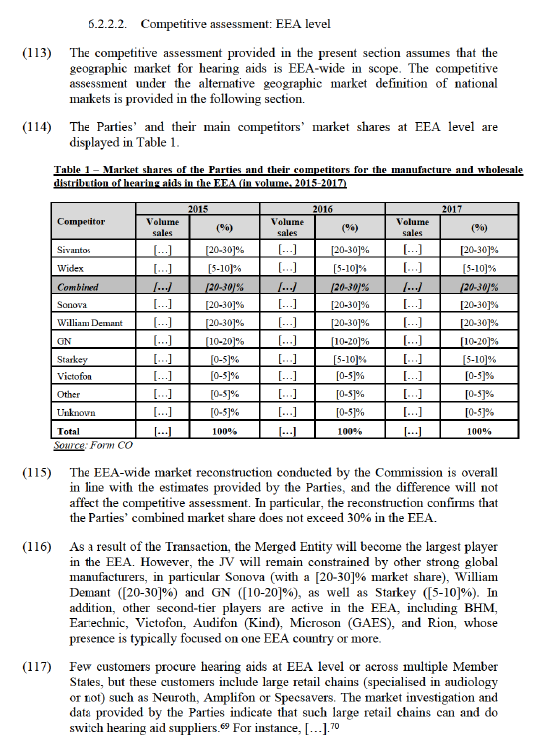
(118) The market investigation also confirmed the Parties’ claim that there are no barriers to expansion for existing manufacturers, in particular since virtually all responding hearing manufacturers indicated that they have sufficient capacity to meet an increase in demand of 5-10%. (71)
(119) Due to the limited market shares of the Parties, and the presence of strong competitors at EEA level, the Commission considers that the Transaction does not raise serious doubts as to its compatibility with the internal market with regard to horizontal non-coordinated effects in the possible market for the production and wholesale of hearing aids at EEA level.
6.2.2.3. Competitive assessment: national level
(120) Based on the Parties’ market share estimates, the Commission finds that with respect to the possible national markets for the manufacture and wholesale distribution of hearing aids, the Transaction would give rise to horizontally affected markets in Austria, Belgium, Bulgaria, Croatia, Czechia, Denmark, France, Germany, Greece, Hungary, Iceland, Ireland, Latvia, Lithuania, Malta, Luxembourg, the Netherlands, Norway, Poland, Portugal, Romania, Slovakia, Slovenia, Spain, Sweden and the United Kingdom. (72)
Austria
(121) The distinction between public and private markets as described in recital 49 above is not applicable for Austria as hearing aids are exclusively dispensed through private retail stores (be it independent stores or large chains).
(122) Austria is a well-developed market with around 92 100 units dispensed through around 600 points of sale.
(123) Austria has a reimbursement system where the National Health Insurance subsidises patients from EUR 792 for the purchase of a hearing aid and the fitting (or EUR 1 425 in case of binaural hearing aids) to EUR 2 100 (or EUR 3 780 in case of binaural hearing aids) every six years. (73) To the Parties’ best knowledge, all their hearing aids, as well as their competitors’ products, are eligible for reimbursement. The average sale price (“ASP”) of hearing aids in Austria at wholesale level is EUR 198, which is lower than the EU-wide ASP of EUR 255. The average retail price of the audiologist is comprised between EUR [1 000-1 550]. (74)
(124) Neither Party has a local presence at wholesale level in Austria. Sivantos is active through its German affiliate, Sivantos GmbH, through which it sells
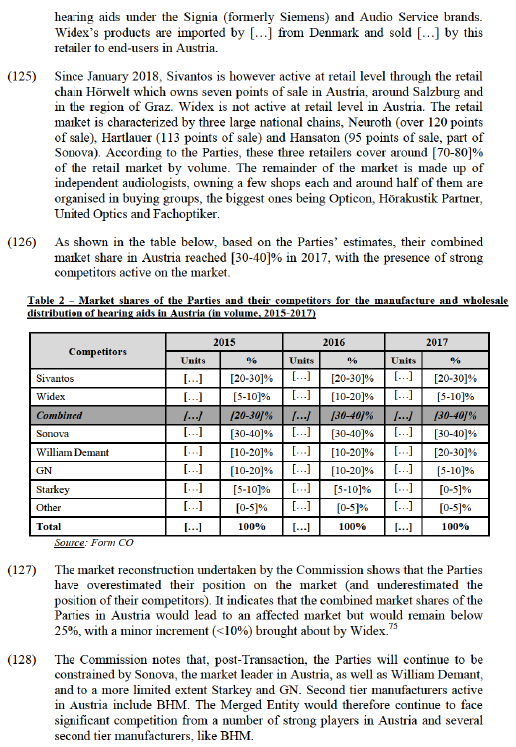
(129) In addition, no respondent to the market investigation, and in particular retailers active in Austria, raised substantiated concerns in relation to the Transaction. (76) One respondent pointed out that, in general, a large number of hearing aid manufacturers guarantees a greater choice of products for retailers and end- users. However, this respondent also acknowledged that if market conditions were to change, it may consider the possibility of entering into contracts with other potential suppliers, the number of alternative manufacturers on the market post-Transaction being sufficient. (77)
(130) The Commission, taking into consideration all of the above, including the results of the market investigation, concludes that the Transaction does not raise serious doubts as to its compatibility with the internal market in relation to the manufacture and wholesale distribution of hearing aids in Austria.
Belgium
(131) The distinction between public and private markets as described in recital 49 above is not applicable for Belgium as hearing aids are exclusively dispensed through private retail stores (be it independent stores or large multinational chains).
(132) Belgium is a well-developed market with around 103 000 units dispensed through around 680 points of sale. Patients suffering from a hearing loss of at least 40 dB (moderate hearing loss) are eligible for reimbursement from Belgian health insurance of EUR 680 per hearing aid every five years (children receive up to EUR 1 300 per ear every three years). The ASP of hearing aids in Belgium at wholesale level is EUR 348, which is higher than the EU-wide ASP of EUR 255. The average retail price including the fitting fees of the audiologist is comprised between EUR [1 000-1 500]. (78)
(133) Manufacturers who wish to distribute their hearing aids under the public reimbursement system in Belgium need to follow a two-step homologation process: (i) first, in order to sell hearing aids in Belgium, manufacturers need to register the maximum price for their hearing aids with the Ministry of Economic Affairs on a product level, and (ii) second, in order to have hearing aids eligible for reimbursement in Belgium, manufacturers need to request the listing of the hearing aids with RIZIV (part of the Ministry of Health). In practice, the vast majority of hearing aids sold in Belgian are registered with both the Ministry of Economic Affairs and RIZIV.
(134) Neither Party has a local presence at wholesale level in Belgium. Both Parties sell hearing aids to the [a customer] (who resells part of its stock to independent retailers). In addition, Sivantos sells its Signia branded hearing aids to [a customer], and its AudioService branded hearing aids to independent retailers.
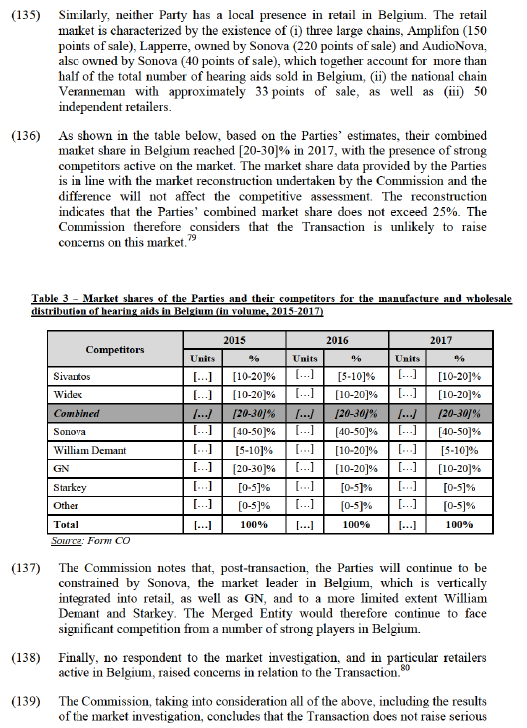
doubts as to its compatibility with the internal market in relation to the manufacture and wholesale distribution of hearing aids in Belgium.
Bulgaria
(140) The distinction between public and private markets as described in recital 49 above is not applicable for Bulgaria as hearing aids are exclusively dispensed through retail stores.
· Regulatory background
(141) While there is a public healthcare financing system in Bulgaria, nearly half of all hearing aids purchased in Bulgaria are not covered by any reimbursement.
(142) The national health insurance scheme provides a flat reimbursement of EUR 200-220 per hearing aid for all adults every 5-6 years (depending on the employment situation). Children benefit from an increased reimbursement rate.
(143) In order to be eligible for reimbursement, a hearing aid must be registered with the Ministry of Health. For this purpose, a hearing aid model has to meet a number of technical requirements. In practice, local distributors are the ones that carry out this registration process.
(144) As of 2018, the Bulgarian government introduced a new reimbursement system relying on vouchers. Under this new scheme, a patient will be allowed to pay with a voucher corresponding to the eligible reimbursement and the retailer (instead of the patient) will have to obtain reimbursement from the national health insurance system.
· The Parties' and their competitors' market shares in Bulgaria
(145) Widex’s hearing aids are […] dispensed by [a customer] who sells the […] and […] other retailers. (81) Sivantos operates in Bulgaria through three third-party distributors, [a distributor], [a distributor] and [a distributor], which are also active at retail level through their respective retail stores.
(146) All the other major manufacturers are active in Bulgaria. While Sonova and Starkey are active in this country through a local wholesale subsidiary, GN and William Demant rely on local third-party distributors, which are typically vertically integrated into the retail market.
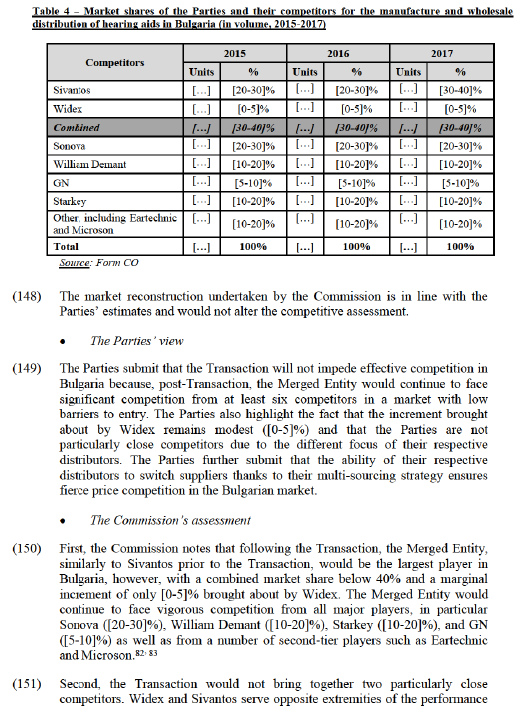
(147) The Parties provided market share estimates for all manufacturers active in Bulgaria from 2015 to 2017.
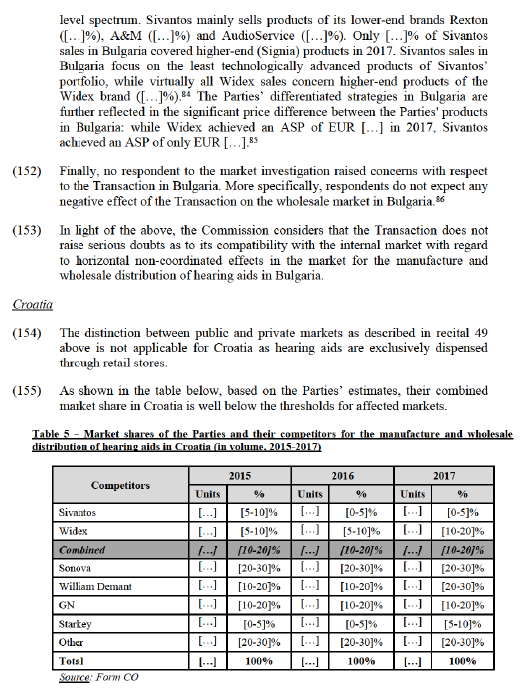
(156) The market reconstruction undertaken by the Commission slightly differs and indicates that the combined market shares of the Parties in Croatia would lead to an affected market but would remain below 25%, with a minor increment (< 5%) brought about by Sivantos. The Transaction is thus unlikely to raise concerns on this market. (87)
(157) Post-Transaction, the Parties would continue to be constrained by Sonova, the market leader in Croatia, as well as William Demant, and to a more limited extent Starkey and GN, as confirmed by the Commission’s market reconstruction. Second-tier manufacturers active in Croatia include BHM. The Merged Entity would therefore continue to face significant competition from a number of strong players in Croatia.
(158) Finally, no respondent to the market investigation, and in particular retailers active in Croatia, raised concerns in relation to the Transaction. (88)
(159) The Commission, taking into consideration all of the above, including the results of the market investigation, concludes that the Transaction does not raise serious doubts as to its compatibility with the internal market in relation to the manufacture and wholesale supply of hearing aids in Croatia.
Czechia
(160) The distinction between public and private markets as described in recital 49 above is not applicable for Czechia as hearing aids in Czechia are exclusively dispensed through authorised ENTs.
(161) All major manufacturers of hearing aids, as well as a number of second-tier players, are active in Czechia. The Parties, GN and Audifon have a direct presence through a local wholesale affiliate. By contrast, Sonova, William Demant, Starkey and other second-tier players are active through third-party distributors.
· Regulatory background
(162) Contrary to the situation in the majority of EEA countries, hearing aids in Czechia can only be dispensed through a regulated number of ENTs (comprised between 135 and 145 authorized ENTs). The price of hearing aids in Czechia is regulated in the sense that prior to being put on the market every device needs to be registered with the public insurance body, at which point in time the price of the device is set and cannot be changed by manufacturers over the device’s lifetime. The maximum mark-up that suppliers (i.e. manufacturers selling hearing aids directly to ENTs and third-party distributors) can apply to the price of registered hearing aids is fixed at 15%. ENTs cannot apply any mark-up to the wholesale price of hearing aids (i.e. the price at which the hearing aid is registered, plus the 15% mark-up of the supplier). ENTs are remunerated for providing fitting services with a flat fee.
(163) Historically, Czechia had been characterized by low reimbursement levels (89) and a low frequency of registration of new products (limited by law to twice per year). Low reimbursement rates translated into few high-end products being sold on the market. Since 1 January 2019, the reimbursement level of hearing aids has been substantially raised, (90) which is expected to shift the market towards higher-end products.
(164) As far as the relationship between hearing aid wholesalers and ENTs is concerned, the regulatory framework governing the sale of hearing aids in Czechia dictates that ENTs are obliged to offer a choice among at least three different manufacturers of hearing aids in order to qualify for reimbursement by the health insurance providers. (91)
(165) In practice, The Commission finds that ENTs typically follow the VZP guidelines and offer hearing aids from at least three different manufacturers for patients to choose from. (92) A majority of dispensers indeed confirmed that “[a]ccording to Czech law, I need to offer different suppliers” (93) or that offering products from a single supplier “is not possible by law”. (94)
· The Parties' and their competitors' market shares in Czechia
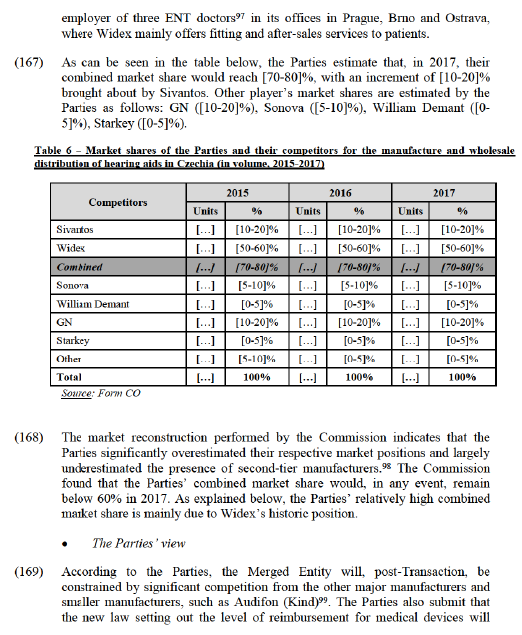
(166) All the main manufacturers of hearing aids, as well as a number of second-tier players, are active in Czechia. The Parties, GN and Audifon have a direct presence through a local wholesale affiliate. By contrast, Sonova, William Demant and Starkey are active through third-party distributors. (95) Moreover, Widex has a very small (96) presence at retail level since Widex is the part-time
likely lead to a higher attractiveness of the Czech market and potentially to new market entries and/or increased efforts by established market players. Finally, they argue that the Parties are not close competitors, as Sonova and GN offer a similar range of products to Widex in Czechia and that, in any event, the Transaction would not lead to the elimination of an important competitive force in this country.
· The Commission’s assessment
(170) First, the Commission notes that all major players, some of which having a local presence (like Audifon with both a wholesale and retail presence), are active in Czechia alongside the Parties. Besides the major players, second-tier competitors such as Audifon, BHM, Horentek and NewSound (China) and a couple of local players such as Anticer and Fonika are active in Czechia. (100) The current relatively higher market share of Widex ([50-60]% according to the Parties; lower according to the Commission’s market reconstruction) was explained during the market investigation by respondents as stemming from its historical first-mover advantage. Respondents explain that Widex was the first hearing aid manufacturer to enter the Czech market in the 1990s (101) and thus effectively started its business activity in Czechia with a 100% market share. The erosion of Widex’s market share is illustrated by sales of current competitors active in Czechia. For instance, Sonova’s distributor of hearing aids entered the Czech market 9 years ago (102) and currently holds a market share of more than 8%.
(171) Second, the competitive landscape in Czechia is expected to be reshuffled as a result of the entry into force of a new regulation in January 2019. The increase of the reimbursement level is expected to shift demand to higher-end products, which in turn will render the Czech market more attractive to manufacturers. In addition, suppliers can now register hearing aids on a monthly basis (rather than just twice a year). This likely effect was largely confirmed during the market investigation. (103) ENTs who responded to the market investigation shared their intention to dispense higher-end and more expensive hearing aid products, potentially from alternative manufacturers, as a result of the new regulation. (104)
(172) Third, the fact that ENTs propose hearing aids from at least three suppliers (as imposed by the official VZP guidelines in order for an ENT to qualify for reimbursement by health insurance providers) further guarantees the ability of patients to switch between suppliers. In this respect, respondents to the Commission’s market investigation indicated that price plays a significant role and, should the Merged Entity increase prices post-Transaction, they would have sufficient choice of products by other manufacturers to offer to their patients generally unwilling (or unable) to pay extra amounts. (105) The fact that, ENTs offer products from several suppliers, implies that ENTs who currently offer the two Parties’ products to their patients will likely introduce new manufacturers into their portfolio post-Transaction.
(173) One third-party distributor considers that the Transaction would reinforce the Merged Entity’s capability “to reach out to even more ENTs and allocate significant funds to engage in additional marketing activities (in many cases focused on existing technologies, and neglecting the benefits of new generations of products)” (106) However, such outcome may actually increase the competitive pressure existing in the market. As explained above, the new regulatory system in Czechia is expected to facilitate the introduction of hearing aids including newer technologies. Given that ENTs typically provide products from three different manufacturers, the combination of Widex and Sivantos is likely to lead ENTs who dispense products from both to introduce new manufacturers in their portfolio.
(174) The Commission, taking into consideration all of the above, including the results of the market investigation, concludes that the Transaction does not raise serious doubts as to its compatibility with the internal market in relation to the manufacture and wholesale supply of hearing aids in Czechia.
Denmark
(175) With 158 000 hearing aids sold in 2017, Denmark is the ninth largest market for hearing aids in the EEA. The Danish hearing aid market is around 50% public (sales of hearing aids to a public procurement authority based on tendering procedures) and 50% private (sales of hearing aids to private retail stores based on bilateral negotiations). In line with the market definitions presented in recital 49 above, the Commission assesses the impact of the Transaction on the public and private markets for the manufacture and wholesale distribution of hearing aids separately.
(176) According to the Parties’ best estimates, the ASP of hearing aids at wholesale level in the private sector was EUR 284 per hearing instrument (unit) and EUR 236 per hearing instrument (unit) in the public sector. The average retail price however varies significantly: while hearing aids are provided free of charge on the public market, the price of hearing aids is approximately EUR […] on the private retail market. (107) Patients in the private sector will however receive a reimbursement of EUR 552 for one ear and EUR 870 for both ears, every four years.
(177) All major hearing aid manufacturers except for Starkey are present in Denmark. (108) Widex is active in Denmark with both a wholesale subsidiary and a retail presence. Sivantos only has a wholesale presence in Denmark, through a local subsidiary.
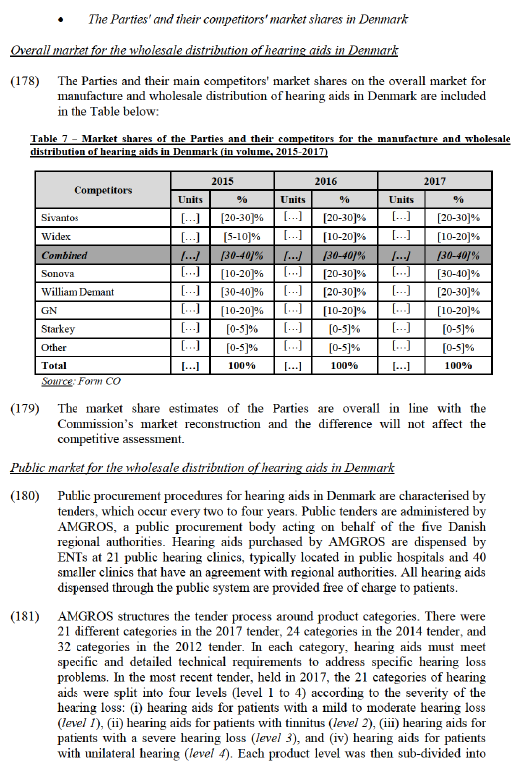
several categories, ranging from A to D, depending on the patients' needs and use of the hearing aids. (109)
(182) As part of its selection process, AMGROS pre-qualifies suppliers whose products meet the technical requirements set for each product category. It then selects the three to five bidders (depending on the category) offering the lowest prices. (110) Suppliers selected by AMGROS are publicly ranked according to the price of their hearing aids (from the cheapest to the most expensive) within each of the tender categories. Once listed, the price of hearing aids is fixed for each category for the duration of the tender. Qualified suppliers may introduce newer versions of their hearing aids (in replacement of older models listed by AMGROS) every 6 months but at the same price as agreed upon in the framework contract.
(183) Contracts resulting from the AMGROS’s tenders typically run for two to four years: an initial period of two years is provided with the possibility for AMGROS of prolonging it by 1+1 years. Therefore, contracts resulting from the latest AMGROS’s tender will run at least until August 2019. According to AMGROS, they are however likely to be extended until August 2021. (111)
(184) ENTs dispense hearing aids from the AMGROS list. In theory, they must prescribe products within the relevant AMGROS category and according to the ranking, unless they can prove that the device does not meet the patient’s needs. In practice, categories are not mutually exclusive and ENTs have a margin of discretion in determining to which category a patient belongs. (112) In addition, ENTs may also dispense hearing aids outside of the AMGROS framework; this situation is rare and typically occurs with returning patients used to a specific brand of hearing aids, or for paediatric hearing aids. This practice is however declining and mostly limited to some niche product categories.
(185) All major global manufacturers participate in AMGROS tender with one or more affiliates, except for Starkey, which is currently not present on the public segment of the Danish market.
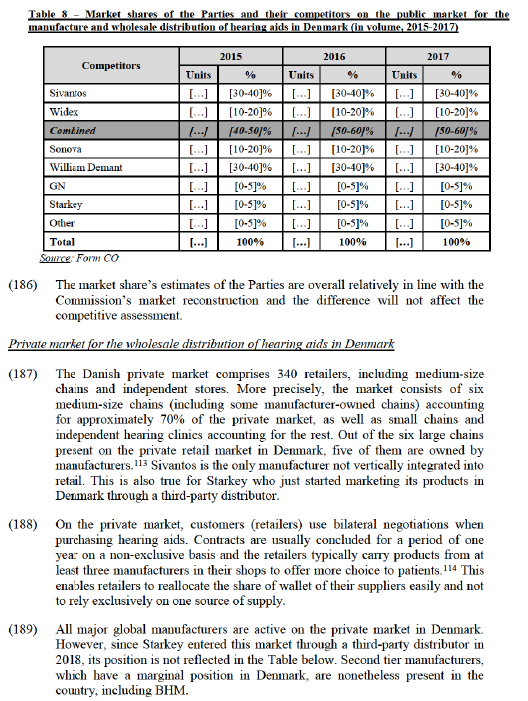
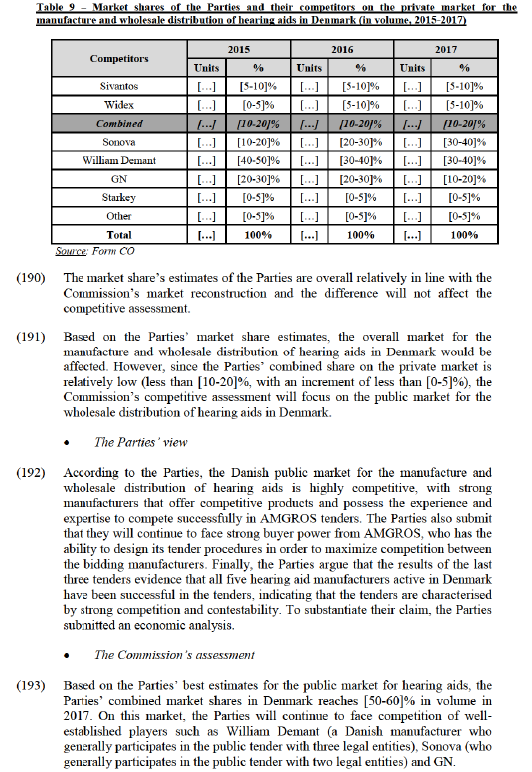
(194) As explained above, AMGROS’s tenders are used to select preferred suppliers following a competitive process ultimately based on price competition. As a result of this process, competition on the public market in Denmark first takes place “for the market” (to be listed by AMGROS) and, “in the market”, once listed by AMGROS, in order for manufacturers’ products to be dispensed by ENTs.
(195) The Commission investigated the extent to which the AMGROS tender makes the Danish public market competitive. To this end, AMGROS provided the Commission with share data for the 12 months preceding the entry into force of the 2017 tender and the 12 months following the entry into force of the 2017 tender. This data enabled the Commission to assess the extent to which AMGROS’s tenders have had an impact of the competitive landscape of the public market in Denmark. It shows that GN, who was ranked in only one tender category in the 2014 tender (category accounting for only [0-5]% of the total number of hearing aids on the public market in Denmark) (115), qualified for 11 out of the 21 tender categories of the 2017 tender (categories accounting for more than [20-30]% of the total number of hearing aids on the public market in Denmark) and increased significantly its market position on the public market within a short period of time. Conversely, while William Demant was selected in 14 tender categories out of 24 tender categories in 2014 (categories accounting for almost [70-80]% of the total number of hearing aids on the public market in Denmark), it was less successful in the 2017 tender and secured position in only four categories (categories accounting for slightly more than half of the total number of hearing aids on the public market in Denmark). This had a direct impact on its market share which decreased in 2018.
(196) These market share fluctuations evidence the importance of being selected by AMGROS in order to be successful on the public market. Securing a position in the AMGROS tender is crucial to increase sales and gain exposure on the public market. Consequently, suppliers have an incentive to bid with a low price; any other strategy would put the supplier at risk of not being listed at all by AMGROS. This is confirmed by the results of the market investigation. In this respect, one participant stressed that the key factor to be successful in AMGROS’s tenders is “to offer low prices”. (116) This is explained by the fact that only the three to five suppliers with the lowest price (potentially the same undertaking as manufacturers are allowed to place several bids through different affiliates or distributors) will be selected.
(197) The volatility of the AMGROS tender results (and as a result of the manufacturers’ market shares) illustrates the contestability of the public market in Denmark: the 2014 and 2017 tender results in particular show that previously successful manufacturers can lose most of their winning positions and previously small players can become important suppliers from one tender to the next. Competition is also strong within each individual tender categories: each tender category generally comprises a sufficient number of alternative suppliers (either actual competitors who have been selected by AMGROS or potential competitors whose bid was not ultimately selected) who will continue to be a significant competitive constraint on the Merged Entity. A less competitive price strategy by the Merged Entity post-Transaction (i.e. in future tenders) would likely translate into an increased risk of losing winning positions, and consequently increase the market shares of other manufacturers.
(198) In that regard, the data provided by the Parties (in line with AMGROS’s data) enabled the Commission to assess the level of competition in the market: while Sivantos was selected in almost all categories of both the 2017 and the 2014 tenders (each time being represented in product categories accounting for virtually all sales on the public market), its market share fluctuated within each tender period. Similarly, respondents to the market investigation pointed out that William Demant recently launched an aggressive marketing campaign to promote its newer products. (117) Thus, despite being listed in fewer categories in 2017 (compared to the 2014 tender) and as a result having lost market share following the entry into force of the 2017 tender, William Demant is expected to re-gain market share in the short term primarily by increasing its share in the categories in which it was selected. ENTs also indicate that, since listed manufacturers are allowed to update their product twice a year within the framework of the AMGROS tenders, manufacturers that introduce newer products, tend to be rewarded by increased prescriptions from ENTs in the categories for which they have been selected. (118)
(199) There are however four tender categories (2C for moderate complexity tinnitus as well as the three categories belonging to the level 4) where the Parties were the only manufacturers selected in the 2017 tender. The Commission first notes that these are ‘niche’ categories characterised by low sales volumes (together accounting for less than 5% of the total sales of hearing aids on the public market in Denmark in 2017). Second, the Commission recalls that it is not possible to change the price of a product during the entire duration of the tender that is in this case likely to run until September 2021. (119)
(200) Finally, as concerns the future tenders, the definition of individual categories regularly evolves with each tender, and AMGROS can design categories ensuring it will receive bids from a sufficient number of manufacturers. Historically, there has been a trend in AMGROS tenders towards a reduction of the number of categories (from 32 in 2012, to 24 in 2014, and 21 in 2017). In future tenders, AMGROS would thus be able to redefine the categories where only the parties were successful in the 2017 tender, with a view to attracting more bidders. Moreover, even if the categories were to remain unchanged, the market investigation indicated that the Merged Entity would continue to be subject to sufficient competitive constraints.
(201) Specifically, as regards category 2C three products have been selected in the current tender, namely products of two affiliates of Sivantos and one affiliate of Widex. However, bidding data shows that several other companies have products responding to the technical requirements of this category and indeed submitted a bid for this category. Although in this specific tender they were not successful, in the future tenders they will exert a competitive constraint on the Merged Entity.
(202) This is also true concerning categories 4A, 4B, and 4D (CROS/Bi-CROS categories) for which three products have been selected in each of these categories in the current tender, namely products of either two affiliates of Sivantos and one affiliate of Widex or two affiliates of Widex and one affiliate of Sivantos. However, the market investigation revealed that Sonova, who was the only manufacturer supplying CROS/Bi-CROS hearing aids to the public market in Denmark prior to the 2017 tender, still enjoys a relatively important market presence due to its reputation on the market (120) and despite not having been listed by AMGROS. (121) Sonova is also expected to exert a strong competitive constraint on the Parties in future tenders. In addition, other manufacturers, such as William Demant offers an alternative solution to traditional CROS/Bi-CROS hearing aids in order to treat unilateral hearing loss; to the best of William Demant’s knowledge, his competing product qualify for CROS/Bi-CROS tender’s categories. (122) Finally, other manufacturers not currently active on the public market in Denmark (e.g. Starkey and second tier manufacturer BHM) have CROS/Bi-CROS products in their portfolios and could participate, either directly or through a third-party distributor, in future tenders. (123)
(203) Finally, respondents to the market investigation did not raise substantiated concerns in relation to the Transaction.
(204) From the point of view of ENTs, which largely determine the commercial success of manufacturers whose products are listed by AMGROS, the market investigation did not point to any manufacturer being more successful in terms of the quality of its products, breadth of its portfolio, services or prices, compared to other players. (124) ENTs are equipped with the fitting software of all manufacturers selected by AMGROS and usually do not have a single preferred supplier. The ENTs having responded to the market investigation considered that all manufacturers active in Denmark constitute credible suppliers of hearing aids on the public market. (125)
(205) Moreover, while AMGROS noted the reduction in the number of players active on the public market in Denmark, it also indicated that the market would remain competitive, with other players being able to constrain the Merged Entity. According to AMGROS, if a manufacturer were to increase its price in the next tender, AMGROS believes it would be able to select alternative suppliers with lower prices and comparable product quality. (126)
(206) The Commission, taking into consideration all of the above, including the results of the market investigation, concludes that the Transaction does not raise serious doubts as to its compatibility with the internal market in relation to the manufacture and wholesale supply of hearing aids in Denmark.
France
(207) The distinction between public and private markets, as described in recital 49 above, is not applicable for France as hearing aids are exclusively dispensed through private retail stores (be it independent stores or large multinational chains).
(208) France is one of the largest markets for hearing aids in the EEA with around 753 000 units sold in 2017 and more than EUR 240 million in turnover. Due to an increase in the proportion of over 65-year olds, who are most likely to require a hearing aid, the market for hearing aids in France has been growing strongly and steadily for the last 20 years with an average annual market growth rate of 6%.
(209) The market is entirely private, with a flat reimbursement of EUR 120 per hearing aid provided by the French social security. (127) Optional complementary healthcare providers offer an average reimbursement of EUR 400 per hearing aid. (128)
(210) The ASP of hearing aids in France at wholesale level is EUR 314, which is higher than the EU-wide ASP of EUR 255. The average retail price including the fitting fees of the audiologist reaches EUR 1 500. (129)
(211) Despite the low reimbursement rate, the high average retail price, and the high co-payments that need to be made by patients, the penetration rate in France is relatively high. Premium hearing aids form a larger proportion of the French market than other major European markets, since those patients who can afford a hearing aid, and have to make significant co-payments in any event, often opt to buy the best devices. (130)
(212) A recent governmental proposal, which entered into force on 1st January 2019, provides for a gradual introduction by 2021 of a full reimbursement by the Social Security and optional complementary healthcare providers of certain types of hearing aids with certain pre-defined characteristics (that would make them of comparatively high quality). (131) As from 1st January 2019, the “out-of- pocket” amounts that patients must pay already decreased by approximately EUR 300. This is due to the fact that, since that date, the French social security reimbursement has increased (from EUR 200 to EUR 300 per ear) and the price of certain devices has decreased (it should not exceed EUR 1 300 compared to the previous average of EUR 1 500). By 2021, these devices will be provided to patients free of charge.
(213) Hearing aids in France are dispensed by private retail stores of varying sizes and business models, which amount to approximately 5 200 points of sale across the country. The French retail market is characterized by certain large chains (including Amplifon), some of whom are owned by hearing aid manufacturers Audition Santé owned by Sonova or Audika owned by William Demant), as well as optical chains who have entered the hearing aid market (including Optical Center and Alain Afflelou) and a large number of independent stores, many of whom are organised in one or more buying groups. According to the Parties, buying groups and franchise chains form the largest channel in France (at around 38% in volume), followed by independent retailers and manufacturer owned retail stores (both around 20% by volume), optical chains (12% by volume), and national chains (11% by volume).
· The Parties' and their competitors' market shares in France
(214) All major manufacturers are present on the French market through local wholesale affiliates. In addition, Sonova, William Demant and Widex are vertically integrated into retail.
(215) Sivantos is active in France through two wholesale affiliates: Sivantos (offering the Signia and A&M brands) and Biotone (offering the Rexton and Audio Service brands). Sivantos is also indirectly active at retail level through its online platform audibene which refers patients to local audiologists. In 2017, […] hearing aids were sold by independent audiologists following a referral by audibene.
(216) Widex is active in France through its wholesale affiliate Widex France SASU, through which it distributes hearing aids under the Widex brand. Widex is also active on the French retail market with 38 points of sale in France under the SoluSons brand. Moreover, Widex is also financing a smaller chain, […] (28 points of sale) […]. The chain has a sister company, an […] (with 55 points of sale), […].
(217) The Parties provided market share estimates for all manufacturers active in France from 2015 to H1 2018.
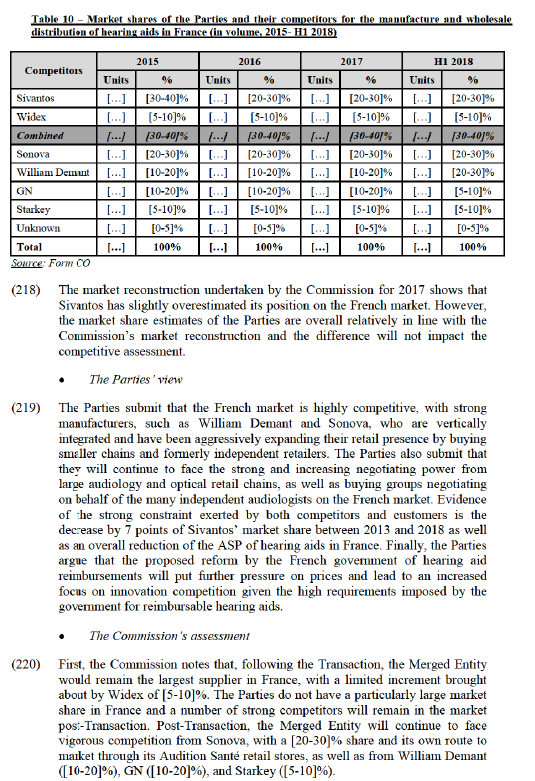
(221) Second, the Parties are not close competitors to each other. The market investigation confirms that all hearing aid manufacturers constitute credible suppliers and that no competitor is more innovative than others. (132) Several respondents to the market investigation pointed out that Sonova and William Demant (rather than Widex) are largely seen as closer competitors to Sivantos, in terms of portfolio breadth, product quality, services and pricing. This is mostly due to the fact that these three manufacturers are the three largest players active in France while Widex’s position on the market is rather limited.
(222) Third, customers can switch among suppliers with relative ease. Contracts with retailers are always contestable and can be easily terminated given that they are generally entered into for a period of one year. (133) Independent retailers are typically not subject to exclusivity clauses, meaning they can progressively insert new suppliers into their product mix and they typically carry products from at least three suppliers, which enable them to easily re-allocate the share of wallet of their suppliers. (134) In this respect, one respondent to the market investigation specified that "Audiologists can influence [patients] on their choice. That's why [retailers] can easily switch from one supplier to another and that's the reason why I consider being a price maker". (135)
(223) This also applies to larger chains and buying groups that generally follow a multi-brand strategy and can therefore switch by simply increasing or decreasing volumes from a certain supplier without the adjustment or amendment of their contracts being required. In this respect, Sivantos explained that it used to supply approximately 80% of Amplifon's volumes in France 10 years ago but now supplies approx. […] of its French volumes. Similarly, Sivantos was delisted from […] after Sivantos […] and its volume with […] dropped [significantly] in 2018 following the launch of a new tendering procedure by the buying group. The constraint exerted by customers was further confirmed during the market investigation. As an example, one of the Parties’ customers indicated in response to the market investigation that if the Merged Entity were to increase its price by 5-10% post-Transaction, it would not continue to purchase the same quantity of hearing aids from the Merged Entity and would increase its share of wallet of Sonova's products. (136)
(224) Finally, since Sivantos generated more than […]% of its sales in France with large specialised ([…]) and optical ([…] and […]) chains, it could not afford to raise its prices or reduce the quality/choice of its products and services without the risk of losing these customers and seeing the share of wallet of its products decrease. Similarly, Widex generated [20-30]% of its sales in France with these large purchasers and could not afford to raise its prices or reduce the quality/choice of its products and services without the risk to lose these customers and/or see the share of wallet of its products decrease.
(225) Fourth, the Transaction does not eliminate an important competitive force on the hearing aids market in France. Widex is today the smallest player on the French market and the removal of this competitor will hardly change the competitive landscape. Widex can hardly be regarded as a maverick, as it has been active in France for more than 40 years and focuses on supplying its products mainly through […] and […]. In addition, Widex is not regarded as offering any must- have products on the market. (137)
(226) Fifth, all hearing aid retailers (customers) responding to the market investigation indicated that they expect the impact of the Transaction to be either positive or neutral. (138) The vast majority of respondents consider that, post-Transaction, there will still be a sufficient number of competing manufacturers to exert a competitive constraint on the Merged Entity. As a result, prices are unlikely to increase since competitors would react immediately and gain market shares at the expense of the Merged Entity.
(227) The Commission, taking into consideration all of the above, including the results of the market investigation, concludes that the Transaction does not raise serious doubts as to its compatibility with the internal market in relation to the manufacture and wholesale supply of hearing aids in France.
Germany
(228) The German hearing aid market is entirely private and therefore the split between public and private markets is not applicable. The German market is the second biggest in Europe by volume. In 2017, 1.26 million hearing aids were dispensed through over 6 300 points of sale. The market is predicted to grow in the next years.
(229) In the German hearing aid market reimbursement is available for hearing aids. A reform in 2013 increased the level of reimbursement of EUR 750 to EUR 800 per hearing aid, meaning that around 40% of patients barely have to pay for their hearing aid.
(230) Similar to other EEA markets, a patient in Germany suffering from hearing impairment must receive a prescription from an ENT based on an audiological test which the ENT performs. The patient is then fitted with a hearing aid by an authorised audiologist. There is also a legal requirement in Germany that patients must be offered a minimum of three different devices to test in their everyday lives, i.e. outside of the shop environment. Patients test these devices for 40 days on average, during which they can compare the different hearing aids, figure out the right price point for their needs and finally work with their audiologist on fitting their requested hearing aid. The three devices will usually be from three different brands or suppliers (meaning the audiologist is de facto required to carry a selection of hearing aids) and the manufacturers themselves carry the cost of these trials (including the “demo” hearing aids given to patients in store to try on), most importantly the cost of refurbishing the hearing aid which the patient has tested but not chosen. The Parties estimate that on average there are 2.4 test devices for each one that is bought.
(231) The retail market comprises (i) independent retailers accounting for [5-10]% of the total units sold; (ii) buying groups bringing together independent audiologists to benefit from greater scale and accounting for [50-60]% of the total units sold, which have around 890 POS in the case of Dialog, 470 POS in the case of Meditrend, 200 POS in the case of Proakustik and 530 POS in the case of Hörex; (iii) large regional or national chains which have between 20 and 50 stores located in one or two regions and account for [5-10]% of the total units sold; (iv) international chains, which typically have more than 150 POS across the country and account for [10-20]% of the total units sold and include chains such as Amplifon with 475 POS or Kind with 630 POS; (v) store-within-store, non specialist retailers like optical retailers which have entered the hearing aid market and account for [0-5]% of the total units sold; and (vi) manufacturer- owned retail outlets which account for [10-20]% of the total units sold, for example Sonova which owns 800 POS under the AudioNova, Geers, Lindacher, Vitakustik and Fiebing brands. Furthermore, larger chains and all purchasing groups also increasingly purchase privately labelled hearing aids from manufacturers in bulk, which they sell under their own brand.
(232) Sivantos is only active in sales to end-consumers through its online affiliate audibene, and cooperates with independent brick and mortar audiologists to make sales to end-customers. Widex is not active in retail in Germany.
· The Parties' and their competitors' market shares in Germany
(233) All major hearing aid manufacturers sell into Germany. There are 13 established hearing aid brands in Germany.
(234) Sivantos is active in Germany through its wholesale affiliate Sivantos GmbH. Sivantos’ channel strategy mainly focuses on independents and buying groups with […]% and […]% of its sales, as well as large chains, which account for around […]% of sales volume. Sivantos sells hearing aids under the brands Signia and Audio Service.
(235) Widex is active in the German wholesale market through its German affiliate, Widex Hörgeräte GmbH. Widex makes over […]% of its sales to buying groups and about […]% to national chains and key accounts. Widex is not active in the German retail market.
(236) Sivantos is active in the German retail market through audibene. audibene is an online business based in Berlin, founded in 2012 and taken over by Sivantos’ owner EQT in 2015. audibene had a market share of about [0-5]% in the German market in 2017. It provides a platform for end customers to understand their precise needs and possible suitable hearing aids. audibene nowadays employs around 800 employees in nine countries out of which 200 are working for the German market.
(237) Regulatory restrictions in place in Germany prevent sales of hearing aids over the internet without a visit to a certified audiologist, and in order to get any reimbursement patients are required to get their hearing aids fitted by an audiologist. audibene has roughly 1 000 partner audiologist shops in Germany,
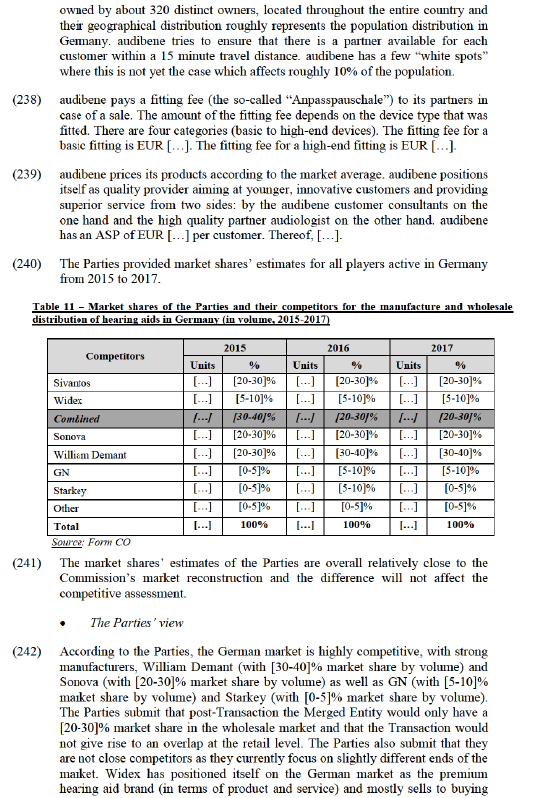
groups, while Sivantos has both high-end (Signia) and entry-level (Audio Service) brands and generally covers a larger variety of price points within the market and is much more present with independent audiologists that are not in buying groups. The Parties further submit that there are no impediments to entry or expansion and in this respect large optician chains, like Fielmann or Apollo Optik have entered the German hearing aid market. Furthermore, the Parties argue that in recent years large retail chains have started selling private label hearing aids which they purchase from hearing aid manufacturers.
· The Commission’s assessment
(243) First, the Commission notes that the Transaction brings together the third and fourth largest manufacturers in the market. The Merged Entity would become the second largest in the German wholesale market for hearing aids with a market share of [20-30]%. William Demant, with a market share of [30-40]%, will continue to be the largest manufacturer and Sonova, which is also a vertically integrated player in the German market, with a market share of [20- 30]% will be quite close to the Merged Entity’s size. Furthermore, players such as GN ([5-10]% market share), Starkey ([0-5]% market share), and smaller players like Kind, which has a strong retail network in Germany, also impose a competitive constraint on the Parties. Furthermore, the Commission observes a certain dynamic in the evolution of market shares in Germany (see Table 11) which shows that Sivantos has lost about [5-10] percentage points in two years. Contrary to this William Demant or GN have respectively observed a [5-10] percentage point and [0-5] percentage point increase. The fluctuation of the market shares supports the idea that there is competition in the market. Widex, has also increased its sales by [0-5] percentage point between 2015 and 2017.
(244) Second, the Commission notes that the Parties are not particularly close competitors in the German market, with Widex focusing on the premium segment compared to Sivantos, which covers a larger range of price points. The market investigation has confirmed this. (139) In particular, several respondents to the market investigation pointed out that Sonova and William Demant (rather than Widex) are largely seen as closer competitors to Sivantos, in terms of portfolio breadth, product quality, services and pricing. Similarly, several respondents to the market investigation pointed out that Sonova and William Demant (rather than Sivantos) are largely seen as closer competitors to Widex, in terms of portfolio breadth, product quality, services and pricing.
(245) Third, retailers multisource from a large number of manufacturers, often more than three, and the market investigation has revealed that retailers have switched in the past and still have the ability to switch across the different manufacturers. (140) Retailers, both large and small have switched in the past. For
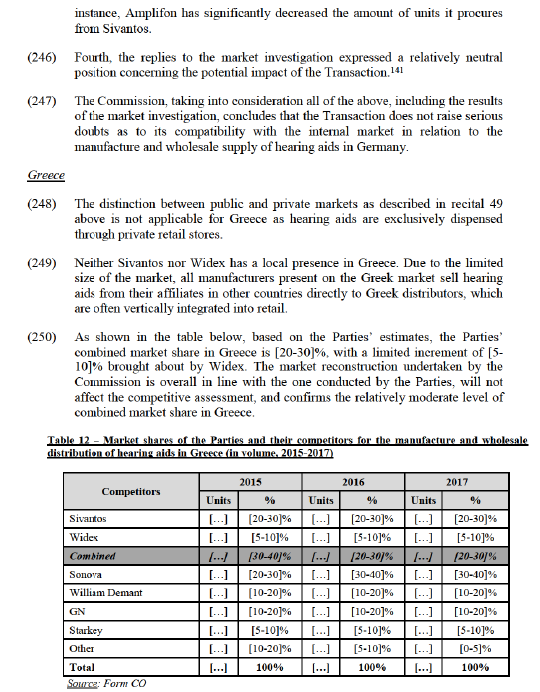
(251) Post-Transaction, the Parties would continue to be constrained by market leader Sonova ([30-40]%), as well as William Demant ([10-20]%), GN ([10-20]%), and Starkey ([5-10]%). The market in Greece is largely price-driven and second tier manufacturers active in Greece include BHM and Eartechnic. The Merged Entity would therefore continue to face significant competition from a number of strong players in Greece.
(252) No respondent to the market investigation raised concerns with respect to the Transaction in Greece, and market participants confirmed that the Greek market was characterised by “very low price[s]” (142), fuelled by the presence of several second-tier players on top of all major manufacturers.
(253) The Commission, taking into consideration all of the above, including the results of the market investigation, concludes that the Transaction does not raise serious doubts as to its compatibility with the internal market in relation to the manufacture and wholesale supply of hearing aids in Greece.
Hungary
(254) The distinction between public and private markets as described in recital 49 above is not applicable to Hungary as hearing aids are exclusively dispensed through the private market.
(255) Both Sivantos and Widex have a local wholesale presence in Hungary. Among the other major hearing aid manufacturers, Sonova and Starkey are also active at wholesale level with their own local subsidiaries, while GN and William Demant are active through third-party distributors. Each of Widex, Sivantos and Sonova are also active at the retail level, operating directly their own points of sales. (143)
(256) As shown in the table below, based on the Parties’ estimates, the Parties’ combined market share in Hungary is below 25% in 2017 and would even be below the thresholds for affected markets in 2015 and 2016. The market reconstruction undertaken by the Commission confirms that the Parties’ combined market share is below 25%, (144) with a limited increment brought about by Sivantos. The Transaction is thus unlikely to raise competition concerns on this market. (145)
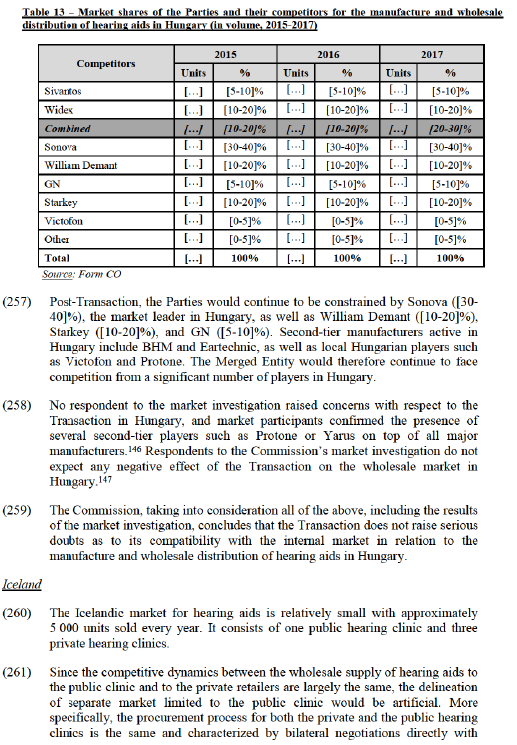
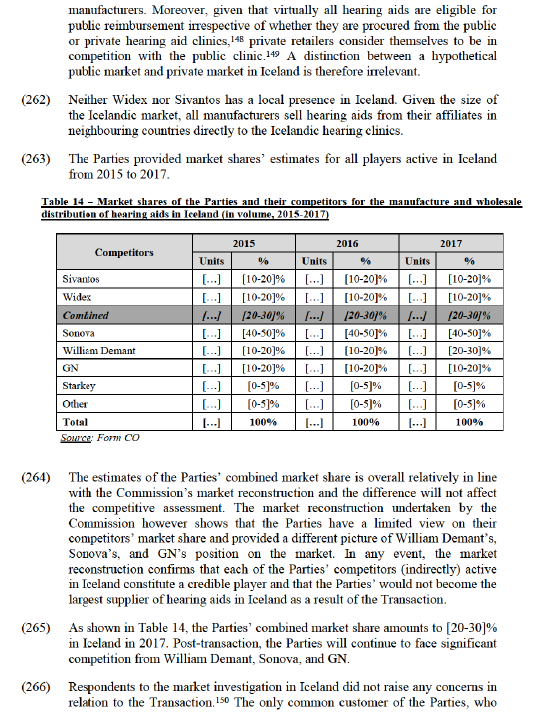
currently also procure hearing aids from a third supplier, considers that William Demant, Sonova and GN will exert a sufficient competitive constraint on the Merged Entity post-Transaction. It also explained that barriers to enter the Icelandic market are relatively low and new entrants could easily start supplying hearing aids in this country (151)
(267) In light of the above, the Commission considers that the Transaction does not raise serious doubts as to its compatibility with the internal market in Iceland.
Ireland
(268) The Irish hearing market is split between public sales, administered by the Ireland’s National Health Service (or “HSE”), which accounts for around 43% of hearing aids dispensed to patients in the country, with the remaining 57% being dispensed via private retailers, including both independent shops, and large chains such as Amplifon and Specsavers.
(269) Neither Sivantos nor Widex has a local wholesale presence in Ireland. Hearing aid manufacturers, including Widex, typically serve the Irish market via their UK wholesale subsidiary.
· Regulatory background
(270) In Ireland, sales of hearing aids fall either under (i) a public tender by the HSE, which dispenses hearing aids to patients on low income via around 12 major hospitals; or (ii) a private retail channel.
(271) The public market in Ireland is a tender based system designed by the HSE. The HSE launched its first tender process in 2013, based on which hearing aids are provided through the public system. A new public tender was scheduled to be launched by the end of 2018 but has been since put on hold.
(272) The 2013 HSE tender provides for three lots of hearing aids: paediatric hearing aids, adult hearing aids, and CROS/Bi-CROS hearing aids. (152) The paediatric hearing aids lot was sub-divided into the following four categories: new-born / preschool / primary school age / second-tier school and higher education age, and the lot for adults’ hearing aids into the following two categories: standard and poor dexterity). Each sub-category of these two lots was then further subdivided into (i) mild/moderate, (ii) severe and (iii) profound.
(273) Under the Irish tender system, only one hearing aid supplier by sub-category (e.g. hearing aids for new-born with a severe hearing loss) is chosen. This supplier signs a contract for a period of 3 years with the option to extend the contract for two further periods of up to 12 months.
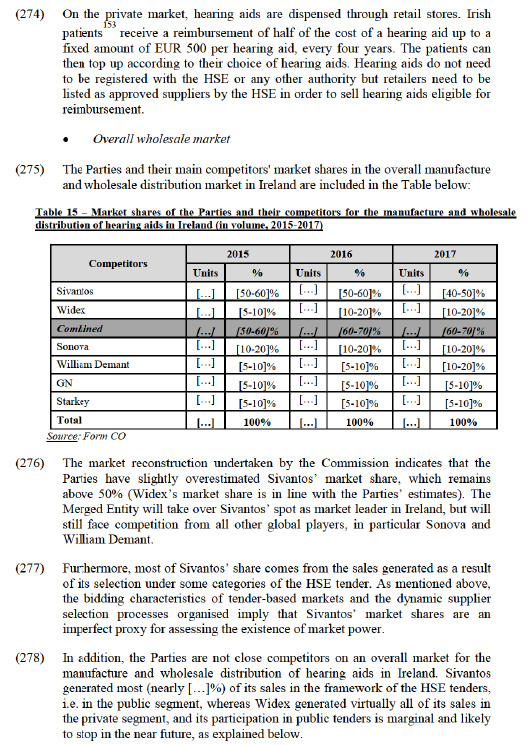
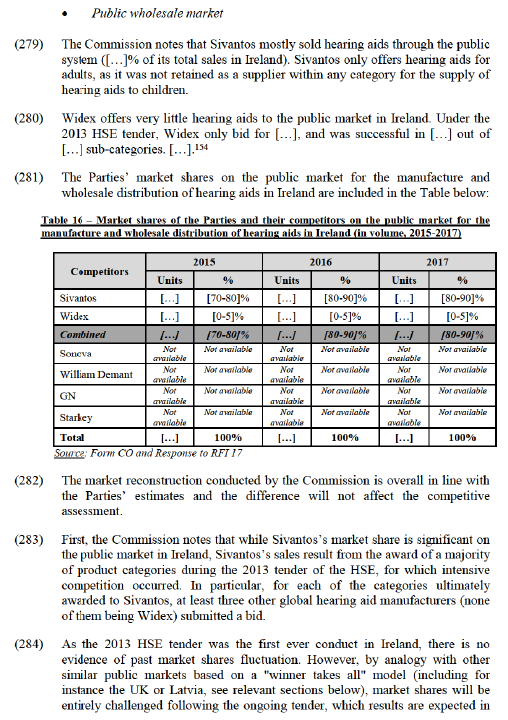
2019 and involves a similar process as the 2013 tender. (155) The Merged Entity’s market share could thus drop drastically if Sivantos does not submit a competitive bid.
(285) Second, within the public market, the Parties are not particularly close competitors. Widex is only a marginal player on the public market, which did only bid for paediatric hearing aids in the 2013 HSE tender, whereas Sivantos tendered for multiple categories, and was only awarded tenders in the adult hearing aid categories, for which Widex did not bid. In the paediatric segments awarded to Widex, three to four other hearing aid manufacturers in addition to Sivantos also systematically submitted bids.
(286) Third, while Widex was retained in several paediatric categories, it only sold […] hearing aids in 2017, resulting in a marginal market share (and thus a marginal increment) of less than [0-5]%. As a consequence of its […] performance on the public market in Ireland, Widex decided […] and […] (156). Widex’s strategy is further illustrated by its internal documents which indicate a […]. (157) Therefore, regardless of the Transaction, the very limited overlap between the Parties on the public market in Ireland would have ceased to exist.
(287) In light of the above, the Commission considers that the Transaction does not raise serious doubts as to its compatibility with the internal market with regard to horizontal non-coordinated effects in the public market for the production and wholesale of hearing aids in Ireland.
· Private wholesale market
(288) The Commission considers that neither Sivantos nor Widex have a local wholesale presence in Ireland. Sivantos is active via a local distributor, [a customer], which provides hearing aids and related services to retailers in Ireland (including Specsavers) (158) Widex serves the Irish market via its UK wholesale subsidiary and offers its products through its own retail stores, as well as to third party retailers (including Specsavers).
(289) The Irish private market comprises around 200 points of sales, including both independent retailers, manufacturer-owned retailers as well as large chains, including in particular Specsavers and Amplifon. William Demant owns the largest retailer in Ireland (Hidden Hearing). Widex is also active at the retail level via its retail subsidiary Bloom, which acquired Celtic Hearing and Bonavox. Widex thus operates three full-time retail outlets in Ireland.
(290) The Parties and their main competitors' market shares on the private market for the manufacture and wholesale distribution of hearing aids in Ireland are included in the Table below: equipment, training and marketing costs as such costs or delays. (162) The ability of retailers to switch suppliers is further evidenced by the fluctuation of the Parties’ market shares over the last years. For instance, Widex’s market share steadily increased between 2015 and 2017, in particular due to its […]. Sivantos’ market share decreased over the same period as a result of […].
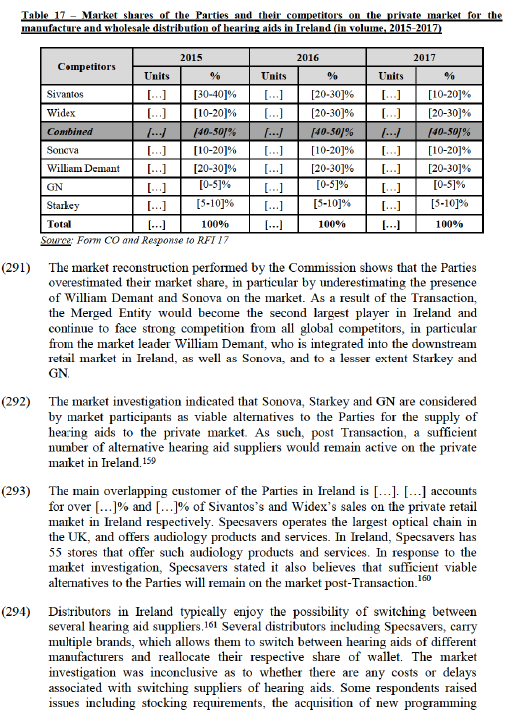
(295) Finally, retailers active in Ireland, did not raise merger-specific concerns in relation the Transaction and its impact on the Irish private retail market. (163) Some market participants stated that the Merged Entity may terminate Sivantos’ distribution arrangement with [a customer], and instead serve the Irish market directly, possibly via the UK, which could impact the quality of services provided. However, this concern is not merger specific. Currently, neither Sivantos nor Widex serve the Irish market through a local wholesale entity. Widex serves the market from the UK, and Sivantos could already decide to supply the Irish market directly, including via its UK subsidiary, pre-Transaction. (164)
(296) In light of the above, the Commission considers that the Transaction does not raise serious doubts as to its compatibility with the internal market with regard to horizontal non-coordinated effects in the private market for the production and wholesale of hearing aids in Ireland.
· Conclusion
(297) The Commission, taking into consideration all of the above, including the results of the market investigation, concludes that the Transaction does not raise serious doubts as to its compatibility with the internal market in relation to the manufacture and wholesale supply of hearing aids in Ireland.
Latvia
(298) The Latvian hearing aid market is small, accounting for around 7 000 hearing aids, and is split around 70% public and 30% private. (165) The Parties, as well as other hearing aid manufacturers, do not have a local presence in Latvia and are active through distributors, which usually operate one or more retail outlets and offer hearing aids into the public tender. From the point of view of the hearing aid manufacturers, there is no distinction between the private and the public Latvian market. As opposed to other countries involving public tenders, in Latvia, neither the Parties nor any of their competitors are directly active in the public tender. Bids are only submitted by third-party distributors of hearing aid manufacturers. As a result, the distinction between public and private markets for hearing aids discussed in recital 49, is not particularly relevant for Latvia.
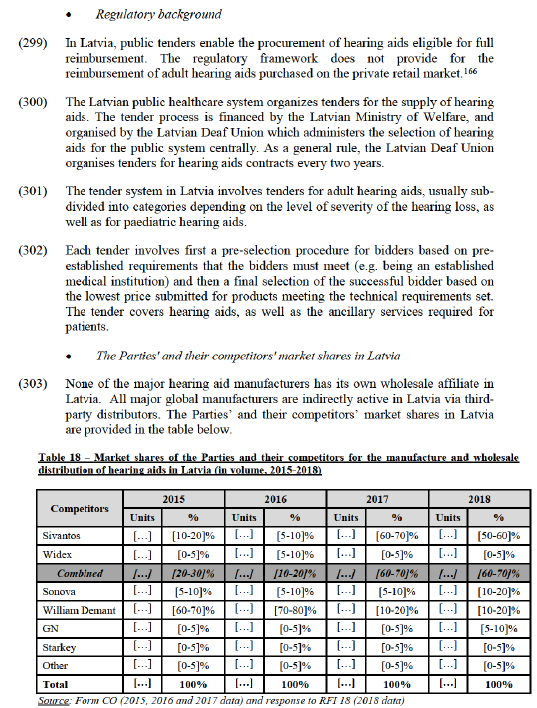
· The Parties’ view
(304) The Parties claim that the Transaction does not raise any competition concern in particular because (i) they are only active via independent distributors, and (ii) their combined market share in 2017 was exceptionally high and is not a good indication of their market power.
· The Commission’s assessment
(305) Under the assumption of an overall market for the manufacture and wholesale distribution of hearing aids, the Commission finds that while the Parties’ own market share estimates as per Table 18 appear high, the market reconstruction conducted by the Commission indicates that the Parties significantly overestimated their combined market share in 2017, which in facts remains below 50%. The Transaction would only bring about a minor increment from Widex (below 5%).
(306) Furthermore, Sivantos’ market share increased significantly in 2017, which derives from a large order (of around […] units) from its main customer, […], as a result of the latter being selected in the public tender to supply hearing aids to adults. The fact that an order of this magnitude was unusual is evidenced by the company’s market share over the two previous years (in 2015 and 2016), which were over three times as small, and further confirmed by sales achieved by Sivantos in 2018, which were all made to […], and also reflect two orders in June and October respectively as a result from the public tender award, similarly as for 2017.
(307) Tender-driven markets are prone to market share fluctuations, and high market shares in a given year are not necessarily evidence of market power. This is also indirectly the case for the overall wholesale market in Latvia, as the Parties’ customers bid for the public tender. The market investigation indicates that hearing aid manufacturers do not influence whether their distributors participate or not in public tenders. (167)
(308) Furthermore, local distributors are able to switch supplier of hearing aid. Some distributors multi-source, such as Hearing Systems, which offers both GN and Sonova products. Similarly, Sivantos’ second Latvian distributor besides [Sivantos’ main customer], […] also sells Unitron (Sonova) products. None of Sivantos’ local distributors are bound by exclusivity obligations. This is in particular the case of […], whose orders accounted for most of the overall Latvian wholesale market in 2017 and 2018, and is not either contractually bound to purchasing certain volumes from Sivantos. […] considers that alternative manufacturers will remain on the market post-Transaction. (168) Similarly, Widex’s distributor indicated that it could procure hearing aids from another supplier in the future should it decide to do so. (169)
Public market for the wholesale distribution of hearing aids in Latvia
(309) In the hypothetical public market segment, the Parties would, post-Transaction, continue to face competition from well-established players such as GN, William Demant, Sonova and Starkey, whose distributors all participated in the most recent Latvian public tenders. Market shares of most hearing manufacturers fluctuate over the years, depending on the distributors that ultimately win the public tenders. A representative for the Latvian Deaf Association confirmed that most global hearing aid brands were represented in the most recent tender, (170) and appear to have also participated in the previous tenders.
(310) The Parties are not particularly close competitors on the hypothetical public segment in Latvia, as evidenced by the fact that the Parties’ distributors do not submit bids the same categories of the public tenders. [Sivanto’s main customer], which only sells Sivantos products via the public tender, exclusively focused on tenders for hearing aids for adults, whereas Widex’s only distributor […] focuses on the paediatric tender, and did not bid in the adult tenders in the last three tender periods. Prices are considerably higher in the paediatric categories (EUR […]) than in the adult categories (EUR […]), while the wholesale price of Widex hearing aids in Latvia is at least EUR […], meaning Widex distributors could […] tenders in […] categories at […]. As a result, Widex’s distributor is generally unable to bid in […]categories.
Private market for the wholesale distribution of hearing aids in Latvia
(311) In the hypothetical private market segment, the activities of the Parties’ distributors do not give rise to any affected market in Latvia. (171)
(312) Moreover, similarly as in the public segment, the Parties’ distributors have different strategies on the private market. Widex’s distributor focuses on […] hearing aids as a commercial strategy, and only sells around […] hearing aids a year on the private retail market (corresponding to less than [0-5]% of the estimated private wholesale market in Latvia), (172) whereas Sivantos does not market […] in Latvia.
Conclusion
(313) Finally, irrespective of the hypothetical split into private and public segments, no respondent to the market investigation, and in particular local distributors in Latvia, raised specific competition concerns in relation the Transaction and its potential impact on the Latvian market. (173)
(314) The Commission, taking into consideration all of the above, including the results of the market investigation, concludes that the Transaction does not raise serious doubts as to its compatibility with the internal market in relation to the market for the manufacture and wholesale distribution of hearing aids in Latvia or in either of its hypothetical public and private segments.
Lithuania
(315) The distinction between public and private markets as described in recital 49 above is not applicable for Lithuania as hearing aids are all sold by manufacturers to third-party distributors who act as local retailers.
· Regulatory background
(316) Lithuania has a public healthcare financing system, in which compulsory healthcare insurance is regulated by the National Health Insurance Fund (“NHIF”). The NHIF operates a reimbursement system for hearing aids, with contracts running on an annual basis from January to December. Approximately 90% of the hearing aids sold in Lithuania are (at least partially) covered by some reimbursement. Only approximately 10% of the total volume of hearing aids (typically higher-priced products) are purchased by patients without any reimbursement.
(317) The public system in relation to the supply of hearing aids recently changed from a tender-based to a list-based system. (174) Under the previous scheme, the NHIF was in charge of the organisation of public tenders. One supplier (retailer) by tender category (based on the severity of the hearing loss) was selected every two to three years and became the sole supplier of that type of hearing aids in the public market until the launch of the next tender. As from March 2017, all suppliers (retailers) who want their hearing aids to be eligible for reimbursement must introduce a request to the NHIF.
(318) In practice, under the new procurement system, the NHIF sets a maximum reimbursement amount for each of the nine categories of hearing aids. In order to qualify a hearing aid within a specific category, each retailer must offer at least one product that (i) meets the technical requirements of that category and, (ii) is fully reimbursed. If a retailer offers one product meeting those two conditions, it can then qualify more products that meet the technical requirements of that category, at a price that exceeds the maximum reimbursement amount. (175) The technical requirements are reviewed (and upgraded) every two to three years to ensure that the fully reimbursed products include the latest technical features.
(319) According to the NHIF, this new system increases the choice of hearing aids available to patients since patients can now choose between different products within each category. (176)
(320) The average wholesale price of hearing aids in Lithuania is EUR 94, while the reimbursement usually varies from EUR 55 to EUR 160. Patients choosing hearing aids that exceed the maximum reimbursement amounts have to pay the difference from their own pocket. Hearing aids are reimbursable every five years for adults and up to every three years for children. (177)
· The Parties' and their competitors' market shares in Lithuania
(321) Despite the relatively small size of the Lithuanian market, all major hearing aids manufacturers, as well as second-tier players such as Audifon and BHM sell hearing aids in Lithuania. None of the manufacturers active in Lithuania has a local presence: each of them sells its products to local third-party distributors, which are active at retail level.
(322) Widex has one Lithuanian distributor, Surdotechnika, which sells hearing aids under the Widex brand through its own retail stores at an average wholesale price of EUR […].
(323) Sivantos is active in Lithuania through three distributors, UAB Klausos Technika (supplying hearing aids under the Signia (formerly Siemens), A&M ([…]) and Rexton brands in Lithuania), UAB Laudata (supplying hearing aids under the Rexton brand in Lithuania […]) and UAB Opera Klausos (supplying hearing aids under the AudioService brand […]). All Sivantos’ distributors are non-exclusive, and at least Opera and Laudata also sell other brands, respectively Unitron and Audifon. Sivantos’ average wholesale price in Lithuania reaches EUR […].
(324) The Parties provided market shares’ estimates for all players active in Lithuania from 2015 to 2017.
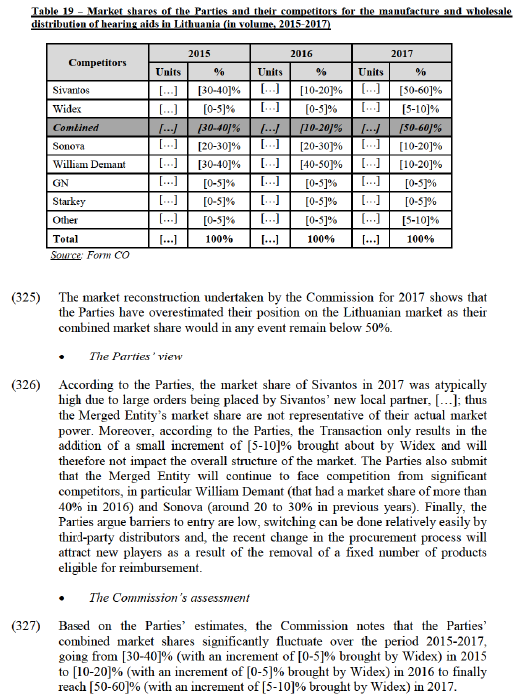
(328) The market investigation confirmed that the atypically high market share of Sivantos in 2017 was due to large wholesale orders placed by its new (178) distributor [Sivanto’s customer] as a result of the procurement reform implemented in March 2017. [Sivanto’s customer] explained that, at the time of the legislative change in 2017, they were one of the few companies having products (Sivantos’ AudioService branded products) meeting the pricing conditions for full reimbursement. (179) As a result of both the introduction of the new list-based system and the fact that [Sivanto’s customer] started stocking AudioService products in 2017, sales of AudioService branded products increased significantly and Sivantos’ market share grew proportionately. This observation is also confirmed by the NHIF, which indicated that “this may be linked to the fact that other suppliers at the time chose not to supply products for the listing price that was set / had no products that could be fully reimbursed to offer (and therefore, they [couldn’t] qualify any products in the categories concerned)”. (180) The high fluctuation of market shares and the fact that the increase of Sivantos’ market shares (and the corresponding decrease of William Demant’s and Sonova’s market shares) occurred during the period in which a number of William Demant and Sonova products were not eligible for reimbursement illustrate the competitive constraint exerted by competitors on the Parties. The Commission considers that such ability of competitors to fill in a gap in the market demonstrates the degree of competitive pressure in the market for hearing aids in Lithuania.
(329) Moreover, substantially more hearing aid products are listed in the 2019 NHIF list than in 2017 (when the new list-based system was introduced) and will exert a competitive pressure on the Parties post-Transaction. More specifically and contrary to the situation in 2017, the list published by the NHIF in 2019 (181) counts, for each individual category, a minimum of three additional manufacturers (on top of the Parties) whose products will remain available to patients post-Transaction. In fact, in the first four categories (for children), William Demant (Oticon, Bernafon), Sonova (Unitron, Phonak) and GN (ReSound) products are represented, while in the remaining categories (for adults), in which the Parties’ products overlap, William Demant (Oticon), Sonova (Phonak), GN (ReSound) and Starkey (Starkey) products are represented on top of the Parties’ products.
(330) Therefore, the Commission considers that, although the 2017 market share figures are more appropriate than the 2015 or 2016 figures to assess the future market conditions under the new NHIF system, these figures largely overestimate the Merged Entity’s (and, in particular, Sivantos’) actual market power in Lithuania. (182)
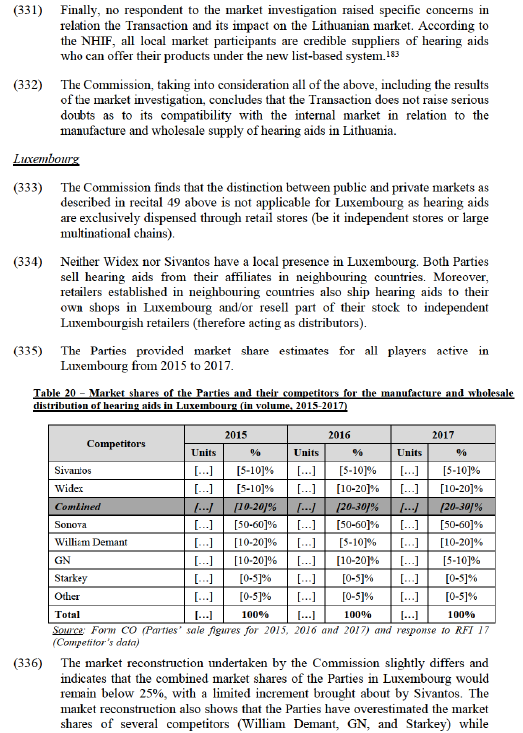
underestimating the market shares of others (Sonova). In addition, the market investigation revealed that second-tier players are also active in Luxembourg. (184)
(337) The Parties’ combined market share in Luxembourg being below 25%, the Transaction is unlikely to raise concerns on this market. (185)
(338) Post-transaction, the Parties will continue to face significant competition from the market leader, Sonova, with a [50-60]% market share and its own route to market with the audiology retail chain Lapperre. In addition, the Parties will be constrained by William Demant, which is active in Luxembourg through a third- party distributor, and the German hearing aid manufacturer Audifon (Kind), who has a retail presence in Luxembourg. Moreover, despite not being directly or indirectly (through third-party distributor) active in Luxembourg, Starkey and GN’s hearing aids are also available on the Luxemburgish market, illustrating the low barriers to entry and the ease with which retailers can start distributing new brands of hearing aids. The Merged Entity would therefore continue to face significant competition in Luxembourg.
(339) Finally, the market participants who participated in the market investigation, and in particular retailers active in Luxembourg, did not raise any concerns in relation the Transaction.
(340) In light of the above, the Commission considers that the Transaction does not raise serious doubts as to its compatibility with the internal market in Luxembourg.
Malta
(341) The Maltese hearing aid market is split between public sales, administered through tenders organised by the public hospital and which account for around 40% of hearing aids dispensed to patients in Malta, with the remaining 60% being dispensed via approximately ten private independent retailers. While the Maltese social system does not generally provide for reimbursement, financial aid is granted by the government exclusively for children and disabled patients with special needs. The financial aid in such cases is organised by the local Ministry of Health and applies to hearing aids supplied through the public hospital. The public tenders are structured around three different categories based on the severity of hearing loss into (i) mild-to-moderate, (ii) moderate-to- severe and (iii) severe-to-profound. Each tender category covers limited amounts of between 60 to 350 devices and is put out to tender every two to three years. Over this period, the retailer who won the tender in a given category is the sole supplier of hearing aids belonging to this category. Some hearing aids are however also dispensed through the public hospital without financial aid and with full out-of-pocket payment by the patient.
(342) No hearing aid manufacturer has a local wholesale or retail presence in Malta. The Parties each serve the Maltese market via two separate local third-party distributors who are vertically integrated into the retail market and independently decide whether to participate or not in public tenders organized
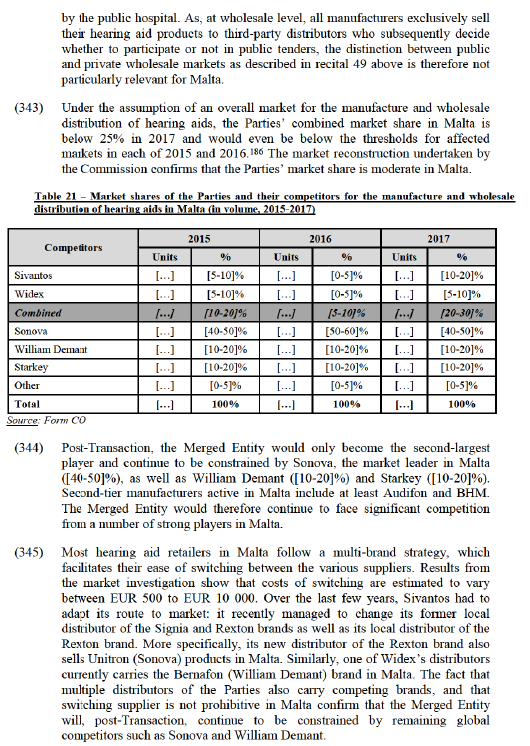
(346) In light of the above, the Commission considers that the Transaction does not raise competition concerns on the overall market for the manufacture and wholesale distribution of hearing aids in Malta.
Public market for the wholesale distribution of hearing aids in Malta
(347) To the Parties’ knowledge, only one of Sivantos’s local distributors sold a limited amount ([…] hearing aid devices) of products to the Maltese public hospital in 2016. As a result, the activities of the Parties’ distributors do not overlap in the public segment over 2015-2017.
Private market for the wholesale distribution of hearing aids in Malta
(348) In the hypothetical private market segment covering around 60% of the total market, the Parties estimate that their combined market shares amount to [20- 30]% in 2015, [5-10]% in 2016 and [30-40]% in 2017. (187)
(349) The Commission’s market reconstruction for the Parties’ 2017 market share in the private segment does, however, not substantiate the Parties’ best estimate and shows that the Merged Entity’s combined market share would in any event (and under a conservative approach) remain below 30%.
(350) Post-Transaction, the Merged Entity would continue to face competition from multiple global players including Sonova, William Demant, Starkey as well as second-tier manufacturers.
(351) While one respondent to the Commission’s market investigation considers that patients’ choice may become more limited post-Transaction, retailers active in Malta consider that having access to two to three different suppliers is sufficient to cover the full range of products, including latest innovations, at reasonable price points. (188) Given that, post-Transaction, four global competitors as well as second-tier players remain active on the Maltese market, the Transaction is unlikely to significantly affect the competitive dynamics in the hypothetical private segment of the market for the wholesale distribution of hearing aids in Malta.
Conclusion
(352) In general terms, irrespective of a hypothetical split into private and public segments, market participants in Malta confirmed that no particular impact of the Transaction could be expected in the market for the manufacture and wholesale distribution of hearing aids in Malta. (189) One respondent to the Commission’s market investigation explained that the Maltese market is characterised by “considerable price competition”. (190)
(353) The Commission, taking into consideration all of the above, including the results of the market investigation, concludes that the Transaction does not raise serious doubts as to its compatibility with the internal market in relation to the manufacture and wholesale supply of hearing aids in Malta or in either of its hypothetical public and private segments.
The Netherlands
(354) The distinction between public and private markets as described in recital 49 above is not applicable for the Netherlands as hearing aids are exclusively dispensed through retail stores (be it independent stores or large multinational chains).
(355) The Netherlands is a well-developed market with around 300 000 units sold in 2017 in approximately 1 100 points of sale. The ASP of hearing aids at wholesale level in the Netherlands is at EUR 198, which is lower than the EU- wide ASP at EUR 255, while the average retail price reaches EUR [870- 1 000]. (191)
(356) Similarly to other EEA countries, a patient suffering from hearing impairment in the Netherlands need to visit an ENT or an audiologist at a private dispenser in order to be provided with a prescription determining the category of hearing aid for which the patient is eligible to receive reimbursement.
(357) Reimbursement in the Netherlands used to be among the most generous in the EEA, with reimbursements up to EUR 500 per hearing aid (including services provided by the audiologists). However, in 2013, there was a reform within the reimbursement system that significantly reduced sales, since reimbursement is now linked to the severity of the hearing loss.
(358) Today, there are five categories of hearing aids based on the severity of the patient's hearing loss and the need for a high performing hearing aid (category 5 being prescribed to people with severe hearing loss and high necessity for a high performing hearing). Preconditions of reimbursement are that the patient chooses a hearing aid within the prescribed hearing aid category, and that he/she obtains the hearing aid in the shop of a dispenser that has a contract with an insurance company (about 83-85% of hearing aids in the Netherlands are dispensed through shops that have contracts with a health insurance company). The reimbursement is administered by the Dutch Ministry of Health, and subsidies are provided by health insurance companies which act privately, but are directly linked to the Dutch government by the Ministry of Health.
(359) Health insurance providers reimburse 75% of the retail price of a hearing aid within the category for which the patient qualifies (patients paying the remaining 25%). The maximum price per hearing aid differs per insurance company, based on the contract in place between the insurance company and retailers, being specified that the majority of these contracts are won following tender procedures organised by health insurance companies where price is a key driver. The Parties argue that since reimbursement rates have been reduced, indirect pressure is mounting on manufacturers of hearing aids: even though
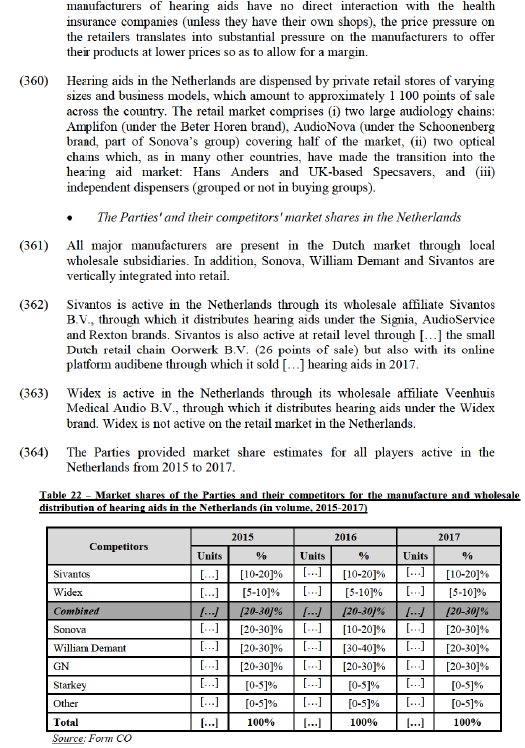
(365) The market share estimates of the Parties are overall in line with the Commission’s market reconstruction and the difference will not impact the competitive assessment.
· The Parties’ view
(366) According to the Parties, the Dutch market is highly competitive, with strong manufacturers, such as GN (the largest player on the market) as well as William Demant and Sonova. The Parties also submit that, since the 2013, health insurance companies have exerted a downward pressure on wholesale prices: according to the Parties, wholesale prices of hearing aids in the Netherlands are lower than the EU average and have in fact decreased by up to 10% per year over the past three years.
· The Commission’s assessment
(367) First, the Commission notes that the Parties do not have a particularly large market share and a number of strong competitors would remain in the market post-Transaction. The Merged Entity would continue to face vigorous competition from GN, with a [20-30]% market share, as well as Sonova ([20- 30]% market share) and William Demant ([20-30]% market share), with their own route to market, and Starkey ([0-5]% market share). In addition, the Parties provided market share data showing that during the period 2012-2016, William Demant’s market share increased from [20-30]% to [30-40]% (and then dropped to [20-30]% in 2017) and GN’s market share grew from [10-20]% to [20-30]%, illustrating the dynamics in the market and the degree of competitiveness of the marketplace.
(368) Second, customers can switch among suppliers with relative ease. Contracts with retailers are always contestable and can be easily terminated given that they are generally entered into for a period of one year or can be terminated at any moment by the retailer. (192) Independent retailers are typically not subject to exclusivity clauses, meaning they can progressively insert new suppliers into their product mix and they typically carry products from at least three suppliers, which enable them to easily re-allocate the share of wallet of their suppliers. (193) This also applies to larger chains that generally follow a multi-brand strategy and can therefore switch by simply increasing or decreasing volumes from a certain supplier without the adjustment or amendment of their contracts being required. (194) In this respect, Sivantos explained that […] decided to […] Sivantos' products in the Netherlands (in favour of […]’s products) following Sivantos' decision […] at the time of the implementation of the new reimbursement system in 2013.
(369) Third, the Parties are not close competitors. The market investigation confirms that all hearing aid manufacturers constitute credible suppliers and that no competitor is more innovative than others. (195) While Widex generates the majority ([…]%) of its sales with independent retailers, Sivantos only generated […]% through this channel of distribution and focuses its efforts towards large chains ([…]%) and buying groups ([…]%). This is further illustrated by the fact that, other than large chains ([…]), the Parties' do not have any common customers
(370) Fourth, the replies to the market investigation expressed a relatively neutral position concerning the potential impact of the Transaction. (196) The vast majority of respondents consider that, post-Transaction, there will still be a sufficient number of competing manufacturers to exert a competitive constraint on the Merged Entity.
(371) The Commission, taking into consideration all of the above, including the results of the market investigation, concludes that the Transaction does not raise serious doubts as to its compatibility with the internal market in relation to the manufacture and wholesale supply of hearing aids in the Netherlands.
Norway
(372) The distinction between public and private markets as described in recital 49 above is not applicable for Norway. (197)
· Regulatory background
(373) Similarly to other Nordic countries like Denmark and Sweden, Norway offers hearing aids directly through its public healthcare system and the Norwegian market is characterised by the use of tendering procedures.
(374) Public tenders are administered by the Norwegian Labour and Welfare Administration (“NAV”), a public procurement body in charge of organising tenders every two to four years to select the hearing aids dispensed at public hospitals and clinics. All hearing aids dispensed through the public system are subject to the same fixed reimbursement level (EUR 620 in 2018, including 25% VAT). In practice, the vast majority of hearing aids are provided free of charge to patients.
(375) Contracts resulting from NAV’s tenders run for two to four years: an initial period of two years with the possibility for NAV to extend it twice by one year. Contracts resulting from the latest NAV tender will run until September 2019. A new tender has been launched on 16 December 2018; participants had until 31 January 2019 to submit their bids. The results of the tender are expected to be published in April 2019 and the new contracts are expected to be signed in May 2019.
(376) NAV structures the tender process around product categories. There were eight different categories in the most recent tender launched in 2014 (with contracts resulting from this tender entering into force on 1 October 2015), 14 categories in the 2011 tender, and two categories in the 2009 tender. In each category, hearing aids must meet specific and detailed technical requirements to address specific hearing loss problems.
(377) As part of its selection process, NAV assigns a score to each product tendered, based on a point system for technical features (typically 70% of the final note) and prices (typically 30% of the final note). Each participant can submit multiple bids (one bid per product) within a same category. Products with the best price/quality ratio are selected and ranked from the highest to the lowest score. The number of products selected in each category is at the discretion of NAV. For instance, 23 products were selected in category 4 (concerning so- called “Mini” hearing aids) of the 2014 tender, while 24 products were rejected due to low ranking of price/performance and five products were not qualified. On the other hand, all 14 products which tendered for category 3 (concerning so-called “Superpower” RIC hearing aids) were ultimately selected. Participants typically do not know in advance how many bids will be selected within each category.
(378) The new tender that was published in December 2018 contains 18 products categories. The segmentation into more categories aims at making it easier for small suppliers to fulfil the technical requirements set by NAV (instead of broad categories covering several types of products) and therefore to participate in the tender. In this tender, NAV also gives more importance to price (which accounts for 35-45% of the final note in most categories and up to 100% of the note for five categories, therefore increasing competition between manufacturers and exerting a downward pressure on prices).
(379) In practice, due to the lower importance given to price in the 2014 tender (30% of the final note to quality a product), the reimbursement level determined by NAV acts as a focal point that eliminates price competition (everyone just bids at the level that NAV reimburses). (198) According to the Parties, the approximate ASP of hearing aids in Norway in 2017 was EUR 468 per hearing instrument. According to NAV, the high level of prices in Norway compared to other EEA countries with similar functioning (such as Denmark) is explained by the fact that (i) the reimbursement level acts as a focal point, (ii) only the most advanced hearing aids including the latest technological features are offered to patients, and (iii) additional services are included for the price, such as the possibility for patients to try hearing aids for a period of up to six months free of charge. (199) The level of price is however expected to decrease (at least for some product categories) due to the new selection criteria set by NAV in the ongoing tender.
(380) After the tender contract is awarded, public hospitals and clinics can procure the hearing aids listed by NAV directly from the suppliers (who in turn will invoice
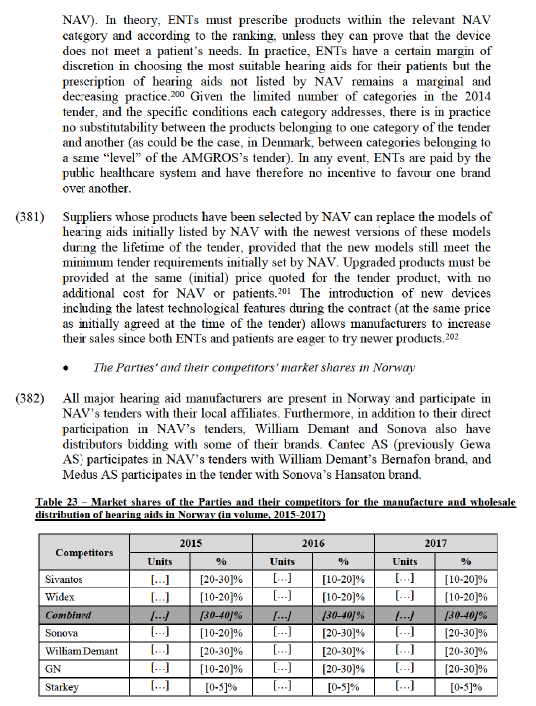
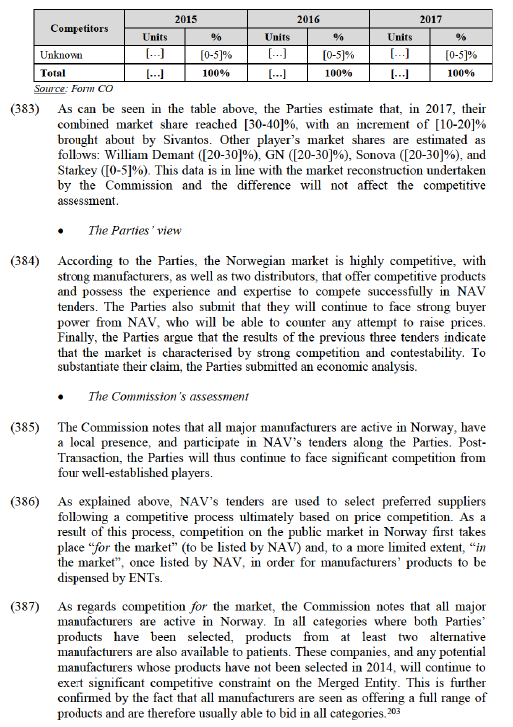
(388) An analysis of the Parties’ position within each product category shows that the Parties are not close competitors and other strong players will continue to constrain the Merged Entity post-Transaction. While in several categories the Parties’ combined market share remains moderate (below 30%), with the presence of other strong competitors, in the other categories, the data provided by NAV shows that the Parties are not each other’s closest competitor. Indeed, even if Widex holds a market share of [40-50]% in category 4; the Transaction would not bring about a significant change on the market since the increment brought about by Sivantos would be minimal, amounting to [0-5]%, and the Merged Entity would continue to face the competition of strong players such as Sonova with a market share of [30-40]%, and Starkey with a market share of [10-20]%. The same holds true for the tender category 8 (concerning tinnitus therapy instruments) where Sivantos holds a market share of [50-60]%; the Transaction would not bring about a significant change on the market since the increment brought by Widex would be minimal, amounting to [0-5]% and the Merged Entity would continue to face the competition of strong players such as Sonova with a market share of [10-20]%, William Demand with a market share of [10-20]%, as well as GN and Starkey with a market share below 10% each.
(389) In addition, according to the NAV, the increase in the number of categories (from 8 to 18) is expected to attract smaller suppliers who will be able to meet the technical requirements set by NAV and thus to participate in the tender. The relatively higher importance given to price is also expected to increase price competition between manufacturers and exert a downward pressure on price levels in Norway.
(390) Finally, as concerns future tenders, the market investigation indicated that the Merged Entity will continue to be subject to sufficient competitive constraints. Specifically, NAV considers that “all manufacturers are perceived by NAV as being innovative companies and they all compete fiercely” and that “a sufficient number of hearing aid suppliers will remain active on the market and ensure its competitiveness”. (204)
(391) As regards competition in the market, an analysis of the Parties’ position within each of the 2014 tender category between 2016 and 2017 illustrates the competitiveness of the Norwegian market: while Sivantos’s market share decreased significantly in category 8 in favour of William Demant’s share, Widex’s market share dropped dramatically in favour of Sonova in category 8. This high fluctuation of market shares and the increase of (i) Sivantos’ market shares (and the corresponding decrease of William Demant’s market shares) and (ii) Widex’s market shares (and the corresponding decrease of Sonova’s market shares) illustrate the competitive constraint exerted by competitors on the Parties.
(392) The Commission, taking into consideration all of the above, including the results of the market investigation, concludes that the Transaction does not raise serious doubts as to its compatibility with the internal market in relation to the manufacture and wholesale supply of hearing aids in Norway.
Poland
(393) The Polish hearing aid market is entirely private and therefore the split between public and private is not applicable. The Polish market had a total market size of 159 000 units in 2017. The market has been growing over the past years at a rate of 5-7% per year. There are approximately 2 200 points of sale. Half of these retail stores are retails chains and independent audiologists whereas the other half is owned fully or partly by manufacturers.
(394) In the Polish hearing aid market reimbursement is available for hearing aids via public health programmes administered by the National Health Fund (NFZ) on behalf of the Ministry of Health in Poland. The NFZ provides a flat reimbursement of EUR 166 per hearing aid for all adults every five years. For children, there is an increased reimbursement rate of EUR 444 per hearing aid. Patients suffering from binaural hearing loss can receive up to full reimbursement. Repairing costs are not reimbursed, but manufacturers must provide a 30-month manufacturer guarantee in order to qualify from reimbursement.
(395) Similar to other EEA markets, a patient in Poland suffering from hearing impairment must receive a prescription from one of the approximatively 4 500 ENTs in order to benefit from reimbursement. Hearing aids are sold by private hearing aid clinics (retail stores), and the clinic takes care of the reimbursement. Nearly all hearing aid purchases are made on the basis of an ENT prescription, and almost all patients “top up” their hearing aids by paying an amount that exceeds the reimbursement rate. Approximately 40% of all patients with NFZ prescriptions apply for an additional reimbursement from the State Fund for Rehabilitation of Disabled Persons, which is administrated by the Ministry of Social Affairs of Poland. As the waiting list is long (up to one year), this application can delay the fitting of the hearing aid. Only a very limited number of users pay for their hearing aids entirely by themselves without reimbursement. This is, for example, the case for users who have lost a hearing aid.
(396) The retail market comprises (i) a number of manufacturer owned retail stores: the Sluchmed chain (between 300-450 POS and owned by William Demant), the Audiofon chain (roughly 300 POS and owned by Widex), the Geers chain (roughly 200 POS and owned by Sonova), the MarMed chain (roughly 50 POS and owned by Starkey) and Kind which owns 85 POS, (ii) buying groups and franchise chains like Amplifon with around 60 POS and (iii) independent retail stores.
· The Parties' and their competitors' market shares in Poland
(397) All six major manufacturers of hearing aids and Audifon (Kind) are present in Poland. In addition, a number of smaller competitors, such as the Spanish manufacturer Microson, the Chinese manufacturer AST, and the Austrian manufacturer BMH, are also active in Poland.
(398) Sivantos is active in Poland through its wholesale affiliate Sivantos Sp. z.o.o. and sells hearing aids under the brands Signia and Audio Service. Sivantos sells the majority of its volume to independent retailers (approximately 70%) of sales
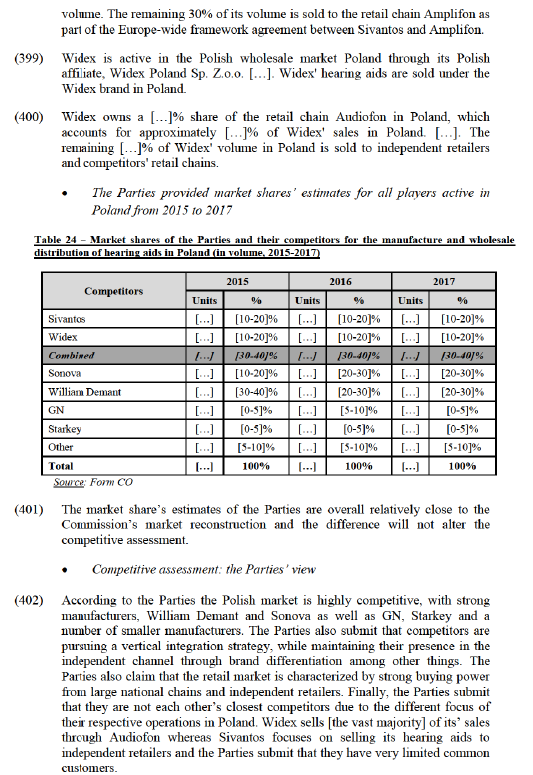
· Competitive assessment: the Commission’s view
(403) First, the Commission notes that the Transaction combines the third and fourth player in the market and creates a new number one with roughly a [30-40]% market share. Post-Transaction, the Merged Entity would continue to face competition from William Demant ([20-30]%), Sonova ([20-30]%), GN ([0- 5]%), Starkey ([0-5]%) with their own route to market. Smaller companies such as Kind are also present in the Polish heading aid market with a direct route to market.
(404) Second, the Parties’ closeness is limited as they target different routes to market. Whereas Widex sells mostly to […] with [a vast majority] of its total sales in 2017 in Poland and the rest of its sales to […], Sivantos is mostly focused on sales to […] retailers for [the vast majority] of its total sales in 2017 in Poland. Furthermore, there is a very limited subset of common customers. These common customers usually also carry additional brands from different manufacturers.
(405) In addition, no respondent to the market investigation, and in particular retailers active in Poland, raised substantiated concerns in relation to the Transaction.
(406) The Commission, taking into consideration all of the above, including the results of the market investigation, concludes that the proposed Transaction does not raise serious doubts as to its compatibility with the internal market in relation to the manufacture and wholesale supply of hearing aids in Poland.
Portugal
(407) The Portuguese hearing market is split between public sales, which account for around 10% of hearing aids dispensed to patients in the country, with the remaining 90% being dispensed via private retailers, including both independent shops, and large chains such as GAES/Amplifon.
(408) The public market typically offers lower-end hearing aids that can be distributed free of charge through public hospitals. Public hospitals in Portugal collect (at least three) quotes from retailers before prescribing hearing aids to a specific patient. In addition, there is one national tender covering less than 1% of the total hearing aid market in Portugal which takes place annually. In both cases, price is the key factor for hearing aid manufacturers to be retained. Widex does not participate in the per-patient “tenders”. The company previously participated in the national tender, but has not done so in any of the last three years due to a substantial price drop. Sivantos did not register any sales to the public sector in Portugal over the last three years. As a result, there is no overlap on the public market in the Portugal between the Parties, and the competitive assessment in the present section focuses on the private wholesale market.
(409) Sivantos does not have a local presence in Portugal, whereas Widex is active both at wholesale and retail level. (205) Out of the other major hearing aid manufacturers active in Portugal, only GN operates through a local wholesale
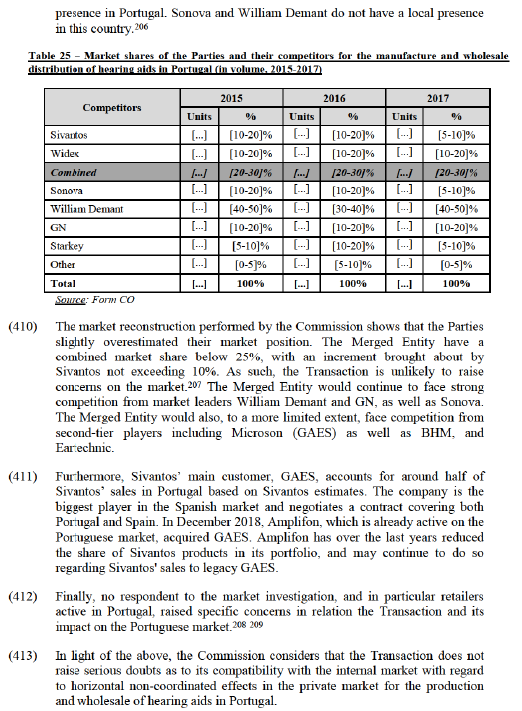
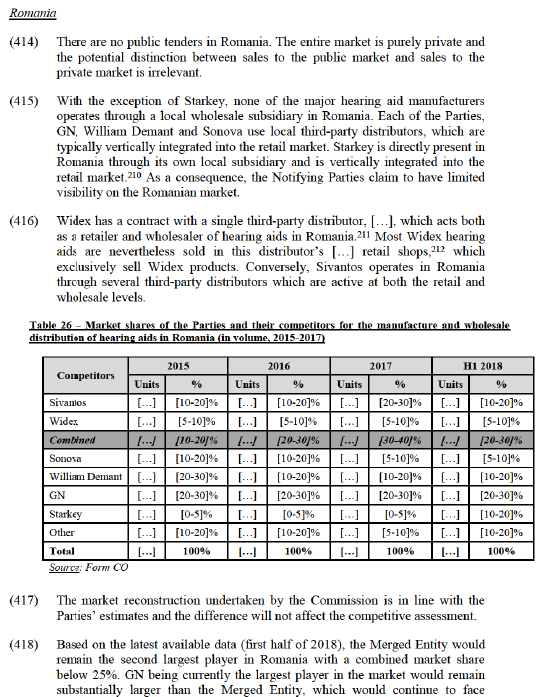
competition from all global competitors and a number of second-tier players including the Japanese-based manufacturer RION and BHM. (213), (214)
(419) In Romania, the Parties are not close competitors. First, they serve opposite extremities of the performance level spectrum. Sivantos mainly sells products of its lower-end brands AudioService ([…]%) and A&M ([…]%). Only […]% of Sivantos sales in Romania in 2017 covered higher-end (Signia) products in 2017. Sivantos sales in Romania focus on the least technologically advanced products of Sivantos’ portfolio, while the vast majority of Widex products cover higher-end products of the Widex brand ([…]%). (215) Only […]% of Widex’ sales in Romania correspond to Widex’s lower-end brand Coselgi. The Parties’ differentiated strategies in Romania are further reflected in the very different average wholesale prices achieved by either Party: in 2017, Widex achieved an average wholesale price of EUR […] while Sivantos achieved an average wholesale price of only EUR […]. (216)
(420) Second, the Parties do not share any common distributor and use different routes to market. While Widex’s distributor Sonorom is marginally active in the wholesale market and acts as Widex’s exclusive distributor mostly in its own retail stores, Sivantos’ distributors are more largely active at wholesale distribution level and commercialise some Sivantos products in their own retail stores.
(421) Third, the market investigation confirmed that the Parties are not particularly close competitors in Romania. In particular, no respondent identified either Party as being particularly close to the other. On the contrary, Sonova, GN and William Demant were quoted by distributors and retailers as Sivantos’s and Widex’s closest competitors.(217) More specifically, one market participant in Romania notes that “Sivantos and Widex are on the opposite spectrum of amplification philosophy - Widex is traditionally more conservator, more noise reduction savvy, whereas Sivantos is more aggressive, more intrusive”. (218)
(422) Moreover, distributors in Romania typically enjoy the possibility of switching between several hearing aid suppliers. Unlike Widex’s distributor […], several distributors active in Romania, including Sivantos’ distributor Soundservice, (219) carry multiple brands, which allows distributors to readily switch between hearing aids of different manufacturers and reallocate their respective share of wallet. For instance, in 2017, the Romanian distributor of the Phonak (Sonova) brand stopped distributing Sonova products and reallocated its purchases in favour of other manufacturers. While Widex’s distributor […] exclusively carries Widex products, its contract with Widex does not contain any exclusivity clause.
(423) Finally, no market participant raised particular concerns with respect to the Transaction in Romania. More specifically, respondents do not expect any particular effect of the Transaction on the wholesale market in Romania. (220)
(424) In light of the above, the Commission considers that the proposed Transaction does not raise serious doubts as to its compatibility with the internal market with regard to horizontal non-coordinated effects in the market for the production and wholesale of hearing aids in Romania.
Slovakia
(425) The distinction between public and private markets as described in recital 49 above is not applicable for Slovakia as there are no public tenders in Slovakia and hearing aids are exclusively prescribed by ENTs and sold via authorized retailers.
(426) All major hearing aid manufacturers, with the exception of Widex, are active in Slovakia through third-party distributors or sell directly to Slovakian retailers from wholesale affiliates located in neighbouring countries.
· Regulatory background
(427) In Slovakia, hearing aids are eligible for reimbursement via both public and private health insurance schemes, up to a fixed level of EUR 250 for one customised hearing aid. Insurance schemes, both public and private, use standard contracts with hearing aid distributors, for which there are no tenders or negotiations.
(428) To qualify for reimbursement, hearing aids must be registered in an official list at a fixed price (consisting of a base price negotiated between hearing aids manufacturers and distributors, as well as a 20% profit margin and VAT). Once the price of a specific hearing aid model has been fixed accordingly at national level, it cannot be modified. The registration process, which is carried by the hearing aid manufacturers’ local affiliate or distributor involves low fees, but is complex and takes around 6-9 months on average.
(429) Patients must visit an ENT and obtain a prescription to benefit from the reimbursement scheme. The ENT examines the patient, then may conduct tests using two different hearing aid brands and/or provides the patient with a list of suitable hearing aids, and then provides the patient with a prescription for a specific hearing aid model. ENTs are prohibited by law from selling hearing aids directly to customers or from receiving payment from suppliers based on
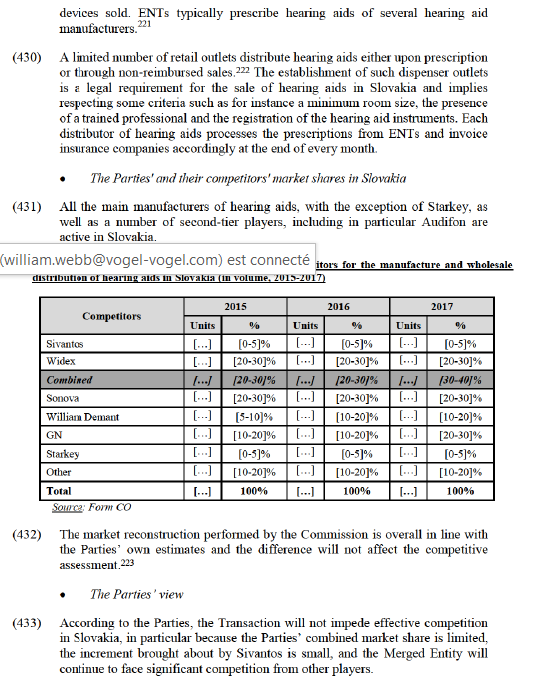
· The Commission’s assessment
(434) All major players, except Starkey, are active in Slovakia along the Parties. While the Merged Entity would take over Widex’s place as the largest player in the Slovakian market, it would continue to face strong competitors such as Sonova ([20-30]% market share), GN ([20-30]% market share) and William Demant ([10-20]% market share). According to the Parties, Starkey is expected to be currently exploring opportunities for entering the market through a local distributor. Besides the major players, second tier competitors such as Audifon also offer products on the Slovakian market.
(435) Furthermore, the increment brought by the Transaction remains limited (below 5%). Among the major hearing aid manufacturers, Sivantos is the smallest player in Slovakia through one single exclusive third-party distributor.
(436) In addition, Sivantos and Widex have very different market positioning in Slovakia and, as a result, do not appear as particularly close competitors. The Commission’s comparative assessment of performance levels in Slovakia in fact shows that Sivantos is offering a high proportion of lower-end products, while Widex focuses on middle-class products.
(437) Finally, no respondent to the market investigation, and in particular retailers active in Slovakia, raised specific competition concerns in relation to the Transaction and its impact on the Slovakian market. (224)
(438) The Commission, taking into consideration all of the above, including the results of the market investigation, concludes that the Transaction does not raise serious doubts as to its compatibility with the internal market in relation to the manufacture and wholesale supply of hearing aids in Slovakia.
Slovenia
(439) The distinction between public and private markets as described in recital 49 above is not applicable for Slovenia as hearing aids are exclusively dispensed through private retailers.
(440) Out of all the major manufacturers of hearing aids, only Widex has a direct presence through a local wholesale affiliate. Other players, including Sivantos, are either active through third-party distributors or sell directly to Slovenian retailers from wholesale affiliates located in neighbouring countries. Widex is also active on the retail market, with 10 points of sale in Slovenia.
(441) The Health Institute of Slovenia (the "HIS") provides reimbursements of up to EUR 300 for the purchase and fitting of hearing aids. If the price of hearing aids exceeds the reimbursement level, patients need to pay for the difference. The Parties estimate that a majority of patients in Slovenia pay up to an additional EUR 300 for hearing aids. Only 10% of patients procure hearing aids outside of the reimbursement system (without any reimbursement).
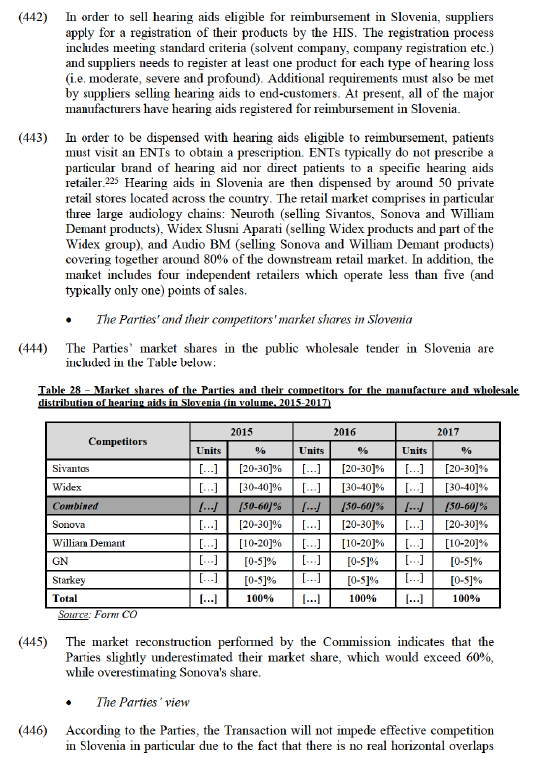
between the Parties as Sivantos is only indirectly active in Slovenia via a distributor.
· The Commission’s assessment
(447) As can be seen in Table 28, the Parties estimate that, in 2017, their combined market share would be higher than 50% (60% under the market reconstruction). Other players whose products are supplied (directly or indirectly) in Slovenia include William Demant, Sonova, and GN. In addition, the market investigation confirmed that Starkey entered the Slovenian market in 2018 through a third- party distributor vertically integrated into retail. (226) It also revealed that BHM was marginally present in the country.
(448) […] Austria-based retailer Neuroth, the leader of the retail market in Slovenia, which operates 21 points of sale in the country. Neuroth benefits from a strong brand recognition due in particular to its aggressive marketing activities. (227) In its Slovenian outlets, Neuroth offers Sivantos products, […], but also products from Sonova and William Demant. Neuroth does not market Widex products in Slovenia, although it did so in the past.
(449) Sivantos sales to Slovenia are indirect, and the company does not have the ability to single-handedly increase or decrease its supply to the Slovenian market, or modify the relevant prices, should it decide to do so. Sivantos sales to Neuroth take place within the framework of a […] contract that covers […], which are much larger end markets than Slovenia. Under the […] contract, […].
(450) On […]. As a result, the expected share of supply of Sivantos to customers in Slovenia is expected to decrease […]. (228). By contrast, sales of hearing aids from other manufacturers (in particular William Demant’s and Sonova’s, which are currently dispensed by Neuroth in Slovenia) are expected to grow proportionally to the decrease of Sivantos’ market share.
(451) Furthermore, a sufficient number of alternative manufacturers will remain active in Slovenia post-Transaction. All the main manufacturers of hearing aids, are active in Slovenia, as well as second-tier manufacturers such as BHM to a very limited extent. Starkey entered the Slovenian market in 2018, which has had a positive impact on the competitive landscape. (229) All of the major hearing aid manufacturers have hearing aids eligible for reimbursement in Slovenia.
(452) Finally, no respondent to the market investigation, and in particular retailers in Slovenia, raised credible concerns in relation the Transaction and its impact on the Slovenian market. (230)
(453) The Commission, taking into consideration all of the above, including the results of the market investigation, concludes that the Transaction does not raise serious
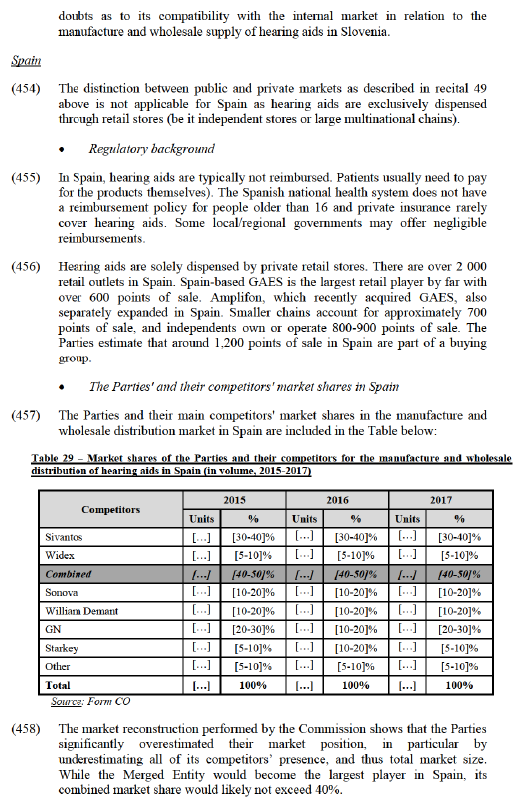
· The Parties’ view
(459) The Parties argue that the Transaction will not impede effective competition in Spain in particular because neither Sivantos nor Widex has a local presence in Spain, and because all major hearing aid manufacturers are present in the Spanish market, which is characterised by strong countervailing buyer power by large chains, in particular GAES/Amplifon.
· The Commission’s assessment
(460) Widex does not have a local presence in Spain, whereas Sivantos started a direct wholesale business in September 2018 with the acquisition of AS Iberica, a historic distributor of Sivantos products. (231) Widex is only active through two exclusive distributors, which are local partners in which Widex holds a […]. With the exception of Starkey, all of the other major hearing aid manufacturers operate through a local wholesale presence in Spain. Widex and Starkey use local third-party distributors, which are typically vertically integrated into the retail market. (232)
(461) Sivantos is mainly active in Spain through GAES, which operates the largest hearing aids retail chain in Spain, and also manufactures its own hearing aids under the Microson brand. GAES holds exclusive sales rights over the higher- end Signia and Rexton brands in Spain. GAES has been acquired by Amplifon in December 2018. (233) Sivantos also sells hearing aids to other third-party distributors which are active at the retail and/or wholesale levels.
(462) While it will become the main player on the market, the Merged Entity’s market share would remain below 40%. The Merged Entity would continue to face strong competition from all global competitors, including in particular GN as well as Sonova and William Demant. The Merged Entity would also, to a more limited extent, face competition from a number of second-tier players including in particular Spain-based Microson (GAES), as well as BHM, and Eartechnic.
(463) Also, the Parties are not particularly close competitors based on their customers’ profile. While Widex distributes its products via local partners in which it holds a minority stake, Sivantos focuses its activity on GAES, the largest hearing aid retailer in Spain, to which Widex makes no sales.
(464) Furthermore, Sivantos’ main customer, GAES, which accounts for [the vast majority] of Sivantos’ sales in Spain, enjoys a significant degree of countervailing buyer power. GAES is the biggest player at the retail level by far, with over 600 point of sales in Spain, and accounts for over 40% of the total retail share. It carriers other brands than Sivantos’ in its shops, including Starkey and also manufactures hearing aids under the Microson brands that it sells in its shops. In December 2018, Amplifon, which accounts for over 10% of the total Spanish retail share, acquired GAES, meaning the Merged Entity represents over 50% of the retail market in Spain, and as such represents a critical distribution channel for hearing aid manufacturers. […].
(465) Several distributors, including Sivantos’ main customer, carry multiple brands, which allows them to switch between hearing aids of different manufacturers and reallocate their respective share of wallet. Widex’s local partners on the other hand only carry Widex products.
(466) Finally, no respondent to the market investigation, and in particular retailers active in Spain, raised substantiated concerns in relation the Transaction and its impact on the Spanish market. (234) (235)
(467) In light of the above, the Commission considers that the Transaction does not raise serious doubts as to its compatibility with the internal market with regard to horizontal non-coordinated effects in the market for the production and wholesale of hearing aids in Spain.
Sweden
(468) The Swedish market for hearing aids is large with a total market size of approximately 190 000 units in 2017 and a growth rate of 9% in 2016 and 6% in 2017. The Swedish market is around 80% public (sales of hearing aids to regional public procurement authorities based on tendering procedures) and 20% private (sales of hearing aids to private retail stores based on bilateral negotiations). In line with the market definitions presented in recital 49, the Commission assesses the impact of the Transaction on the public and private markets for hearing aids separately.
(469) According to the Parties’ best estimates, the ASP of hearing aids at wholesale level in the private sector was EUR 177 per hearing instrument (unit) and in the public sector EUR 132 per hearing instrument (unit).
(470) All major hearing aid manufacturers are present in Sweden, but Starkey does not participate in the public tenders. Both Widex and Sivantos have a direct local presence at wholesale level with the establishment of an affiliate. However, for both Parties, the stock of hearing aids and the back office are in Denmark.
· The Parties' and their competitors' market shares in Sweden
Overall market for manufacture and wholesale distribution of hearing aids in Sweden
(471) The Parties and their main competitors' market shares on the overall market for manufacture and wholesale distribution of hearing aids in Sweden are included in the table below:
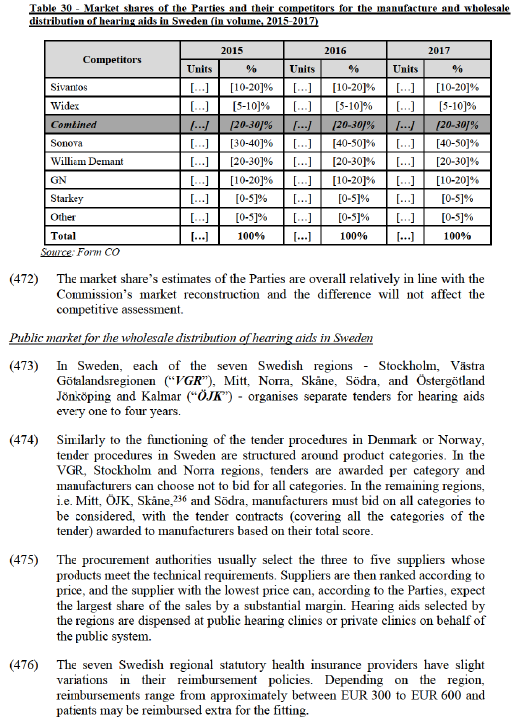
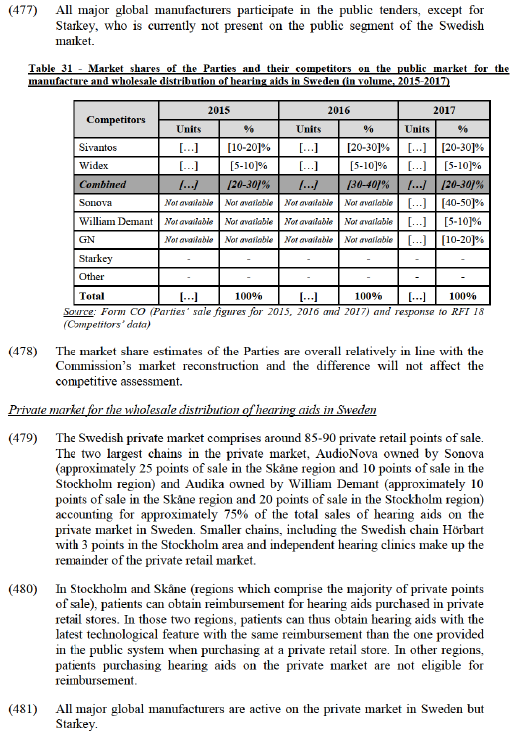
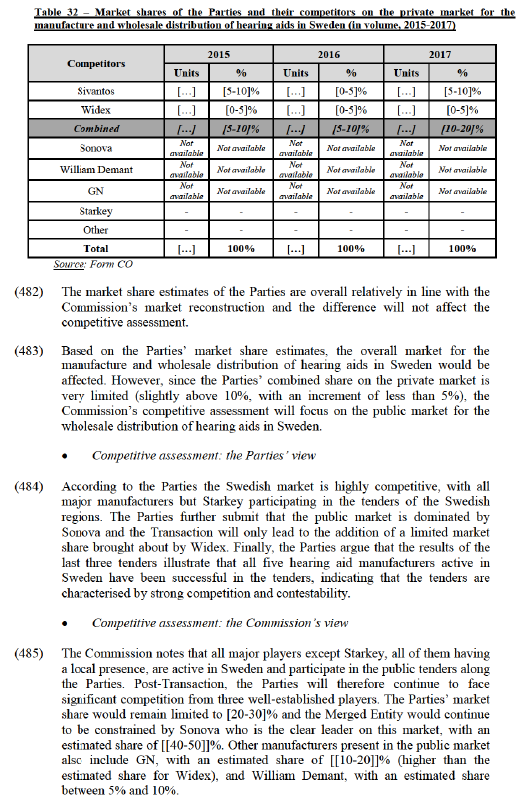
(486) Moreover, an analysis of the Parties’ position within each of the most recent tenders organised by the seven Swedish regions shows that there is certain degree of competition in the market. Sonova, GN and William Demant are all frequent bidders and winners in the different tenders organized in the Swedish regions. The Merged Entity would therefore continue to be constrained by a sufficient number of players post-Transaction.
(487) Finally, no respondent to the market investigation, and in particular the public procurement authorities, raised substantiated concerns in relation the Transaction and its impact in Sweden. (237)
(488) The Commission, taking into consideration all of the above, including the results of the market investigation, concludes that the Transaction does not raise serious doubts as to its compatibility with the internal market in relation to the manufacture and wholesale supply of hearing aids in Sweden.
United Kingdom
(489) The UK is the EEA’s largest market for hearing aids, with over 1.7 million units sold in 2017. The overall framework for the provision of hearing aids in the UK is characterized by the preponderance of public sales, administered via the UK’s National Health Service (or “NHS”), which account for over 80% of hearing aids dispensed to patients in the UK. The remaining 20% are dispensed via private retailers, including both independent shops, and large chains such as Amplifon and Specsavers.
(490) While Sivantos offers products to the NHS, Widex virtually offers no hearing aids to the public market. (238) Widex entered the UK market in 2010, and is fully focused on the private market, largely due to […]. This situation is not expected to change in the foreseeable future, as Widex […]. As a result, there is no overlap on the public market in the UK between the Parties, and the competitive assessment in the present section focuses on the private wholesale market.
(491) The Parties, as well as all of the major hearing aid manufacturers (including Starkey) operate in the UK private wholesale market through a local wholesale affiliate. In addition, several manufacturers are also vertically integrated into retail. This is the case of Widex, which offers its products through its own Bloom / Regional Hearing retail stores, as well as to third party retailers, (239) but also of Sonova (through its joint venture with Boots) and William Demant (through Hidden Hearing). Conversely, Sivantos targets third party retailers.
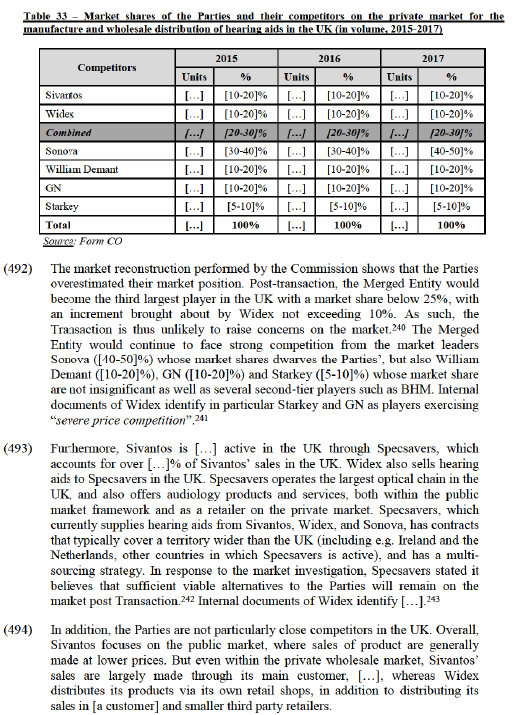
(495) Retailers in the UK can easily switch between several hearing aid suppliers. (244) They usually carry multiple brands from different manufacturers, which allows them to switch hearing aid manufacturers and reallocate their respective share of wallet with a short period of time.
(496) Finally, respondents to the market investigation, and in particular retailers active in the UK, did not raise substantiated concerns in relation the Transaction and its impact on the UK market. (245)
(497) The Commission, taking into consideration all of the above, including the results of the market investigation, concludes that the Transaction does not raise serious doubts as to its compatibility with the internal market in relation to the manufacture and wholesale supply of hearing aids in the UK.
6.2.3. Downstream market for the retail distribution of hearing aids
(498) In the EEA, the Parties’ activities only overlap at retail level in Hungary. However, the Hungarian retail market does not constitute a horizontally affected market as the Parties’ retail market share is below 20% both at national level and when considering the narrowest plausible geographic market definition of catchment areas with a radius of a 30-minute drive.
(499) Therefore, the Commission concludes that the Transaction does not raise serious doubts as to its compatibility with the internal market in relation to the market for the retail distribution of hearing aids in Hungary.
6.3. Vertical non-coordinated effects
6.3.1. Legal framework
(500) The Commission guidelines on the assessment of non-horizontal mergers under the Council Regulation on the control of concentrations between undertakings (246) (the "Non-Horizontal Merger Guidelines") distinguish between two main ways in which vertical mergers may significantly impede effective competition, namely input foreclosure and customer foreclosure.
(501) For a transaction to raise input foreclosure competition concerns, the Merged Entity must have a significant amount of market power upstream. (247) In assessing the likelihood of an anticompetitive input foreclosure strategy, the Commission has to examine whether (i) the Merged Entity would have the ability to substantially foreclose access to inputs, (ii) whether it would have the incentive to do so and (iii) whether a foreclosure strategy would have a significant detrimental effect on competition downstream. Concerns are likely to arise only where all three conditions are fulfilled. (248)
(502) For a transaction to raise input foreclosure competition concerns, the Merged Entity should be in a position to restrict access of upstream competitors to a significant customer base as a result of the transaction. Similarly as for the assessment of input foreclosure concerns, in assessing the likelihood of an anticompetitive input foreclosure strategy, the Commission has to examine whether (i) the Merged Entity would have the ability to foreclose upstream competitor's access to clients downstream, (ii) whether it would have an incentive to do so and (iii) whether such a foreclosure strategy would have a significant detrimental effect on customers. (249) Concerns are likely to arise only where all three conditions are fulfilled.
6.3.2. Competitive assessment
(503) Hearing aid manufacturers supply their products (either directly or through third-party distributors) at the wholesale level to hearing aid dispensers (upstream market). Hearing aid dispensers then serve patients at the retail level, typically through audiology shops, hospitals or clinics (downstream market).
(504) All hearing aid manufacturers are, at least to some extent, vertically integrated at the retail level. Depending on the EEA country, the individual degree of vertical integration of the various manufacturers can be very different. In general terms, hearing aid manufacturers are only occasionally present downstream in Eastern European countries and in smaller markets while they tend to operate retail stores in larger national markets. This trend has accelerated over the last years, in particular with Sonova's acquisition of Audionova (active in 10 countries including Belgium, Denmark, Germany, France, Italy, Luxembourg, Poland, and Portugal in the EEA), in September 2016 and William Demant's acquisition of Audika (active in Belgium and France) in November 2015.
(505) Sivantos has marginal retail activities in the EEA, focused on Austria, Hungary and the Netherlands. Widex, on the other hand, owns and/or operates retail shops in each of Denmark, France, Hungary, Ireland, Poland, Portugal, Slovenia, and the United Kingdom.
(506) Moreover, since 2015, Sivantos operates the online platform audibene in Germany, France and the Netherlands. This online platform refers potential customers to partner audiologists. When a sale is made following a referral, audibene earns the purchase price and pays the audiologist a fitting fee (which varies according to the price level of the device). audibene has grown dramatically in recent years and now has around […] partner audiologists in Germany, […] in the Netherlands and […] in France. Despite the dramatic rise of audibene in recent years, only a marginal number of hearing aids were sold through audibene in France ([…] units) and the Netherlands ([…] units) in 2017, accounting for less than […]% of the total volume of hearing aids sold in each of these countries. Similarly, sales of hearing aids through audibene in Germany only accounts for less than […]% of the total sales of hearing aids in Germany in 2017.
(507) An overview of the vertically affected markets arising from the Transaction is provided in the table below.
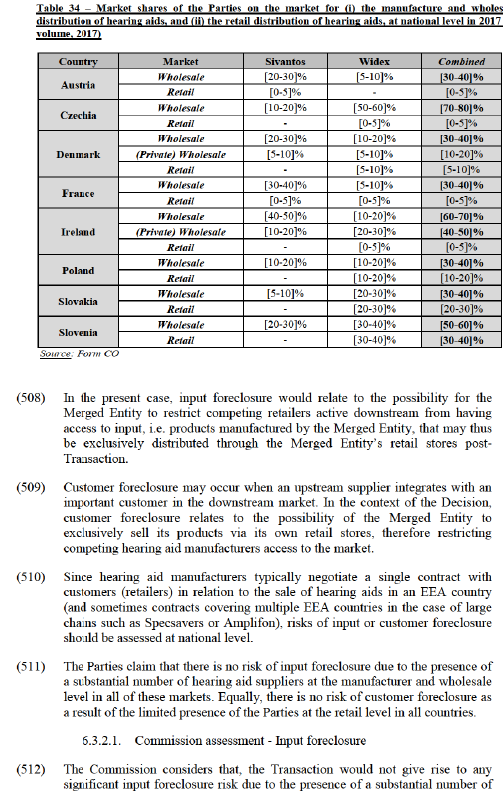
competing hearing aid suppliers at the manufacture and wholesale level in each of the vertically affected markets. More specifically, the Parties will continue to face competition from at least three other major manufacturers, including global market players such as Sonova, William Demant, GN, and/or Starkey, as well as second-tier players such as Audifon and BHM (particularly in Czechia, Poland and Slovakia).
(513) The Commission finds that in the present case, any foreclosure strategy conducted at a national level would likely divert wholesale sales towards rival manufacturers while only leading to marginal benefits at the retail level due to the Parties’ limited market share downstream, and the competition they face in every relevant market. The market investigation indeed confirms the ability of retailers to switch between hearing aid suppliers within a short period of time, in particular due to the fact that the vast majority of retailers rely on multi-sourcing strategies. (250) Retailers usually carry multiple brands from different manufacturers, which allows them to switch hearing aid manufacturers and reallocate their respective shares of wallet within a short period of time, should supply conditions from the Merged Entity deteriorate post-Transaction.
(514) This is further reinforced by the fact that Widex’s products typically generate higher margins than Sivantos products. As such, an input foreclosure strategy that would imply ceasing to supply Sivantos products to third parties and instead offer these Sivantos products in Widex shops would negatively impact the Merged Entity's margin.
(515) As regards Slovenia more particularly, where Widex holds a market share of [30-40]% downstream, input foreclosure risks can also be excluded since Sivantos’s only customer in Slovenia, Neuroth, […], and Widex only sells its products in its own retail shops.
(516) As a result, the Parties would lack the ability and the incentive to foreclose competing retailers in each of the affected market of Table 34. Accordingly, the Commission concludes that the Transaction does not raise serious doubts as to its compatibility with the internal market relative to input foreclosure risks.
6.3.2.2. Commission assessment - Customer foreclosure
(517) The Commission considers that the Transaction does not give rise to any customer foreclosure risk due to very limited retail presence of the Parties when compared to their wholesale activities. In most countries, the national market share of Sivantos or (mostly) Widex, is around or below 5%. The only exceptions are Poland and Slovenia, where Widex’s share on the national retail market reaches [10-20]% and [30-40]% respectively. Furthermore, with the exception of Hungary (which, nevertheless, is not a vertically affected market as the Parties’ combined market share remains largely below 30% both at the upstream and downstream levels), the Parties’ activities do not overlap at retail level.
(518) As a result, the Commission finds that the Transaction would not lead to any reinforcement of the Parties' downstream market presence downstream, limiting the impact of the Transaction on any incentive to foreclose its upstream competitors by leveraging its downstream retail presence. Accordingly, the Commission concludes that the Transaction does not raise serious doubts as to its compatibility with the internal market relative to customer foreclosure risks.
6.3.2.3. Conclusion
(519) In light of the above, the Commission concludes that the Transaction does not raise serious doubts as to its compatibility with the internal market as regards vertical effects in relation to the retail distribution of hearing aids
6.4. Horizontal coordinated effects
6.4.1. Legal framework
(520) According to the Horizontal Merger Guidelines, horizontal concentrations may also significantly impede effective competition by way of coordinated effects. Such situation would occur if the Transaction would (a) increase the likelihood that firms are able to coordinate successfully, or (b) make existing coordination easier, more stable or more effective, either by making the coordination more robust or by reinforcing its effects, for example by facilitating the detection of deviation, limiting the ability and incentives of some market players to deviate and allowing more efficient retaliation. (251) Coordination may take various forms, such as setting prices above the competitive level, limiting production or capacity, dividing the market, or by allocating contracts in bidding markets. (252) In assessing whether it would be possible to reach terms of coordination and whether the coordination is likely to be sustainable, the Commission takes account of all the changes that a transaction is likely to bring about.
(521) In general, according to case law of the European courts, three features of the market may provide indications as to whether coordination is likely to be sustainable. First, the coordinating firms should be able to monitor to a sufficient degree whether the terms of coordination are being adhered to. Second, coordinating firms are more likely to adhere to coordinated behaviour if the incentives not to deviate deter them from departing from the coordinated action. Third, the reactions of outsiders, such as current and future competitors not participating in the coordination, as well as customers, should not be able to jeopardise the results expected from the coordination or the effect of their reaction would be too small to effectively counterbalance the effect of potential coordination on the relevant market. (253)
(522) Coordination is more likely to emerge in markets where it is relatively simple to reach a common understanding on the terms of coordination. The less complex and the more stable the economic environment, the easier it is for the firms to reach a common understanding on the terms of coordination. (254) In addition, firms may find it easier to coordinate if they are relatively symmetric, especially in terms of cost structures, market shares, capacity levels, and levels of vertical integration. (255) Market transparency resulting from publicly available key information or, for example, from information exchanged through structural links between competitors may further facilitate coordination. (256)
6.4.2.The Parties’ view
(523) The Parties submit that the characteristics of the hearing aid market indicate that the Transaction does not raise coordinated effects concerns because: (i) the characteristics of the hearing aid markets are not conducive for reaching a common understanding on the terms of coordination, (ii) the low level of data transparency in the market for hearing aids would prevent the possibility to monitor competitors’ behaviour in order to detect any deviation from a potential coordinated agreement and ensure enforcement of the agreement, (iii) no credible deterrent mechanism could be implemented since rivals on the market would lack access to pricing information required to enable retaliation against another potential cheating rival and the terms and conditions of already existing contracts would limit the scope for effective punishment, and (iv) retailers and potential entrants would be able to counter-act any attempt at coordination.
6.4.3. The Commission’s assessment
(524) The Commission considers that in the present case the above conditions are not met, and thus the Transaction will not result in the creation or strengthening of coordination leading to serious doubts on any of the markets concerned by the Transaction. The Commission considers so for the following reasons.
(525) First, the markets affected by the Transaction involve the sales of hundreds of differentiated products through a variety of distribution channels (be it private retailers including independent retail stores, multinational audiology chains, optical chains as well as buying groups or public procurement authorities). The importance and frequency of innovation in the hearing aid industry translates, for each manufacturer, into the introduction of new product ranges every 18-30 months as well as smaller upgrades of products, which further reinforces product differentiation and asymmetry on the market.
(526) In addition, the price and market characteristics of hearing aids (i.e. reimbursement levels, registration requirements, etc.) vary significantly in each EEA country. The industry is increasingly characterized by national regulatory changes (such as the reforms in the Netherlands in 2013, in Lithuania in 2017 or in Czechia and France in 2019) and/or the intervention of public authorities (e.g. the public procurement authorities in Norway and in Denmark have a large margin of discretion in the design of tender requirements, which in practice change with each new tender) that brings an element of instability to the market.
(527) Furthermore, the relevant market structures make price coordination or market sharing (by bids or customers) unlikely. Market shares may be subject to sudden and large shifts between competitors due to sourcing decisions in particular from key accounts, including large retail chains and/or public authorities where relevant. The market investigation indicated that such customers regularly reallocate the share of supply of hearing aids manufacturers. (257)
(528) Companies in the hearing aid industries are typically not symmetric, in particular in relation to cost structures, (258) market shares, or vertical integration into retail. While some companies, including the Parties, are only active on the hearing aid markets, others, such as Starkey, William Demant and Sonova are also active on neighbouring markets, such as cochlear implants, PSAPs, bone- conducting systems and/or diagnostic equipment, which they sell to some of the same customers. Other players are primarily active in the retail distribution of hearing aids, and have a more limited activity in the manufacture and wholesale distribution of hearing aids, such as Audifon (Kind) and Microson (GAES/Amplifon).
(529) For the reasons mentioned in recitals 525 to 528, it would be difficult for the Merged Entity and its competitors to reach common terms of coordination. (259)
(530) Second, most national hearing aid markets are characterized by a low level of transparency, limiting or preventing potential coordination between competitors and making deviations from a coordinated outcome harder to detect. In private markets, supply contracts are negotiated bilaterally with no transparency on pricing and often include rebates/bonus/discounts to incentivise retailers to sell their products. Prices are typically confidential and differ per country, as well as per customer (for instance between large chains and small independent retailers). (260) For public tenders, although the winning bid’s price may become public, the infrequency of tenders, which typically cover a minimum of two years, as well as changes in the subsequent tenders’ design limit the relevance of ex post price information. (261) The differentiation of hearing aid products, as well as the variety of distribution channels (from large specialized retail chains, optical chains, buyer groups, to independent retailers) also hinder the ability of competitors to effectively and sufficiently monitor each other’s behaviours.
(531) For the above reasons, it would be difficult for the Merged Entity and its competitors to effectively monitor deviations from any coordinated outcome on the markets for the manufacture and wholesale distribution of hearing aids.
(532) Third, retaliation against undertakings deviating from a coordinated outcome would only be possible after a significant time lag, in particular for public tenders, and would include an element of uncertainty, in particular for negotiation with private customers (given the pricing mechanism determined through bilateral negotiations and these customers’ bargaining power).
(533) In addition, third parties not involved in a potential coordination would likely react to any coordination attempt by others. Customers would likely retaliate in the event of coordination between hearing aid manufacturers. In a number of EEA countries, a small number of key customers account for substantial volumes of sales. These customers would likely have a particularly strong interest to undermine any attempt at coordination by hearing aid manufacturers. Second-tier hearing aid suppliers would likely react by increasing their sales. Moreover, major manufacturers who are not yet present in a particular EEA market would likely react by entering the market. This is particularly true for Central and Eastern European countries, where hearing aids are typically less advanced in performance levels, and may thus be provided (or increasingly provided) by second-tier manufacturers.
(534) For the above reasons, it would be difficult for the Merged Entity and its competitors to benefit from sufficient deterrent mechanisms to enforce any coordinated outcome on the market for the manufacture and wholesale distribution of hearing aids.
(535) The Commission concludes that the Transaction does not raise serious doubts as to its compatibility with the internal market relative to risks of horizontal coordinated effects.
7. CONCLUSION
(536) For the above reasons, the European Commission has decided not to oppose the notified operation and to declare it compatible with the internal market and with the EEA Agreement. This decision is adopted in application of Article 6(1)(b) of the Merger Regulation and Article 57 of the EEA Agreement.
1 OJ L 24, 29.1.2004, p. 1 (the 'Merger Regulation'). With effect from 1 December 2009, the Treaty on the Functioning of the European Union ('TFEU') has introduced certain changes, such as the replacement of 'Community' by 'Union' and 'common market' by 'internal market'. The terminology of the TFEU will be used throughout this decision.
2 OJ L 1, 3.1.1994, p. 3 (the 'EEA Agreement').
3 Publication in OJ C 20, 16.1.2019, p. 10.
4 No member of the Topholm or Westermann families holds controlling shares in companies active in the hearing aid industry, outside of T&W Medical, Audiofon (Poland) and Din Hørespecialist (Denmark) which are discussed in the relevant country sections.
5 Shareholders’ Agreement, clause 12.1.1.
6 Shareholders’ Agreement, clause 12.3.
7 Shareholders’ Agreement, clause 12.2.3.
8 Strategic matters ("Reserved Matters” in clause 13.1.1 of the Shareholders’ Agreement) include inter alia (i) material amendments of the business plan, (ii) approval of budget, (iii) appointment or removal of members of the top management and (iv) any acquisition either requiring additional equity funding or having a value in excess of EUR 100 million.
9 Shareholders’ Agreement, clause 13.1.1.
10 Turnover calculated in accordance with Article 5 of the Merger Regulation.
11 While both Parties distributed diagnosis equipment in Poland and the Netherlands at one point over the last three years, their activities are marginal, and the Parties’ combined market share does not reach the 20% threshold in any plausible market. Furthermore, […], which will further decrease the relevance of this activity.
12 A typical classification for the degree of hearing loss is provided by the World Health Organization as follows: mild hearing loss (deficit of 26-40dB), moderate hearing loss (41-60dB), severe hearing loss (61-80dB) and profound hearing loss (above 81dB).
13 A decibel (“dB”) is a unit of measurement that indicates the loudness of a sound. A human ear typically distinguishes acoustic signals between 0 and 140dB.
14 ISO 13485 is an ISO standard, published in 2003, that represents the requirements for a comprehensive management system for the design and manufacture of medical devices.
15 ISO 9001 belongs to the ISO 9000-family of standards related to quality management systems and designed to help organizations ensure they meet the needs of customers and other stakeholders. It deals with the requirements that organizations wishing to meet the standard have to fulfil.
16 Article 11 of Council Directive 93/42/EEC of 14 June 1993 concerning medical devices specifies general requirements that a product has to meet in order for the manufacturer to affix the CE marking
17 Non-confidential replies to questionnaire Q1 to competitors, question 17.3.
18 French competition authority Decision dated 18 September 2015 in Case 15-DCC-115, recitals 19 to 22. The French competition authority considered in particular that this market was distinct from the manufacture and wholesale of (i) other audiology equipment, including PSAPs, (ii) auditive implants, (iii) diagnostic equipment, and (iv) preventive equipment.
19 German competition authority Decision dated 11 April 2007 in Case B3 578/06, Section 3.2.
20 Dutch competition authority Decision dated 7 September 2016 in Case 16.0721.22 / Sonova - AudioNova, recitals 19 to 21.
21 There is no consensus as to the definition of profound hearing loss. While the WHO considers as profound a hearing loss above 81dB, the Parties use a threshold of 95dB
22 Non-confidential replies to questionnaire Q6 to associations for the hearing impaired, question 3.
23 Non-confidential replies to questionnaire Q6 to associations for the hearing impaired, question 7.
24 The market investigation confirms that hearing aid prices reflect technical performance. As such, the present section assesses the relevance of a possible segmentation by both price and performance.
25 Non-confidential replies to questionnaire Q2 to retailers of hearing aids, questions 10 to 12.
26 Non-confidential replies to questionnaire Q3 to large retail chains, questions 14 to 17.
27 Non-confidential replies to questionnaire Q4 to public purchasers of hearing aids, question 4.
28 Non-confidential replies to questionnaire Q2 to retailers of hearing aids, question 10.
29 Non-confidential replies to questionnaire Q1 to competitors, questions 10.1 to 10.5.
30 Non-confidential replies to questionnaire Q3 to large retail chains, questions 37 and 38.
31 Non-confidential replies to questionnaire Q3 to large retail chains, question 36 and non- confidential replies to questionnaire Q1 to competitors, question 1.
32 Non-confidential replies to questionnaire Q7 to competitors, question 14.
33 EEA countries with a public market for hearing aids include Denmark, Estonia, Finland, Ireland, Latvia, Malta, Norway, Portugal, Sweden, and the UK.
34 Non-confidential replies to questionnaire Q4 to public purchasers of hearing aids, questions 10 and 19. Non-confidential replies to questionnaire Q1 to competitors, questions 17.1 to 17.3.
35 As evidenced by the fact that the Parties’ customers include manufacturer-owned retails (e.g. Sonova, William Demant, and Starkey) in the following countries: Austria, Belgium, Denmark, Germany, France, the Netherlands, Poland, Spain and Sweden. Similarly, shops owned by Widex in Denmark, Hungary, Ireland, and the UK also offer products from competing suppliers.
36 Distribution of hearing aids by hospitals or health services under public schemes thus do not form part of the retail segment.
37 French competition authority Decision in Case 15-DCC-115, recitals 8 to 12. The French competition authority considered in particular that this market was distinct from the retail of (i) other audiology equipment, including PSAPs, (ii) auditive implants, (iii) diagnostic equipment and
(iv) preventive equipment.
38 Dutch competition authority Decision in Case 16.0721.22 / Sonova - AudioNova, recitals 15 to 18.
39 See for example Commission decision of 1 March 2018 in Case No COMP/M.8394 Essilor/Luxottica; Commission decision of 25 August 2005 in Case No COMP/M.3687 Johnson & Johnson/Guidant; Commission decision of 27 May 2003 in Case No COMP/M.3146 Smith & Nephew/Centerpulse; Commission decision of 28 October 1998 in Case No COMP/M.1286 Johnson & Johnson/DePuy.
40 French competition authority Decision in Case 15-DCC-115, recitals 19 to 22. The French competition authority considered in particular that this market was distinct market from the manufacture and wholesale of (i) other audiology equipment, including PSAPs, (ii) auditive implants, (iii) diagnostic equipment and (iv) preventive equipment.
41 German competition authority Decision dated 11 April 2007 in Case B3 578/06, Section 4.
42 Dutch competition authority Decision in Case 16.0721.22 / Sonova - AudioNova, recital 31.
43 Non-confidential replies to questionnaire Q3 to large retail chains, question 4.
44 Non-confidential replies to questionnaire Q2 to retailers of hearing aids, question 1.2.
45 Some similarities can exist across specific groups of countries; e.g. between the UK and Ireland.
46 Parties’ response to the Commission's request for information RFI 16, question 15, paragraphs 65 and 66 and question 20, paragraph 86.
47 French competition authority Decision in Case 15-DCC-115, recitals 13 to 18.
48 Dutch competition authority Decision in Case 16.0721.22 / Sonova - AudioNova, recital 31.
49 Non-confidential replies to questionnaire Q6 to associations for the hearing impaired, question 21.
50 Non-confidential replies to questionnaire Q2 to retailers of hearing aids, question 1.3.
51 Non-confidential replies to questionnaire Q1 to competitors, question 4.
52 OJ C3, 05.2.2004, p. 5.
53 Horizontal Merger Guidelines, paragraph 24.
54 Horizontal Merger Guidelines, paragraphs 27 to 38.
55 Parties’ internal documents.
56 Non-confidential replies to questionnaire Q2 to retailers of hearing aids, question 56 and non- confidential replies to questionnaire Q3 to large retail chains, question 79.
57 Parties’ internal documents.
58 Non-confidential replies to questionnaire Q2 to retailers of hearing aids, question 15 and non- confidential replies to questionnaire Q3 to large retail chains, question 24.
59 Non-confidential replies to questionnaire Q2 to retailers of hearing aids, question 45 and non- confidential replies to questionnaire Q3 to large retail chains, question 45.
60 Non-confidential replies to questionnaire Q2 to retailers of hearing aids, questions 9 and 15 to 17 and non-confidential replies to questionnaire Q3 to large retail chains, questions 14 and 20 to 22.
61 Non-confidential replies to questionnaire Q2 to retailers of hearing aids, questions 9 and 10 and non-confidential replies to questionnaire Q3 to large retail chains, questions 14 and 15.
62 By default, Sivantos offers continual support to retailers through fitting software, training material and content, free of cost. The only extra costs potentially taken on by retailers are their own additional on-site trainings which is decided by the sales representative individually. Widex does – in principle – not charge for providing training or Widex-specific software to any retailers in any countries.
63 Non-confidential replies to questionnaire Q2 to retailers of hearing aids, questions 30 and 36 and non-confidential replies to questionnaire Q3 to large retail chains, questions 56 and 62.
64 Non-confidential replies to questionnaire Q2 to retailers of hearing aids, question 30 and non- confidential replies to questionnaire Q3 to large retail chains, question 56.
65 Non-confidential replies to questionnaire Q7 to competitors, questions 10 and 11.
66 Parties’ internal documents.
67 Non-confidential replies to questionnaire Q2 to retailers of hearing aids, questions 35.2 and 36 and non-confidential replies to questionnaire Q3 to large retail chains, questions 61.2 and 62.
68 Non-confidential replies to questionnaire Q1 to competitors, question 61.
69 Non-confidential replies to questionnaire Q3 to large retail chains, questions 58.
70 Parties' response to the Commission's request for information RFI 19, question 4.
71 Non-confidential replies to questionnaire Q7 to competitors, question 5.
72 The Parties’ activities do not give rise to affected markets in each of Cyprus, Finland and Italy and do not overlap in Estonia, as Widex is not active in this EEA country and in Liechtenstein where neither Party is active. Moreover, based on the Parties’ market share estimates, no affected market arises in Finland even if the public and the private markets for the manufacture and wholesale distribution of hearing aids were assessed separately.
73 Including VAT. Special provision for people working in difficult noisy environment or due to special audiological requirements: up to EUR 1 750 for one hearing aid, EUR 3 150 in case of binaural hearing aids.
74 Parties’ response to the Commission's request for information RFI 19, questions 1 and 3.
75 Horizontal Merger Guidelines, paragraph 18.
76 Non-confidential replies to questionnaire Q2 to retailers of hearing aids, question 59 and non- confidential replies to questionnaire Q3 to large retail chains, questions 82 and 83.
77 Non-confidential minutes of the call with a retailer active in Austria of 31 October 2018.
78 Parties’ response to the Commission's request for information RFI 19, questions 1 and 3.
79 Horizontal Merger Guidelines, paragraph 18.
80 Non-confidential replies to questionnaire Q2 to retailers of hearing aids, question 59 and non- confidential replies to questionnaire Q3 to large retail chains, questions 82 and 83.
81 The Notifying Parties estimate that there are about 200 to 250 retail points of sales in Bulgaria.
82 Non-confidential replies to questionnaire Q1 to competitors, question 4.
83 The Parties claim that Chinese manufacturer LiSound is also actively selling hearing aids in Bulgaria but this information could not be confirmed during the Commission’s market investigation.
84 Assessment based on the Parties' response to the Commission's request for information RFI12, question 4.
85 This compares to ASP of major competitors ranging between EUR [...] and EUR [...]. In other terms, Sivantos products are sold within the [...] end of the ASP range achieved by competitors, while Widex is, by some distance, [...], hearing aid wholesale active in Bulgaria. (Estimates based on the Notifying Parties' market intelligence, Form CO).
86 Non-confidential replies to questionnaire Q2 to retailers of hearing aids, question 59.
87 Horizontal Merger Guidelines, paragraph 18.
88 Non-confidential replies to questionnaire Q2 to retailers of hearing aids, question 59.
89 CZK 2 700 for patients with mild to moderate hearing losses; CZK 3 900 for patients with moderate to severe hearing losses; CZK 5 100 for patients with severe to profound hearing losses. The Notifying Parties explain that the vast majority of hearing aids dispensed in Czechia are nevertheless (fully or partially) covered by the reimbursement scheme.
90 CZK 6 087 (for adults) and CZK 8 696 (for children below 18 years old) for hearing loss of at least 30dB (i.e. even mild hearing losses are covered by the increased reimbursement level).
91 Official guidelines of the National Insurance Company (Všeobecná zdravotní pojistovna – VZP), owned and managed by the State: “For every hearing impaired insured person, it is necessary to ensure subjective testing of a hearing aid of the same category from at least three manufacturers listed in the Payment Catalog.” (convenience translation of extract provided on page 28 of the official VZP guidelines.)
92 Non-confidential replies to questionnaire Q2 to retailers of hearing aids, questions 16 and 18; Non-confidential replies to questionnaire Q8 to ENTs active in Czechia, questions 6 and 7; websites of common customers of the Notifying Parties (www.prosluch.cz/ceny.ph, http://www.poliklinika-budejovicka.cz/foniatrie, http://www.orlvary.cz/en/sluchadla html, http://www.foniatrie-uh.cz/sluzby/sluchadla/) consulted on 29 January 2019.
93 Non-confidential replies to questionnaire Q2 to retailers of hearing aids, question 16.
94 Non-confidential replies to questionnaire Q2 to retailers of hearing aids, question 18.
95 While the Transaction brings together two out of the four hearing aid manufacturers with local wholesale operations, results of the market investigation did not confirm that a local presence was critical for being successful in Czechia and ENTs who responded to the market investigation unanimously confirmed that they would still continue dispensing hearing aids of a particular manufacturer even in the absence of a local wholesale presence. Non-confidential replies to questionnaire Q8 to ENTs active in Czechia, question 11.
96 In 2017, Widex’s market share was less than [0-5]% of the Czech retail market. While the Transaction theoretically gives rise to a vertically affected relationship between the upstream wholesale market and the downstream retail market, customers and input foreclosure concerns are unlikely to arise due to Widex’s immaterial activity in the retail market.
97 Accounting together for one full-time equivalent ENT doctor.
98 The Parties estimates of competitors' sales as provided in the Form CO are weighted averages of the estimates provided individually by Widex and Sivantos. The weights correspond to the volumes sold by each Party. While Widex considered Audifon's presence to be negligible, Sivantos's internal estimate for Audifon sales in 2017 in Czechia reaches [...] units. This alone is considerably above the joint estimate of [...] units for all remaining second-tier players, including Audifon. Due to the methodology used by the Parties, Widex's estimate has a considerable weight. The Commission's market reconstruction did not confirm Widex's market intelligence.
99 As explained in the previous footnote, contrary to the Parties joint estimate, Sivantos' estimate of Audifon sales in Czechia [...] units) is comparable in volume to sales of Sonova in 2017 ([...] units).
100 Annexes 165-167 to the Form CO.
101 Non-confidential minutes of the call with a competitor of 19 November 2018.
102 Non-confidential minutes of the call with a third-party distributor active in Czechia of 21 November 2018.
103 Non-confidential replies to questionnaire Q8 to ENTs active in Czechia, question 22.
104 Non-confidential replies to questionnaire Q8 to ENTs active in Czechia, question 18.
105 Non-confidential replies to questionnaire Q2 to retailers of hearing aids, question 43.
106 Non-confidential minutes of the call with a third-party distributor active in Czechia of 21 November 2018.
107 Parties’ response to the Commission's request for information RFI 19, question 3.
108 Starkey recently entered the private retail market in Denmark through a third-party distributor.
109 For instance, within the level 2 (hearing aids for patients with tinnitus), category 2A addresses very high complexity tinnitus, category 2B addresses high complexity tinnitus, 2C moderate complexity tinnitus and 2D less complex tinnitus.
110 Since AMGROS allows companies to submit multiple bids through different affiliates within a same tender category (subject to the participation with different products), in practice there are often less than 3 to 5 hearing aid suppliers in each tender category. As an example […].
111 Non-confidential minutes of the call with AMGROS of 3 December 2018.
112 Non-confidential replies to questionnaire Q10 to ENTs in Denmark, questions 5 and 6.
113 In addition to the minority controlling share of Widex in the retail chain Din Horespecialist, the Danish private market comprises two retail chains owned by William Demant (Audika and Audiovox), one retail chain owned by Sonova (AudioNova), one retail chain owned by GN (Dansk Horecenter), and one idependent retail chain (Auditiva).
114 Non-confidential replies to questionnaire Q2 to retailers of hearing aids, question 6 and 15.
115 See Economic analysis submitted by the Parties, Annex 185 to the Form CO.
116 Non-confidential replies to questionnaire Q7 to competitors, questions 31 and 32.
117 Non-confidential minutes of the call with an ENT active in Denmark of 7 December 2018; non- confidential minutes of the call with an ENT active in Denmark of 14 December 2018.
118 Non-confidential minutes of the call with an ENT active in Denmark of 14 December 2018.
119 Non-confidential minutes of the call with AMGROS of 3 December 2018.
120 One ENT indicated that “[a]s concerns CROS/BiCROS devices more particularly, the ENT Doctor does not expect the transaction to have an impact on the availability or price of these products since Sonova is the leading and preferred hearing aid supplier of CROS/BiCROS devices in Denmark”; Non-confidential minutes of the call with an ENT active in Denmark of 7 December 2018.
121 One ENT active in Denmark explained that “CROS/BiCROS devices cover the majority of hearing aids within the 5% products prescribed by ENTs outside the AMGROS lists (this is explained by the fact that Sonova was the first company to introduce CROS/BiCROS solutions; patients whose first hearing aids were from Sonova typically request the same brand when renewing their hearing aids)”; Non-confidential minutes of the call with an ENT active in Denmark of 12 December 2018.
122 Non-confidential replies to questionnaire Q7 to competitors, question 7.1.3.
123 Non-confidential replies to questionnaire Q1 to competitors, question 4 and non-confidential replies to questionnaire Q7 to competitors, question 6.
124 Non-confidential replies to questionnaire Q10 to ENTs in Denmark, questions 18 and 19.
125 Non-confidential replies to questionnaire Q10 to ENTs in Denmark, question 17.
126 Non-confidential minutes of the call with AMGROS of 24 October 2018.
127 For patients under the age of 20 years, the reimbursement levels are more generous. Moreover, patients receiving social assistance (so-called "CMU-C") are offered basic equipment whose sale price is limited to EUR 700 per device, which are fully covered by the French social security.
128 Annex FR8 to the Form CO. According to Ministry of Health, 95% of population is covered by complementary healthcare insurance.
129 Price data have been provided by the Parties in the Form CO.
130 Parties’ response to the Commission's request for information RFI 18.
131 Annexes FR8 and FR9 to the Form CO.
132 Non-confidential replies to questionnaire Q2 to retailers of hearing aids, question 38 and 39 and non-confidential replies to questionnaire Q3 to large retail chains, question 64 and 66.
133 Non-confidential replies to questionnaire Q2 to retailers of hearing aids, question 6.
134 Non-confidential replies to questionnaire Q2 to retailers of hearing aids, question 32.1.
135 Non-confidential replies to questionnaire Q2 to retailers of hearing aids, question 22.
136 Non-confidential replies to questionnaire Q3 to large retail chains of hearing aids, question 70.1
137 Non-confidential replies to questionnaire Q2 to retailers of hearing aids, questions 43 and 58 and non-confidential replies to questionnaire Q3 to large retail chains, questions 70.2 and 81.
138 Non-confidential replies to questionnaire Q2 to retailers of hearing aids, questions 59 and 60 and non-confidential replies to questionnaire Q3 to large retail chains, questions 82 and 83.
139 Non-confidential minutes of the call with a retailer active in Germany of 30 October 2018; non- confidential minutes of the call with another retailer active in Germany of 30 October 2018; non- confidential minutes of the call with a third retailer active in Germany of 30 October 2018 and non-confidential replies to questionnaire Q2 to retailers of hearing aids, questions 38 to 40, 59 and 60.
140 Non-confidential replies to questionnaire Q2 to retailers of hearing aids, questions 15, and 31 to 37.
141 Non-confidential minutes of the call with a retailer active in Germany of 30 October 2018; non- confidential minutes of the call with another retailer active in Germany of 30 October 2018; non- confidential minutes of the call with a third retailer active in Germany of 30 October 2018 and non-confidential replies to questionnaire Q2 to retailers of hearing aids, questions 38 to 40, 59 and 60
142 Non-confidential replies to questionnaire Q1 to competitors, question 72.
143 The Hungarian retail market does not constitute a horizontally affected market as the Parties’ retail market share is below 20% both at national level and when considering the narrowest plausible geographic market definition of catchment areas with a radius of a 30-minute drive.
144 The market reconstruction is conservative, as it does not include shares from local players such as Victofon or Protone.
145 Horizontal Merger Guidelines, paragraph 18.
146 Non-confidential replies to questionnaire Q2 to competitors, question 37.
147 Non-confidential replies to questionnaire Q2 to competitors, question 59.
148 Non-confidential minutes of the call with a public clinic in Iceland of 12 November 2018.
149 Non-confidential minutes of the call with a private hearing clinic in Iceland of 28 November 2018.
150 Non-confidential minutes of the call with a private hearing clinic in Iceland of 12 November 2018 and Non-confidential minutes of the call with a private hearing clinic in Iceland of 28 November 2018.
151 Non-confidential minutes of the call with a public clinic in Iceland of 12 November 2018.
152 Other categories include audiology accessories, audiological assessment & fitting equipment, and hearing aid moulds.
153 Insured workers, self-employed and retired people who have paid their Pay Related Social Insurance.
154 Over the last three years, (...) Widex hearing aids were sold via the public market, representing less than (0-5)% of the total sales to the public market in Ireland over the 2015-2017 period.
155 The HSE tender was process was put on hold in November 2018 to allow the HSE to refine its specification and should restart in 2019.
156 Parties’ response to the Commission's request for information RFI 16, question 17. While a new tender had been launched by the HSE at the end of 2018, and participants had submitted a bid, the tender has then been put on hold for an indefinite period of time.
157 Parties’ response to the Commission's request for information RFI 14.
158 As […], the Parties have limited information regarding the sales made by the company in Ireland.
159 Non-confidential replies to questionnaire Q11 to retailers in Ireland, question 8 to10.
160 Non-confidential minutes of the call with a retailer active in Ireland of 16 January 2019.
161 Non-confidential replies to questionnaire Q2 to retailers in of hearing aids, question 3.3 and 4.3..
162 Non-confidential replies to questionnaire Q11 to retailers in Ireland, question 7.
163 Non-confidential replies to questionnaire Q2 to retailers of hearing aids, question 59. Non- confidential replies to questionnaire Q11 to retailers in Ireland, questions 20 and 21.
164 Non-confidential replies to questionnaire Q11 to retailers in Ireland, questions 20 and 21.
165 Non-confidential minutes of the call with a representative of the public authority of 7 December 2018.
166 Hearing aids for children may be reimbursed, in particular via non-profit organisations.
167 Non-confidential minutes of the call with a retailer active in Latvia of 5 December 2018.
168 Non-confidential replies to questionnaire Q2 to retailers of hearing aids, question 37.
169 Non-confidential minutes of the call with a retailer active in Latvia of 5 December 2018.
170 Non-confidential minutes of the call with a representative of the public authority of 7 December 2018.
171 Based on (i) the Parties’ best estimate of their respective distributors’ sales into private and public segments as provided in the Parties’ reply to RFI 21, (ii) the Parties’ estimate of the total size of the overall market in Latvia as well as (iii) the proportion between the public and private markets as provided in the non-confidential minutes of the call with a representative of the public authority, the Parties’ combined market share in the hypothetical private segment for the manufacture and wholesale distribution of hearing aids in Latvia remains below 20%.
172 Non-confidential minutes of the call with a retailer active in Latvia of 5 December 2018.
173 Non-confidential replies to questionnaire Q2 to retailers of hearing aids, question 59. Non- confidential minutes of the call with a retailer active in Latvia of 5 December 2018.
174 Contrary to other EEA countries that rely on a list-based system (such as Czechia), the Lithuanian system does not establish one single list of registered hearing aid products, but publishes one list per retailer on its official website (cf. http://www.vlk.lt/veikla/veiklos-sritys/klausos- aparatai/kusigytklausoapara/Puslapiai/default.aspx consulted on 11 February 2019). While four (of the eight registered) retailers carry products of one single brand, two carry products of different brands from the same manufacturer and two carry several brands from different manufacturers. In practice, there are no common brands between retailers as, according to the official website, each brand (that is represented in the NHIF system) is exclusively carried by one retailer.
175 The NHIF explained that this rule applies to each retailer (and not per manufacturer or brand). See non-confidential minutes of the call with the NHIF of 6 December 2018.
176 Non-confidential minutes of the call with the NHIF of 6 December 2018.
177 Ibidem.
178 As this distributor started to introduce the AudioService brand shortly before being registered on the NHIF list, the Commission understands that it had to place a large first-time order in order to build its initial stock and be able to immediately serve the market.
179 Non-confidential minutes of the call with a retailer active in Lithuania of 6 November 2018.
180 Non-confidential minutes of the call with the NHIF of 6 December 2018.
181 http://www.vlk.lt/veikla/veiklos-sritys/klausos-aparatai/kusigytklausoapara/Puslapiai/default.aspx consulted on 11 February 2019
182 This is confirmed by Sivantos’s estimate of its 2018 market share which dropped by [5-10]% in Lithuania between 2017 and 2018 (Parties’ reply to RFI21).
183 Non-confidential minutes of the call with the NHIF of 6 December 2018.
184 Non-confidential replies to questionnaire Q3 to large retail chains, questions 1 and 4. .
185 Horizontal Merger Guidelines, paragraph 18.
186 Based on the Parties' estimate, the Parties' combined market share in 2015 and 2016 would be (10-20)% and (5-10)% respectively.
187 The Parties were unable to provide specific market share estimates per competitor in the hypothetical private market for the wholesale distribution of hearing aids in Malta.
188 Non-confidential replies to questionnaire Q2 to retailers of hearing aids, question 19.
189 Non-confidential replies to questionnaire Q2 to retailers of hearing aids, question 59.
190 Non-confidential replies to questionnaire Q2 to retailers of hearing aids, question 21.
191 Parties’ response to the Commission's request for information RFI 19, questions 1 and 3.
192 Non-confidential replies to questionnaire Q2 to retailers of hearing aids, question 6.
193 Non-confidential replies to questionnaire Q2 to retailers of hearing aids, question 15.
194 Non-confidential replies to questionnaire Q3 to large retail chains, question 24.
195 Non-confidential replies to questionnaire Q2 to retailers of hearing aids, question 18 and non- confidential replies to questionnaire Q3 to large retail chains, question 23.
196 Non-confidential replies to questionnaire Q2 to retailers of hearing aids, questions 59 and 60 and non-confidential replies to questionnaire Q3 to large retail chains, questions 82 and 83.
197 Virtually all sales of hearing aids in Norway are made through the public system, and the Parties’ (marginal) sales outside of the public system are made by the Parties directly to patients (in most instances, this concerns sales of replacement hearing aids not covered by the public system). As a result, a distinction between public and private markets in Norway is irrelevant for the purpose of the present case.
198 According to NAV, hearing aids are usually priced close to the maximum level of reimbursement (73.6% of the products are priced below the reimbursement level, 16.6% of the products are priced at the reimbursement level, and only 9.8% of the products are priced above the reimbursement level). See non-confidential minutes of the call with NAV of 26 October 2018.
199 Non-confidential minutes of the call with NAV of 26 October 2018.
200 Non-confidential minutes of the call with NAV of 26 October 2018.
201 Non-confidential minutes of the call with NAV of 26 October 2018. 85% of the change in the Norwegian Consumer Price Index, which is issued by the goverment's statistical office can be reflected. This also applies to the introduction of newer products.
202 Non-confidential minutes of the call with NAV of 26 October 2018.
203 Non-confidential replies to questionnaire Q4 to public purchasers of hearing aids, question 24 and 25.
204 Non-confidential minutes of the teleconference with NAV dated 26 October 2018.
205 There is no vertically affected market in Portugal due to the Parties’ limited market share (below 30%) on both the upstream and downstream markets.
206 Non-confidential replies to questionnaire Q1 to competitors, question 3.
207 Horizontal Merger Guidelines, paragraph 18.
208 Non-confidential replies to questionnaire Q2 to retailers of hearing aids, question 59.
209 Non-confidential replies to questionnaire Q6 to association for the hearing impaired, question 23.
210 Non-confidential replies to questionnaire Q1 to competitors, question 3.
211 For instance, Sonorom sells Widex hearing aids to Oto Protica. (Non-confidential replies to questionnaire Q2 to retailers of hearing aids, question 5).
212 In total, the Parties estimate that there are 200-250 retail points of sale in Romania.
213 Non-confidential replies to questionnaire Q1 to competitors, question 4.
214 The Notifying Parties explain that the Chinese manufacturer LiSound is actively selling hearing aids in Romania via online sales channels, but this information could not be confirmed during the Commission’s market investigation. Similarly, the Notifying Parties claim that the Turkish manufacturer Eartechnic is present in Romania, but this information could not be confirmed.
215 Assessment based on the Parties’ response to the Commission's request for information RFI 12, question 4.
216 This compares to ASP of major competitors ranging between EUR 40 and EUR 180. In other terms, Sivantos products are sold within the ASP range achieved by competitors, while Widex is, by some distance, the most expensive hearing aid wholesale active in Romania.
217 Non-confidential replies to questionnaire Q2 to retailers of hearing aids, questions 39 and 40.
218 Non-confidential replies to questionnaire Q2 to retailers of hearing aids, question 59.
219 Soundservice distributes products of the AudioService (Sivantos), Phonak (Sonova), Sonic (William Demant) and Audifon (Kind) brands (http://www.soundservice ro/produse-proteze- auditive, consulted on 24 January 2019).
220 Non-confidential replies to questionnaire Q2 to retailers of hearing aids, question 59.
221 Non-confidential minutes of the call with a retailer active in Slovakia of 7 November 2018.
222 The Parties estimate that less than 5-7% of hearing aids are sold outside pf the reimbursement schemes.
223 The Commission reconstructed the Slovakian market not only based on sales data provided by competing hearing aid manufacturers but also using (confidential) statistical data from the Slovakian Ministry of Health.
224 Non -confidential minutes of calls with a retailer active in Slovakia of 7 November 2018 and non- confidential minutes of the call with a retailer active in Slovakia of 21 November 2018.
225 Non -confidential minutes of calls with a retailer active in Slovenia of 19 December 2018.
226 Non-confidential minutes of the call with a retailer active in Slovenia of 19 December 2018.
227 Non-confidential minutes of the call with a retailer active of 19 December 2018.
228 […].
229 Non-confidential minutes of the call with a retailer active of 19 December 2018.
230 Non-confidential replies to questionnaire Q3 to large retail chains, question 82. Non-confidential minutes of the call with a retailer active of 19 December 2018
231 https://www.sivantos.com/2018/09/05/as-iberica-joins-sivantos-group-and-continues-as-sivantos- iberica/.
232 Non-confidential replies to questionnaire Q1 to competitors, question 3.
233 http://corporate.amplifon.com/amplifon-completes-the-acquisition-of-gaes.
234 Non-confidential replies to questionnaire Q2 to retailers of hearing aids, question 59.
235 Non-confidential replies to questionnaire Q6 to associations for the hearing impaired, question 23.
236 Skane has two sub-tenders, for which separate bids needed to be placed (each of which covers all categories of the respective sub-tenders).
237 Non-confidential replies to questionnaire Q4 to public purchasers of hearing aids, question 35.
238 Over the last three years, […] Widex hearing aids were sold via the public market, representing less than [0-5]% of the total sales over the period.
239 There is no vertically affected market in the UK due to the Parties’ limited market share (below 30%) on both the upstream and downstream markets.
240 Horizontal Merger Guidelines, paragraph 18.
241 Annex 93 to the Form CO.
242 Non-confidential minutes of the call with a retailer active in the UK of 16 January 2019.
243 Annex 93 to the Form CO.
244 Non-confidential replies to questionnaire Q2 to retailers of hearing aids, questions 3.3 and 4.3.
245 Non-confidential replies to questionnaire Q2 to retailers of hearing aids, question 59. Also see Non-confidential replies to questionnaire Q4 to public purchasers of hearing aids, question 35.
246 OJ C 265, 18.10.2008, p. 6 to 25, paragraph 30.
247 Non-horizontal Merger Guidelines, paragraph 35.
248 Non-horizontal Merger Guidelines, paragraph 32. These points, while analysed separately are closely intertwined.
249 Non-horizontal Merger Guidelines, paragraph 59.
250 Non-confidential replies to questionnaire Q2 to retailers of hearing aids, questions 3.3 and 4.3.
251 Horizontal Merger Guidelines, paragraph 42.
252 Horizontal Merger Guidelines, paragraph 40.
253 See Case T-342/99 Airtours v Commission, recital 62 ; and Case C-413/06 P Bertelsmann and Sony Corporation of America v Impala, recital 123.
254 Horizontal Merger Guidelines, paragraph 45.
255 Horizontal Merger Guidelines, paragraph 48.
256 Horizontal Merger Guidelines, paragraph 47.
257 Non-confidential replies to questionnaire Q3 to large retail chains, question 58.
258 See Widex’s 5(4) documents, Annex 34.
259 Horizontal Merger Guidelines, paragraph 45.
260 Horizontal Merger Guidelines, paragraph 50.
261 Non-confidential replies to questionnaire Q4 to public purchasers of hearing aids, question 8.