

GC, 5th chamber, March 26, 2025, No T-441/21
GENERAL COURT
Judgment
Annuls
PARTIES
Demandeur :
UBS Group, UBS, Natixis, UniCredit, UniCredit Bank, Nomura International, Nomura Holdings, Bank of America, Bank of America Corporation, Portigon
Défendeur :
European Commission
COMPOSITION DE LA JURIDICTION
President :
S. Papasavvas
Judge :
J. Svenningsen (Rapporteur), C. Mac Eochaidh, J. Martín y Pérez de Nanclares, M. Stancu
Advocate :
I. Ioannidis, C. Riis-Madsen, J. Stratford, E. Neill, J.-J. Lemonnier, L. Ghebali, I. Vandenborre, M. Siragusa, S. Dionnet, G. Rizza, B. Massella Ducci Teri, M. Lesaffre, T. Selwyn Sharpe, I. Antoniou, W. Howard, M. Demetriou, C. Thomas, D. Bailey, D. Gregory, J. Turner KC, D. Liddell, D. Slater, S. Whitfield, M. García, H.‑J. Niemeyer, M. Röhrig, C. Dankerl
JUDGMENT OF THE GENERAL COURT (Fifth Chamber, Extended Composition)
1 By their action in Case T‑441/21, brought under Article 263 TFEU, the applicants UBS Group AG and UBS AG (together, ‘UBS’) seek (i) annulment of Commission Decision C(2021) 3489 final of 20 May 2021 relating to a proceeding under Article 101 TFEU and Article 53 of the EEA Agreement (Case AT.40324 – European Government Bonds) (‘the contested decision’), and (ii) a reduction of the amount of the fine imposed on them in that decision.
2 By its action in Case T‑449/21, brought under Article 263 TFEU, Natixis seeks annulment of the contested decision in so far as that decision concerns it.
3 By their action in Case T‑453/21, brought under Article 263 TFEU, UniCredit SpA and UniCredit Bank AG (together, ‘UniCredit’), seek (i) annulment of the contested decision in so far as it concerns them, and (ii) a reduction of the amount of the fine which has been imposed on them in that decision.
4 By their action in Case T‑455/21, brought under Article 263 TFEU, Nomura International plc and Nomura Holdings, Inc. (together, ‘Nomura’), seek (i) annulment of the contested decision in so far as it concerns them, and (ii) a reduction of the amount of the fine imposed on them in that decision.
5 By their action in Case T‑456/21, brought under Article 263 TFEU, Bank of America N.A. and Bank of America Corporation (together, ‘BofA’) seek annulment of the contested decision in so far as it concerns them.
6 By its action in Case T‑462/21, brought under Article 263 TFEU, Portigon AG, formerly WestLB AG, seeks annulment of the contested decision in so far as that decision concerns it.
I. Background to the dispute
A. The EGB sector
7 The conduct at issue relates to European Government Bonds (‘EGBs’), that is to say, sovereign bonds denominated in euros and issued by the central governments of the Eurozone Member States. EGBs are debt securities allowing European governments to raise cash to fund certain expenditures or certain investments, and in particular to refinance existing debt.
8 A Member State (the issuer) may thus issue a bond to borrow money (the notional amount) from an investor (the holder) for a fixed term which may be short (for example, 2 years) or long (for example, 10 or 30 years) and at a predefined fixed or floating rate of interest. The bondholder receives the interest (the coupon) from the issuer at regular intervals, as well as the repayment of the notional amount at the agreed maturity.
9 EGBs are offered for sale for the first time by, or on behalf of, their issuer on the primary market, and are subsequently traded on the secondary market.
10 The functioning of those markets, described in recitals 3 to 51 of the contested decision, is briefly set out below for the purposes of the present judgment.
1. Issuance on the primary market
11 EGBs are issued by central governments on the primary market. That issue is often delegated to a debt management office, which defines the procedure for issuing those bonds. The latter procedure generally takes the form either of an auction, which is a tendering process, or of a syndication, which is a private placement process involving a more limited group of operators.
12 The bonds may be obtained, in either of the aforementioned forms, only by financial institutions with the status of primary dealers. Those dealers compete on the primary market to acquire EGBs. After acquiring the EGBs, the dealers may keep them or resell them on the secondary market to other financial institutions or investors.
13 In an auction, primary dealers submit a bid.
14 Primary dealers are subject to various obligations. First, they are obliged, to a certain extent, to take part in the auctions and to acquire and place a significant volume of EGBs on the secondary market during a given reference period. Second, they are generally expected to take on a role as market maker on the secondary market by quoting two-way prices – namely bid prices and ask prices – and by trading at those prices generally and continuously rather than transaction by transaction. The debt management offices exert some pressure on the primary dealers by ranking them, in particular on the basis of the volumes of EGBs that they place and of their participation in auctions. A high ranking may bring with it, inter alia, privileged access to syndications and associated derivatives orders.
15 The price at which primary dealers decide to bid at auctions depends on the benchmark price; this is the price at which similar bonds are quoted on the secondary market. If the auction concerns a new tranche (tap) of an existing bond – namely a new supply of EGBs which have previously been issued, with the same original maturity, the same notional amount and the same coupon but sold at the current price – the price information is readily available, since the EGBs concerned are already quoted on the secondary market.
16 Within that framework, the price of the bonds is generally set as a percentage of the notional amount, and that percentage is generally expressed by reference to its first two decimal places only.
17 In that context, bids made on the primary market by primary dealers in respect of those bonds are often made above the prevailing mid-price – or ‘mid’ – of that bond on the secondary market. The mid-price is the mid-point between the prevailing bid and ask prices on the secondary market and is expressed in cents (namely, to two decimal places). The latter two types of prices are those at which traders on the secondary market are ready respectively to buy or sell the relevant EGBs. The bid made by primary dealers therefore involves a spread around the mid-price.
18 When the bidding window is closed, the debt management office of the issuing Member State publishes the auction results and allocates volumes of EGBs to the primary dealers, starting with the highest bidders. The latter bidders generally obtain EGBs for the entirety of the volume that they offered to buy.
19 In practice, the level of the bid made by primary dealers will depend on their assessment of the market conditions and the need to win a significant share of the EGB issue in question. Thus, a given primary dealer could place a bid that is higher than the mid-price – known as overbidding – or place a bid that is closer to the mid-price, which is sometimes called a flat bid. Overbidding could, initially, lead to a financial loss on the EGBs acquired when these were issued (since the primary dealer would not be able to re-sell them at the same price on the secondary market); however, the primary dealer can then expect to be able to offset that loss subsequently, on account of its status (which gives access to syndications and other advantages) and its later trading activity on the secondary market.
20 In a syndication, the debt management office instructs a group of primary dealers (the lead managers) to assist it in placing a new EGB on the market or in tapping an existing EGB. Those lead managers commit to purchasing the bulk of the EGBs issued and to sell them to investors on the secondary market. Syndication is less common than an auction, but it is generally larger in volume and longer in duration. Syndication is often used by the Member States in order to introduce large volumes of new EGBs.
21 Involvement in syndications offers, for primary dealers selected as lead managers, advantages in terms of reputation but also because those lead managers are remunerated by means of underwriting fees. That selection is made on the basis, inter alia, of their ranking, which is based on their results in the auctions in which they have participated (those results being related to the volumes of EGBs acquired and the prices offered to the issuer). Thus, the prospect of being able to participate in syndication is one of the elements driving the competitive bids of those primary dealers at the auctions (see paragraph 19 above).
22 The lead managers assist the debt management offices in pricing EGBs for issuance on the basis of a benchmark bond on the secondary market. To that end, they may receive information from their internal EGB trading desks.
23 The lead managers must, however, maintain strict confidentiality vis-à-vis their internal desks on account of the involvement of the latter in secondary market trading. Thus syndications are, as a matter of principle, the responsibility of a team that is separate from the internal EGB trading desk of the lead manager bank.
2. Trading on the secondary market
24 Unless they decide to hold them until maturity, primary dealers offer EGBs, acquired on the primary market, for sale on the secondary market, in order to trade them either with other banks that may or may not have primary dealer status (known as ‘D2D’ trades), or with other investors (known as ‘D2C’ trades). The EGBs are used for investment or hedging purposes or as a benchmark for determining the price of other assets. Trading takes place ‘over the counter’, namely without a central exchange, electronically or via brokers.
(a) Price formation of EGBs on the secondary market
25 The value of an EGB on the secondary market depends on its yield to maturity – which is expressed as an annual percentage of its notional amount – on the fixed coupon and on the gains or losses from trading the bond. The price at which the EGB is traded varies according to a range of factors, such as changes in the economic environment (for example, the general interest rate evolution in the markets or inflation expectations) or issuer-specific factors (for example, the perceived risk, liquidity, or the availability of newer issues). Thus, there is an inverse relationship between the yield and the price of an EGB: a lower yield is translated in a price increase and a higher yield in a price decrease.
26 In that context, a ‘yield curve’ is often used to represent the expected yield of EGBs depending on their time to maturity. Such a curve thus indirectly reflects the price of EGBs on the financial markets, taking into account investor expectations in terms of inflation developments, interest rates and general risk (economic environment and financial health of the issuer).
(b) Participants on the secondary market
27 As is apparent from recitals 11 and 40 of the contested decision and footnote 10 thereto, primary dealers are generally expected to take on the role of market maker on the secondary market, quoting two-way prices for bonds as described in paragraph 14 above.
28 When banks act on the secondary market, they seek to generate revenue by capturing the difference between the bid price and the ask price. The difference between those two prices is known as the ‘spread’ and constitutes the bank’s revenue on a combined buy and sell transaction.
29 In managing their portfolios, traders may adopt long or short trading positions. Where traders take a long position on a bond, they hold or purchase bonds before reselling them, thereby speculating on foreseen gains if the value of the bond rises; in other words, the traders expect the price of bonds to increase, which will increase the value of the bonds that they hold. Where traders take a short position, they sell bonds that they do not own. They will have to purchase them at a later date and are speculating that the price of the bonds will fall, so that they can be bought at a lower price than that at which the traders have sold them.
30 In the same context of portfolio management, traders are also led to engage in hedging, which is intended, in particular, to offset a long position by selling bonds, and a short position by buying bonds.
B. The administrative procedure which gave rise to the contested decision
31 Further to an application of 29 July 2015, on 27 January 2016 the European Commission granted The Royal Bank of Scotland Group plc and The Royal Bank of Scotland plc (together, ‘RBS’) – which subsequently became NatWest Group plc and NatWest Markets Plc, respectively (together, ‘NatWest’) – conditional immunity from fines pursuant to point 8(a) of the Commission Notice on Immunity from fines and reduction of fines in cartel cases (OJ 2006 C 298, p. 17; ‘the Leniency Notice’).
32 On 29 June and 30 September 2016, UBS and Natixis respectively applied for a reduction of the fine, pursuant to point 23 of the Leniency Notice.
33 On various occasions, in accordance with Article 18(2) of Council Regulation (EC) No 1/2003 of 16 December 2002 on the implementation of the rules on competition laid down in Articles [101 and 102 TFEU] (OJ 2003 L 1, p. 1), or with point 12 of the Leniency Notice, the Commission sent requests for information to the addressees of the contested decision and to other banks.
34 On 31 January 2019, the Commission (i) initiated proceedings with a view to adopting a decision pursuant to Chapter III of Regulation No 1/2003, in accordance with Article 2(1) of Commission Regulation (EC) No 773/2004 of 7 April 2004 relating to the conduct of proceedings by the Commission pursuant to Articles [101 and 102 TFEU] (OJ 2004 L 123, p. 18), and (ii) issued a Statement of Objections to, inter alia, UBS, Natixis, UniCredit, Nomura, BofA, Portigon – which had succeeded WestLB – and NatWest (‘the Statement of Objections’). On that occasion, the Commission also informed UBS and Natixis that they were not eligible for immunity from fines, but that they were the second and third banks, respectively, to produce evidence of the suspected infringement and that, a priori, they could be eligible for a reduction of the fines that might be imposed on them, should that event arise.
35 All of the banks to which the Statement of Objections was addressed were granted access to the Commission’s investigation file. In accordance with Article 10(2) of Regulation No 773/2004, all submitted written observations on that statement. Pursuant to Article 12(1) of that regulation, they also presented their arguments at a hearing which took place from 22 to 24 October 2019.
36 On 6 November 2020, the Commission sent each of the banks to which the Statement of Objections had been addressed, and on which fines could potentially be imposed, a letter (the ‘Letter on Fines’) providing further clarification of the fining methodology proposed by that institution in order to determine the proxy for the value of sales (‘the proxy’). That methodology was accompanied by underlying data and the intended amount of the proxy, for each of the addressees concerned, resulting from the application of that methodology. UBS submitted observations in response on 18 December 2020, UniCredit on 24 November 2020 and 8 January 2021, Nomura on 24 November 2020 and 8 January 2021, and Portigon on 15 January 2021.
37 On 12 November 2020, the Commission sent the addressees of the Statement of Objections a letter containing a statement of facts, inviting them to give their views on the factual additions and corrections set out in that statement and relating to elements contained in the Statement of Objections (‘the Letter of Facts’). To that end, those addressees were once again granted access to the Commission’s investigation file. Most of those addressees submitted observations between 8 December 2020 and 8 January 2021.
38 On 20 May 2021, the Commission adopted the contested decision on the basis of Articles 7 and 23 of Regulation No 1/2003.
C. The contested decision
1. The finding of the infringement at issue
39 In the contested decision, the Commission referred to over 380 discussions between the traders of the banks concerned, via persistent chatrooms – namely, essentially, two chatrooms named ‘DBAC’ and ‘CODS & CHIPS’ – and via bilateral communications, by telephone or instant messaging, over a period between 3 January 2007 and 28 March 2012.
40 According to the Commission, those discussions involved exchanges of commercially sensitive information which allowed the banks concerned to be informed about each other’s conduct and strategies, and, in that way, may have allowed them to adjust or otherwise coordinate their conduct and gain competitive advantages when EGBs were issued, placed on the market and traded (see recitals 94 and 95 of the contested decision).
41 In that context, the Commission considered that the overall aim of the collaboration between the traders was to help each other in their operation on the market, by reducing uncertainties regarding the issuing and/or trading of EGBs, with the general purpose of increasing the revenues earned on both the primary and secondary markets and resulting from the participation of the banks concerned in EGB issues and subsequent trading thereof. In doing so, those banks knowingly substituted practical cooperation between them for the risks of the market, to the detriment of other market participants, their customers or debt management offices.
42 According to the Commission, the discussions at issue can, for analytical purposes, be grouped into four categories of conduct which are intertwined and partially overlap (see recitals 93 and 95, together with Section 5.1.3.2 of the contested decision).
43 Those four categories of conduct consist, respectively, in:
– first, attempts to influence the prevailing market price on the secondary market in function of the conduct on the primary market (‘Category 1’);
– second, attempts to coordinate the bidding on the primary market (‘Category 2’);
– third, attempts to coordinate the level of overbidding on the primary market (‘Category 3’);
– fourth, other exchanges of sensitive information, including exchanges relating, in the first place, to pricing elements, positions and/or volumes and strategies for specific counterparties related to individual trades of EGBs on the secondary market (‘Category 4(i)’); in the second place, individual recommendations given to a debt management office (‘Category 4(ii)’) and, in the third place, the timing of pricing of syndicates (‘Category 4(iii)’) (together, ‘Category 4’).
44 As regards the legal classification of the conduct at issue, the Commission found that this formed part of a single and continuous infringement consisting in agreements and/or concerted practices which had as their object the restriction and/or distortion of competition in the EGB sector within the European Economic Area (EEA).
45 In order to arrive at that finding, in the first place, the Commission considered that the conduct at issue constituted a single and continuous infringement having regard, in particular, to the content of the discussions, the methods employed, the systematic nature of some of that conduct and the participants involved. In particular, that conduct formed part of a common plan, since a stable group of individuals was involved in the cartel, the means of communication used were generally the same for the different practices, and the discussions were frequent, took place over the same period and covered the same or overlapping topics (see recitals 412 to 421 of the contested decision).
46 In the second place, the Commission considered that the object of the single and continuous infringement at issue was to restrict and/or distort competition through the sharing of commercially sensitive information between members of a circle of competitors with the aim of coordinating their strategies for acquiring EGBs on the primary market and/or trading those bonds on the secondary market. That conduct was capable of impacting the normal course of pricing components for EGBs (see recital 495 of the contested decision).
47 In the third place, the Commission found that, having regard, in particular, to the fact that the conduct at issue had occurred from trading desks situated in the European Union and EEA, that conduct had been implemented in the EEA and had substantial, immediate and foreseeable effects on competition in the EEA. Accordingly, that conduct was capable of having an appreciable effect on trade between Member States and Contracting Parties to the EEA Agreement, with the result that the Commission had jurisdiction to apply both Article 101 TFEU and Article 53 of the EEA Agreement (see recitals 725 and 726 of the contested decision).
48 In the fourth place, the Commission considered, given, in particular, that the conduct at issue constituted a restriction by object, that none of the conditions under Article 101(3) TFEU and Article 53(3) of the EEA Agreement was satisfied in the present case (see recitals 728 and 731 of the contested decision).
2. The imposition of fines
49 As regards the imposition of a fine on the banks concerned in respect of their participation in the infringement at issue, in the first place, the Commission stated that, pursuant to Article 25 of Regulation No 1/2003, its power to impose a fine was time-barred in so far as concerns BofA and Natixis, on account of the fact that their respective involvement had ended more than five years before the start of the investigation (see recital 778 of the contested decision).
50 Pursuant to the final sentence of Article 7(1) of Regulation No 1/2003, the Commission nevertheless found the infringement at issue against those two banks (see recitals 780 to 784 of the contested decision).
51 In the second place, as regards the other banks concerned – that is, UBS, UniCredit, Nomura, Portigon and NatWest – the Commission stated that it had determined the amount of the fines in accordance with the Guidelines on the method of setting fines imposed pursuant to Article 23(2)(a) of Regulation No 1/2003 (OJ 2006 C 210, p. 2; ‘the Guidelines’) (see recital 807 of the contested decision). However, taking into account the particularities of the financial sector and, in particular, the fact that financial products such as EGBs did not generate sales in the usual sense, the Commission, rather than using a ‘value of sales’ linked to the issue and trading of EGBs, deemed it appropriate to determine a proxy. The latter was based on, first, the notional amount of EGBs traded on the secondary market by the banks concerned over the course of their respective periods of participation in the infringement at issue and, second, the bid-ask spread of 32 representative categories of EGB (see recitals 813 to 832 of the contested decision).
52 As to the remainder, the Commission calculated the amount of the fine for each of the banks referred to in the preceding paragraph by establishing, as is provided in the Guidelines, a basic amount, determined having regard, in particular, to the gravity and duration of the infringement, and by adjusting the basic amount in the light of considerations such as any aggravating or mitigating circumstances, the maximum legal threshold for the fine or rules stemming from the Leniency Notice.
53 In that connection, first, the amount of the fine imposed on Portigon was capped at EUR 0, pursuant to the maximum threshold of 10% of total turnover during the preceding business year (as provided under Article 23(2) of Regulation No 1/2003 and point 32 of the Guidelines), having regard to the fact that that bank was gradually ceasing its activities and that Portigon’s net turnover in 2020 was negative (see recital 893 of the contested decision). Second, pursuant to the Leniency Notice, the Commission granted immunity from fines to NatWest and a reduction of 45% of the amount of the fine imposed on UBS, in respect of their respective cooperation in the investigation (see recitals 895 to 903 of the contested decision).
3. The operative part
54 The operative part of the contested decision reads as follows:
‘Article 1
The following undertakings have infringed Article 101 of the Treaty and Article 53 of the EEA Agreement by participating, during the periods indicated, in a single and continuous infringement regarding EGB covering the entire EEA, which consisted of agreements and/or concerted practices that had the object of restricting and/or distorting competition in the EGB sector:
– [BofA] participated from 29 January 2007 until 6 November 2008, with respect to the CODS & CHIPS chatroom;
– [Natixis] participated from 26 February 2008 until 6 August 2009;
– [NatWest] participated from 4 January 2007 until 28 November 2011 and NatWest Markets NV participated from 17 October 2007 until 28 November 2011;
– [Nomura] participated from 18 January 2011 until 28 November 2011;
– [Portigon] participated from 19 October 2009 until 3 June 2011;
– [UBS] participated from 4 January 2007 until 28 November 2011;
– [UniCredit] participated from 9 September 2011 until 28 November 2011;
Article 2
For the infringement(s) referred to in Article 1, the following fines are imposed:
– [NatWest] and NatWest Markets NV jointly and severally liable: EUR 0
– [Nomura]: EUR 129 573 000
– [Portigon]: EUR 0
– [UBS]: EUR 172 378 000
– [UniCredit]: EUR 69 442 000
…
Article 3
The undertakings listed in Article 1 shall immediately bring to an end the infringements referred to in that Article insofar as they have not already done so.
They shall refrain from repeating any act or conduct described in Article 1, and from any act or conduct having the same or similar object or effect.
…’
II. Forms of order sought
55 In Case T‑441/21, UBS claims that the Court should:
– principally, annul the contested decision;
– in the alternative, reduce the amount of the fine imposed on it to EUR 51.3 million in accordance with the methodology based on UBS’ ‘net value traded’ methodology; or reduce that amount to EUR 60.6 million in accordance with UBS’ ‘adjusted net value traded’ methodology; or reduce that amount by at least 65% as a consequence of the errors and inaccuracies identified in the Commission’s methodology; and
– order the Commission to pay the costs.
56 In Case T‑449/21, Natixis claims that the Court should:
– annul the contested decision in so far as it concerns Natixis;
– order the Commission to pay the costs.
57 In Case T‑453/21, UniCredit claims that the Court should:
– annul Articles 1 and/or 2 of the contested decision in so far as they concern UniCredit;
– in the alternative, reduce substantially the amount of the fine imposed on it;
– order the Commission to pay the costs.
58 In Case T‑455/21, Nomura claims that the Court should:
– annul Article 1, fourth indent, of the contested decision;
– in the alternative, annul Article 2, second indent, of the contested decision;
– in the further alternative, reduce substantially the amount of the fine imposed on Nomura;
– order the Commission to pay the costs.
59 In Case T‑456/21, BofA claims that the Court should:
– annul the contested decision in so far as it concerns BofA;
– order the Commission to pay the costs.
60 In Case T‑462/21, Portigon claims that the Court should:
– annul the contested decision in so far as it concerns Portigon;
– order the Commission to pay the costs.
61 In Cases T‑441/21, T‑449/21, T‑453/21, T‑455/21, T‑456/21 and T‑462/21, the Commission contends that the Court should:
– dismiss the action in its entirety;
– order the applicants to pay the costs.
III. Law
62 After hearing the parties, the Court has decided to join Cases T‑441/21, T‑449/21, T‑453/21, T‑455/21, T‑456/21 and T‑462/21 for the purposes of the present judgment, in accordance with Article 68(1) of its Rules of Procedure.
A. The applications for the omission of certain data vis-à-vis the public
63 In the course of the proceedings before the Court, UniCredit, Nomura, BofA and the Commission requested, in essence, that certain data be omitted vis-à-vis the public in the present judgment, pursuant to Articles 66 and 66a of the Rules of Procedure.
64 In that regard, UniCredit stated that no information contained in the procedural documents which it filed in connection with its action is secret or confidential and thus should be omitted in the text of the judgment to be delivered, with the exception of the name of its trader and several literal citations from the leniency statements of UBS and RBS.
65 Nomura stated that the names of, and information that might make it possible to identify, the traders involved in the infringement at issue, the experts who have assisted it in connection with its action and in the administrative procedure which led to the contested decision as well as the companies employing those experts, and certain bond issuers should be omitted from the text of the judgment to be delivered.
66 Lastly, BofA stated that (i) the names of, and information that might make it possible to identify, its employees or former employees; (ii) the content of the discussions that took place in the chat rooms, of the leniency statements and of the replies to the Commission’s requests for information; (iii) the source references for the elements referred to in (ii); (iv) quotations from the leniency applicants’ oral statements; (v) strong language or derogatory comments by its traders in relation to third parties; and (vi) references to conduct that took place outside of the infringement period should be omitted from the text of the judgment to be delivered.
67 The Commission also proposed that the names of the traders involved in the conduct complained of be anonymised.
68 In that regard, it should be recalled that, in reconciling the need to make judicial decisions public, on the one hand, and the right to protection of personal data and of business secrets, on the other, the court must seek, in the circumstances of each case, to find a fair balance, having regard also to the public’s right of access, in accordance with the principles set out in Article 15 TFEU, to judicial decisions (see judgment of 27 April 2022, Sieć Badawcza Łukasiewicz – Port Polski Ośrodek Rozwoju Technologii v Commission, T‑4/20, EU:T:2022:242, paragraph 29 and the case-law cited).
69 Furthermore, the confidential treatment of an item of information is not justified in the case, for example, of information which is already public or to which the general public or certain specialist circles have access, information featuring also in other passages or documents in the case file in respect of which the party seeking to preserve the confidential nature of the information in question neglected to make a request to that effect, information which is not sufficiently specific or precise to reveal confidential data, or information which is largely apparent or may be deduced from other information which is legitimately available to the interested parties (see order of 14 March 2022, Bulgarian Energy Holding and Others v Commission, T‑136/19, EU:T:2022:149, paragraph 9 and the case-law cited).
70 In addition, information which was secret or confidential, but which is at least five years old, must, as a rule, on account of the passage of time be considered historical and therefore as having lost its secret or confidential nature unless, exceptionally, the party relying on that nature shows that, despite its age, that information still constitutes an essential element of its commercial position or of that of interested third parties (see judgment of 19 June 2018, Baumeister, C‑15/16, EU:C:2018:464, paragraph 54 and the case-law cited).
71 In the light of the foregoing, the Court has decided, in the present case, as regards the public version of the present judgment, to anonymise only the names of the natural persons referred to in the contested decision and the names of the experts used by the banks concerned as well as of the companies which employ them.
72 First, there is no need to treat as confidential the figures used by the Commission in calculating the amount of the fines imposed on UBS, UniCredit and Nomura, in view of (i) the fact that no application to that effect has been made by those banks; (ii) the fact that all of those figures will be more than 13 years old as at the date of delivery of the present judgment; (iii) the fact that those figures are mainly relative or estimated figures and have already been sent to all the banks concerned, as evidenced by the versions of the contested decision notified to those banks; and (iv) the need to ensure that the reasoning of the present judgment is comprehensible, especially where some banks are claiming that the Commission made errors of calculation, the examination of which naturally requires reference to the figures used by the Commission.
73 Second, there is no reason to redact the content of the discussions at issue, even if they might disclose strong language or derogatory comments by the traders of the banks concerned, particularly in relation to third parties.
74 First of all, as is apparent from the contested decision, those discussions constitute almost all of the evidence on which that decision is based and the messages exchanged in the context of those discussions reveal, according to the Commission, the anticompetitive nature of the conduct of the banks concerned.
75 Next, almost all of the messages contained in the discussions at issue appear in the public version of the contested decision and do not, therefore, warrant any protection. The same applies to the names of the bond issuers which Nomura seeks to have omitted.
76 Lastly, as regards the excerpts from discussions not referred to in the contested decision but which the Court will make use of in the present judgment, their reference is justified by the requirement to provide an intelligible response to the arguments raised by the applicants and, in particular, by BofA.
77 It is also that requirement which substantiates the Court’s finding that there is no need to treat as confidential the excerpts from documents – including the leniency documents – contained in its case file and which it considers necessary to mention when examining the arguments raised by BofA.
78 Third, as regards the references to the sources of the evidence used by the Commission and referred to in the contested decision and the conduct of BofA that is unrelated to the infringement at issue, suffice it to state that they will not be used in the present judgment.
B. The object of the infringement found in the contested decision
79 The pleas raised by several applicants alleging errors in the characterisation of the conduct at issue as a ‘single and continuous infringement’ and an ‘infringement by object’ as well as the Commission’s defences reveal a difference in understanding of the object of the infringement found in the contested decision.
80 On the one hand, certain applicants understand, in essence, that, by Article 1 of the contested decision, the Commission found a single and continuous infringement composed of multiple separate infringements.
81 In that regard, UniCredit suggests, inter alia in its fourth plea, that the Commission found a single and continuous infringement composed of two single and continuous infringements, the first relating to the primary market for EGBs and the second relating to the secondary market for EGBs.
82 Similarly, in maintaining, in the case of Nomura, that the Commission erred in placing certain of the discussions at issue in one or more of the categories referred to in recitals 93, 382 and 496 of the contested decision (second plea) or, in the case of Portigon, that the discussions referred to in Category 4 could not be regarded as having an anticompetitive object, unlike those in Categories 1 to 3 (first part of its fifth plea), those banks suggest that the Commission found a single and continuous infringement itself composed of four single and continuous infringements, which correspond to each of those Categories 1 to 4 and which should therefore be examined separately.
83 On the other hand, the Commission disputes those readings of the contested decision and maintains that the banks concerned participated in one single and continuous infringement; according to the Commission, whether that infringement reveals a sufficient degree of harm to competition should be assessed ‘overall’ in order to determine whether it can be regarded as having an anticompetitive object, and not category by category or even discussion by discussion.
84 It should be noted that the exact determination of the scope and number of infringements found in the contested decision is essential in order to assess the legality of that decision. It is also essential in order to determine the effectiveness of certain arguments raised by the applicants, in particular those alleging errors in the classification of certain forms of conduct in one or other of the categories referred to in recitals 93, 382 and 496 of the contested decision, errors in the characterisation of a single and continuous infringement and in the participation of the banks concerned in the infringement at issue, and errors in the characterisation of the conduct at issue as a ‘restriction by object’.
85 In that regard, the Court of Justice has held that, while a complex of practices may be characterised as a ‘single and continuous infringement’, it cannot be inferred from that that each of those forms of conduct must, in itself and taken in isolation, necessarily be characterised as a separate infringement. That can be the case only if, in the decision concerned, the Commission has chosen to identify and characterise as such each of those forms of conduct and then to provide evidence of the involvement of the undertaking concerned to which they are attributed (see, to that effect, judgment of 16 June 2022, Sony Corporation and Sony Electronics v Commission, C‑697/19 P, EU:C:2022:478, paragraph 67).
86 Moreover, in interpreting the decision concerned, the General Court must take care not to confuse the concept of ‘conduct’ with that of ‘infringement’, otherwise it would err in law (see, to that effect, judgment of 16 June 2022, Sony Corporation and Sony Electronics v Commission, C‑697/19 P, EU:C:2022:478, paragraph 78).
87 In the present case, it is therefore necessary to determine whether, in the contested decision, the Commission found that there was only one single and continuous infringement with an anticompetitive object or, on the contrary and as UniCredit, Nomura and Portigon suggest, that there was a single and continuous infringement, composed of two or four additional, separate and independent single and continuous infringements, each with an anticompetitive object.
88 In that regard, there is no doubt that, in the contested decision, the Commission criticises the banks concerned for their participation in only one single and continuous infringement, and that any other interpretation results from a misreading of the contested decision.
89 First, Article 1 of the contested decision merely finds that the banks concerned ‘have infringed Article 101 of the Treaty and Article 53 of the EEA Agreement by participating, during the periods indicated, in a single and continuous infringement regarding EGB covering the entire EEA, which consisted of agreements and/or concerted practices that had the object of restricting and/or distorting competition in the EGB sector’.
90 Thus, unlike Article 1 of the decision at issue in the case giving rise to the judgment of 16 June 2022, Sony Corporation and Sony Electronics v Commission (C‑697/19 P, EU:C:2022:478), which referred to a single and continuous infringement composed of several separate infringements, Article 1 of the contested decision makes no reference to any other infringement which may correspond to the forms of conduct identified in the four categories of conduct referred to in recitals 93, 382 and 496 of that decision and mentioned in paragraphs 42 and 43 above.
91 Second, that reading of the wording of Article 1 of the contested decision is confirmed by the statement of reasons for that decision, in the light of which its operative part must be interpreted, should the need arise (judgment of 15 May 1997, TWD v Commission, C‑355/95 P, EU:C:1997:241, paragraph 21).
92 First of all, in recitals 424, 469, 484, 737, 781 and 841 of the contested decision, the Commission repeatedly uses the singular to refer to the infringement in which it considers that the banks concerned participated.
93 Next, the structure of the contested decision highlights the fact that the Commission first explained the reasons why approximately 380 discussions formed a single and continuous infringement (Section 5.1.2) and then stated the reasons why that single infringement had an anticompetitive object (Section 5.1.3).
94 Lastly, in recitals 93, 382, 496, 516, 549 and 550 of the contested decision, the Commission expressly stated that the four categories of conduct which it had identified were described for analytical purposes and that they were intertwined and partially overlapping, which precludes conduct coming within one or other of those four categories from also being classified, separately and independently, as infringements of Article 101(1) TFEU.
95 It follows from the foregoing that the complaints based on errors of classification of the conduct at issue in one or other of the four categories of conduct referred to in recitals 93, 382 and 496 of the contested decision, and their consequences for the characterisation of the conduct at issue as a ‘single and continuous infringement’, and as a ‘restriction by object’, or based on errors in the characterisation of one or other of those four categories of conduct as a ‘restriction by object’, are ineffective and must therefore be rejected.
96 However, the arguments put forward by UniCredit, Nomura and Portigon against specific discussions will be taken into consideration subsequently in order to determine whether the Commission was entitled, without making any error, to characterise the discussions at issue, taken as a whole, as a single and continuous infringement with an anticompetitive object.
97 Furthermore, it must be pointed out that, in the contested decision, the Commission criticised the banks concerned for their participation in the discussions analysed in the body of that decision and in the table annexed thereto. That table refers, for certain discussions that took place on the same day, to several timestamped excerpts.
98 However, contrary to what Portigon implicitly submits, such a presentation does not imply that the Commission intended to assess the anticompetitive nature of the discussions at issue on an intraday excerpt basis.
99 It is apparent from both the body of the contested decision and that table that the Commission’s assessment relates to all excerpts from a given day. It is also in that regard that the Commission stated, in response to a question from the Court, that the aim of specifying time slots in the contested decision was to structure the evidence and make the decision more intelligible.
100 Accordingly, when examining Portigon’s claims that the Commission erred in characterising the discussions at issue as a ‘single and continuous infringement’ and as a ‘restriction by object’, the Court will examine the discussions relied on against that bank on a daily basis.
C. The applicants’ claims for annulment
101 As a preliminary point, it should be recalled that a decision adopted on the basis of Article 101 TFEU with respect to several undertakings, although drafted and published in the form of a single decision, must be seen as a set of individual decisions finding that each of the addressees is guilty of the infringement or infringements of which they are accused and imposing on them, where appropriate, a fine (judgment of 16 September 2013, Galp Energía España and Others v Commission, T‑462/07, not published, EU:T:2013:459, paragraph 90).
102 It follows that, by bringing an action for the annulment of such a decision, each addressee thereof may bring an action before the EU judicature only in relation to those aspects of the decision which concern that addressee, whereas aspects concerning other addressees cannot, in principle, form part of the matter to be tried by the EU judicature (see, to that effect, judgment of 15 July 2015, Emesa-Trefilería and Industrias Galycas v Commission, T‑406/10, EU:T:2015:499, paragraph 117).
103 However, that case-law does not deprive all the addressees of such a decision of the possibility of challenging, in their respective actions, all of the facts on which the Commission relied in order to conclude that the conduct at issue had to be characterised as a ‘single and continuous infringement’ or as a ‘restriction by object’, notwithstanding the fact that the addressee challenging that conduct did not take part in it.
104 Consequently, UBS is not entitled to seek the annulment of the contested decision in its entirety. At most, it may seek the annulment of those parts of the operative part of that decision which concern it.
105 The application for annulment of the contested decision made by UBS must therefore be understood as referring solely to the sixth indent of Article 1 and the fourth indent of Article 2 of that decision.
106 In support of their claims for annulment of the contested decision in so far as it concerns them, the applicants put forward various pleas, which overlap to a large extent, and which it is appropriate to examine in the following order:
– the pleas alleging infringement of the rights of the defence and an inadequate statement of reasons relating to the identification of the conduct at issue (the first limb of Nomura’s fifth plea; BofA’s third plea; Portigon’s first plea);
– the pleas alleging errors on the part of the Commission for having held the banks concerned liable for the acts of their employees (the first part of UniCredit’s third plea; the second limb of Nomura’s fourth plea; the second limb of Portigon’s fifth plea);
– the pleas alleging errors in the characterisation of the conduct at issue as a ‘single and continuous infringement’ and as regards the attributability of that infringement to the banks concerned for a certain period (UniCredit’s second plea, the second part of its third plea, part of its fifth plea and its sixth plea; part of Nomura’s first plea, its second and third pleas, the first and third limbs of its fourth plea, the third argument of the first limb and the second, third and fourth limbs of its fifth plea; BofA’s first plea; Portigon’s fourth plea and part of the first limb of its fifth plea);
– the pleas alleging errors in the characterisation of that single and continuous infringement as a ‘restriction by object’, possibly accompanied by a failure to state reasons (UniCredit’s first and third to fifth pleas; Nomura’s first plea and part of its second plea; part of the first limb of Portigon’s fifth plea);
– the pleas based on errors relating to the existence of a legitimate interest on the part of the Commission in making a finding of infringement against the banks which were not fined, possibly accompanied by an infringement of the rights of the defence and an inadequate statement of reasons in that regard (Natixis’s first to third pleas; BofA’s second plea; Portigon’s sixth plea);
– the pleas alleging errors in the amount of the fines imposed on them, as regards the determination of the basic amount of those fines and the individual adjustments made to that basic amount (UBS’s first to fifth pleas; UniCredit’s seventh to tenth pleas; Nomura’s sixth to tenth pleas);
– the plea alleging a failure to observe the principles of unity of the legal order and of consistency (Portigon’s second plea);
– the plea alleging an unlawful failure by the Commission to exercise its discretion (Portigon’s third plea);
– the plea alleging that the Commission exceeded its powers, reversed the burden of proof and breached the principle of the presumption of innocence as a consequence of the wording of Article 3 of the contested decision (Natixis’s fourth plea).
1. The objections alleging infringements of the rights of the defence and an inadequate statement of reasons relating to the identification or presentation of the conduct at issue
107 As a preliminary point, it should be noted that Nomura, in the first branche of its fifth plea, BofA, in its third plea, and Portigon, in the first branche of its first plea, object to the presentation of the conduct relied on against them as set out in the Statement of Objections and in the contested decision, claiming infringements of their rights of defence and of the Commission’s obligation to state reasons.
108 While those two objections are raised jointly, they are separate, the first alleging, in essence, deficiencies in the Statement of Objections which deprived those banks of the opportunity to exercise their rights of defence effectively during the administrative procedure which led to the contested decision, and the second alleging a failure to state reasons specific to that contested decision, which deprived the banks concerned of the opportunity to ascertain the reasons for it and the EU judicature of the opportunity to exercise its power of review.
109 Those two objections must therefore be examined in turn.
(a) The objections alleging infringements of Nomura’s, BofA’s and Portigon’s rights of defence
(1) BofA’s objection alleging infringement of its rights of defence owing to the substantial difference between the evidence relied on against it in the Statement of Objections and in the contested decision
110 In the first limb of its third plea, BofA claims that the Commission ‘altered the intrinsic nature’ of the single and continuous infringement alleged against it between the Statement of Objections and the contested decision.
111 In the Statement of Objections, the Commission initially alleged that BofA had participated in the entire single and continuous infringement at issue, relying, principally, on discussions which had taken place in the DBAC chatroom and, to a lesser extent, on those which had taken place in the CODS & CHIPS chatroom. To that end, in recitals 596 and 618 to 622 of the Statement of Objections, the Commission relied on the fact that that bank was aware of, or could have reasonably foreseen, the conduct of the other banks participating in the infringement at issue put into effect in the DBAC chatroom or through instant messaging.
112 Then, in the contested decision, it alleged only that BofA had participated in the single and continuous infringement at issue ‘with respect to the CODS & CHIPS chatroom’, after finding, in recital 441 of that decision, that ‘it cannot be concluded with sufficient certainty that [BofA] was aware or ought reasonably to have been aware and was willing to take the risk of the existence and functioning of the DBAC chatroom or other anticompetitive communications’.
113 In order to enable BofA to defend itself, the Commission should have indicated in the Statement of Objections that it intended to find that that bank had participated in the infringement at issue solely by virtue of its participation in the discussions that had taken place in the CODS & CHIPS chatroom, that ‘all the various types of conduct that constituted the cartel took place in the CODS & CHIPS chatroom during the period of BofA’s involvement’ or that the discussions which took place in the DBAC and CODS & CHIPS chatrooms pursued the same objective.
114 Consequently, the Statement of Objections addressed to BofA did not enable it to understand that the Commission could, in the contested decision, find that it had participated in a single and continuous infringement with respect only to the CODS & CHIPS chatroom, which, moreover, it indicated during the administrative procedure after having been informed on 16 March 2021 that the Commission was no longer claiming that it was aware of the DBAC chatroom.
115 That infringement of its rights of defence is confirmed by the fact that numerous discussions which took place in the CODS & CHIPS chatroom and which were referenced only in Annex 1 to the Statement of Objections were added to the body of the contested decision, which in itself also constitutes a second infringement of BofA’s rights of defence. Those additions show that, at the stage of the contested decision, the Commission relied on a materially different presentation and analysis of the evidence in order to conclude that the two chatrooms in question pursued the same objective.
116 In that regard, it should be recalled that observance of the rights of the defence requires, in particular, that the statement of objections which the Commission sends to an undertaking on which it envisages imposing a penalty for an infringement of the competition rules contain the essential elements used against it, such as the facts, the characterisation of those facts and the evidence on which the Commission relies, so that the undertaking may submit its arguments effectively in the administrative procedure brought against it (see judgment of 16 June 2022, Sony Corporation and Sony Electronics v Commission, C‑697/19 P, EU:C:2022:478, paragraph 70 and the case-law cited).
117 However, the essential elements on which the Commission relies in the statement of objections may be set out summarily and the final decision is not necessarily required to replicate the statement of objections, since that statement is a preparatory document containing assessments of fact and of law which are purely provisional in nature. Thus, it is permissible to supplement the statement of objections in the light of the parties’ response, whose arguments show that they have actually been able to exercise their rights of defence. The Commission may also, in the light of the administrative procedure, revise or supplement its arguments of fact or law in support of its objections. Consequently, until a final decision has been adopted, the Commission may, in view, in particular, of the written or oral observations of the parties, abandon some or even all of the objections initially made against them and thus alter its position in their favour or decide to add new complaints, provided that it affords the undertakings concerned the opportunity of making known their views in that respect (see judgment of 18 June 2013, ICF v Commission, T‑406/08, EU:T:2013:322, paragraph 118 and the case-law cited).
118 In the present case, the Commission found, in the first indent of Article 1 of the contested decision, that BofA had participated in the infringement at issue, with the material scope of that participation being narrower than that envisaged in the Statement of Objections.
119 The Commission criticised BofA for having participated in that infringement no longer in respect of all the anticompetitive discussions which had taken place in the DBAC and CODS & CHIPS chatrooms and by means of bilateral communications, but only as regards those discussions which had taken place in the CODS & CHIPS chatroom.
120 That narrowing of the scope of BofA’s participation in the infringement at issue found in the Statement of Objections compared with that found in the contested decision is favourable to BofA and cannot therefore, in principle, harm its interests (see, to that effect, judgment of 18 June 2013, ICF v Commission, T‑406/08, EU:T:2013:322, paragraph 123 and the case-law cited).
121 However, in the light of BofA’s arguments, it is necessary to examine whether that narrowing of the material scope of BofA’s participation in the infringement at issue led the Commission to find, in the contested decision, that it had participated in an infringement so different from that set out in the Statement of Objections that it should be treated as a new objection on which that bank should have been able to submit its written and oral observations, in order to ensure that its rights of defence were observed.
122 In the first place, it must be pointed out that, in its reply, BofA acknowledges that, by the contested decision, the Commission did not criticise it for participating in ‘a standalone single and continuous infringement based solely on [the discussions that took place in the] CODS & CHIPS [chatroom]’.
123 In the second place, BofA does not dispute that, subject to a marginal reduction in its total duration, the material, geographic and temporal scope of the infringement alleged against all of the banks to which the contested decision was addressed does not differ between the Statement of Objections and that decision.
124 Accordingly, only the material scope of BofA’s participation in the infringement at issue was altered between the Statement of Objections and the contested decision, and not the scope of the infringement as such.
125 In the third place, it must be noted that, both in the Statement of Objections and in the contested decision, the Commission alleged that BofA had participated in a single and continuous infringement.
126 First, as the Commission recalled, in essence, in recital 590 of the Statement of Objections, it is settled case-law that an undertaking which has participated in a single and continuous infringement through its own conduct, which meets the definition of ‘agreements’ or ‘concerted practices’ for the purposes of Article 101(1) TFEU and was intended to help bring about the infringement as a whole, may also be liable in respect of the conduct of other undertakings in the context of the same infringement throughout the period of its participation in the infringement. That is the position where it is shown that the undertaking intended, through its own conduct, to contribute to the common objectives pursued by all the participants and that it was aware of the offending conduct planned or put into effect by other undertakings in pursuit of the same objectives or that it could reasonably have foreseen it and was prepared to take the risk (see judgment of 6 December 2012, Commission v Verhuizingen Coppens, C‑441/11 P, EU:C:2012:778, paragraph 42 and the case-law cited; see also, to that effect, judgment of 16 June 2011, Team Relocations and Others v Commission, T‑204/08 and T‑212/08, EU:T:2011:286, paragraphs 36 and 37).
127 Second, as is apparent, first of all, from the Statement of Objections, the Commission indicated that the ‘representative’ discussions referred to in the body of that statement and all of those referenced in Annex 1 thereto had the same general characteristics, set out in recitals 111 to 120 of the Statement of Objections, irrespective of the chatroom in which the banks concerned had participated.
128 Next, the table annexed to the Statement of Objections listing all of the discussions in question showed that the Commission considered that BofA’s trader had participated in discussions that could be classed in all four categories of conduct identified in recital 529 of the Statement of Objections, as the Commission indeed noted in recital 614 of that statement.
129 Lastly, in recitals 114 and 615 of the Statement of Objections, the Commission expressly stated that the traders of the banks concerned had participated ‘in some or all of these activities’ by taking part in the discussions that took place in the CODS & CHIPS ‘and/or’ DBAC chatrooms.
130 It follows from the three preceding paragraphs that the single and continuous infringement set out in the Statement of Objections and alleged against, inter alia, BofA, was essentially linked to the subject matter and content of the discussions between the banks concerned, viewed independently of the chatroom in which the banks concerned participated.
131 Thus, contrary to BofA’s contention, the fact that the banks concerned were connected to the two chatrooms was not a decisive factor in the single and continuous infringement detailed by the Commission in the Statement of Objections.
132 That finding is confirmed by footnote 129 to the Statement of Objections, from which it is clear that, at that stage of the procedure, the Commission considered that only a limited proportion of the 3 583 messages exchanged in the chatrooms in question were anticompetitive.
133 Consequently, by finding in the contested decision that BofA had participated in the infringement at issue only ‘with respect to the CODS & CHIPS chatroom’, the Commission merely reduced the scope of the objections addressed to that bank and set out in the Statement of Objections.
134 Therefore, in the contested decision, the Commission did not find that BofA had participated in an infringement so different from that set out in the Statement of Objections that it should be treated as a new objection on which BofA should have been able to submit its written and oral observations in order to ensure that its rights of defence were observed.
135 For the same reasons, BofA cannot meaningfully claim that, following the Statement of Objections, it was not able to foresee that its participation limited solely to the discussions which took place in the CODS & CHIPS chatroom might lead the Commission to find that it participated in the alleged single and continuous infringement.
136 For the same reasons again, BofA’s line of argument set out in paragraph 113 above must also be rejected.
137 Those conclusions are not called into question by BofA’s line of argument, referred to in paragraph 115 above, that numerous discussions which took place in the CODS & CHIPS chatroom and which were referenced only in Annex 1 to the Statement of Objections were added to the body of the contested decision, which, according to BofA, demonstrates the ‘material’ difference in the Commission’s analysis between the Statement of Objections and the contested decision.
138 As pointed out in paragraph 117 above, the Statement of Objections is a preparatory document, which the Commission may supplement in the final decision, provided that its addressee was able to reasonably deduce from it the conclusions which the Commission intended to draw.
139 In addition, Annex 1 to the Statement of Objections formed an integral part of that statement, as the Commission indeed expressly indicated in recital 125, which reads, first, ‘the contacts mentioned in the chronological overview of this Statement of Objections are non-exhaustive but considered representative for the description of the pattern of conduct in the relevant period’ and, second, ‘a full overview of the selected contacts between competitors that support the preliminary conclusions set out in this Statement of Objections can be found in Annex 1’.
140 BofA does not indicate to what extent the explanations relating to each of the discussions contained in the body of the contested decision and referenced solely in Annex 1 to the Statement of Objections differ materially from the preliminary analysis deriving from a combined reading of sections 4 and 5 of the Statement of Objections, the table annexed thereto setting out the categories within which each of the timestamped discussions allegedly came and, where necessary, the Letter of Facts.
141 In the light of the foregoing, the first limb of BofA’s third plea must be rejected as unfounded.
142 Moreover, in so far as BofA relies on an additional infringement of its rights of defence owing to the use in the contested decision of discussions referenced only in Annex 1 to the Statement of Objections, as stated in paragraph 115 above, that objection is also raised in the second limb of its third plea and, on that basis, will therefore be examined in paragraphs 143 to 189 below.
(2) The objections raised by Nomura, BofA and Portigon alleging infringement of their rights of defence due to the presentation of the conduct at issue in the Statement of Objections and in the Letter of Facts
143 Nomura, in the first limb of its fifth plea, BofA, in the second limb of its third plea, and Portigon, in its first plea, claim that the Commission infringed their rights of defence due to the presentation of the conduct at issue in the Statement of Objections and in the Letter of Facts.
144 In essence, first of all, that infringement is said to stem from the fact that, in the body of the Statement of Objections, the Commission detailed only a small number of discussions which it considered representative and, as to the remainder, referred to Annex 1 to that statement. BofA thus states that a very significant number of discussions which concerned that bank and were referenced only in Annex 1 to the Statement of Objections – namely 29 excerpts from 18 discussions – were explained, for the first time, in the contested decision.
145 Next, that infringement of Nomura’s, BofA’s and Portigon’s rights of defence stems from the fact that, in Annex 1 to the Statement of Objections, namely a table headed ‘Selection of relevant contacts’, the Commission merely used the letter ‘Y’ for each discussion to identify the category or categories to which it belonged; those categories were, moreover, insufficiently defined. Furthermore, the difficulty in understanding the forms of conduct referred to in the table in Annex 1 to the Statement of Objections was exacerbated where, within a given day, several periods were referred to. By way of example, Portigon refers to the discussion of 5 November 2009 and to ‘six other contacts’. However, since those ‘six other contacts’ have not been clearly identified by Portigon, they cannot be examined by the Court.
146 Lastly, BofA argues that not only should the Commission have indicated the market and the bonds concerned, but should also have provided a detailed explanation of those discussions. Those explanations were made all the more necessary because the language used by the traders was extremely technical and those discussions could be legitimate.
147 Those omissions, taken as a whole, denied Nomura, BofA and Portigon the possibility of readily deducing the conclusions which the Commission intended to draw from all the discussions referred to in the Statement of Objections and, therefore, of effectively making their positions known. In that regard, BofA adds that, had they been able to do so, the outcome of the administrative procedure might have been different.
148 As a preliminary point, first, it should be noted that, in the first part of its fifth plea, Nomura claims, inter alia, that its rights of defence were infringed due to the way in which the Statement of Objections was presented.
149 However, that claim is supported only by paragraphs 112 to 115 of its application and will therefore be examined only in the light of the considerations referred to in those paragraphs.
150 Second, in the second part of its third plea, BofA relies not only on an infringement of its rights of defence but also, and on the same grounds, on a failure to comply with the obligation to state reasons in the Statement of Objections. Since those two objections overlap, they will be examined together.
151 In that regard, it should be noted that, in recital 112 of the Statement of Objections, the Commission stated that ‘the alleged cartel consisted of various actions and/or inactions that were interrelated and largely overlapped’ and that it ‘could potentially be achieved by means such as attempting to drive the price of an EGB bond down in the run up to an auction of further bonds (with the aim of paying less for the issue), attempting to coordinate on bidding levels and thus reduce the chances of overbidding in an auction, and exchanging information on the timing of the pricing of syndicates for new bond issues’.
152 In recitals 113 and 529 of the Statement of Objections, the Commission stated that ‘these interrelated activities [could] be presented in different categories or stages’, namely, first, coordination and attempts to coordinate trading strategies, second, coordination to facilitate the alignment of bidding strategies, third, coordination and attempts to coordinate the level of overbidding, and, fourth, other exchange of forward-looking sensitive information.
153 The Commission indicated the types of conduct that each of those categories covered.
154 As regards, in particular, Category 4, it stated that that category included ‘the sharing of other sensitive information that actually or potentially allowed the [banks concerned] to directly or indirectly adjust or align their EGB trading activities and, in particular, the sharing of information on (i) individual recommendations given to a debt management office before an upcoming auction on the type, maturity or size of the EGB to be issued; (ii) prices and/or volumes of individual trades of EGB on the secondary market; (iii) strategies for specific counterparties; and (iv) the timing of pricing of syndications’.
155 In Section 4.2 of the Statement of Objections, the Commission presented more than 130 discussions in the form either of tables containing relevant and timestamped excerpts of the discussion concerned or, in a more concise manner, quotations, which are often timestamped and are identified by inverted commas and italics.
156 Moreover, in recital 81 of the Statement of Objections, the Commission stated that ‘the selection presented in Section 4.2, however, [wa]s not exhaustive, but rather constitute[d] a representative sample of the whole body of evidence on which the Commission relie[d], which [wa]s included in Annex 1’ and that ‘Section 4.2 below [wa]s complemented, therefore, by Annex 1, which identifie[d] all of the selected relevant contacts with which the Commission t[ook] issue for the purpose of th[e] … Statement of Objections’.
157 Annex 1 included a table identifying approximately 480 discussions that had taken place between all or some of the banks concerned, including the 130 discussions presented in the body of the Statement of Objections.
158 For each of those 480 discussions, Annex 1 indicated its date, the chatroom in which it had taken place, the time of the relevant ‘non-exhaustive extracts’, the banks which participated in it, its classification in one or more of the categories referred to in recital 113 of the Statement of Objections, the location of any reference to it in the body of that statement, the bank which provided the Commission with the transcript of the discussion and its/their index number in the Commission’s file.
159 That presentation took the following form in English and German:


160 Furthermore, in the Letter of Facts, the Commission rectified certain material errors and, after that letter was communicated, the banks concerned were again able to access the evidence in the Commission’s file and submit their observations in writing.
161 It follows from the foregoing that, as regards the more than 130 discussions set out in the body of the Statement of Objections, a combined reading of Section 4.2 of that statement and the table in Annex 1, which identified the participants in each discussion, the excerpts referred to by the Commission and the nature of the conduct at issue by reference to the categories referred to in recital 113 of that statement, did enable the banks concerned properly to identify that evidence and the use that the Commission was likely to make of it in the contested decision.
162 As regards the approximately 350 discussions referenced only in Annex 1 to the Statement of Objections, it should be borne in mind, as already stated in paragraphs 116 and 117 above, that the Statement of Objections is a preparatory document intended to enable its addressees properly to identify the conduct complained of by the Commission and the evidence available to it.
163 That information may be given summarily, provided that the Commission sets forth clearly all the essential facts upon which the Commission is relying at that stage of the procedure (judgment of 7 June 1983, Musique Diffusion française and Others v Commission, 100/80 to 103/80, EU:C:1983:158, paragraph 14).
164 In that regard, it must be noted that, in the present case, it is clear from recital 125 of the Statement of Objections that Annex 1 to that statement constitutes an integral part of it and is to be read in the light of all the recitals set out in the body of the statement.
165 It follows that, in the table in Annex 1 to the Statement of Objections, the use of the letter ‘Y’ to indicate the category of conduct into which the Commission intended a discussion should come cannot be regarded as lacking clarity or precision.
166 Since the Commission had identified and detailed, in recitals 113 to 120 of the Statement of Objections, the types of anticompetitive conduct covered by each of the four categories of conduct in question by means of a general definition and examples, the banks concerned were able to understand the type of conduct to which the Commission was referring for each discussion, without the Commission having to provide further explanations as to the unlawful nature of the discussion in question.
167 In that regard, the fact that, in relation to the same discussion on the same day, the Commission was able to identify several excerpts without, however, indicating, for each of those excerpts, the category or categories of conduct to which it belonged, does not call that conclusion into question.
168 In addition to the fact that organising each excerpt into a single category was not necessarily practicable owing to the rapid succession and interweaving of messages that might have different subject matters and therefore come within different categories, the methodology used by the Commission in any event enabled the banks concerned to identify with certainty the excerpts which the Commission considered, at that stage, to be anticompetitive.
169 Moreover, as is apparent, implicitly but necessarily, from the Statement of Objections and in particular from recitals 577 and 578 thereof, the categories of conduct used by the Commission had been defined for analytical purposes and not to identify as many infringements of Article 101 TFEU as there were categories referred to in recital 113 of the Statement of Objections.
170 Therefore, even if the banks concerned themselves had to identify the category referred to by the Commission to which each excerpt from a particular discussion belonged, they remained fully informed that the Commission was likely to use that discussion to demonstrate the existence of a single and continuous infringement with an anticompetitive object comprising all of the discussions placed in those categories.
171 In that regard, in so far as concerns the discussion of 11 June 2007, objected to by BofA, Annex 1 to the Statement of Objections referred to the discussion of that day, dividing it into five excerpts, consisting, as is apparent from that annex read in conjunction with the transcript of that discussion, of approximately 1 minute and 5 messages, less than 4 minutes and 12 messages, approximately 1 minute and 5 messages, approximately 31 minutes and 21 messages and, finally, 9 seconds and 2 messages, respectively, and placing it in Categories 1, 2 and 4. Such a presentation cannot have led BofA to have been unable to identify the messages which, in the Commission’s view, were capable of being anticompetitive. That is the case, for example, with the third excerpt which, in two of its five messages, shows that RBS’s trader wrote ‘where u got mid on bono 37 vs bund?’ and that UBS’s trader replied ‘6.15’.
172 It must also be found that BofA’s objection, referred to in paragraph 144 above and based on the fact that 29 excerpts from 18 discussions were explained, for the first time, in the contested decision, and that of Portigon relating to the discussion of 5 November 2009, referred to in paragraph 145 above, cannot succeed.
173 First, two of the discussions objected to by BofA were analysed in the body of the Statement of Objections by reference to messages exchanged on the same day and included in other excerpts referred to in the table contained in Annex 1 to the Statement of Objections (discussion of 25 July 2007 detailed in recitals 144 and 145 of the Statement of Objections; discussion of 27 March 2008, detailed in recital 200 of that statement).
174 Second, the discussion of 5 November 2009 objected to by Portigon and five of the discussions objected to by BofA (discussion of 5 June 2007, consisting of four excerpts; discussions of 25 and 30 July 2007, consisting of two and three excerpts, respectively; discussion of 11 October 2007, consisting of five excerpts; discussion of 27 March 2008, which took place in the CODS & CHIPS chatroom and consists of two excerpts) gave rise, at the time of the Letter of Facts, to detailed explanations, at least with regard to certain categorisations.
175 By way of example, as regards the discussion of 5 November 2009 which took place in the CODS & CHIPS chatroom, referred to in recital 277 of the contested decision and not examined in the body of the Statement of Objections, the ‘Explanations’ column in the Letter of Facts indicates that classifying that discussion in Categories 1 and 3 is justified by the fact that ‘in accordance with [recital] 532 of the [Statement of Objections], it includes an attempt to move the curve ahead of an auction (“why does it seem when we want it flatter all these […]?”’ and by the fact that, ‘in accordance with [recital] 542 of the [Statement of Objections], it also touches upon an attempt to coordinate overbidding levels (“what we thinking of overpaying?”)’.
176 Third, eight of the discussions objected to by BofA were challenged only in relation to certain excerpts and not the entirety of them, even though BofA’s trader was connected to the relevant chatroom when the messages referred to in the excerpts which are not contested were exchanged (discussion of 6 March 2007 in the CODS & CHIPS chatroom, only one of the two excerpts from which was contested; discussion of 3 July 2007, only one of the four excerpts from which was contested; discussion of 4 October 2007, only one of the two excerpts from which was contested; discussion of 11 October 2007, only three out of the five excerpts from which were contested; discussion of 8 November 2007, only three out of the five excerpts from which were contested; discussion of 23 November 2007, only one of the two excerpts from which was contested; discussion of 9 January 2008, only one of the six excerpts from which was contested; discussion of 11 January 2008 in the CODS & CHIPS chatroom, only one of the two excerpts from which was contested).
177 Fourth, 10 of the excerpts or discussions objected to (excerpt from 3 July 2007, comprising 9 messages; excerpt from 25 July 2007, comprising 26 messages; 3 excerpts from 11 October 2007, comprising a total of 33 messages; discussion of 10 January 2008 in the CODS & CHIPS chatroom comprising 16 messages; excerpt from 11 January 2008 in the CODS & CHIPS chatroom, comprising 7 messages; discussion of 13 February 2008 in the CODS & CHIPS chatroom, comprising 4 messages; discussion of 4 March 2008 in the CODS & CHIPS chatroom, comprising 47 messages; discussion of 6 March 2008 in the CODS & CHIPS chatroom, comprising 23 messages) consisted of a sufficiently small number of messages to make it easy for BofA to identify them in the light of the information contained in Annex 1 to the Statement of Objections and, in particular, the Commission’s classification.
178 Furthermore, contrary to BofA’s submission, the Commission cannot reasonably be criticised for having failed to clarify its intentions sufficiently as regards each of the discussions referenced only in Annex 1 to the Statement of Objections, failing to take account of the complexity or technical nature of the language used in those discussions and failing to provide detailed explanations relating in particular to the relevant market, the bonds concerned or the alleged unlawfulness of each discussion concerned.
179 The complex or technical language used by the traders of the banks concerned in their discussions could not require the Commission to explain those discussions, in order to make up for BofA’s alleged misunderstanding of them.
180 Since the discussions in question took place in a context known to that bank, it could be expected that it would be able to understand them or, at the very least, succeed, by its own means, in obtaining the clarifications necessary for a proper understanding of them.
181 For the same reasons, it was not for the Commission to indicate to BofA which EGBs were at issue in each discussion relied on or in relation to which market – primary or secondary – it had taken place.
182 Such elements could be deduced from the transcript of the relevant discussion by the banks concerned themselves, which are informed and experienced operators in the EGB sector. Moreover, those elements were not genuinely decisive in assessing whether the discussions at issue were anticompetitive, since what mattered was much more the nature of the information exchanged by the traders than the specific EGB to which that information related.
183 In any event, BofA has not adduced any evidence to demonstrate that it had been unable to determine to which EGBs the discussions in which its trader participated related, or to what extent that undermined its ability to defend itself.
184 Lastly, BofA cannot reasonably rely on the fact that the presentation of the discussions in Annex 1 to the Statement of Objections prevented it from understanding that the Commission was likely to find against it in respect of discussions to which its trader was connected but in which it did not actively participate, such as those of 3 January, 13 February and 30 April 2008.
185 It is clear from recital 125 of the Statement of Objections, read in conjunction with the relevant lines of the table annexed to that statement where the initials of BofA’s trader appeared, that the Commission was likely to rely on those three discussions against that bank.
186 BofA was therefore given the opportunity to express any comments on the fact that, according to BofA, the mere presence of its trader in the chatrooms in question at the time when traders from other banks were engaged in anticompetitive discussions was not such as to give rise to liability on its part.
187 In the light of all the foregoing, it must be concluded that, by the Statement of Objections addressed to them to which the table setting out all the discussions supporting the Commission’s preliminary conclusions contained in that statement was annexed, Nomura, BofA and Portigon were put in a position properly to identify all of the conduct complained of by the Commission and the evidence available to it, as well as to put forward their defences effectively before the Commission adopted the contested decision.
188 Accordingly, there is no need to examine whether, without the failures alleged by BofA, the outcome of the administrative procedure might have been different.
189 Consequently, the first limb of Nomura’s fifth plea, the second limb of BofA’s third plea and Portigon’s first plea must be rejected as unfounded.
190 Furthermore, it should be noted that Nomura, in the first limb of its fifth plea, and BofA, in the second limb of its third plea, also criticise the Commission for having referred, in the contested decision, to discussions or excerpts from discussions that were not presented either in the Statement of Objections or in the Letter of Facts, and for having criticised them for a number of discussions or excerpts from discussions referenced only in Annex 1 to that decision.
191 Since the first of those objections, alleging that there was no reference to certain discussions in the Statement of Objections or in the Letter of Facts, overlaps with that made by BofA in the third part of its third plea, it will be dealt with together with the latter in paragraphs 218 to 226 below.
192 Since the second of those objections, alleging that certain discussions were referenced only in Annex 1 to the contested decision and not in the body of that decision, is linked not to observance of the rights of defence of the banks concerned but to the statement of reasons for the contested decision, it will be examined in paragraphs 262 to 280 below.
(3) Portigon’s objection alleging infringement of its rights of defence due to the fact that the Commission sent a Letter of Facts instead of a supplementary Statement of Objections
193 In the second part of its first plea, Portigon submits that the amendments made to the Statement of Objections by the Letter of Facts, sent by the Commission on 12 November 2020, should have taken the form not of such a letter, but of a supplementary Statement of Objections, following which the Commission should have allowed that bank to be heard at an oral hearing, in accordance with the Commission notice on best practices for the conduct of proceedings concerning Articles 101 and 102 TFEU (OJ 2011 C 308, p. 6; ‘the notice on best practices’) and, therefore, to better defend itself.
194 Portigon contends that by the Letter of Facts, the Commission added and substantially altered evidence and provided a fundamentally new legal assessment of the conduct at issue, as compared with the Statement of Objections.
195 In that regard, first, Portigon argues that certain discussions, such as that of 6 November 2009, were listed and categorised for the first time at the stage of the Letter of Facts. Second, the Commission altered the categorisation of certain discussions at that stage, such as those of 11 October 2007, 22 January, 13 February and 16 April 2009, and 25 January 2010, initially classified in Categories 1, 2 or 3 and then also in Category 4; those of 18 April 2007, 4 January 2008, 29 January 2009 and 24 June 2011, initially classified in Categories 1, 2 or 3 and then only in Category 4; and that of 11 January 2012 placed in Category 4 only in that letter. According to Portigon, the conduct classified in Category 4 constitutes, at most, a restriction by effect and not a restriction by object. Third, in the reply, Portigon argues that the discussion of 11 January 2012, of which it had not previously been aware, makes clear that it ‘did not, for the most part, raise any competition concerns’.
196 In that regard, it should be borne in mind that, in order to ensure observance of the rights of defence of the undertakings concerned and, more particularly, their right to be heard, Articles 10 to 12 of Regulation No 773/2004 provide that the Commission may adopt, in its decisions, only objections on which the undertakings concerned have had the opportunity to comment, which they may do in the context of written submissions in response to the statement of objections notified to them by the Commission and at a hearing, if they so request in their written submissions.
197 It must also be recalled that, where, during the administrative procedure, the Commission decides to add new objections to those initially raised against the undertakings, it must afford those undertakings the opportunity of making their views known in that respect (see, to that effect, judgment of 27 June 2012, Microsoft v Commission, T‑167/08, EU:T:2012:323, paragraphs 184 and 191 and the case-law cited), by sending them a supplementary Statement of Objections, following which they may submit written observations and request that an oral hearing be held in order to have the opportunity to develop their arguments.
198 That obligation to allow the undertakings concerned to make known their views both in writing and at an oral hearing, in accordance with Articles 10 and 12 of Regulation No 773/2004, also applies where the Commission intends to alter materially the evidence for the infringements in respect of which proceedings are brought (see judgment of 7 January 2004, Aalborg Portland and Others v Commission, C‑204/00 P, C‑205/00 P, C‑211/00 P, C‑213/00 P, C‑217/00 P and C‑219/00 P, EU:C:2004:6, paragraph 192 and the case-law cited).
199 On the other hand, in line with paragraph 111 of the notice on best practices, which can be relied on against the Commission and the validity of which is not contested by Portigon, where the Commission wishes to rely only on new evidence corroborating the objections already substantiated in the Statement of Objections, it may simply bring this to the attention of the undertakings concerned by a letter of facts, in response to which those undertakings may submit written comments within a fixed time limit.
200 In the present case, it is apparent from the contested decision that, on 31 January 2019, the Commission issued a Statement of Objections to Portigon. On 12 November 2020, the Commission sent that bank a Letter of Facts in which, following the replies of the banks concerned to that Statement of Objections referring to various factual errors, it made ‘factual additions or corrections concerning certain communications reported in the Statement of Objections and its Annex in support of the objections raised’.
201 In addition to certain factual corrections, the Commission added ‘a number of communications not mentioned in the Statement of Objections, including its Annex, on which [it] may rely for contextual purposes or to support the objections raised’ and which ‘support, for instance, the date of accession of a trader to a persistent chatroom and/or his ability to trade[,] the existence of social contacts between the traders or the existence of exchanges of sensitive information in 2012’.
202 The Commission then invited Portigon to submit written comments, in accordance with paragraph 111 of the notice on best practices, which Portigon sent on 8 January 2021.
203 It is therefore necessary to determine whether, in order to make the additions and alterations referred to in paragraphs 200 and 201 above, the Commission should have adopted a supplementary Statement of Objections, on which it should have allowed Portigon to submit its written and oral observations, or, on the contrary, was entitled simply to send that bank a letter of facts on which it allowed it to submit only written observations.
204 In that regard, first, it must be held that corrections intended to remedy errors in the ID number of the chat rooms concerned or in the date, time or participants in the discussions in question – regrettable as they may be – cannot constitute material alterations to the evidence for the infringement in respect of which proceedings are brought, within the meaning of the case-law referred to in paragraph 198 above.
205 That is particularly true of amendments made to discussions that were presented in the body of the Statement of Objections and referenced in the table in Annex 1 to which corrections were made.
206 Moreover, Portigon does not dispute that, during the administrative procedure and even before the Letter of Facts was sent, it had access to all the discussions relied on against it, as is apparent from recital 74 of the contested decision.
207 Second, the amendments made by the Commission to the classification of one or other of the discussions, such as those of 18 April and 11 October 2007, 4 January 2008, 22 and 29 January, 13 February, 16 April and 6 November 2009, 25 January 2010, 24 June 2011 and 11 January 2012, referred to by Portigon, did not result in the Commission extending the material, temporal or geographic scope of the infringement alleged against, inter alia, that bank in the Statement of Objections.
208 As is clear from paragraph 6 of the Letter of Facts, that letter ‘relates solely to the objections set out in the Statement of Objections of 30 January 2019’, namely that bank’s alleged participation from 16 October 2009 to 31 August 2011 in the infringement by object at issue, which began on 4 January 2007 and ended on 1 February 2012.
209 Moreover, it appears that all the discussions objected to by Portigon were referred to in Annex 1 to the Statement of Objections, with the exception of that of 11 January 2012, which, however, could not be relied on against Portigon, since it took place after the date on which that bank’s participation in the infringement at issue ended, as found in the Statement of Objections, namely 31 August 2011.
210 Furthermore, with the exception of the discussions of 29 January 2009 and 24 June 2011, the discussions objected to by Portigon had been set out in detail in the body of the Statement of Objections (see recitals 141, 150, 151, 162, 163, 302, 310 to 313, 317, 318, 389, 393 and 394), thus enabling that bank, at the stage of the Statement of Objections, to understand the reasons why the Commission considered that those discussions were incriminating, and ruling out the possibility that amendments made at the time of the Letter of Facts could be regarded as material alterations to the evidence.
211 As regards the discussion of 29 January 2009, it should be noted that, while it spanned a relatively long period of almost 10 hours, it was classified only in Category 1 and could therefore only have concerned an exchange of trading strategies, which should have enabled Portigon to identify the type of messages complained of.
212 As regards the discussion of 24 June 2011, suffice it to note that it is in any event subsequent to the date on which Portigon’s participation in the infringement at issue ended, as ultimately found by the Commission in the contested decision, namely 3 June 2011.
213 Third, the recurrent use of the term ‘Verhalten’ (‘conduct’ in German) in the singular in the Statement of Objections, and, in particular, in recitals 528, 529 and 587 of that statement, clearly establishes that the Commission solely intended to accuse Portigon and the other banks concerned of a single and continuous infringement with an anticompetitive object, consisting of all the discussions identified in Annex 1 to the Statement of Objections and divided into the four categories referred to in recitals 113 and 529 of that statement.
214 Thus, the Commission did not intend to accuse them of as many infringements of Article 101 TFEU as there were discussions listed, possibly grouped together within an additional single and continuous infringement which also had an anticompetitive object. Nor did it intend to accuse them of four infringements with an independent anticompetitive object, corresponding to each of the four categories of conduct referred to in recitals 113 and 529 of the contested decision, grouped together within an additional single and continuous infringement which also had an anticompetitive object.
215 Therefore, in view of the global approach to the infringement at issue adopted by the Commission in the Statement of Objections, Portigon cannot reasonably maintain that classifying certain discussions in Category 4 – a category which it considers cannot be characterised as a ‘restriction by object’ – only at the time of the Letter of Facts resulted in the Commission making a fundamentally new legal assessment of the conduct at issue and, therefore, raising new objections against it.
216 Consequently, none of the corrections or amendments made by the Commission at the time of the Letter of Facts warranted the Commission having to send Portigon a supplementary Statement of Objections.
217 The second part of Portigon’s first plea must therefore be rejected as unfounded.
(4) BofA’s objection alleging breach of its rights of defence due to the failure to mention in the Statement of Objections five discussions referred to in the contested decision
218 In the third limb of its third plea, BofA claims that the Commission infringed its rights of defence by, first, making use in the contested decision of messages exchanged between the traders from the banks concerned outside the time slots of the excerpts referred to in the Statement of Objections, second, changing the category of certain discussions between the Statement of Objections, as amended by the Letter of Facts, and the contested decision, and, third, extending, at the time of the Letter of Facts, the objections referred to in the Statement of Objections, by specifying the time slot of a discussion.
219 As regards, in the first place, the Commission’s use, in the contested decision, of messages not referred to in the Statement of Objections, it was pointed out in paragraph 116 above that the Statement of Objections must contain the essential elements used against BofA, namely, in particular, the facts complained of and the evidence on which the Commission relies.
220 It is clear that, as regards the discussion of 14 February 2007, set out in recital 106 of the contested decision, the Commission did in fact rely on three messages exchanged before the beginning of the first of the two excerpts referenced in Annex 1 to the Statement of Objections, namely ‘Our bid in BTP 21’s on the tele’, ‘lifted by you [BofA trader]’ and ‘I WAS JUST LIFTED’.
221 As regards the discussion of 3 July 2007, set out in recital 116 of the contested decision, the Commission also relied on four messages exchanged after the end of the fourth and final excerpt referred to in the table annexed to the Statement of Objections, namely ‘bidding 40m ragb 21 spiv’, ‘02’, ‘ta’ and ‘.015’.
222 As regards the discussion of 25 July 2007, set out in recitals 121 and 605 to 608 of the contested decision, the Commission likewise relied on 13 messages exchanged after the end of the second excerpt referred to in Annex 1 to the Statement of Objections, namely ‘ok so market here where we all bidding’, ‘28 and 17’, ‘17/18’, ‘i am bidding mid and -5’, ‘15 16’, ‘wat mid’, ‘20’, ‘wow’, ‘wot the fuk’, ‘31 stop’ and ‘iam fuked’, ‘a few bks must have bid really aggressive and then the 1.6bln on nonn comps got screwed along with him’ and ‘i missed’.
223 It follows that, without having been informed that the Commission intended to rely on those excerpts against it, BofA was not given the opportunity meaningfully to submit its observations on those messages taken from the discussions of 14 February, 3 July and 25 July 2007.
224 Nonetheless, the conclusion reached by the Commission in relation to each of those three discussions is essentially, if not almost exclusively, based on messages exchanged in the course of the excerpts referred to in the Statement of Objections, which BofA does not dispute.
225 Consequently, although the Commission referred to the messages set out in paragraphs 220 to 222 above for the first time at the stage of the contested decision, that irregularity does not entail an infringement of BofA’s rights of defence, since it could not have had any impact on the assessment of the anticompetitive nature of each of those discussions taken in their entirety or, a fortiori, on the characterisation of the more than 480 discussions in question, taken as a whole, as a single and continuous infringement with an anticompetitive object.
226 Therefore, the irregularities on the part of the Commission cannot result in the annulment of the contested decision (see, by analogy, judgment of 16 June 2016, SKW Stahl-Metallurgie and SKW Stahl-Metallurgie Holding v Commission, C‑154/14 P, EU:C:2016:445, paragraph 69 and the case-law cited).
227 As regards, in the second place, the discussions of 4 October 2007 and 25 February 2008, BofA complains that, between the Statement of Objections and the contested decision, the Commission amended the categories in which those discussions were classified.
228 As regards the discussion of 4 October 2007, it must be stated that its classification in the categories referred to in recitals 113 and 529 of the Statement of Objections was indeed amended during the administrative procedure; that discussion was classified, at the time of the Statement of Objections, in Categories 2, 3 and 4, then, at the time of the Letter of Facts, only in Category 4, and, finally, at the time of the contested decision, in Category 4, together with an explanation suggesting that it also reveals coordination of bidding strategies and bid levels, coming within Categories 2 and 3 (see recital 127 of the contested decision).
229 That amendment does not, however, entail an infringement of BofA’s rights of defence.
230 In addition to the fact that that bank has not demonstrated to the requisite legal standard how that amendment could have had any impact on the assessment of the anticompetitive nature of that discussion as a whole or on the characterisation of the more than 480 discussions at issue as a single and continuous infringement with an anticompetitive object, it is not disputed that BofA was fully informed of the fact that that discussion could come within Category 4.
231 Moreover, as already pointed out in paragraphs 169 and 170 above, it is apparent from the Statement of Objections that the categories used by the Commission had been drawn up for analytical purposes and not in order to identify as many infringements of Article 101 TFEU as there were categories referred to in recitals 113 and 529 of the Statement of Objections, but also that those categories were intertwined and capable of partially overlapping, which meant that a discussion frequently fell within several categories.
232 That is particularly the case for exchanges between traders relating to their bidding strategies or bid levels, at issue, inter alia, in the discussion of 4 October 2007, and which could be classified in Categories 2, 3 and 4.
233 Therefore, BofA ought reasonably to have been aware that the message sent by its trader at 07:27:24 – and therefore in the first excerpt from the discussion of 4 October 2007 referred to in the Statement of Objections, as amended by the Letter of Facts – which read ‘I am just bidding mkt levels, and if we miss cover the short via non-comps’ could be objected to by the Commission as an exchange of sensitive information, covered by Category 4, even if it might also come within Categories 2 and 3.
234 Accordingly, even if BofA had not been informed that the discussion of 4 October 2007 was likely to be considered by the Commission as indicative of coordination of bidding strategies or bid levels covered by Categories 2 and 3, that bank had been fully informed of the fact that the Commission was likely to make use of that discussion to establish the existence of a single and continuous infringement with an anticompetitive object, thus allowing it to dispute that that discussion was anticompetitive; moreover, the time slots of that discussion were precisely indicated.
235 As regards the discussion of 25 February 2008, classified in Categories 2 and 3 both in the Statement of Objections and in the contested decision, BofA criticises the Commission for having suggested, at the stage of the Statement of Objections, that it considered it to be indicative of coordination of bidding strategies or bid levels on the primary market (see recitals 171 and 172 of the Statement of Objections) and, at the stage of the contested decision, as an exchange of sensitive information concerning the secondary market (see recitals 618 and 620 of the contested decision).
236 That criticism results from a misreading of the contested decision and hence cannot prove any infringement of BofA’s rights of defence.
237 In the contested decision, the Commission did not amend the classification of that discussion and maintained, in recital 155 thereof, that it constituted a discussion relating to ‘bidding strategies ahead of the forthcoming Belgian OLO auction of bonds with a maturity of three years’, referring to exactly the same messages and using almost identical terms to those used in the Statement of Objections.
238 The fact that, in recital 618 of the contested decision, the Commission stated that ‘the information shared by other participants may have been relevant for trading that bond on the secondary market’ does not mean that the Commission considered that that discussion also came within Category 4, in the absence of any indication to that effect in Annex 1 to that decision.
239 Moreover, that statement is merely a response to BofA’s argument, set out in recital 617 of that decision, that the Commission could not rely on the discussion of 25 February 2008 against that bank on the ground that it was not active on the primary market for Belgian EGBs and remained passive during that discussion.
240 Moreover, in so far as BofA relies on recital 620 of the contested decision, it is clear that that recital relates to a separate discussion, namely that of 27 March 2008.
241 As regards, in the third place, the discussion of 25 July 2007, BofA also criticises the Commission for having extended, in the Letter of Facts, the duration of the excerpt initially referred to in the Statement of Objections with a view to incorporating a new objection referred to in recital 121 of the contested decision.
242 In this instance the Commission did indicate, in the Statement of Objections, that the messages complained of had been exchanged ‘from 06:15:58’, then stated, in the Letter of Facts, that the messages complained of had been exchanged in the time periods ‘06:15:43 – 06:29:16’ and ‘06:58:56 – 07:08:43’. However, that amendment is limited to reducing and clarifying, at the time of the Letter of Facts, the time frame of the discussion complained of in the interests of the addressee of that letter. It cannot therefore be regarded as the addition of a new objection at time of the Letter of Facts.
243 In the light of the foregoing, the third part of BofA’s third plea must be rejected as unfounded.
(b) The objections raised by Nomura, BofA and Portigon alleging infringements of the obligation to state reasons due to the presentation of the conduct at issue in the contested decision
244 Nomura, in the first limb of its fifth plea, BofA, in the second limb of its third plea, and Portigon, in the first limb of its first plea, complain that the Commission infringed its obligation to state reasons due to the presentation of the conduct at issue in the contested decision.
245 First of all, in the table annexed to the contested decision, headed ‘Overview of anticompetitive communications in Decision’, the Commission merely used the letter ‘Y’ in relation to each discussion in order to identify the category or categories within which it came; moreover, those categories were insufficiently defined. Furthermore, the difficulty in understanding the forms of conduct referred to in the table in Annex 1 to the Statement of Objections was exacerbated where, within a given day, several periods were referred to. By way of example, Nomura refers to the discussion of 18 January 2011 and Portigon the discussion of 5 November 2009 and ‘six other contacts’. However, since those ‘six other contacts’ have not been clearly identified by Portigon, they cannot be examined by the Court.
246 Next, Nomura and BofA argue that a number of discussions or excerpts from discussions are referenced only in Annex 1 to the contested decision and hence are not accompanied by any explanation as to the EGB or market concerned. In that regard, BofA states that these ‘include 38 excerpts’ from 18 discussions.
247 Lastly, Nomura criticises the Commission for having provided a more limited level of detail for the discussions relating to its period of participation in the infringement at issue as compared with that relied on for prior discussions involving the other banks which participated in the infringement at issue.
248 In that regard, it should be borne in mind that the obligation to state reasons provided for in the second paragraph of Article 296 TFEU requires that Commission decisions set out the facts and legal considerations of fundamental importance in the context of the decision (see judgment of 1 July 2008, Chronopost and La Poste v UFEX and Others, C‑341/06 P and C‑342/06 P, EU:C:2008:375, paragraph 96 and the case-law cited).
249 In the present case, it is clear that, in recitals 376 to 383, 411 to 484, 495 to 544, 723 to 726, 737 to 752 and 760 to 771 of the contested decision, the Commission indicated the reasons why the discussions at issue, referred to in recitals 97 to 356 of that decision and in Annex 1 thereto – which forms an integral part of that decision – had to be characterised as agreements and/or concerted practices constituting a single and continuous infringement with an anticompetitive object, in which the banks concerned participated during the periods indicated in Article 1 of that decision.
250 Moreover, that statement of reasons is to be read in the light of the Commission’s replies to the arguments raised by the banks concerned during the administrative procedure and referred to in recitals 384 to 402, 545 to 719 and 753 to 759 of the contested decision.
251 Consequently, Nomura, BofA and Portigon cannot reasonably maintain that, in the contested decision, the Commission did not set out the facts and legal considerations of fundamental importance in the context of that decision.
252 That conclusion cannot be called into question by the arguments put forward by Nomura, BofA and Portigon that, in essence, the Commission did not sufficiently explain the reasons why, taken individually, each of the approximately 380 discussions referred to in the table annexed to the contested decision, or each of the 783 excerpts from those discussions referred to in the fourth column of that table, corroborate the existence of a single and continuous infringement with an anticompetitive object.
253 In that regard, first, it should be noted that, in the contested decision, the Commission did not criticise the banks concerned of as many infringements of Article 101 TFEU as there were discussions or excerpts from discussions listed in the table annexed to that decision, but of a single and continuous infringement with an anticompetitive object consisting of all those discussions (see paragraph 88 above).
254 Accordingly, it was not for the Commission to demonstrate that each discussion or each excerpt from a discussion had to be characterised as an agreement, decision or concerted practice within the meaning of Article 101(1) TFEU (see, to that effect, judgment of 16 June 2022, Sony Corporation and Sony Electronics v Commission, C‑697/19 P, EU:C:2022:478, paragraphs 83 and 84).
255 Second, it is settled case-law that, for the purpose of complying with its obligation to state reasons, the Commission is not required to provide a detailed description of each of the factors underpinning its contested decision, particularly where the applicants were directly associated with the administrative procedure leading to the adoption of that decision and where, as the present actions show, they were perfectly able to challenge the validity of the Commission’s substantive appraisal in the contested decision before the General Court (see, to that effect, judgment of 10 July 2008, Bertelsmann and Sony Corporation of America v Impala, C‑413/06 P, EU:C:2008:392, paragraph 180).
256 While, in the present case, the Commission could not merely refer to the discussion of 3 March 2008, which took place in the CODS & CHIPS chatroom, only in the table annexed to the contested decision, it should be noted that, by the presentation of the other discussions – including those objected to by Nomura, BofA and Portigon – the Commission enabled those banks to understand the reasons why the discussions referred to in the body of, and Annex 1 to, the contested decision, taken as a whole and read in the light of the categories referred to by the Commission, inter alia, in recital 496 of that decision, and of the description of the specific nature of the discussions relied on – set out in recitals 497 to 531 of the contested decision and covering, inter alia, discussions to flatten or steepen the curve and communications relating to mid-prices, yield spreads, bid levels and current or future trading positions – corroborated its findings.
257 In the first place, for reasons similar to those set out in paragraphs 151 to 161 and 165 to 170 above concerning the discussions referred to both in the body of the Statement of Objections and in Annex 1 thereto, it is clear that a combined reading of Section 4.2 of the contested decision, the table annexed thereto and the discussions themselves in the light of the explanations provided in recitals 496 to 531 of that decision enabled the banks concerned to identify the reasons why the Commission relied on each of the discussions referred to both in the body of that decision and in the table annexed thereto against them.
258 That is particularly the case for the two discussions of 18 January 2011 which took place in the DBAC and CODS & CHIPS chatrooms and which are objected to by Nomura.
259 A combined reading of recitals 496 to 531 of the contested decision, recital 307 thereof, the table annexed to that decision and the discussions themselves enabled Nomura to be fully aware of the fact that the Commission considered that, in view of the messages which it had reproduced and the explanations provided by UBS in an oral statement, those discussions not only constituted exchanges of commercially sensitive information relating to ‘trading positions, mid-prices and curves’, in particular concerning a Belgian syndication, but also contained ‘relevant explanations on the context of the participation to the various chatrooms’. Furthermore, clarification in that regard was provided by the annex to the Letter of Facts, which states that the relevant excerpts from the discussions ‘illustrate that the pricing of a Belgian syndication was discussed in both persistent chatrooms on that day’, and above all by recital 642 of the contested decision, in which the Commission rejected the arguments raised by Nomura.
260 Moreover, in so far as, in its objection alleging a failure to state reasons in the contested decision with regard to the discussion of 18 January 2011, Nomura relies on the fact that the evidence produced by the Commission in recitals 307 and 642 of the contested decision is not capable of establishing the anticompetitive nature of that discussion, suffice it to point out that the question whether the reasoning adopted by the Commission in the present case is well founded is unrelated to the question whether the Commission complied with the requirement laid down in the second paragraph of Article 296 TFEU (see, to that effect, judgment of 2 September 2021, Commission v Tempus Energy and Tempus Energy Technology, C‑57/19 P, EU:C:2021:663, paragraph 199 and the case-law cited).
261 As regards the discussion of 5 November 2009 which took place in the CODS & CHIPS chatroom and which is objected to by Portigon, a combined reading of recitals 496 to 531 and 277 of the contested decision, the table annexed to that decision and the discussion itself enabled that bank to be fully aware of the fact that the Commission was criticising it for conduct coming within the four categories referred to in recital 93 of that decision, more specifically, for discussions relating to ‘bidding strategies and sharing information on their mid-prices, volumes and submitted bids and overbidding ahead of EGB auctions’, similar to those referred to in recitals 275 and 276 of that decision. Furthermore, as already pointed out in paragraph 175 above, the Letter of Facts had previously enabled Portigon to identify precisely the messages from the discussion of 5 November 2009 which came within Categories 1 and 3 and the reasons justifying that classification.
262 The same is true of the discussions of 11 and 29 June 2007, 3 July 2007, 9 August 2007, 11 December 2007, 3 and 23 January 2008 and 19 May 2008 objected to by BofA.
263 The discussions of 11 and 29 June 2007, both consisting of five excerpts, and of 3 July 2007, consisting of three excerpts, are referred to in their entirety in recital 116 of the contested decision as having a similar object to that of the discussion of 5 June 2007, detailed in the preceding recital, and as constituting ‘further examples of exchanges of sensitive information in the chatroom’ which ‘contradict [BofA’s] claim that its trader did not regularly participate in the contacts and that there are serious gaps between the instances of his participation’. Furthermore, as regards the discussion of 3 July 2007, the Commission added, in recital 116 of the contested decision, that ‘the traders are exchanging and aligning their strategy and positions for an Austrian EGB’, and illustrated its assessment by means of quotations from the relevant messages.
264 The discussion of 9 August 2007, consisting of three excerpts, is referred to in recital 123 of the contested decision and is presented as a ‘further [example] of traders exchanging sensitive information and coordinating on their (over)bidding regarding mid-prices and specific counterparties’.
265 The discussion of 11 December 2007, which took place in the CODS & CHIPS chatroom and consists of two excerpts, is referred to in recital 132 of the contested decision and is presented as a discussion similar to that of 8 November 2007, referred to in recital 131 of that decision, and as constituting a ‘further [example] of traders cooperating and exchanging sensitive information on their auction bids and other sensitive information’, which is evidenced by oral statements made by RBS and UBS, as is apparent from footnote 190 to that decision.
266 The discussion of 3 January 2008, which took place in the CODS & CHIPS chatroom and consists of two excerpts, is referred to in recital 137 of the contested decision and is presented as a discussion similar to that of 2 January 2008 and as constituting ‘another example of traders exchanging information on their mid-prices and overbidding levels’.
267 The discussion of 23 January 2008, consisting of a single excerpt, is referred to in recital 147 of the contested decision and is presented as a discussion among ‘other contacts [that took place] in DBAC between the traders of RBS and UBS’ in respect of which UBS indicated in an oral statement that ‘these communications reveal[ed] potential coordination between traders of auction bids, potential coordination to move the market, potential coordination on the secondary market ahead of an auction, mid-prices and spread checks and disclosure of potential sensitive information’. In addition, given the unique nature of the excerpt relied on in respect of the discussion that took place on that day and its classification only in Category 3, there is no doubt that the Commission analysed that excerpt as a discussion relating to bidding levels.
268 The discussion of 19 May 2008, which took place in the CODS & CHIPS chatroom, consisting of a single message, is referred to in recital 177 of the contested decision and is presented as a discussion similar to that of 30 April 2008, detailed in recitals 173 to 176 of the contested decision, and as one of the discussions constituting ‘further examples of traders disclosing their trading positions and mid-prices’. In that regard, the Commission adds that that discussion together with those of 7, 13, 14, 15, 19, 21 and 22 May 2008 reveal that ‘traders exchanged their views on the size of the bond issuance they would recommend to the Spanish DMO, as well as other commercially sensitive information and tried to push down the price of the EGB ahead of and during the auction’ and that they also ‘exchanged information on their bidding intentions, mid-prices, spreads and bid levels ahead of the auction’. In addition, in support of its assessment, the Commission refers, in footnote 276 to that decision, to the oral explanations provided by Natixis and RBS.
269 In the second place, the fact that certain specific excerpts from discussions, identified in the ‘Extracts’ column of the table annexed to the contested decision, are not analysed in the body of the contested decision does not prove that the Commission failed to fulfil its obligation to state reasons.
270 In that regard, in relation to 17 excerpts spread across 10 discussions, BofA complains, in essence, that the Commission did not mention or detail in the body of the contested decision at least one message from each of the excerpts referred to in the ‘Extracts’ column in the table annexed to that decision of which the discussion from a given day was composed.
271 However, such a reference was not necessary since, for each of the discussions referred to by BofA, the Commission provided the reasons why the discussion from that day, taken as a whole, was anticompetitive and could contribute to the characterisation of the conduct at issue as a single and continuous infringement with an anticompetitive object.
272 As regards, more specifically, the second excerpt from the discussion of 6 March 2007 in the CODS & CHIPS chatroom, it is true that it did not give rise to any explanation in the body of the contested decision. However, in recitals 109 and 110 of the contested decision, the Commission explained the reasons why it had used the first excerpt from that discussion. In addition, the Commission’s concerns regarding the second excerpt, consisting of eight messages, could readily be determined, given the classification of the entire discussion in Categories 2 and 3, the explanations provided in recital 505 of the contested decision relating to the exchange of mid-prices and the unambiguous nature of the messages concerned revealing that the RBS and UBS traders exchanged their mid-prices for an EGB (‘where you got en mid …?’ then ‘60’ then ‘got them at 56’).
273 As regards the discussion of 25 July 2007, only messages from the first three excerpts are analysed in recital 121 of the contested decision. However, the fourth and final excerpt, consisting of only three messages, contains the following message from RBS’s trader: ‘scumbag tried to buy 110m 31s from me right after auction . guess who .?’, a message which the banks concerned were in a position to recognise as regarding the communication of information relating to a bid which had been submitted to it by one of its clients.
274 As regards the discussion of 4 October 2007, only messages from the first excerpt are analysed in recital 127 of the contested decision, but the second excerpt, consisting of seven messages, includes messages such as: ‘hit in 55s ans dsl137 20 m’ or ‘iam small short those’, messages which the banks concerned were in a position to recognise, in the light of recital 516 of the contested decision, as regarding the communication of information concerning pricing elements related to trades on the secondary market and to a trading position.
275 As regards the discussion of 11 October 2007, only messages from four of the five excerpts are analysed in recitals 128 and 129 of the contested decision, but the fourth excerpt, consisting of 29 messages, includes messages such as: ‘sold 10 at 6’, ‘i hit him at 07’, ‘got hit 21s’ or ‘just got hit 25 21s’, messages which the banks concerned were in a position to recognise, in the light of recital 516 of the contested decision, as containing information concerning pricing elements related to trades on the secondary market.
276 As regards the discussion of 8 November 2007, only messages from the last three of the five excerpts are analysed in recital 131 of the contested decision. However, the first two excerpts, consisting of 2 and 17 messages, respectively, include messages such as: ‘what you got? … 23’ or ‘i ha[v]e 28 mid’, which the banks concerned were in a position to recognise as regarding mid-prices, particularly in view of the explanations provided in recital 505 of the contested decision, relating to the exchange of mid-prices.
277 Concerning the discussion of 13 December 2007, which took place in the CODS & CHIPS chatroom, only messages from the second of the three excerpts are analysed in recital 134 of the contested decision. However, the first and third excerpts, consisting of 6 and 12 messages, respectively, include messages such as: ‘bidding 50m spain32s vs bund31s’ or ‘just bid 28m 34s ... offered 20m jan37s’, which the banks concerned were in a position to recognise as regarding bidding strategies, particularly in view of the explanations given in recital 506 of that decision, relating to the communication of bid levels. In addition, in recital 134 of that decision, the Commission indicated that that discussion, taken together with that which took place on the same day in the DBAC chatroom, ‘g[a]ve context on the participation in the chatrooms [and were] also another example of traders exchanging sensitive information on mid-prices and spreads and attempting to coordinate their strategy for specific counterparties’, which was explained by UBS and RBS in their respective oral statements, as is apparent from footnote 194 to the contested decision.
278 As regards the discussion of 9 January 2008, only messages from the third of the six excerpts are analysed in recital 143 of the contested decision. However, the first, second, and fourth to sixth excerpts, consisting of 5, 7, 8, 13 and 14 messages, respectively, include messages such as: ‘100.35 mid?’, ‘lets see if there is a shadow in the spgb 37 for u my offer in the tele’, ‘adjust your price so you are 2 cents off the offer bid, get [name of RBS trader] to be ready to hit and you flash ur price up for a sec and pull it’ or ‘been asked an ofr in oat 35 in 40m tweb. traded away’, messages which the banks concerned were in a position to recognise, particularly in view of recitals 516 and 571 of that decision, as containing information concerning mid-prices, the lifting of the anonymity of bids on trading platforms or a bid submitted by a client. In addition, in recital 143 of that decision, the Commission indicated that that discussion was similar to that of 8 January 2008, detailed in the preceding recital of that decision.
279 Concerning the discussion of 11 January 2008, which took place in the CODS & CHIPS chatroom, only messages from the first of the two excerpts are analysed in recital 146 of the contested decision. However, the second excerpt, consisting of 20 messages, includes messages such as: ‘lifted spain 40s on tv’ and ‘hit in 38’s on tv’, messages which the banks concerned were in a position to recognise, particularly in view of recitals 516 and 571 of that decision, as containing information lifting the anonymity of bids on trading platforms and pricing elements related to trades on the secondary market. In addition, in that recital 146, the Commission stated that that discussion, taken together with that which took place on the same day in the DBAC chatroom, had led the RBS, UBS and BofA traders to ‘discuss their bidding, overbidding and mid-prices’.
280 Moreover, as regards the discussion of 23 November 2007, it must be pointed out that BofA criticises the Commission for failing to refer to messages exchanged in the excerpt between 09:20:10 and 09:28:29. However, the Commission relied on a single discussion that took place between 07:57:43 and 12:39:18 and, in recital 132 of the contested decision, expressly mentioned messages exchanged during that period.
281 In the third place, Nomura cannot reasonably claim that the Commission failed to comply with its obligation to state reasons with respect to Nomura by having, according to Nomura, presented the discussions relating to its period of participation in the infringement at issue with a more limited level of detail than that relied on for prior discussions implicating the other banks which participated in the infringement at issue.
282 In that regard, it is true that, in recital 99 of the contested decision, the Commission expressly stated that ‘some instances [were] described in more detail than others’ and that, for example, ‘the first occurrence of a specific type of conduct explains this conduct in detail, while the descriptions of subsequent occurrences of the same type of conduct may thus be set out more briefly as the same analysis applies mutatis mutandis’.
283 However, in addition to the fact that such an approach is sound administrative practice if it avoids the Commission having to repeat similar explanations concerning similar conduct unnecessarily, it in no way deprived Nomura, in the circumstances, of the opportunity to become fully aware of the conduct alleged against it, even if, as that bank maintains, the level of detail in the presentation of the discussions which took place between 18 January and 28 November 2011 was less than that of the discussions which took place between 4 January 2007 and 17 January 2011.
284 First, in recitals 307 to 350 and 641 to 719 of the contested decision, the Commission set out, in sufficient detail and by means of excerpts, in most cases timestamped, the discussions which took place during the period of Nomura’s participation in the infringement at issue. It also rejected the arguments concerning those discussions raised by that bank during the administrative procedure.
285 In addition, further explanatory material was provided by the table annexed to the contested decision, which, as already pointed out in paragraph 249 above, forms an integral part of that decision and the presentation of which is identical for all of the discussions, irrespective of the period during which they took place.
286 Second, and contrary to Nomura’s contention, it was not for the Commission to describe ‘in more detail’ the anticompetitive nature of the first instance of each type of discussion that took place from 18 January 2011, the date on which the Commission considered that that bank began to participate in the infringement at issue.
287 In the contested decision, the Commission criticised Nomura for its participation in a single and continuous infringement which had begun more than four years prior to that bank taking part in it, and not for its participation in an infringement which began at the time when that bank took part in it.
288 In the light of the foregoing, the Commission did not fail to comply with its obligation to state reasons in finding, in Article 1 of the contested decision, that the banks concerned had participated in a single and continuous infringement regarding EGBs covering the entire EEA, which consisted of agreements and/or concerted practices that had the object of restricting and/or distorting competition in the EGB sector.
289 Consequently, the first part of Nomura’s fifth plea, the second part of BofA’s third plea and the first part of Portigon’s first plea must be rejected as unfounded.
2. The pleas alleging that the Commission erred in holding UniCredit, Nomura and Portigon liable for the conduct of their traders
290 UniCredit, in the first part of its third plea, Nomura, in the second limb of its fourth plea and Portigon, in the second limb of its fifth plea, claim that the Commission erred in attributing to them the conduct of their respective employees.
291 In the first place, UniCredit, Nomura and Portigon submit that the Commission could not consider that those banks were automatically aware of all the information acquired by their respective traders during their previous employment in the service of other banks involved at that time in the infringement at issue.
292 In the second place, UniCredit, Nomura and Portigon submit that the Commission could not accuse them of the conduct of their respective traders during a period or on a market where they were not authorised to trade.
293 In that regard, first, UniCredit and Nomura argue that the Commission found them liable for the conduct of their respective traders carried out before those traders had obtained regulatory authorisation to trade on behalf of their employers. While the UniCredit and Nomura traders had obtained that authorisation on 4 March and 16 September 2011, respectively, the Commission took 9 September and 18 January 2011, respectively, as the dates on which UniCredit’s and Nomura’s participation in the infringement at issue began.
294 Second, UniCredit submits that the Commission criticises it for positions taken by its trader related to the primary market, even though that trader had no mandate from UniCredit to trade on that market and was therefore not authorised to trade on its behalf. Similarly, Portigon argues that its trader acted without its authority and outside of Portigon’s area of activity, which was limited to the primary market in German EGBs. Thus, Portigon cannot be held liable for the conduct of its trader which went beyond the scope of that bank’s commercial activities.
295 In the third place, UniCredit and Portigon submit that the Commission attributed to them the conduct not of a manager but of a rogue employee, who, moreover, in the case of UniCredit, was on a probation period.
296 In the fourth place, Portigon submits that, in the absence of any negligence on its part, the Commission was wrong to attribute to Portigon the conduct of its trader.
297 In that regard, first, Portigon submits that it could not have been aware of the conduct of its trader, since it could not easily have accessed or viewed the chatrooms used by him without infringing data protection law or employment law. In addition, it put various measures in place intended to ensure that its employees complied with due diligence requirements, in particular by making compliance with such requirements a term of their contracts of employment, having its trader sign an undertaking to comply with the bank’s compliance guidelines, organising compulsory compliance training and carrying out annual checks.
298 Second, Portigon submits that it would be appropriate and proportionate to exclude its liability, given the particular circumstances of the case, namely that (i) its trader did not occupy a managerial position; (ii) he was the only trader from that bank involved in the infringement at issue; (iii) its involvement in that infringement began when that trader joined that bank and ended with his departure; (iv) during that period, most of the positions taken by that trader were neither beneficial nor successful; and (v) the trader’s conduct had begun before he was recruited.
299 At the outset, it should be noted that Portigon’s claim, which is made only in the title of its fifth plea, alleging a failure to state reasons in the contested decision as regards attributing liability to that bank for the conduct in which its trader took part during the period in which he was employed by that bank, is manifestly unfounded.
300 In recitals 755 to 759 of the contested decision, the Commission explained the reasons why the banks concerned could be held liable for the conduct of the traders they employed.
301 In that regard, it stated, in essence, that the employees formed an economic unit with the companies employing them and that the anticompetitive conduct of the former was attributable to the latter, which could, as a matter of principle, be held liable, irrespective of whether the management of those companies had authorised such conduct, was aware of such conduct or whether such conduct ran contrary to instructions provided. The Commission also indicated that the trading activity was characterised by a high level of recording and supervision of the activities of the employees, which enabled the banks concerned to be aware of the essential characteristics of the collusive scheme and the involvement of their employees, and which prevented them from being able to invoke their ignorance.
302 By providing such reasons, the Commission complied with its obligation under the second paragraph of Article 296 TFEU.
303 As to the substance, as the Commission correctly recalled in recitals 733 to 735 of the contested decision, it is settled case-law, first, that, under EU competition law, an undertaking must be understood as designating an economic unit even if in law that economic unit consists of several persons, natural or legal, and, second, that an employee performs his or her duties for, and under the direction of, the undertaking for which the employee works and is thus regarded as forming part of the economic unit constituted by that undertaking (see, to that effect, judgment of 21 July 2016, VM Remonts and Others, C‑542/14, EU:C:2016:578, paragraphs 22 and 23 and the case-law cited).
304 It follows that, for the purposes of a finding of infringement of EU competition law, any anticompetitive conduct on the part of an employee is attributable to the undertaking to which he or she belongs and that undertaking is, as a matter of principle, held liable for that conduct (judgment of 21 July 2016, VM Remonts and Others, C‑542/14, EU:C:2016:578, paragraph 24).
305 Therefore, the Commission could legitimately hold Portigon, for the period from 19 October 2009 to 3 June 2011 (given its trader’s period of employment, which began on 16 October 2009 and ended on 31 August 2011), UniCredit, for the period from 9 September to 28 November 2011 (given its trader’s period of employment, which began on 1 September 2011), and Nomura, for the period from 18 January to 28 November 2011 (given its trader’s period of employment, which began on 17 January 2011), liable for the conduct of their respective traders.
306 None of the objections raised by UniCredit, Nomura or Portigon can justify excluding such liability in the present case.
307 In the first place, UniCredit, Nomura and Portigon cannot properly criticise the Commission for having taken into account in their regard, in particular in recitals 418, 426, 427, 764, 767 and 883 of the contested decision, the knowledge of the conduct at issue acquired by their employees prior to joining those banks, in order to characterise that conduct as a single and continuous infringement with an anticompetitive object.
308 First, as has already been pointed out in paragraph 303 above, an employee performing his or her duties for, and under the direction of, the undertaking for which the employee works is regarded as forming part of the economic unit constituted by that undertaking.
309 Knowledge which is acquired by an employee prior to joining a new undertaking and which the employee in fact makes available to the new employer may therefore be regarded as knowledge shared by his or her new employer.
310 Second, in accordance with settled case-law, the Commission may rely on contacts prior to, or subsequent to, the period of the infringement in order to construct an overall picture and to show the preparatory stages of the cartel as well as to corroborate the interpretation of certain evidence (see, to that effect, judgments of 8 July 2008, Lafarge v Commission, T‑54/03, not published, EU:T:2008:255, paragraph 428; of 2 February 2012, Denki Kagaku Kogyo and Denka Chemicals v Commission, T‑83/08, not published, EU:T:2012:48, paragraph 188; and of 27 June 2012, Coats Holdings v Commission, T‑439/07, EU:T:2012:320, paragraph 60).
311 In the present case, and in the light of the other evidence relied on by the Commission – namely, in essence, several hundred transcripts of discussions that took place between the traders of the banks concerned – the Commission was therefore entitled to use the knowledge acquired by their respective traders prior to those traders taking up employment and which those traders in fact made available to those banks.
312 More specifically, the Commission was entitled to take account of the fact that, prior to joining Portigon and then UniCredit, the trader from those banks had, as a trader at RBS, and then at Natixis, directly participated in the conduct which took place within the chatrooms at issue and during bilateral discussions, and the fact that that trader had been the founder of one of those two chatrooms.
313 The same finding applies to Nomura’s trader who, prior to joining that bank, had participated in the conduct at issue as a trader at RBS.
314 In the second place, UniCredit, Nomura and Portigon cannot meaningfully rely on the fact that their respective traders acted on their own initiative and without their authority or on the fact that those traders did not occupy management positions within those banks.
315 The attribution to an undertaking of an infringement of Article 101 TFEU does not require there to have been action by, or even knowledge on the part of, the partners or principal managers of the undertaking concerned by that infringement; action by a person who is authorised to act on behalf of the undertaking suffices (see judgments of 16 February 2017, Tudapetrol Mineralölerzeugnisse Nils Hansen v Commission, C‑94/15 P, not published, EU:C:2017:124, paragraph 28 and the case-law cited, and of 11 July 2019, Huhtamäki and Huhtamaki Flexible Packaging Germany v Commission, T‑530/15, not published, EU:T:2019:498, paragraph 72 and the case-law cited). Similarly, formal authorisation of the participation of an undertaking’s employee in a cartel is not a prerequisite of that participation being attributable to the undertaking (see judgment of 29 February 2016, Schenker v Commission, T‑265/12, EU:T:2016:111, paragraph 167 and the case-law cited).
316 Although UniCredit, Nomura and Portigon dispute that they authorised their respective traders to take part in the infringement at issue, they do not dispute that, throughout the entire duration of their participation in that infringement, they did in fact employ those traders.
317 Therefore, even without regulatory authorisation to trade issued by the Financial Conduct Authority, or authorisation given by UniCredit to its trader to trade not only on the secondary market but also on the primary market, the traders from those banks, by virtue of their employment with their respective banks, were put in a position, by their employers and by the means made available to them by their employers, to obtain and disclose information which they were subsequently able to pass on to other traders.
318 Concerning UniCredit more specifically, it is true that the Commission acknowledged, in recital 861 of the contested decision, that it had not been able to demonstrate that UniCredit’s trader had passed on the information he had obtained in relation to the primary market, on which he was not active, to other traders from that same bank who were active on the primary market. However, the Commission also noted in recital 861 that UniCredit’s trader was able to use the information obtained in the chatrooms at issue relating to the primary market in his activity on the secondary market.
319 For the same reason, Portigon cannot meaningfully rely on the fact that its activity was limited to German EGBs on the primary market, since the information exchanged in the chatrooms could be useful to it for its activity on the secondary market, which was not limited to trading German EGBs, as the Commission noted in footnote 1452 to the contested decision without being contradicted by Portigon on that point.
320 Accordingly, the Commission was entitled to find, in particular in recitals 412, 426, 434, 436 or 438 of the contested decision, that UniCredit, Nomura and Portigon had been aware or were presumed to have been aware of the actions of their respective employees (see, to that effect and by analogy, judgment of 30 September 2009, Hoechst v Commission, T‑161/05, EU:T:2009:366, paragraph 55).
321 In the third place, Portigon cannot meaningfully claim that it adopted various measures to prevent its employees from engaging in conduct contrary to ‘due diligence requirements’.
322 In that regard, suffice it to recall that an undertaking cannot reasonably rely on any malfunctioning of its internal organisation (see, to that effect, judgment of 30 September 2009, Hoechst v Commission, T‑161/05, EU:T:2009:366, paragraph 55 and the case-law cited) and that measures adopted by an undertaking in order to comply with competition law cannot affect the reality of an infringement committed (see, to that effect, judgment of 13 July 2011, Shell Petroleum and Others v Commission, T‑38/07, EU:T:2011:355, paragraph 96 and the case-law cited).
323 In addition, the fact that the various measures which Portigon claims to have adopted did not enable it to prevent the conduct at issue on the part of its employee ultimately demonstrates that those measures were inadequate in ensuring full compliance with EU competition rules within that bank.
324 In the fourth place, Portigon is likewise not justified in claiming that it would have been appropriate and proportionate for the Commission to exclude its liability on the ground that the anticompetitive conduct penalised was the act of a single employee who pursued a personal course of conduct initiated before he was recruited and that that course of conduct was only marginally successful.
325 The number of employees involved in anticompetitive conduct is irrelevant for the purpose of attributing that conduct to the undertaking employing them, provided that the constituent elements required by Article 101(1) TFEU are present, which will be assessed in the context of the pleas relating to the existence of a single and continuous infringement with an anticompetitive object.
326 The same is true of the reasons which might have prompted the employee concerned to engage in the conduct in question or even of the fact that that employee pursued a course of conduct that was initiated previously within another undertaking, provided that the acts attributed to the undertaking employing him or her are for a period during which that same employee was actually working within that undertaking and therefore acted on its behalf.
327 Such a conclusion is all the more justified in the present case since Portigon has not indicated that it has lodged a complaint or taken any steps against its former employee, despite the fact that that bank submits that it was involved in the conduct at issue without its knowledge.
328 Lastly, the fact that, according to Portigon, its trader’s actions were only marginally successful and that that bank could not easily have accessed the chatrooms at issue is irrelevant for the purpose of assessing whether that trader’s conduct was attributable to that bank.
329 Consequently, the Commission was entitled to find that UniCredit, Nomura and Portigon were liable for the conduct of their respective employees and to take into account the knowledge acquired by them through previous employment relationships with other banks that had engaged in the same conduct.
330 Moreover, in so far as Portigon claims that, in so doing, the Commission failed to observe the principle of the presumption of innocence, it must be held that that claim is not supported by any arguments and is therefore inadmissible pursuant to Article 76(d) of the Rules of Procedure. In any event, it is unfounded for the same reasons as those set out in paragraphs 303 to 329 above.
331 In the light of the foregoing, the first part of UniCredit’s third plea, in so far as it criticises the Commission for finding UniCredit liable for the conduct of its trader, the second limb of Nomura’s fourth plea and the second limb of Portigon’s fifth plea must be rejected as unfounded.
3. The pleas alleging errors as to the classification of the conduct at issue as a ‘single and continuous infringement’ and as to whether that infringement can be attributed to the banks concerned over a certain period of time
(a) Preliminary observations
332 Where there is a dispute as to the existence of an infringement of the competition rules, it is incumbent on the Commission to prove the infringements found by it and to demonstrate to the requisite legal standard, by means of a firm, precise and consistent body of evidence, the existence of the circumstances constituting an infringement (see, to that effect, judgments of 31 March 1993, Ahlström Osakeyhtiö and Others v Commission, C‑89/85, C‑104/85, C‑114/85, C‑116/85, C‑117/85 and C‑125/85 to C‑129/85, EU:C:1993:120, paragraphs 126 and 127; of 17 December 1998, Baustahlgewebe v Commission, C‑185/95 P, EU:C:1998:608, paragraph 58; and of 6 January 2004, BAI and Commission v Bayer, C‑2/01 P and C‑3/01 P, EU:C:2004:2, paragraph 62).
333 According to settled case-law, an infringement of Article 101(1) TFEU can result not only from an isolated act, but also from a series of acts or from continuous conduct, even if one or more aspects of that series of acts or continuous conduct could also, in themselves and taken in isolation, constitute an infringement of that provision. Accordingly, if the different actions form part of an ‘overall plan’ because their identical object distorts competition within the internal market, the Commission is entitled to attribute liability for those actions on the basis of participation in the infringement considered as a whole (see judgment of 6 December 2012, Commission v Verhuizingen Coppens, C‑441/11 P, EU:C:2012:778, paragraph 41 and the case-law cited).
334 An undertaking which has participated in such a single and continuous infringement, by its own conduct, which meets the definition of ‘agreements’ or ‘concerted practices’ within the meaning of Article 101(1) TFEU and was intended to help bring about the infringement as a whole, may also be responsible for the conduct of other undertakings in the context of the same infringement throughout the period of its participation in that infringement. As has been recalled in paragraph 126 above, that is the position where it is shown that the undertaking intended, through its own conduct, to contribute to the common objectives pursued by all the participants and that it was aware of the offending conduct planned or put into effect by other undertakings in pursuit of the same objectives, or that it could reasonably have foreseen it and was prepared to take the risk.
335 An undertaking may thus have participated directly in all the forms of anticompetitive conduct comprising the single and continuous infringement, in which case the Commission is entitled to attribute liability to it in relation to that conduct as a whole and, therefore, in relation to the infringement as a whole. Equally, the undertaking may have participated directly in only some of the forms of anticompetitive conduct comprising the single and continuous infringement, but have been aware of all the other unlawful conduct planned or put into effect by the other participants in the cartel in pursuit of the same objectives, or could reasonably have foreseen that conduct and have been prepared to take the risk. In such cases, the Commission is also entitled to attribute liability to that undertaking in relation to all the forms of anticompetitive conduct comprising such an infringement and, accordingly, in relation to the infringement as a whole (see judgment of 6 December 2012, Commission v Verhuizingen Coppens, C‑441/11 P, EU:C:2012:778, paragraph 43, and of 24 June 2015, Fresh Del Monte Produce v Commission and Commission v Fresh Del Monte Produce, C‑293/13 P and C‑294/13 P, EU:C:2015:416, paragraph 158).
336 On the other hand, if an undertaking has directly taken part in one or more of the forms of anticompetitive conduct comprising a single and continuous infringement, but it has not been shown that that undertaking intended, through its own conduct, to contribute to all the common objectives pursued by the other participants in the cartel and that it was aware of all the other offending conduct planned or put into effect by those participants in pursuit of the same objectives, or that it could reasonably have foreseen all that conduct and was prepared to take the risk, the Commission is entitled to attribute to that undertaking liability only for the conduct in which it had participated directly and for the conduct planned or put into effect by the other participants, in pursuit of the same objectives as those pursued by the undertaking itself, where it has been shown that the undertaking was aware of that conduct or was able reasonably to foresee it and prepared to take the risk (judgments of 6 December 2012, Commission v Verhuizingen Coppens, C‑441/11 P, EU:C:2012:778, paragraph 44, and of 24 June 2015, Fresh Del Monte Produce v Commission and Commission v Fresh Del Monte Produce, C‑293/13 P and C‑294/13 P, EU:C:2015:416, paragraph 159).
337 It follows that the finding of the existence of a single and continuous infringement is separate from the question whether liability for that infringement as a whole can be attributed to an undertaking (see, to that effect, judgment of 26 September 2018, Infineon Technologies v Commission, C‑99/17 P, EU:C:2018:773, paragraph 174).
338 More specifically, as is clear from the case-law cited in paragraphs 333 to 336 above, three factors are decisive for the purpose of concluding that an undertaking participated in a single and continuous infringement. The first concerns the very existence of the single and continuous infringement, namely that the conduct at issue must form part of an ‘overall plan’ pursuing a single anticompetitive objective. The second and third factors concern whether or not the single and continuous infringement can be attributed to an undertaking. In that connection, first, that undertaking must have intended, through its own conduct, to contribute to the common objectives pursued by all the participants. Second, it must have been aware of the offending conduct planned or put into effect by other undertakings in pursuit of the same objectives, or could reasonably have foreseen all that conduct and been prepared to take the risks.
339 In the present case, the second plea in law and the second part of the third plea, together with part of the fifth plea relied upon by UniCredit allege errors on the part of the Commission in so far as concerns the finding of a single and continuous infringement, in particular on the ground that the infringement at issue was focused on the primary market, whereas UniCredit was, it is argued, active only on the secondary market. At the hearing, UniCredit stated that it did not dispute the existence of a single and continuous infringement, only its participation in that infringement. UniCredit also relies on a sixth plea in law, alleging errors in the determination of the date on which its participation in the infringement at issue began.
340 Part of the first plea in law, the second plea, the first and third limbs of the fourth plea, and the third argument in the first limb together with the second and third limbs of the fifth plea, on all of which Nomura relies, allege errors of law or of assessment relating to the finding of a single and continuous infringement, and to its participation therein. By its third plea in law and the fourth limb of its fifth plea, Nomura also relies on errors relating, in particular, to the duration of its participation in the infringement at issue.
341 The first plea in law on which BofA relies alleges an error of law or of assessment relating to the finding of a single and continuous infringement. At the hearing, BofA stated that it disputed only the existence of an overall plan pursuing a single anticompetitive objective.
342 The fourth plea in law relied upon by Portigon alleges incorrect findings linked to the existence of an overall plan pursuing a single anticompetitive objective, the continuous nature of the infringement at issue and the date on which its participation in the infringement at issue came to an end. Furthermore, by way of part of the first limb of its fifth plea, Portigon disputes, in particular, the anticompetitive nature of several discussions relied upon against it by the Commission.
343 In the light of the considerations set out in paragraphs 332 to 338 above, it is appropriate to examine the arguments put forward by UniCredit, Nomura, BofA and Portigon by distinguishing between, first, those directed at the finding of the existence of a single and continuous infringement and, second, those directed against the finding that liability for that infringement can be attributed to those applicants for a certain period of time.
344 However, prior to the examination of the arguments referred to in paragraphs 339 to 342 above, it is necessary to analyse certain findings of fact and certain assessments made by the Commission and linked to the existence of anticompetitive agreements and/or concerted practices, which findings and assessments are set out in recitals 376 to 403 and then recitals 495 to 531 of the contested decision. Those findings and assessments may have an incidence on the merits of the Commission’s findings as to (i) the existence of a single and continuous infringement and (ii) whether liability for that infringement can be attributed to the banks concerned.
(b) The criticisms put forward by UniCredit, Nomura and Portigon relating to the existence of anticompetitive agreements and/or concerted practices
345 In the body of the contested decision and in Annex 1 thereto, the Commission found approximately 380 discussions, which took place between early January 2007 and late November 2011, to be anticompetitive.
346 In Section 4.2 of the contested decision, the Commission set out the content, together with its interpretation, of over 100 discussions.
347 In the context of its third plea in law, UniCredit expressly and specifically criticises the anticompetitive nature of the eight discussions in which the Commission found that UniCredit had participated, namely the discussions of 26 and 28 September, of 4, 12 and 19 October, and of 2, 3 and 28 November 2011.
348 As regards Nomura, the Commission relied on the participation of that bank in 34 discussions that took place on 33 different days over a period running from 18 January to 28 November 2011.
349 In the context of its second plea, Nomura expressly and specifically disputes the anticompetitive nature of 15 discussions that took place over the course of 14 different days, namely 2 discussions on 18 January along with the discussions of 26 January, 3 and 25 February, 5 and 12 April, 3, 5 and 18 May, 22 June, 7 July, 28 September, 4 October and 2 November 2011.
350 As regards Portigon, the Commission relied on the participation of that bank in 63 discussions that took place on 60 different days over a period running from 19 October 2009 to 3 June 2011.
351 In the context of its fifth plea in law, Portigon expressly and specifically disputes the anticompetitive nature of discussions or messages that arose over the course of 13 different days, namely certain excerpts from the discussions of 20 and 21 October 2009; the discussion of 6 November 2009; certain excerpts from the discussions of 14 January and 15 February 2010; two messages sent on 22 February 2010; an excerpt from the discussion of 9 September 2010; a sequence of messages from the discussion of 17 November 2010; the two discussions of 18 January 2011, the discussion of 6 April 2011; a sequence of messages from the discussion of 11 April 2011; the discussion of 12 April 2011; and a sequence of messages from the discussion of 18 May 2011.
352 Lastly, it must be observed that UniCredit and Nomura have put forward horizontal arguments, namely arguments seeking to call into question the anticompetitive nature of all or a large part of the discussions referred to in the contested decision, such as the alleged excessive reliance on the leniency statements and the alleged public nature or the alleged lack of value of one or more kinds of information exchanged in those discussions.
353 In that connection, first, for the purposes of the present proceedings, it must be held that the interpretation of the content of the discussions not specifically disputed by UniCredit, Nomura and Portigon is accepted (see, by analogy, judgment of 7 November 2019, Campine and Campine Recycling v Commission, T‑240/17, not published, EU:T:2019:778, paragraph 105).
354 Thus, without prejudice to the arguments, put forward by UniCredit and Nomura and referred to in paragraph 352 above, seeking to call into question the anticompetitive nature of all or a large part of the discussions referred to in the contested decision, the discussions not specifically disputed by those two banks and by Portigon must be regarded as established and, therefore, final, as must the interpretation given by the Commission of the content of those discussions.
355 Second, it should be recalled that, although drafted and published as a single decision, a decision adopted in a competition matter with respect to several undertakings must be regarded as a group of individual decisions establishing, in relation to each of the undertakings to which it is addressed, the infringement or infringements which that undertaking has been found to have committed and, where appropriate, imposing on it a fine (see judgment of 15 October 2022, Limburgse Vinyl Maatschappij and Others v Commission, C‑238/99 P, C‑244/99 P, C‑245/99 P, C‑247/99 P, C‑250/99 P to C‑252/99 P and C‑254/99 P, EU:C:2002:582, paragraph 100 and the case-law cited).
356 Furthermore, the scope of judicial review provided for in Article 263 TFEU extends to all the elements of Commission decisions relating to proceedings applying Articles 101 and 102 TFEU which are subject to in-depth review by the General Court, in law and in fact, in the light of the pleas raised by the applicant and taking into account all the relevant evidence submitted by the latter (judgment of 26 September 2018, Infineon Technologies v Commission, C‑99/17 P, EU:C:2018:773, paragraph 48).
357 Finally, joinder for the purposes of the judgment does not affect the independence and autonomy of the cases which it covers. Thus, in its judgment of 21 June 2001, Moccia Irme and Others v Commission (C‑280/99 P to C‑282/99 P, EU:C:2001:348, paragraphs 66 to 68), the Court of Justice held that two applicants were not entitled to rely, before the Court of Justice, on pleas which they had not raised at first instance, despite the joinder before the General Court of their cases to other cases in which those pleas had indeed been raised by other applicants.
358 Accordingly, in the present case, the General Court cannot, in the context of its review of the lawfulness of the contested decision, grant an applicant the benefit of the relevant evidence produced and arguments raised by another applicant in a different case. Consequently, any finding that one of the applicants has raised arguments and produced evidence demonstrating an error of assessment on the part of the Commission with regard to the anticompetitive nature of a discussion relied upon by the Commission cannot benefit the other applicants who have failed to demonstrate the same.
359 In the light of the foregoing considerations, the horizontal arguments put forward by UniCredit and Nomura, and the fact that account should be taken of the anticompetitive nature of the conduct found by the Commission and, more specifically, the interpretation of the content of the discussions analysed in the contested decision in order to examine the question whether a single and continuous infringement and a restriction by object exist, it is necessary, in the first place, to present the content of the discussions that are not the subject of specific criticism on the part of UniCredit, Nomura and Portigon (see paragraphs 362 to 380 below).
360 In the second place, it is appropriate to assess the anticompetitive nature of those discussions not specifically disputed by those banks (see paragraphs 381 to 620 below).
361 In the third place, it is necessary to assess the anticompetitive nature of those discussions the interpretation of which is specifically disputed by those banks (see paragraphs 621 to 921 below), bearing in mind that those banks dispute neither the existence of the discussions analysed in the contested decision nor the content of those discussions, in particular the language used by their respective traders.
(1) The content of the discussions not specifically disputed by UniCredit, Nomura and Portigon
362 In recitals 93, 382 and 496 of the contested decision, the Commission identified, for analytical purposes, the four categories of conduct recalled in paragraph 43 above. Furthermore, it pointed out that those categories were intertwined and partially overlapped, or even that some discussions did not fall into any of those categories. Moreover, in Section 4.2 of the contested decision, the Commission examined the content of over 100 discussions which took place between the banks concerned. Finally, in Section 5 of the contested decision, the Commission classified the conduct that it had found, and illustrated that behaviour, in particular in recitals 379 to 381, 500, 502, 514, 521, 526 and 529 of that decision, by means of excerpts of discussions or references to the discussions referred to in Section 4.2 of the contested decision.
363 It is apparent from the discussions examined in Section 4.2 of the contested decision, and from the assessments of those discussions contained in Section 5 of that decision, that the Commission found that different types of information had been exchanged between the traders of the banks concerned. It is those different types of information, exchanged in the course of the discussions the interpretation of which is not specifically disputed, that are set out in paragraphs 364 to 380 below.
364 In recital 529 of the contested decision, the Commission explained that it had identified 13 discussions, over the period from 16 October 2007 to 22 June 2011, in the course of which the traders had exchanged information on their strategy vis-à-vis a syndication and alerted one another as to the timing of the pricing of an EGB issued by syndication.
365 In that connection, the discussions not disputed by the banks concerned show that the participants spoke in the following terms in so far as concerned the timing of the pricing of a syndication:
‘“priced” “?”’ ‘“does later mean after 3pm” “?”’ ‘“im still working on around 3pm” “i keep getting lifted on a few issues but the hedges seem bigger than expected so i am staying offered in screens”’ ‘thanks’ (discussion of 16 October 2007 in the DBAC chatroom, referred to in recital 130 of the contested decision), ‘“Pxg [pricing] at 11. Your time I hear” “The pxg call is beginning again now” “priced”’ (discussion of 9 September 2008 in the DBAC chatroom, referred to in recital 194 of the contested decision), ‘“whats the crack on the OLO pxg [UBS trader]?” “someone just said its in 5mins?”’ ‘priced’ (discussion of 14 January 2009 in the DBAC chatroom, referred to in recital 227 of the contested decision), ‘is it priced?’ ‘yes’ (discussion of 14 January 2009 in the CODS & CHIPS chatroom, referred to in recital 227 of the contested decision), ‘“when u think the pxg [pricing] will be?” “this rag pxg now?”’ ‘“no u will no within 5 mins ok when I use everton” “heairing its a little later” “everton dry run” “priced”’ (discussion of 16 June 2009 in the DBAC chatroom, referred to in recital 252 of the contested decision), ‘you’d think wait for the pxg call and lift the fuk out of the duration mgr’ (discussion of 19 June 2009 in the DBAC chatroom, referred to in recital 254 of the contested decision), ‘trick is to know when its gonna price tho’ ‘“can you put us in for 25mm” “vs july 19s” “at whatever spread it [comes]?”’ (discussion of 22 June 2009 in the DBAC chatroom, referred to in recital 255 of the contested decision), ‘allocations are out 8.30 ldn [London] time im hearing’ ‘“so means pricing like 10?” “or earlier?”’ ‘“i would guess earlier” “but not sure yet”’ ‘nlg as well wont be 9’ ‘“apparently france will be the first one to price a client is telling me” “u got any timing for ireland yet?”’ ‘not yet’ ‘“so what the talk on the irish pxg?” “any ideas?”’ ‘its after france’ ‘and before olo?’ ‘still no pricing[?]’ ‘nope’ ‘“nope not priced” “pricing soon”’ ‘“still not seen this irish come thru” “has it pxd yet?”’ ‘everton 12.45’ ‘“everton” “?”’ ‘sorry guys yes’ (discussion of 23 June 2009 in the DBAC chatroom, referred to in recital 257 of the contested decision), ‘when is this btp25 gonna price?’ ‘is this the pricing[?]’ ‘no allocations just come out’ ‘everton the code word this afternoon’ ‘is it priced[?]’ (discussion of 7 July 2009 in the DBAC chatroom, referred to in recital 259 of the contested decision), ‘any paddy mumble[?]’ ‘pxd’ ‘ta’ (discussion of 6 October 2009 in the DBAC chatroom, referred to in recital 268 of the contested decision).
366 In recital 526 of the contested decision, the Commission explained that it had identified 10 discussions, over a period running from 26 February 2008 and 15 February 2010, in the course of which the traders involved had discussed their strategy vis-à-vis a debt management office.
367 In that connection, the discussions not disputed by the banks concerned show that the participants spoke in the following terms regarding the recommendations that they intended to make to a debt management office:
‘what u gonna ask for from france tomorrow?’ (discussion of 26 February 2008 in a non-persistent chatroom, referred to in recital 156 of the contested decision), ‘“they def want to issue more new 10yr so i think we will go for 10 plus 32 or 29 small tap” “there has been a little interest to buy them so thought I’d ask for them” “think they [might] do 15y maybe too”’ ‘think ill ask 15 yr’ ‘we r gonna ask for 10yr, [23s] and a small tap in 29s France’ (discussion of 24 April 2008 in the DBAC chatroom, referred to in recital 169 of the contested decision), ‘tomorrow lads iam asking for 18s 19 23s’ ‘“23s deffo” “4 me”’ ‘18,19, 23 here’ ‘I don’t want 10’s we are just asking for 30’s’ (discussion of 25 June 2008 in the CODS & CHIPS chatroom, referred to in recital 179 of the contested decision), ‘when next french tap?’ ‘next week I guess’ ‘“must b a mtg this thurs?” “what we gonna ask for?” “38s?”’ ‘38s’ (discussion of 27 August 2008 in the DBAC chatroom, referred to in recital 190 of the contested decision), ‘“im not gonna ask for sp37s” “47” “dont think [market] needs those”’ ‘“nope” “agree”’ ‘ive got no int [interest] in bidding them right now’ ‘im not asking for 37s’ (discussion of 9 June 2009 in the DBAC chatroom, referred to in recital 250 of the contested decision).
368 In recital 500 of the contested decision, the Commission referred to numerous excerpts from discussions in the course of which the participants spoke in the following terms in the run-up to an auction:
‘so let [BofA trader] try to richen it’ (discussion of 14 February 2007 in the CODS & CHIPS chatroom, referred to in recital 106 of the contested decision), ‘ok i think w gotta try and steepen it’ (discussion of 25 July 2007 in the CODS & CHIPS chatroom, referred to in recital 121 of the contested decision), ‘im just going to bash them’ ‘asking if u can bash the 3yr down as well?’ ‘that is good cheapening preauction!!!!’ (discussion of 30 July 2007 in the CODS & CHIPS chatroom, referred to in recital 122 of the contested decision), ‘need to push it cheaper cos it will prob trade like a dog after’ ‘lets steepen this’ (discussion of 24 September 2007 in the CODS & CHIPS chatroom, referred to in recital 124 of the contested decision), ‘is it wirth smacking em?’ (discussion of 11 October 2007 in the CODS & CHIPS chatroom, referred to in recital 128 of the contested decision), ‘gonna steepen then’ (discussion of 2 January 2008 in the CODS & CHIPS chatroom, referred to in recital 136 of the contested decision), ‘i think we can steepen this curve mate’ (discussion of 11 January 2008 in the DBAC chatroom, referred to in recital 146 of the contested decision), ‘think we can steepenen this long end’ (discussion of 21 January 2008 in the DBAC chatroom, referred to in recital 148 of the contested decision), ‘we can cream 3[8]s tomorrow’ (discussion of 5 March 2008 in the DBAC chatroom, referred to in recital 161 of the contested decision), ‘got to get that down’ (discussion of 3 July 2008 in the DBAC chatroom, referred to in recital 182 of the contested decision), ‘yes want to kill france dont we’ (discussion of 1 October 2008 in the DBAC chatroom, referred to in recital 202 of the contested decision), ‘we going to steepen or flatten into it?’ (discussion of 25 January 2010 in the DBAC chatroom, referred to in recital 280 of the contested decision), ‘at least we try and get [the] curve to steepen’ (discussion of 11 September 2008 in the DBAC chatroom, referred to in recital 196 of the contested decision), ‘we can bash it in the morning’ (discussion of 14 January 2009 in a non-persistent chatroom, referred to in recital 228 of the contested decision), ‘anyway we gonna try fuk itlay today?’ (discussion of 13 February 2009 in the DBAC chatroom, referred to in recital 236 of the contested decision) and ‘“lets likk the curve then” “kill”’ (discussion of 21 May 2009 in the DBAC chatroom, referred to in recital 246 of the contested decision).
369 In recital 502 of the contested decision, the Commission referred to a number of excerpts from discussions in the course of which the participants spoke in the following terms in the run-up to the issuing of EGBs or after such an issue:
‘can we flatten it now’ (discussion of 8 January 2009 in the DBAC chatroom, referred to in recital 224 of the contested decision), ‘so we going to try and flatten this sh!t now?’ (discussion of 11 September 2008 in the DBAC chatroom, referred to in recital 198 of the contested decision), ‘we going to steepen or flatten into it?’ (discussion of 25 January 2010 in the DBAC chatroom, referred to in recital 280 of the contested decision), ‘gonna squeeze it before’ (discussion of 16 October 2008 in the DBAC chatroom, referred to in recital 209 of the contested decision), ‘we a little flatter?’ ‘I will flatten then’ (discussion of 23 June 2009 in the DBAC chatroom, referred to in recital 257 of the contested decision), ‘big month end extensions this month’ ‘lets all get long together squeeze it tomorrow’ (discussion of 28 April 2008 in the DBAC chatroom, referred to in recital 171 of the contested decision).
370 In recital 514 of the contested decision, the Commission referred to numerous excerpts from discussions in the course of which the participants discussed their respective levels of overbidding prior to an auction in the following terms:
‘“wat we over bidding for the Italy” “gonna go higher form my 35” “3%”’ ‘wat we paying wops?’ ‘+13’ ‘+14 for me 4%’ (discussion of 14 February 2007 in the CODS & CHIPS chatroom, referred to in recital 106 of the contested decision), ‘if we bid plus 4 that will be 450 between us thats enough for me’ (discussion of 1 March 2007 in the DBAC chatroom, referred to in recital 108 of the contested decision), ‘so wat we over bidding [f]or rags?’ (discussion of 6 March 2007 in the DBAC chatroom, referred to in recital 109 of the contested decision), ‘What are we thinking for the austria? We are +16 for about 70m.’ (discussion of 6 March 2007 in the CODS & CHIPS chatroom, referred to in recital 110 of the contested decision), ‘i am bidding mid and -5’ (discussion of 25 July 2007 in the CODS & CHIPS chatroom, referred to in recital 121 of the contested decision), ‘“+8 +10” “iam gonna go”’ ‘“what overbidding do we think in olo 10y?” “and5y”’ (discussion of 24 September 2007 in the CODS & CHIPS chatroom, referred to in recital 124 of the contested decision), ‘wat do we have 2 over bid’ (discussion of 30 April 2008 in the DBAC chatroom, referred to in recital 173 of the contested decision), ‘wat we have to pay up’ (discussion of 3 July 2008 in the DBAC chatroom, referred to in recital 183 of the contested decision), ‘what we paying up for 30s tomorrow’ (discussion of 5 June 2008 in the DBAC chatroom, referred to in recital 178 of the contested decision), ‘“what u over bidding [RBS trader]” “10 and 12” “or more”’ (discussion of 11 September 2008 in the DBAC chatroom, referred to in recital 197 of the contested decision), ‘“what we bidding” “overbidding for italy?”’ (discussion of 13 November 2008 in the DBAC chatroom, referred to in recital 218 of the contested decision), ‘what you thinking of overbidding’ (discussion of 7 February 2008, referred to in recital 152 of the contested decision), ‘I go 4 cents 2 carry 2 overbidding’ (discussion of 3 February 2010 in a non-persistent chatroom, referred to in recital 282 of the contested decision), ‘wot we over bidding for the poo’ (discussion of 14 April 2010 in the CODS & CHIPS chatroom, referred to in recital 287 of the contested decision), ‘hi for the 10yrs were thinking 6 cents overbidding, what you guys thinking pls?’ (discussion of 7 October 2010 in the DBAC chatroom, referred to in recital 297 of the contested decision), ‘what we thinking overbidding in these 25s?’ (discussion of 2 December 2010 in the DBAC chatroom, referred to in recital 304 of the contested decision), ‘what we thinking about overbidding on this spain?’ (discussion of 17 February 2011 in the DBAC chatroom, referred to in recital 316 of the contested decision), ‘what do we overbid for oats 10 years’ (discussion of 7 April 2011 in the CODS & CHIPS chatroom, referred to in recital 322 of the contested decision), and ‘“what we thinking overbidding” “23s”’ (discussion of 1 June 2011 in the CODS & CHIPS chatroom, referred to in recital 330 of the contested decision).
371 Other recitals in the contested decision which relate to discussions that took place in 2011 also highlight the fact that the participants discussed their respective levels of overbidding prior to an auction in the following terms:
‘how much u thinking about over bidding on the 40s? 25 cents?’ ‘“yes” “bang on can uu ask ur 5 yr guys what they over bidding”’ ‘10’ ‘ta’ ‘“yeah think around the same here, their not 100% sure yet” “[…] what u guys over bidding on these longs pls”’ (discussion of 14 February 2011 in the DBAC chatroom, referred to in recital 314 of the contested decision), ‘what we thinking about overbidding on this spain?’ ‘we normally do a bp appearently here from the mid’ ‘cheers, we are thinking [t]he same, 15-20 cents’ (discussion of 17 February 2011 in the DBAC chatroom, referred to in recital 316 of the contested decision), ‘what u over bidding in 10 yrs’ ‘15’ ‘ta wat u overbidding 10s [RBS trader][?]’ ‘think like the same 15 area’ ‘ok we a bit lower’ (discussion of 28 February 2011 in the DBAC chatroom, referred to in recital 318 of the contested decision), ‘what we thinking overbidding?’ ‘what do we overbid for oats 10 years’ ‘I send you my grid for france’ ‘ta …I guess about 6 cents’ ‘“what we think we over bidding in 23s and 26s[?]” “what we think” “all lines” “if we close” “should help”’ ‘8-12 my lads saying’ ‘26s I think iam going +8 +10’ ‘“yeah same” “just one bid though”’ (discussion of 7 April 2011 in the CODS & CHIPS chatroom, referred to in recital 322 of the contested decision), ‘what u reckon +8 +10’ ‘prob going to do +12 and +6’’ (discussion of 13 April 2011 in the CODS & CHIPS chatroom, referred to in recital 325 of the contested decision), ‘“what we thinking over bidding” “23s” “+8 +10[?]”’ ‘8 on ten year’ ‘“ok I am going +8 +10 on 23s” “50mm a piece” “at the moment”’ (discussion of 1 June 2011 in the CODS & CHIPS chatroom, referred to in recital 330 of the contested decision), and ‘what we overbidding’ ‘“I’ll pay maybe 10 cents or so but yes don’t think it comes that high” “think at market or tail” “maybe I do+10 for 50 and +2 for 50”’ (discussion of 20 July 2011 in the CODS & CHIPS chatroom, referred to in recital 337 of the contested decision).
372 In the contested decision, the Commission found that the participants had on many occasions discussed their mid-prices in the context of an upcoming or ongoing auction, as is apparent, for example, from the following excerpts:
‘46/7 what u got’ ‘“got 80 x 49” “u?”’ ‘70’ ‘“i seem igh” “prob just going to go 10 cents above screen”’ (discussion of 2 December 2010 in the DBAC chatroom, referred to in recital 304 of the contested decision), ‘“what mid we got[?]” “26s 61 59/60”’ ‘we close to offer’ (discussion of 3 March 2011 in the DBAC chatroom, referred to in recital 319 of the contested decision), ‘mid like 73 here?’ ‘75 i have’ ‘“75 28/9” “i am bidding from mid”’ ‘75 v29’ (discussion of 13 April 2011 in the CODS & CHIPS chatroom, referred to in recital 325 of the contested decision), ‘“where we got these mid at the moment?” “I have just below the offer but haven’t been watching”’ ‘“92” “1/2” “my offer on t.v.”’ ‘“wat mid cash have u new 21s” “77?”’ ‘742’ ‘ok ta’; ‘“what we got mid” “got 97 here but seem high”’ ‘97 4/5’ ‘oh ok’ ‘but does look high’ ‘96’ ‘“i just hit the 96 bid” “96 4/5” “iam going at the moment”’ ‘get bunds down to 94’ ‘95 6/7…mid 23s’ ‘“offer side” “of screen”’ ‘98’; ‘“08 and 06” “iam at the mom[ent]”’ ‘08 bid here’ ‘6 -8’ ‘“yeah havent changed yet” “will keep it there”’ (discussion of 1 June 2011 in the CODS & CHIPS chatroom, referred to in recital 330 of the contested decision) and ‘“wat mid we got” “77/8” “61”’ ‘“66” “63 sorry”’ ‘sorry I missed when you were checking mids’ (discussion of 20 July 2011 in the CODS & CHIPS chatroom, referred to in recital 337 of the contested decision).
373 Certain discussions examined by the Commission in the contested decision show that the participants discussed their yield spreads in the context of an upcoming or ongoing auction, as is apparent, for example, from the following excerpts:
‘“where we got /37/39/” “btps” “now”’ (discussion of 11 September 2008 in the DBAC chatroom, referred to in recital 197 of the contested decision), ‘where we got 37/37 btp/bund’ ‘65.2’ ‘same thought i was high though’ (discussion of 1 October 2008 in the DBAC chatroom, referred to in recital 203 of the contested decision) and ‘where have you got 37/39 please?’ ‘-7’ ‘-3’ (discussion of 13 October 2008 in the DBAC chatroom, referred to in recital 206 of the contested decision).
374 In the contested decision, the Commission found that the participants had discussed volumes for which they envisaged bidding in the context of an upcoming auction, as is apparent, in particular, from the following excerpts:
‘if we bid plus 4 that will be 450 between us thats enough for me’ (discussion of 1 March 2007 in the DBAC chatroom, referred to in recital 108 of the contested decision), ‘how many we gotta buy’ ‘we are going for 100’ ‘thought we all had to buy 5% and no more no less rigfht?’ ‘4%’ (discussion of 9 January 2008 in the CODS & CHIPS chatroom, referred to in recital 143 of the contested decision), ‘how many u gotta buy?’ (discussion of 5 March 2008 in the DBAC chatroom, referred to in recital 162 of the contested decision), ‘“how many btps u gotta buy [RBS trader]” “gotta do 4.5 of the 39s” “so say thats 1.25 bln” “thats 56.250mm 39s” “then 4.5” “%” “of 3 bln” “135mm” “are u gonna do all feb 13s there.”’ ‘“no no” “.was going to do 4.5% of 39s like you then was just going to put a low bit in for 37s here” “think they wont issue much”’ ‘“still think u have to take 4.5% of the 2.5bln to 3.5bln” “so iam probally gona buy 20mm of those” “rest feb 13s.”’ (discussion of 12 November 2008 in the DBAC chatroom, referred to in recital 217 of the contested decision), ‘how much belg u gotta try and buy[?]’ (discussion of 26 January 2009 in the DBAC chatroom, referred to in recital 234 of the contested decision), ‘“what ru planning on the sp24s?” “im gonna bid for 100-150m”’ ‘ill bid about 100 i think u can lead me where ill do same as u’ ‘“def more likely to get em” “this level i think i’ll b bidding like 103.05” “.unless it cheapens a little before”’ ‘ok ill bid same as u’ (discussion of 16 April 2009 in the DBAC chatroom, referred to in recital 241 of the contested decision), ‘anyone got any orders’ ‘“yes” “10m.”’ ‘same small’; ‘putting a small bid in at avg’ (discussion of 13 April 2011 in the CODS & CHIPS chatroom, referred to in recital 325 of the contested decision), ‘you doing the 23s today [RBS trader][?]’ ‘yeah will be taking 50m or so’ (discussion of 1 June 2011 in the CODS & CHIPS chatroom, referred to in recital 330 of the contested decision).
375 In the contested decision, the Commission found that the participants had discussed their trading positions, be it long or short, in the context of an upcoming auction, as is apparent, in particular, from the following excerpts:
‘“i assume its 1-2 longs” “but yes would be nice to get them down” “im only 20k/01 short but hey” “well 15k” “01”’ ‘“italy” “?”’ ‘“yeah” “longs flat now”’ ‘“45k dollars” “so very similar short.”’ (discussion of 11 November 2008 in the DBAC chatroom, referred to in recital 216 of the contested decision), ‘“iam short” “30mm” “so kinda need them”’ (discussion of 26 January 2009 in the DBAC chatroom, referred to in recital 234 of the contested decision), ‘my offer sp24 on tv’ ‘iam short 12mm’ (discussion of 16 April 2009 in the DBAC chatroom, referred to in recital 241 of the contested decision), ‘cant overpay for too much in auction and I am too short’ (discussion of 3 June 2009 in the DBAC chatroom, referred to in recital 248 of the contested decision), ‘how u placed [RBS trader] btps’ ‘“i am flat” “and i guess just gotta buy 25m pre auction and i will be flat coming out”’ (discussion of 13 August 2010 in the DBAC chatroom, referred to in recital 291 of the contested decision), ‘“iam not short france” “gonna see if get any orders” “down here”’ (discussion of 3 March 2011 in the DBAC chatroom, referred to in recital 319 of the contested decision).
376 It is also apparent from the contested decision that the traders discussed the outcome of an auction that had just ended, in particular in the following terms:
‘paid 59 in end’ ‘“66” “55 64 ave”’ ‘where u have mid going in?’ ‘i used 50’ ‘50 mid?’ ‘but think it was 2 high’ (discussion of 2 December 2010 in the DBAC chatroom, referred to in recital 304 of the contested decision), ‘“got 100mm” “missed the other by a thick”’ (discussion of 3 March 2011 in the DBAC chatroom, referred to in recital 319 of the contested decision), ‘anyone get anything?’ ‘“I never moved my bids down” “got 100” “26s”’ (discussion of 7 April 2011 in the CODS & CHIPS chatroom, referred to in recital 322 of the contested decision), ‘i bid 92 for 50 for me’ (discussion of 13 April 2011 in the CODS & CHIPS chatroom, referred to in recital 325 of the contested decision), ‘i went 7-9’ ‘“kept 08” “think thats ok” “both of us”’ ‘“yes” “what mid you have 98” “or 99”’ ‘98’ ‘yup same’ ‘we had 98’ ‘04…07 ave’ (discussion of 1 June 2011 in the CODS & CHIPS chatroom, referred to in recital 330 of the contested decision), ‘was that a good auction?’ ‘“non event” “I think” “had 55 mid” “low 57” “ave 65”’ (discussion of 20 July 2011 in the CODS & CHIPS chatroom, referred to in recital 337 of the contested decision).
377 In the contested decision, the Commission found that the participants had discussed their trading activity on the secondary market, as is apparent, for example, from the following excerpts:
‘“04 81zx” “what mid we got july 28s”’ ‘“98” “GFI [a broker] got 96/02 x81”’ ‘“yup it s my offer” “[sold them] at 97 Six”’ ‘yeah thats about mid’; ‘“bidding 10m of the frtr 10/32 with GFI at 05 x 79” “dealt at 10”’ ‘ta’; ‘bid 40mm july 28s’ ‘ta’ ‘where u got the curve? 55.25 sound ok’ ‘55.5’ (discussion of 14 February 2011 in the DBAC chatroom, referred to in recitals 314 and 315 of the contested decision), ‘“my bid jul39s in [broker at Tullett Prebon]” “im looking for 5m only” “[broker at Tullett Prebon,] hit me at 85 at the same time someone 1ifted 89 on btec [BrokerTec, a broker] in 39s” “doh”’ ‘move curve to 52 fuk knows’ ‘“got 52 also” “feels 1ike it should be steeper” “but i aint gonna short 30yrs ahead of a 2bl tap” “think thats why 42/40s also stuck at 3.5” “my bid jan 30s and jul 39s in [broker at Tullett Prebon]”’ ‘wat u got 5-10 on day?’ ‘-0.5bp’ ‘“steeper” “10-30 1 bp steeper”’ ‘“0.8 i got” “but im high in the cash”’ ‘2-10 2 flatter last question’ ‘1.5’ (discussion of 25 January 2011 in the DBAC chatroom, referred to in recital 308 of the contested decision), ‘Where u got your mid on the jul 28s dbr?’ ‘113.08’ ‘21#’ ‘great thanks, prices crashed, offering 12m’ (discussion of 17 February 2011 in the DBAC chatroom, referred to in recital 316 of the contested decision), ‘what u pay?’ ‘“mid” “75”’ (discussion of 13 April 2011 in the CODS & CHIPS chatroom, referred to in recital 325 of the contested decision), ‘where bunds at 4.15?’ ‘127.25’ ‘“iam with ya” “lets sell oats?”’ ‘I am short already’ ‘same here staying that way want to sell more’ ‘iam long them’ (discussion of 24 June 2011 in the CODS & CHIPS chatroom, referred to in recital 334 of the contested decision).
378 In recital 521 of the contested decision, the Commission referred to several discussions in the course of which the participants spoke of their trading activities with specific counterparties on the secondary market in the following terms:
‘“not budging” “he’s asking” “stay the same”’ (discussion of 4 January 2007 in a non-persistent chatroom, referred to in recital 101 of the contested decision), ‘“asked us twice as well” “we’re flat”’ (discussion of 8 November 2007 in the CODS & CHIPS chatroom, referred to in recital 131 of the contested decision), ‘if he comes here I am going to tell him to fuk off’ ‘shall we fuk him’ (discussion of 12 December 2007 in the DBAC chatroom, referred to in recital 133 of the contested decision), ‘frog insurer asks me if I can offer 50m sp40s’ (discussion of 13 December 2007 in the DBAC chatroom, referred to in recital 135 of the contested decision), ‘same here i would not tell him what i had’ (discussion of 4 November 2008 in the DBAC chatroom, referred to in recital 212 of the contested decision), ‘“btp 23s” “oil asking” “wat mid”’ (discussion of 10 November 2008 in the DBAC chatroom, referred to in recital 215 of the contested decision), ‘just offered 60m dsl28 to same guy’ (discussion of 13 August 2010 in the DBAC chatroom, referred to in recital 292 of the contested decision).
379 Other discussions to which the contested decision refers demonstrate that the traders discussed their trading activities with a specific counterparty on the secondary market, and in particular the discussion of 13 April 2011 in the CODS & CHIPS chatroom, referred to in recital 325 of the contested decision (‘u front run him then?’ ‘“not front run, back run” “trade already don”’ ‘A[?] [identity of the counterparty]’ ‘“yeah.” “you got them”’ ‘yee’ ‘oh i will pull offer’).
380 Consequently, in the contested decision, the Commission brought to light the existence of discussions that related, in particular, to (i) the exact timing of the pricing of a syndication (see paragraphs 364 and 365 above); (ii) the recommendations made by primary dealers to debt management offices (see paragraphs 366 and 367 above); (iii) the conduct envisaged on the secondary market in yield curve matters in the run-up to an auction or subsequent thereto (see paragraphs 368 and 369 above); (iv) the levels of bidding and overbidding, mid-prices, yield spreads, bid volumes, trading positions in the run-up to an auction (see paragraphs 370 to 375 above); (v) the results of an auction (see paragraph 376 above); and (vi) the prices, mid-prices, yield spreads, volumes exchanged, trading positions and transactions carried out on the secondary market, including in respect of specific counterparties (see paragraphs 377 to 379 above).
(2) The anticompetitive nature of the discussions not specifically disputed by UniCredit, Nomura and Portigon
381 It should be recalled that each economic operator must determine independently the policy which it intends to adopt on the internal market (see judgment of 23 November 2006, Asnef-Equifax and Administración del Estado, C‑238/05, EU:C:2006:734, paragraph 52 and the case-law cited).
382 While that requirement of independence does not deprive economic operators of the right to adapt themselves intelligently to the existing or anticipated conduct of their competitors, it does, nonetheless, strictly preclude any direct or indirect contact between such operators by which an undertaking may influence the conduct on the market of its actual or potential competitors or disclose to them its decisions or intentions concerning its own conduct on the market where the object or effect of such contact is to create conditions of competition which do not correspond to the normal conditions of the market in question, regard being had to the nature of the products or services offered, the size and number of the undertakings involved and the volume of that market (see judgment of 19 March 2015, Dole Food and Dole Fresh Fruit Europe v Commission, C‑286/13 P, EU:C:2015:184, paragraph 120 and the case-law cited).
383 In order to assess whether, in the present case, the discussions not specifically disputed gave rise to anticompetitive exchanges of information, it is necessary to examine, in the first place, whether the different types of information referred to in paragraph 380 above were commercially sensitive and, in the second place, whether that information had value for the recipients thereof and conferred an advantage on those recipients. In the third place, it will be necessary to respond to the horizontal arguments put forward by UniCredit and Nomura in that regard.
(i) The existence of exchanges of commercially sensitive information
384 As is apparent, in particular, from recitals 94 and 377 of the contested decision, the Commission found that the traders of the banks concerned had exchanged various pieces of commercially sensitive information which allowed them to be informed of each other’s conduct and strategies.
385 In recital 577 of the contested decision, the Commission pointed out that the exchanges of information that were the subject of that decision were not exchanges of genuinely public information which was generally and equally accessible to all competitors and customers.
386 In recital 97 of the contested decision, the Commission emphasised that most of the discussions that it would examine in Section 4.2 of that decision demonstrated that commercially sensitive information had been exchanged between competitors that went beyond simple observations that any market observer could make. According to the Commission, other communications were relevant because they provided context and contained information on the organisation and functioning of the cartel. In recital 379 of the contested decision, the Commission stated that, as was clear, in its view, from Section 4 of that decision, there had been numerous instances where the traders had exchanged views with each other on their current and future bidding or trading strategy for EGBs.
387 In order to determine whether the Commission rightly found that the information in question was sensitive, it is necessary, first, to assess whether the exchanges of information found to exist related to non-public information which the traders could not already have known and, second, to examine the subject, accuracy and timeliness of the information exchanged.
– The exchange of non-public information which the traders could not already have known
388 First, as regards the exact timing of the pricing of syndication, the Commission essentially explained in recitals 33, 527, 528 and 586 of the contested decision that the lead manager banks assist the debt management office in pricing an EGB by reference to a benchmark EGB on the secondary market. The Commission stated that, to that end, the syndications desk of a lead manager bank can receive information from its own EGB trading desk. However, a lead manager bank’s syndications desk has to maintain strict confidentiality vis-à-vis that bank’s EGB trading desk. The Commission added that the information on the exact timing of the pricing of syndication is not made public until it is announced to the wider market by the lead managers.
389 That assessment is supported by a number of the discussions referred to in paragraph 365 above, the content of which demonstrates that certain traders of the banks concerned sought to find out, before any public announcement, the exact timing of the pricing of syndication (‘“priced” “?”’; ‘is it priced?’; ‘has it pxd yet?’).
390 That search for information took the form of questions put to a trader of one of the banks concerned when that trader’s bank was one of the lead managers of that syndication. Moreover, the exchanges between the traders demonstrate that the information on the exact timing of the pricing of a syndication was all the more difficult to obtain when none of the traders of the banks concerned worked for a bank that was lead manager, as is illustrated by the discussions of 19, 22 and 23 June 2009, referred to in recitals 253, 255 and 257 of the contested decision (‘trick is to know when its gonna price tho’; ‘said he can try from [another bank] but he’s positive they wont leak anyting to him’; ‘he said he doesnt really use them ever so assumes they wont give him the info though’).
391 Second, in recital 525 of the contested decision, the Commission essentially pointed out that the advice given by primary dealers to debt management offices prior to auctions is an individual recommendation that is confidential in principle.
392 That assessment is supported by the fact that, as is apparent from the excerpts referred to in paragraph 367 above, the traders of the banks concerned consulted one another before making a recommendation to a debt management office (‘what u gonna ask for from france tomorrow?’; ‘“what we gonna ask for?” “38s?”’).
393 Furthermore, recommendations to debt management offices can be made solely by the primary dealers designated by each debt management office. Thus, banks that are not primary dealers with the issuer’s debt management office are not meant to know what recommendations are made by those dealers.
394 Third, as regards the level of overbidding of one of the banks concerned in the run-up to or during an ongoing auction, it is admittedly apparent from certain discussions that the traders mentioned the levels attained in previous auctions.
395 However, the discussions analysed by the Commission in Section 4.2 of the contested decision, and particularly those referred to in paragraphs 370 and 371 above, demonstrate that (i) the level of overbidding envisaged by a bank in the context of a particular auction was specific to each bank, and (ii) for that reason, the traders of the banks concerned consulted each other repeatedly regarding their respective levels of overbidding (‘wat we over bidding[?]’; ‘wat we have to pay up[?]’; ‘what u over bidding[?]’; ‘what we thinking overbidding[?]’).
396 Those discussions therefore establish that the level of overbidding that had been attained in previous auctions served as a starting point only, and that the level of overbidding specific to each bank for a given auction was not known to the other banks.
397 Fourth, in recitals 505 and 520 of the contested decision, the Commission explained that the overall market mid-price – that is, the average of mid-price across the market – is available on screen on either D2D or D2C platforms, but that is not the case for individual mid-prices – that is, those specific to a bank – which are not public.
398 Moreover, the Commission found, as is apparent in particular from recitals 579 and 581 of the contested decision, that a bank’s yield curves and spreads were also not public.
399 In recitals 581 to 583 of the contested decision, the Commission explained, in essence, that each trader made his own personal assessment of the publicly available information in order to determine his mid-price and build his own yield curves and spreads.
400 In that regard, those assessments are supported by the content of a very large number of discussions analysed by the Commission and, in particular, those referred to in paragraphs 372, 373 and 377 above.
401 In fact, first, in the course of those discussions, the traders of the banks concerned asked the other traders involved for their mid-prices and their yield curves and spreads (‘where we got these mid’; ‘w[h]at mid [u got]’; ‘where u got [spread] ?’ ‘where u got the curve?’).
402 Second, the discussions examined by the Commission in Section 4.2 of the contested decision demonstrate that (i) the traders were not sure of the assessment and (ii) they arrived at assessments of the mid-price and the yield spread that could vary and, consequently, that that information was indeed the result of a personal interpretation, by each trader, of the various market data available.
403 Those discussions in fact demonstrate that the traders of the banks concerned spoke in particular in the following, particularly explicit, terms on the subject of yield curves and spreads: ‘where u got spr[ea]d?’ ‘“fantasy land” “.4 through i have it” “37s” “think its probally -.55”’; ‘i seem igh’; ‘my mid is high’; ‘im 10tiks higher’; ‘we too high tho’; ‘same thought i was high though’; ‘got 97 here but seem high’ ‘but does look high’; ‘“wat mid 26s now” “20 76/7” “OR THAT 2 HIGH”’; ‘“I got mids well high” “71 29s” “68 39s” “I am going to cheapen”’; ‘got 37s 40 89/90 might be a bit high though’; ‘had 64 but I am high to screen’; ‘“what mid we got 37s” “34/5” “I got 91.77” “is that 2 high”/“july 28” “mid”’ ‘“that’s too high I think” “91.15 37s”/“37 91.33 mid wat about 23s ?”/“fuk the same”’; ‘might be 2 high’; ‘“my mid is high” “i’ll [c]heapen it”’; ‘we a tik higher’; ‘I got em 02 middle but not sure if thats right’.
404 Fifth, the bidding volumes specific to each bank were also not known to other banks before an auction. That lack of knowledge is established by numerous discussions presented in the contested decision, and in particular by the discussions, referred to in paragraph 374 above, in the course of which the traders asked each other about the volumes for which they intended to bid (‘how many we gotta buy’; ‘how many u gotta buy?’ ‘how many btps u gotta buy [RBS trader]’; ‘how much belg u gotta try and buy’).
405 Sixth, each bank’s long or short trading positions were also not known to the other banks, including on the basis of public information as is apparent from the discussions examined by the Commission in the contested decision and, in particular, from the discussion of 25 January 2010 referred to in recital 280 of that decision (‘how u positioned’; ‘short and short some front ends outright’), and the discussion of 13 August 2010 referred to in recital 291 of that decision (‘how u placed [RBS trader] btps’).
406 Seventh, the discussions analysed by the Commission in the contested decision, and in particular those referred to in paragraph 376 above, demonstrate that the traders of the banks concerned put questions to each other after the auctions and that the outcomes of the auctions, in particular the volumes obtained by each bank and the price at which those volumes had been obtained, were not public (‘anyone get anything?’; ‘was that a good auction?’).
407 Eighth, as is apparent from the discussions examined by the Commission in the contested decision, and in particular from the discussions referred to in paragraph 377 and 397 to 405 above, the mid-prices, yield curves, yield spreads and trading positions specific to each bank were not public on the secondary market. The same applies to the volumes traded on the secondary market by each bank, the traders’ individual strategies vis-à-vis counterparties and, more generally, transactions carried out by each of the traders with a counterparty on the secondary market.
408 It follows from the foregoing that the Commission rightly found that the information set out in paragraphs 388 to 407 above was neither public, known nor accessible to the other banks, be it in the context of their activities on the primary market or in the context of their activities on the secondary market.
409 That conclusion is supported by the fact that none of the information set out in paragraphs 388 to 407 above and, in particular, each bank’s mid-prices, yield curves and spreads, and trading positions, as well as the volumes traded by each bank on the secondary market and the identity of a counterparty on that market, could be inferred from the information available on the secondary market.
410 The Commission in fact emphasised that, on the secondary market for EGBs, trading took place over the counter, either electronically or via brokers.
411 Furthermore, the Commission admittedly acknowledged, in particular in recitals 571 and 579 of the contested decision, that some information was publicly accessible to the traders, specifically on D2D and D2C platforms. Moreover, in recital 578 of that decision, the Commission conceded that brokers could sometimes disclose to one trader the individual bid-ask prices or volumes they had received from another trader.
412 However, in recitals 518 and 571 of the contested decision, the Commission explained that the information on transactions executed on D2D and D2C platforms was anonymised and/or aggregated and, consequently, a trader was not usually able to identify who was behind a transaction executed on the secondary market.
413 The anonymity of the source of an offer or a bid on the secondary market and the availability of aggregated data only are established in the present case by a great many discussions examined by the Commission in the course of which the traders of the banks concerned indicated to the other traders involved the transactions that they had carried out on the secondary market and, in particular, stated that it was their offer or their bid that was displayed on their respective screens.
414 The assessment set out in paragraph 413 above is illustrated, for example, by the discussion of 18 April 2007, referred to in recital 112 of the contested decision (‘traded OAT 19/21 at 5.85’ ‘ta’); the discussion of 30 July 2007, referred to in recital 122 of the contested decision (‘its my px [price] on the aug17s for info’; ‘price on tv’); the discussion of 24 September 2007, referred to in recital 124 of the contested decision (‘that is me on olo31s’); the discussion of 2 January 2008, referred to in recital 136 of the contested decision (‘my offer 38s and 55s on screen’ ‘“ta” “wat mid 37s…91/92”’); the discussion of 2 September 2008, referred to in recital 191 of the contested decision (‘my bid tv in 38s’); the discussion of 11 September 2008, referred to in recital 196 of the contested decision (‘yup [I] hit a low bid’ ‘“saw that low hit” “wondered what muppet did that”’ ‘“it was me” “mupprtbell”’); the discussion of 8 January 2009, referred to in recital 224 of the contested decision (‘my b[i]d in 23s oat again so don’t hit it’ ‘“oops its me on the offer” “pulled my offer back”’); the discussion of 20 January 2009, referred to in recital 231 of the contested decision (‘ol31 that you [UBS trader]?’ ‘“yep” “sorry” “forgot 2 say”’ ‘i joined u on the olo31s’); the discussion of 12 September 2009, referred to in recital 200 of the contested decision (‘“being asked offer in 50m” “i had 51.5”’ ‘wat did u show’ ‘“so i offered 50.9” “then i said off” “offered 50.6” “u [see it] [UBS trader]?”’) and the discussion of 2 December 2010, referred to in recital 304 of the contested decision (‘lifted 25 spain on tv’).
– The subject, accuracy and timeliness of the information exchanged
415 In the first place, it is apparent from the discussions set out in the contested decision and from the excerpts reproduced in paragraphs 364 to 379 above that, in the course of those discussions, the traders exchanged information that was specific to each of them, except for information relating to the exact timing of the pricing of a syndication.
416 Information relating to the exact timing of the pricing of a syndication was, for its part, known solely to the lead managers, and they were required to maintain strict confidentiality vis-à-vis their respective internal EGB trading desks (see paragraph 388 above).
417 In the second place, as regards the subject matter of the information exchanged, first, it is apparent from the discussions set out in the contested decision and from the excerpts reproduced in paragraphs 370 to 373, then in paragraphs 376 and 377 above, that the information exchanged by the traders directly concerned their prices or factors used by the traders in setting their prices on the primary and/or secondary markets.
418 It is in fact apparent from a great many discussions analysed by the Commission, and in particular from the excerpts from discussions reproduced in paragraph 368 above, that the traders expressed the desire to ‘steepen’ the yield curve, that is to say, to lower the price of an EGB on the secondary market by opening short positions through the sale of EGBs on the secondary market. On other occasions, the traders of the banks concerned expressed the desire, as is apparent from paragraph 369 above, to ‘flatten’ the yield curve, that is to say, to attempt to increase the prevailing market price on the secondary market.
419 Furthermore, it is apparent from the discussions set out in the contested decision, and from the excerpts reproduced in paragraphs 370 and 371 above, that the traders of the banks concerned exchanged information concerning their levels of bidding and overbidding, that is to say, the price that they intended to offer on the primary market in the context of an auction. As is apparent from the discussions analysed by the Commission and from recital 28 of the contested decision, that level of bidding or overbidding has an impact on the chances of success of the bids and, in the event of a successful bid, on the price paid for the volume of bonds obtained.
420 Moreover, as the Commission essentially noted in recitals 506 and 507 of the contested decision, as is apparent in the discussions examined by the Commission, each bank’s mid-prices and yield spreads were information that was used by the traders in determining their bid levels or in setting their price on the secondary market, particularly vis-à-vis a specific counterparty.
421 In so far as the mid-price is the average between the prevailing bid-ask prices on the secondary market, a trader’s mid-price gives a precise indication of the prices at which that trader is prepared to buy or sell the relevant EGB on the secondary market.
422 The important role played by the mid-price in the context of an auction is established by numerous discussions in the course of which the traders discussed the level of overbidding by taking the mid-price as a starting point (‘from mid’). In other words, the traders expressed their levels of overbidding by announcing the hundredths or number of cents that they would be applying to that mid-price.
423 As regards each bank’s yield spreads, these are used by a bank in order to set the price of a bond on the basis of a comparison between, on the one hand, that bond and, on the other hand, a bond issued by the same issuer but with a different tenor or by a different issuer but with a similar tenor. The yield spreads therefore give a clear indication of the way in which that bank will set the price of a bond compared to the benchmark EGB. Moreover, it is apparent from the discussions examined by the Commission, and in particular from the discussion that took place on 3 August 2009, referred to in recital 261 of the contested decision, that the traders in question used the yield spreads to determine their level of overbidding in an ongoing auction (‘just easier w spread so dont have to watch futures references’).
424 Second, it is apparent from the discussions set out in the contested decision and from the excerpts reproduced in paragraphs 374 and 376 to 378 above that the information exchanged by the traders concerned, first, the volumes to be issued that they would recommend to the debt management offices; next, the volumes that they intended to buy on the primary market in an upcoming auction; further, the volumes that they had actually obtained in that auction; and, finally, the volumes that they had traded or intended to trade on the secondary market, in particular vis-à-vis a specific counterparty.
425 Third, it is apparent from the discussions set out in the contested decision and from the excerpts reproduced in paragraph 375 above that the traders also exchanged information on their respective trading positions. In that connection, the Commission recalled in recital 43 of the contested decision that, when a trader is or goes long on a bond, he holds or buys bonds before reselling them, and expects the price of the bonds to go up. When a trader is or goes short, he sells bonds that he does not have and expects the price of those bonds to go down in such a way as to be able to buy them at a price that is lower than that at which he sold them.
426 Thus, information on trading positions itself provides information on a trader’s strategy and his current or future conduct on the primary or secondary markets. That assessment is confirmed, for instance, by the discussion of 4 November 2010, referred to in recital 302 of the contested decision, in the course of which one of the traders provided information from which it was apparent that he was long and needed to sell (‘stupid fuking trade took me long 600 lots from 76 just got risk in now’).
427 In the third place, the information exchanged related to designated EGBs and was particularly detailed and precise. The bid and trade volumes were expressed in millions or, as regards bid volumes, as a percentage of the volume of bonds issued (see paragraphs 374 and 377 above). Moreover, the long or short positions related to volumes expressed in thousands or millions (see paragraph 375 above). As regards prices, overbidding was expressed in cents or base points and could be split depending on the volumes in the cases of multiple bids (see paragraphs 370 and 371 above). The mid-prices, together with the yield curves and spreads, were also quantified (see paragraphs 372, 373 and 377 above).
428 In the fourth place, information was exchanged in real time, and some of that information was updated in the course of the same discussion as is demonstrated, for instance, by a number of discussions such as those of 3 February and 1 June 2011, in the course of which the traders updated the information concerning their respective prices (‘56 at the moment’ ‘“ok I am going +8 +10 on 23s” “50mm a piece” “at the moment”’). Moreover, that information concerned transactions that were soon to take place, were under way or had just taken place.
429 Thus the discussions, which were examined by the Commission in the contested decision and have not been specifically disputed by the banks concerned, demonstrate that the traders involved disclosed to other traders, spontaneously or on request, precise and detailed information on their current or future strategy in auctions or syndications on the primary market or trading activities on the secondary market in the EGB sector.
430 Consequently, it is clear from paragraphs 388 to 429 above that the Commission has demonstrated to the requisite legal standard that the traders of the banks concerned exchanged information with each other that was not initially known to the other traders involved and that related to their individual commercial strategy.
431 The Commission therefore validly found, specifically in recitals 497 to 531 of the contested decision, that the information exchanged between the traders of the banks concerned, and referred to in paragraph 380 above, was commercially sensitive.
(ii) The value of the commercially sensitive information exchanged, and the advantage conferred on the recipients of that information
432 In the contested decision, in particular in recital 389, the Commission found that, often, the discussions demonstrated that the participants took an interest in those discussions and that the information exchanged was valuable.
433 Moreover, as is apparent, inter alia, from recitals 95 and 378 of the contested decision, the Commission found, in essence, that the exchanges of information conferred an advantage on the participants, on the ground that those exchanges (i) increased market transparency amongst the traders and reduced the uncertainties regarding the issuing and/or trading of EGBs, and (ii) enabled the traders to identify and pursue opportunities for coordination, to align or coordinate their conduct and to help each other when EGBs were issued, placed on the market and traded.
434 In the first place, as regards the value of information concerning the exact timing of the pricing of a syndication and the advantage gained by such information, the Commission pointed out, in recital 528 of the contested decision, that knowing that information in advance, even if very shortly, enabled traders to anticipate when the benchmark bond would be at its cheapest, before the rest of the market could cover their positions. The Commission added that that information allowed the traders to raise or lower the price of the benchmark bond in the secondary market and thereby affect the success or failure of the relevant syndicated bond issue, or alternatively be aware of the timing of possible significant increased volatility and price movements in the market and adjust their trading accordingly.
435 In that connection, the advantage gained by the knowledge, ahead of time, of the exact timing of the pricing of a syndication is substantiated by the interest displayed by the traders of the banks concerned in that information. It is in fact apparent from the discussions set out in paragraphs 365, 389 and 390 above that the traders sought, sometimes insistently, to obtain that non-public information from another trader whose bank was a lead manager, or else by other means.
436 Moreover, the discussions of 23 June and 7 July 2009, referred to in recitals 257 and 259 of the contested decision, respectively, demonstrate that the traders discussed their strategy before and after the pricing of a syndication (‘we a little flatter? im offering some 38s’; ‘iam gonna lean on 23s’).
437 Furthermore, in recital 194 of the contested decision, the Commission explained that, in the discussion of 9 September 2008, the traders had discussed the cheapening of the EGB in the run up to the syndication to increase yield and try to boost the syndication by the lead managers.
438 Finally, the discussion of 19 June 2009, referred to in recital 254 of the contested decision, illustrates the disappointment on the part of one of the participant that his bank was not a lead manager and the intention of taking retaliatory measures by possibly pushing up the price of the benchmark EGB on the secondary market (‘“think this deal is going to be a blowout though” “i am going to cover early next week”’; ‘you’d think wait for the pxg call and lift the fuk out of the duration [manager]’).
439 In the second place, as regards the value of information concerning recommendations made to a debt management office and the advantage gained by such information, the discussions set out by the Commission demonstrate that the traders exchanged views as to the type, maturity and volume of the EGBs that they intended to ask certain debt management offices to issue, and that those exchanges allowed the traders to influence each other or even align their recommendations.
440 Thus, in the course of a discussion of 27 August 2008, referred to in recital 190 of the contested decision, one of the participants replied that he was indeed going to ask for bonds maturing in 2038 (‘“what we gonna ask for?” “38s?”’ ‘38s’). Similarly, in the course of a discussion of 9 June 2009, referred to in recital 250 of the contested decision, one of the participants expressed agreement with the analysis given by another participant who stated that he would not be asking for bonds maturing in 2037. As to the third participant in that discussion, he also stated that he would not ask for those bonds (‘“im not gonna ask for sp37s” “47” “dont think [market] needs those”’ ‘“nope” “agree”’ ‘im not asking for 37s’).
441 Consequently, as the Commission essentially stated in recital 525 of the contested decision, those exchanges conferred an advantage on the traders since it allowed them better to influence the decision of the debt management office to issue EGBs the volume and maturity of which best suited them.
442 In the third place, the discussions examined by the Commission in Section 4.2 of the contested decision, which have not been specifically disputed by UniCredit, Nomura or Portigon, demonstrate that a considerable number of those discussions gave rise, in the run-up to or in the course of an auction, to exchanges of information concerning the strategy intended to steepen or flatten the yield curve on the secondary market, mid-prices, yield spreads, levels of bidding or overbidding, the volumes sought and the long or short trading positions. As regards that information, the Commission found, in essence, that it was valuable, that it allowed the participants to reduce uncertainties and identify opportunities, and adjust, align or coordinate strategies; and, lastly, to maximise the participants’ chances of securing the EGBs they wanted at the cheapest price.
443 In that connection, first, a considerable number of the discussions analysed by the Commission show that the traders expressed the desire to steepen the yield curve and that that conduct was aimed at pushing down the average price of an EGB on the secondary market.
444 As is apparent from several of the discussions examined by the Commission, in particular those referred to in paragraph 368 above, the ultimate objective pursued by that type of conduct was, for the primary dealers, potentially to acquire an EGB on the primary market at a cheaper price in an auction (‘that is good cheapening preauction! ! ! !’; ‘need to push it cheaper cos it will prob trade like a dog after’). As the Commission stated in recital 16 of the contested decision, the price at which primary dealers decide to bid at auctions depends on the price at which similar bonds are priced on the secondary market (benchmark price).
445 The discussions analysed by the Commission in the contested decision, and in particular those referred to in paragraph 369 above, also demonstrate that, on other occasions, the participants expressed the desire to flatten the curve and that the aim of the conduct was, in some cases, to push up the prevailing market price on the secondary market following an auction on the primary market. The ultimate objective pursued by that conduct was, in particular, to make a potential profit therefrom on that secondary market, as is apparent from some of the discussions examined in the contested decision.
446 That information was valuable to the other participants in the chatrooms since (i) it concerned the conduct that one or more participants in those chatrooms intended to adopt on the secondary market in the run-up to an auction and (ii) it could facilitate coordination of the strategies of the various participants in order to push down the purchase prices of an EGB on the primary market or push up the sale prices on the secondary market.
447 A number of discussions demonstrate, furthermore, that the exchange of such information did indeed result in a coordination of strategies. In fact, as is apparent from the discussions referred to in paragraphs 368 and 369 above, the participants repeatedly responded positively to the suggestion made by one amongst them that they steepen the curve. On other occasions, the participants responded positively to the suggestion made by one amongst them that they flatten the curve.
448 Second, the information directly concerning the levels of bidding or overbidding, and therefore the prices envisaged by each of the participants in the run-up to an auction, was evidently valuable to the other participants who were envisaging making a bid in the same auction. The value of that information is illustrated by the numerous exchanges in the course of which the participants discussed their respective levels of bidding or overbidding and, on some occasions, sought to align those levels (‘lets just put the same bids in’; ‘i just moved and now have same as you’; ‘if we bid similar im sure we will get paper’).
449 Third, the discussions set out by the Commission in Section 4.2 of the contested decision, and in particular those referred to in paragraph 403 above, demonstrate that a trader’s mid-prices were the result of an personal interpretation of publicly available information, but also that the traders were not sure whether their interpretation was correct. The traders in fact repeatedly asked each other about their respective mid-prices and disclosed those prices to each other in order to ascertain whether their assessment was accurate. The exchanges of information concerning mid-prices therefore reduced the participants’ uncertainty as to whether their assessment was indeed correct.
450 Furthermore, it is apparent from some of the discussions analysed by the Commission that, when the participants found there to be differences in their mid-prices – and in particular when these were high – the participants sought to adjust those prices in the light of the information that they had received. That conduct is illustrated, for instance, by the discussion of 4 October 2007, referred to in recital 127 of the contested decision (‘“my mid is high” “i’ll [c]heapen it”’).
451 On other occasions, the traders expressed the intention of aligning those mid-prices in the context of an upcoming or ongoing auction, as is illustrated by the discussion of 13 November 2008, referred to in recital 218 of the contested decision (‘lets se[t] our mids’), and the discussion of 6 October 2009, referred to in recital 269 of the contested decision (‘lets get our mid right in this shite’; ‘lets agree mids in 5 min’).
452 Thus, the discussions examined in the contested decision demonstrate that the information on the mid-prices specific to each bank was valuable for the other banks in the run-up to an auction, since that information reduced uncertainties and allowed the bids submitted to be adjusted or aligned, and therefore increased the chances of obtaining the desired allocations of EGBs.
453 Fourth, the assessment carried out by the Commission in recital 507 of the contested decision – according to which, in essence, yield spreads were of help in estimating the price of bonds before these were issued – is demonstrated by the numerous discussions, and in particular those referred to in paragraph 373 above, in the course of which the traders exchanged their yield spreads in order to compare, adjust or align their strategies, and in particular their prices, before an auction or in the context of transactions executed on the secondary market.
454 In that connection, the advantage gained by the exchange of information on yield spreads is highlighted in particular by a discussion that took place on 3 August 2009 and is referred to in recital 261 of the contested decision. In that discussion, two of the participants in the DBAC chatroom informed the Natixis trader, who had been absent for several weeks, that they were currently talking more about yields than prices because it was easier (‘just easier w spread so dont have to watch futures references’). The Natixis trader replied that he understood, and the UBS trader added that ‘it helped to make loads of dosh’.
455 Fifth, the information on the volumes that each participant intended to acquire and their respective long or short trading position, was also valuable for the other participants, as is illustrated by the numerous discussions relating to that type of information. That is the case, for instance, of the discussions referred to in paragraphs 374 and 375 above. The participants’ long or short positions could give an indication to the other participants as to their bidding strategies. Similarly, the levels of bidding and overbidding could vary depending on the volumes sought, and be split into tranches. Moreover, that information on the volumes sought enabled the participants to assess their chances of obtaining what they wanted, or to align their conduct, in the light of the size of the auction as a whole.
456 The various types of information referred to in paragraphs 443 to 455 above were all the more valuable and liable to reduce uncertainties or facilitate coordination since such information was exchanged on the same day, simultaneously or at short intervals, in the run-up to or during an auction.
457 In that connection, it is apparent, for example, from the discussion of 14 February 2011, described in recital 314 of the contested decision, that the exchanges between the participants concerned the levels of overbidding in an upcoming auction, then the bids actually made on and, lastly, activities relating to the secondary market.
458 In the same way, it is apparent from the discussions of 3 March and 20 July 2011, described in recitals 319 and 337 of the contested decision, respectively, that the exchanges between the participants could concern the levels of overbidding in an upcoming auction as well as the mid-prices in an ongoing auction and the outcome of the auction, particularly in terms of the volumes obtained and prices for a specific maturity.
459 Finally, it is apparent from the discussion of 1 June 2011, examined in recital 330 of the contested decision, that, in the run-up to an auction, the participants exchanged information, between themselves, on the volumes in respect of which they intended to bid, their levels of overbidding, their mid-prices and the prices at which they had actually bid.
460 It follows from paragraphs 448 to 459 above that the information concerning each participant’s levels of bidding and overbidding, mid-prices and yield spreads, bid volumes and long or short positions, were of value for the other participants, and conferred an advantage on them in an upcoming or ongoing auction on the primary market.
461 In that regard, first, the exchanges relating to that information raised uncertainties as to the strategies that the participants intended to adopt in an auction, in particular in terms of prices and bid volumes. Second, those exchanges created opportunities for coordination.
462 Furthermore, the traders attempted to coordinate, or did indeed coordinate, their levels of bidding or overbidding as is apparent, for instance, from the discussion of 14 January 2009, referred to in recital 228 of the contested decision (‘“i think also that if we bid the same prices then they cant ignore it” “tho for the purposes of the tapes that’s not really allowed”’ ‘yeah maybe we get on a phone’ ‘yeah’ ‘“ok done” “lets do that”’); the discussion of 26 January 2009, referred to in recital 234 of the contested decision (‘lets just put the same bids in’; ‘i just moved and now have same as you’ ‘ok cool’); the discussion of 16 April 2009, referred to in recital 241 of the contested decision (‘ill bid about 100 i think u can lead me where ill do same as u’ ‘“def more likely to get em” “this level i think i’ll b bidding like 103.05” “.unless it cheapens a little before”’ ‘ok ill bid same as u’); or even the discussion of 6 October 2009, referred to in recital 269 of the contested decision (‘lets agree mids in 5 mins’ ‘ok’; ‘same now’).
463 The traders’ reactions following the exchanges of information and upon their learning of the results of auctions also show that the information exchanged was valuable to the participants and that they benefitted from their exchanges and, where applicable, from coordinating their conduct.
464 That is the case, for instance, of the views exchanged during a discussion of 4 January 2007, referred to in recital 101 of the contested decision (‘we did it’ ‘well done’); of 6 March 2007, referred to in recital 110 of the contested decision (‘well done everyone’ ‘all of below the average well done everybody’); of 30 July 2007, referred to in recital 122 of the contested decision (‘belg i dont see why we should p[ay] a premium’; ‘that is good cheapening preauction! ! ! !’ ‘this is the way auctions should go” “!”’) of 7 February 2008, referred to in recital 151 of the contested decision (‘worked well’); of 3 July 2008, referred to in recital 185 of the contested decision (‘well done guys’ ‘well done everybody’); of 3 October 2008, referred to in recital 205 of the contested decision (‘well done’ ‘“how the fuk we keep doing this” “wat a week”’); of 16 October 2008, referred to in recital 211 of the contested decision (‘“good work” “everyone”’); of 5 November 2009, referred to in recital 275 of the contested decision (‘we all played it well we are all great and deserve 3 mil each’); of 3 February 2010, referred to in recital 282 of the contested decision (‘well done everybody’); of 7 October 2010, referred to in recital 297 of the contested decision (‘well done everyone’); and of 12 October 2011, referred to in recital 345 of the contested decision (‘well done’).
465 In the fourth place, as regards the participants’ activities on the secondary market, it is apparent from the discussions set out in the contested decision that the information on mid-prices, yield curves and spreads, trading positions, the volumes traded or the identity of a counterparty and, more generally, the transactions executed on that secondary market, were valuable to the other participants.
466 As the Commission essentially explained in recitals 519 to 523 of the contested decision, and as is apparent from the discussions analysed in that decision, the information on pricing or the essential price components, trading positions, volumes and counterparties could be taken into consideration by the other participants in order to check whether their own pricing was competitive, determine the appropriate time to sell bonds, assess whether they were in competition or to know what the current market trends were and, more generally, to adjust their trading strategies.
467 Those traders also coordinated their trading activities on the secondary market. In particular, the traders agreed, first, to withdraw an offer on one broker’s platform where such an offer would have harmed one or other of those participants and, second, not to lift an offer or not to hit a bid made by another participant. That type of conduct is apparent, in particular, from the discussion of 8 January 2008, referred to in recital 224 of the contested decision (‘my b[i]d in 23s oat again so don’t hit it’ ‘“oops its me on the offer” “pulled my offer back”’); from the discussion of 3 August 2009, referred to in recital 261 of the contested decision (‘“does that fuka nyone?” “shud I pull ?” “ok” “glad to help”’); from the discussion of 16 October 2009, referred to in recital 271 of the contested decision (‘“keep to urself” “dont touch yet” “but just bid 300m oat21s.”’ ‘[o]k’); and from the discussion of 2 November 2010, referred to in recital 301 of the contested decision (‘so[rr]y I will pull my offer’).
468 The participants also coordinated their conduct in order to refuse to make an offer to a specific client as is illustrated, for instance, by the discussion of 12 December 2007, referred to in recital 133 of the contested decision (‘he can f off’ ‘if he comes here I am going to tell him to fuk off’) or by the discussion of 16 October 2008, referred to in recital 212 of the contested decision (‘same here i would not tell him what i had’ ‘yee nothing for him’).
469 In the fifth place, as the Commission stated, in essence, in recitals 45 to 50 then in recital 479 of the contested decision, the consequence of the interrelationship between the primary and secondary markets was that information exchanged in the context of activities on the one market could confer an advantage in the context of activities on the other market.
470 In that regard, first, the information exchanged in respect of strategies or activities on the secondary market conferred an advantage on the recipients of that information in the context of their activities on the primary market in connection with an auction or a syndication.
471 In fact, on the one hand, the exchanges of information on the conduct that one or more of the participants intended to adopt on the secondary market in order to steepen or flatten the curve, and therefore push the prices of a bond on the secondary market up or down, were aimed at influencing the price at which EGBs would be acquired in an auction on the primary market or issued in a syndication on that market (see paragraphs 444 and 446 above).
472 On the other hand, the information concerning mid-prices, yield spreads and trading positions was information specific to the banks concerned on the secondary market (see paragraphs 420 to 423 and 425 above).
473 However, as is clear from paragraphs 449 to 455 above, information concerning mid-prices, yield spreads and trading positions was exchanged by the traders in the context of their activities on the primary market and, more specifically, in the context of upcoming or ongoing auctions in order to reduce uncertainties or even align or coordinate their conduct on that market.
474 Exchanges of information concerning mid-prices, yield spreads and trading positions on the secondary market, which information was specific to the banks concerned, therefore conferred an advantage on the recipients of that information in the context of their activities on the primary market.
475 It should be added that, as is apparent from the discussions set out in the contested decision by the Commission and from paragraphs 372, 373, 375, 420, 421 and 425 above, the traders exchanged the same types of information – namely information concerning mid-prices, yield spreads and trading positions – in the context of an upcoming or ongoing auction on the primary market and in that of their trading activities on the secondary market. Those types of information were not only used by the traders to reduce uncertainties or even to align or coordinate their conduct on the primary market, but they also provided those traders, in the context of their activities on that primary market, with useful indications as to their prices on the secondary market and their assessment of the evolution of prices on that secondary market. The same may be said of the information on the volumes traded on the secondary market which, in the context of the issuance of EGBs on the primary market, could furnish indications as to demand on the secondary market.
476 Second, and conversely, the information exchanged by the participants in the context of their activities on the primary market was also relevant and conferred an advantage on the recipients of that information in the context of their activities on the secondary market.
477 That finding is established by the discussions examined by the Commission in Section 4.2 of the contested decision.
478 In that connection, first of all, the information on the conduct that one or more of the traders intended to adopt on the secondary market, in the run-up to the issuance of a bond on the primary market or thereafter, in order to steepen or flatten the curve and therefore push the prices of a bond up or down on the secondary market, allowed the evolution of the price of the bond concerned on the latter market to be anticipated as a result of the conduct of those traders, and action to be taken as a consequence on that secondary market.
479 Next, it should be pointed out that, for the reasons set out in paragraphs 472 and 475 above, when information on mid-prices, yield spreads and trading positions was exchanged with an auction on the primary market in mind, that information could also be of value on the secondary market. In other words, when the traders disclosed information on their mid-prices, their yield spreads or their trading positions in the run-up to or during an auction on the primary market, they were providing valuable information on their prices or their position on the secondary market. That information was all the more likely to be of value on the secondary market inasmuch as it was exchanged by primary dealers who were generally expected or required to quote two-way prices continuously on that market (see paragraph 14 above).
480 Furthermore, as regards information on the levels of bidding and overbidding, on the volumes sought and on the volumes and prices ultimately obtained in the context of an auction on the primary market, that information was of a certain value in engaging in activities on the secondary market.
481 A number of discussions examined by the Commission in fact demonstrate that, on the primary market, the levels of bidding and overbidding, along with the volumes requested, were linked to the impression formed by the primary dealers as to the expected level of demand on the secondary market and the value of the bond concerned on the latter market. In other words, as the Commission stated in recital 479 of the contested decision, overbidding on the primary market generally reflects high demand on the secondary market, and vice versa.
482 Finally, information on failed bids submitted by primary dealers, or on the volumes obtained and the prices thereof, exchanged following an auction on the primary market, allowed a precise overview to be formed as to the conduct of those primary dealers on the secondary market.
483 By way of example, as the Commission explained in recital 29 of the contested decision, if the primary dealer’s bid is not entirely successful on the primary market, customer orders can only be filled on the secondary market, as that dealer has been unable to fill all those orders on the primary market.
484 Again by way of example, in a discussion of 4 November 2010, referred to in recital 302 of the contested decision, the RBS trader explained that he was long and needed to sell (‘stupid fuking trade took me long 600 lots from 76 just got risk in now’).
485 Thus, information concerning the outcome of auctions on the primary market, in particular the volumes obtained and the purchase prices for EGBs, was valuable in acting on the secondary market, inasmuch as it allowed the conduct of primary dealers on that secondary market, as well as the volumes of EGBs available and the prices thereof, to be anticipated.
486 It should be added that, as is clear from paragraphs 434 to 438 above, information on the exact timing of the pricing of a syndication on the primary market allowed movements on the secondary market to be anticipated and, in that way, could influence the conduct, on the secondary market, of traders who had that information.
487 In the sixth place, the value of the information exchanged and the competitive advantage conferred by way of those exchanges are also demonstrated by the context in which those exchanges took place and by the views expressed by certain traders.
488 First of all, the information in question was exchanged in closed chatrooms. In that regard, as the Commission observed in recitals 80 and 417 of the contested decision and as is apparent, for instance, from the discussions of 13 December 2007 in the CODS & CHIPS chatroom (‘I am gonna invite [another trader] into this chat unless anyone has any objections?’) and in the DBAC chatroom (‘… do either of u guys mind if i invite [another trader] into the other chat?’), referred to in recital 134 of the contested decision, access to the CODS & CHIPS chatroom was ‘by invitation only’. The same applied to access to the DBAC chatroom, as is demonstrated in particular by a discussion of 16 October 2009 in that chatroom, referred to in recital 271 of the contested decision. During a discussion of 19 July 2007, referred to in recital 119 of the contested decision, one of the participants described the DBAC chatroom, then known as ‘30yr kings’ as a ‘select club’ (‘it’s a select club but there you go’).
489 The exchanges of information therefore took place within a trusted group of traders, as is confirmed by the discussions of 13 December 2007 on the DBAC and CODS & CHIPS chatrooms, referred to in recital 134 of the contested decision, in the course of which the traders discussed the possibility of inviting new members into the CODS & CHIPS chatroom and, in particular, whether the candidates could be trusted (‘can’t be trusted’; ‘i dont trust him’).
490 Next, on the basis of the discussions which it analysed, the Commission highlighted several items of evidence showing that access to the chatrooms was predicated on the expectation that participants would disclose commercially sensitive information, which would confer an advantage on all members of the chatroom.
491 By way of example, the Commission observed in recital 294 of the contested decision that, when adding a new trader to the DBAC chatroom, which operated at that time under the name of CODS & CHIPS, one of the members presented the conduct implemented in that chatroom by stating that ‘we just try to help each other when we can’. Other discussions demonstrate that the participants asked for or offered help (‘i need help with that’; ‘“I got hit on telly earlier” “so just offering it back” “im helpful like that for you guys”’; ‘glad to help’). The discussion of 18 January 2011, referred to in recital 307 of the contested decision, is an equally accurate reflection of the participants’ expectations of each other, since it shows that one participant asked another to ‘make yourself useful and put it on the chat’ ‘you not on for free’.
492 Moreover, it is apparent from the discussions of 4, 8 and 10 January 2008, to which the Commission referred in recital 378 of the contested decision, that some traders who were members of the chatrooms – and, more specifically, the RBS and UBS traders – complained of the fact that other members were not sharing information in the chatrooms in question. Such criticisms, which also feature in a discussion of 27 February 2008, referred to in recital 157 of the contested decision, would not have been made if the information exchanged were of no value and if the exchanges did not confer an advantage on the participants.
493 It should be added that, as is apparent in particular from recital 445 of the contested decision, various views expressed in the discussions that took place in the chatrooms attest to the precautions taken by the traders in order to avoid their conduct coming to the knowledge of persons who were not members of those chatrooms.
494 In that connection, for instance, a discussion in the CODS & CHIPS chatroom dated 29 January 2007, referred to in recital 104 of the contested decision, shows the precautions taken by the participants. In fact, before adding the BofA trader to that chatroom, the UBS and RBS traders expressed the wish that that addition not result in the existence and content of the views exchanged in that chatroom coming to the knowledge of the managers of the trader in question (‘“sure but we ll cut his balls” “if things get out” “ :-)”’; ‘fine as long as [BofA] doesn’t see it and when hes away from desk he logs out thats fair and no chance if [BofA] tries to fuk us’). Moreover, when he was added, the BofA trader reassured the other members of the chatroom in that regard (‘Don’t worry will close the chat if I am off the desk, nothing goes out’).
495 Similarly, as the Commission pointed out in recital 202 of the contested decision, one of the participants in the DBAC chatroom asked, during a discussion of 1 October 2008, that the information exchanged remain within the circle (‘keep it in the circle’). Furthermore, as the Commission observed in recital 276 of the contested decision, the participants in the DBAC chatroom, which operated at that time under the name CODS & CHIPS, reminded each other, during a discussion that took place on 6 November 2009, to keep quiet regarding the existence of their discussions, on the ground that a trader at a French bank had noticed them (‘“he know bout us chats” “so we keep it a bit qui[e]t”’). During a discussion of 28 April 2009, referred to in recital 244 of the contested decision, the RBS trader also expressed his view in the following terms: ‘yeah but don’t say that we occasionally compare prices because then they [the brokers] will know’.
496 The Commission also noted, in recital 331 of the contested decision, that when a new trader from Nomura was added to the CODS & CHIPS chatroom on 1 June 2011, he had agreed that ‘anything said on this chat stays with me’.
497 Finally, the value of the information exchanged to the recipients thereof is confirmed by the thanks that they expressed (‘thanks’ ‘ta’ ‘cheers’).
498 It follows from the foregoing, first, that the discussions not specifically disputed by UniCredit, Nomura and Portigon demonstrate that the participants in the DBAC and CODS & CHIPS chatrooms exchanged sensitive and valuable information within a restricted circle of traders. Second, those exchanges, which took place within that restricted circle of traders, (i) increased transparency solely between the participants in those chatrooms and thus reduced uncertainties existing on the primary and secondary markets, and (ii) created opportunities for those traders to coordinate their conduct on those markets and resulted, in certain cases, in actual coordination.
499 The Commission was therefore justified in finding that the exchanges of information that arose during the discussions not specifically disputed by UniCredit, Nomura and Portigon, which took place in the DBAC and CODS & CHIPS chatrooms, displayed all the characteristics of anticompetitive agreements and/or concerted practices.
500 That finding is not called into question by the horizontal arguments put forward by UniCredit and Nomura, which arguments have been dealt with in paragraphs 501 to 614 below.
(iii) The arguments put forward by UniCredit and Nomura in relation to all of the discussions referred to in the contested decision
501 UniCredit and Nomura rely, on the one hand, on an alleged excessive reliance on the leniency statements and, on the other hand, the alleged public nature or the alleged lack of value of the information exchanged by the participants in the chatrooms in question. Furthermore, Nomura claims that the Commission infringed essential procedural requirements in so far as concerns its aggregation of distinct categories of conduct.
– The alleged excessive reliance on leniency statements
502 In recitals 394 to 397 of the contested decision, the Commission explained that the main evidence consisted in transcripts of discussions between traders and that that evidence was authentic, contemporaneous with the facts and specific. Moreover, the Commission pointed out that it was assisted in the interpretation of that evidence by three banks that had been fully involved in the conduct at issue and which had made the decision to report and explain that conduct to the Commission. The Commission added that the interpretations given by the leniency applicants were credible and that their explanations, given independently, were consistent with the content and context of the discussions to which they related and mutually corroborated each other.
503 UniCredit criticises the Commission for relying excessively on the leniency statements. In its observations on the Commission’s answers to questions put by the Court, UniCredit claims that the explanations put forward in the contested decision by the Commission – according to which the anticompetitive character of the discussions in which UniCredit’s trader took part had been confirmed, depending on the case, by UBS or by UBS and RBS – are baseless and wrong.
504 First of all, UniCredit maintains that a critical assessment of the content of UBS’s and RBS’s oral statements was required. Next, the Commission’s references to those statements, which concern the conduct of all of the banks concerned, failed to recognise the peculiar position occupied by UniCredit, which was not active on the primary market, but only on the secondary market, and only for just over two months. Finally, in those statements, the leniency applicants failed adequately to explain why the discussions in which the UniCredit trader had taken part were anticompetitive, in particular in so far as concerned the secondary market. In that regard, first, UBS’ oral statement of 29 June 2016 which, it is submitted, refers to six of the eight discussions relied upon against UniCredit, contains disclaimers and caveats and describes the relevant content of those discussions without any further explanation and/or qualification. Second, as regards the remaining two discussions relied upon against UniCredit, it is argued that neither UBS’ nor RBS’ statements confirms the anticompetitive nature of those discussions.
505 Nomura also criticises the Commission for excessive reliance on documents produced by the leniency applicants, as is apparent from recital 78 of the contested decision. The Commission principally relies, in Nomura’s submission, on certain oral statements by RBS and two oral statements by UBS, repeating certain errors made in those statements. In doing so, the Commission has failed to adduce objective and consistent indicia in support of its finding as to the existence of the infringement at issue. Furthermore, Nomura claims, in essence, that the error made by the Commission, which led it to give the date of 3 May 2011 to a discussion which in fact took place on 4 May 2011, breached Nomura’s rights of defence. Nomura adds that the statement by UBS of 29 June 2016 and the single overview table annexed thereto are not firm, precise or consistent. Moreover, that table does not contain any explanation of the context of the relevant discussions, the nature of the information exchanged or the purpose of the exchanges concerned.
506 In that connection, it is clear from the case-law that where, in establishing an infringement of Article 101 TFEU, the Commission relies on documentary evidence, the burden is on the undertakings concerned not merely to submit an alternative explanation for the facts found by the Commission, but to show that the evidence relied on in the contested decision is insufficient to establish the existence of an infringement. Similarly, where the Commission relies on direct evidence, the burden is on the undertakings concerned to show that such evidence is insufficient (see, to that effect, judgment of 8 September 2016, Goldfish and Others v Commission, T‑54/14, EU:T:2016:455, paragraph 91 and the case-law cited).
507 Moreover, no provision or any general principle of EU law prohibits the Commission from relying, as against an undertaking, on statements made by other incriminated undertakings, in particular the statements made by the main participants in an unlawful cartel who have applied for immunity or a reduction in the fine under the procedure laid down in the leniency notice (see, to that effect, judgment of 8 September 2016, Goldfish and Others v Commission, T‑54/14, EU:T:2016:455, paragraphs 96 and 97 and the case-law cited).
508 In particular, where a person admits that he or she committed an infringement and thus admits the existence of facts going beyond those whose existence could be directly inferred from the documentary evidence available to the Commission, that implies, a priori, in the absence of special circumstances indicating otherwise, that that person has resolved to tell the truth. Thus, statements which run counter to the interests of the declarant must in principle be regarded as particularly reliable evidence, unless it is not corroborated by other evidence (see, to that effect, judgment of 8 September 2016, Goldfish and Others v Commission, T‑54/14, EU:T:2016:455, paragraphs 98 to 100 and the case-law cited).
509 In the present case, in the first place, it must be pointed out that, in support of the finding of the existence of the single and continuous infringement at issue, the Commission essentially relied on documentary evidence consisting in transcripts of discussions between the traders of the banks concerned. Those transcripts were, for the most part, sent to the Commission by several banks that were granted immunity or a reduction in the amount of the fine under the Leniency Notice.
510 Neither UniCredit nor Nomura disputes the authenticity of that documentary evidence. UniCredit and Nomura in fact confine themselves to criticising the Commission for excessive reliance on the statements by UBS and RBS in order to establish the anticompetitive nature of the conduct in question.
511 In the second place, as is apparent from Sections 5.1.3.2 and 5.1.3.3 of the contested decision, the Commission relied on the leniency statements in question in order to ‘confirm’ its own assessments made on the basis of the documentary evidence available to it. That is apparent from recitals 703, 705, 707, 709, 711 and 713 and footnotes 1019, 1022 and 1023 to the contested decision in so far as concerns UniCredit, and recitals 645, 650, 652, 656, 658, 663, 667, 671, 679, 682, 684, 688, 692, 695, 700, 703, 705, 707, 709, 711, 713, 715 and 717 of that decision in so far as concerns Nomura.
512 UniCredit and Nomura are therefore wrong to criticise the Commission for excessive reliance on the statements by UBS and RBS in order to establish the anticompetitive nature of the conduct in question.
513 That finding is not called into question by the error made by the Commission, on which Nomura relies, concerning the discussion that in fact took place on 4 May 2011, but which was dated, in error, the day before.
514 Indeed, although the question whether the Commission could take that discussion into account will be examined in paragraphs 682 and 683 below, in the context of the assessment of the discussions specifically disputed by Nomura, the fact remains that it cannot be inferred from such an error in the date, concerning a single discussion, that that institution has excessively relied on documents submitted by the leniency applicants.
515 Moreover, even if Nomura were to claim infringement of its rights of defence on account of that error, it is sufficient to hold that that claim was made only at the stage of the reply and is therefore inadmissible since it was made out of time.
516 In the third place, the arguments put forward by UniCredit and Nomura are not capable of depriving of probative value the leniency statements which, according to the Commission, confirm the anticompetitive nature of the numerous discussions on which it relies against those banks.
517 First, as regards UniCredit’s arguments, it is true that, in its statement of 29 June 2016, UBS stated that (i) it had not yet completed its internal investigations and, therefore, the different categories of conduct that it had identified and proposed to the Commission might change and evolve over time; and (ii) those possible categories were in fact submitted without conceding that instances of conduct falling within certain of those categories were or could be problematic in their own right.
518 However, first of all, it is apparent from the statement made on 29 June 2016 that, on that date and through its legal advisors, UBS formally and voluntarily lodged an application with the Commission under Section II of the Leniency Notice, seeking a reduction of the fine that it had incurred.
519 Thus, by way of its statement of 29 June 2016, UBS sought to disclose to the Commission its ‘participation in an alleged cartel’ within the meaning of point 23 of the Leniency Notice.
520 Next, as UBS explains in its statement, its approach was intended to provide the Commission with evidence of the ‘alleged infringement’ which represented significant added value with respect to the evidence already in the possession of that institution, within the meaning of point 24 of the Leniency Notice.
521 Moreover, UBS produced documents consisting in transcripts of discussions which had taken place in persistent and non-persistent chatrooms between its traders and those of other banks between January 2007 and early 2012. In order to assist the Commission in the interpretation and categorisation of the evidence produced, UBS relied on a glossary of terms frequently used in the discussions concerned, and on an explanatory table. That table described the discussions chronologically with, for each discussion, a start date, the name of the chatroom concerned, a timestamp, the excerpts from the discussion in question, the names of the participants and of their respective employers, the products concerned and the possible categories of conduct into which those discussions fall, in UBS’s submission.
522 The information provided by UBS was thus intended to strengthen, by its very nature and/or its level of detail, the Commission’s ability to prove the alleged cartel, within the meaning of point 25 of the Leniency Notice.
523 Lastly, UBS stated that it had identified eight possible categories of conduct, namely (i) potential coordination of auction bids for EGBs; (ii) potential coordination to move the market; (iii) potential coordination in relation to specific counterparties; (iv) potential coordination in the secondary market before an auction; (v) potential coordination to protect another member of the group; (vi) exchanges of information regarding mid-prices (‘Mid Curve Price Checks’); (vii) exchanges of information regarding spreads (‘Spread Checks’); and (viii) disclosure of potentially sensitive information.
524 It follows that, admittedly, having regard to the carefully chosen wording and the disclaimer that it contains, the statement made by UBS on 29 June 2016 may not be given probative value as high as that of a statement in which an undertaking acknowledges not only the fact that the conduct that it describes actually occurred, but also the anticompetitive nature of that conduct.
525 However, having regard to the legal context in which that statement was made, the factual material that that bank provided and recognised in that statement, and having regard to the possible interpretation that it gave of that material, the leniency statement by UBS of 29 June 2016 must be recognised as having a certain capacity to confirm the finding made subsequently by the Commission on the basis of documentary evidence, namely the finding that the discussions at issue were anticompetitive.
526 The arguments put forward by UniCredit in relation to the statement made by UBS on 29 June 2016 must therefore be rejected.
527 Second, as regards the arguments put forward by Nomura, the table accompanying the statement made by UBS on 29 June 2016 was sufficiently firm and precise, and the fact that it contained incorrect timestamps cannot call its probative value into question. Moreover, having regard to its content, the table accompanying the statement by UBS provided sufficient explanations as to the context of the relevant discussions, the nature of the information exchanged and the purpose of those exchanges.
528 The excerpts from the discussions reproduced in that table were sometimes accompanied by clarifications provided by UBS. Furthermore, each entry in the table was associated with one or more of the eight possible categories of conduct identified by UBS. Finally, as to the context of the exchanges at issue, this was provided in the statement of 29 June 2016 that accompanied that table and, where applicable, by certain discussions identified by UBS as providing useful context with regard to specific chatrooms and the relationships between the traders. It is also apparent from recital 70 of the contested decision and other passages in that decision that, following its statement of 29 June 2016, UBS continued to provide information to the Commission and that that information, to which Nomura had access during the administrative procedure, may have consisted in additional contextual elements.
529 The arguments put forward by Nomura in relation to the table provided by UBS with its leniency statement of 29 June 2016 must therefore be rejected.
530 In the fourth place, the arguments advanced by UniCredit, recalled in paragraph 504 above, that (i) UBS and RBS failed to recognise UniCredit’s alleged particular situation and (ii) the statements made by those leniency applicants could at most concern the addressees of the contested decision, who participated in the alleged cartel on the primary market, must be rejected.
531 The probative value of a leniency statement or the capacity of such a statement to confirm documentary evidence in so far as concerns the anticompetitive nature of a discussion in which the UniCredit trader was involved cannot depend on whether or not UniCredit’s alleged particular situation was taken into account by the leniency applicants.
532 Moreover, the UniCredit trader is indeed listed amongst the participants in the discussions that took place from September 2011 onwards, which participants are referred to in the statements made by UBS or RBS and produced by the Commission in response to a measure of inquiry taken by the Court, namely the discussions of 26 and 28 September; 4, 12 and 19 October; and 2, 3, and 28 November 2011.
533 Furthermore, in the second leniency statement made by RBS on 3 November 2015, that bank did not omit the fact that certain discussions had given rise to exchanges of information that went beyond what was acceptable on the secondary market. Nor did it neglect to mention the consequences, on the primary market, of exchanges of information relating to the secondary market, and vice versa.
534 Finally, RBS admittedly stated that the most obvious examples of anticompetitive conduct could be seen in the discussions that took place between January 2009 and February 2010, namely an infringement period that was not relied upon against UniCredit. However, that statement of 3 November 2015 also set out discussions that took place in 2011 and, in particular, 3 November 2011.
535 More generally, the leniency statements made by RBS and UBS, produced by the Commission in Case T‑453/21, demonstrate that those leniency applicants described conduct arising in particular between 2007 and late 2011, that that conduct was also linked to the secondary market for EGBs, and that the UniCredit trader had participated in that conduct.
536 As to the probative value of the leniency statements by UBS and RBS in so far as concerns the discussions of 3 and 28 November 2011, which are specifically disputed, this will be examined as part of the assessment of the criticisms specifically directed against those discussions by UniCredit.
537 It follows that, subject to the examination of the probative value of the leniency statements in so far as concerns the discussions specifically disputed by UniCredit, the Commission was justified in finding that those statements confirmed the anticompetitive nature of a large number of the discussions that it had examined, even though the probative value of the statement made by UBS on 29 June 2016 was lower than that of the other leniency statements.
– The alleged public nature or the alleged lack of value of one or more types of information exchanged
538 Inasmuch as, inter alia, Nomura annexed to the application a document described as an ‘expert report’, it is appropriate to examine, first, the arguments put forward and evidence produced by that bank and, second, the arguments put forward and evidence produced by UniCredit.
– The arguments put forward and evidence produced by Nomura
539 In its first plea in law, Nomura claims that the Commission did not properly examine, in recitals 3 to 51 of the contested decision, the characteristics of the primary and secondary EGB markets, which were such that the likelihood of collusion through exchanges of information was very low, in particular in 2011.
540 Relying on an expert report written by an industry professional, Nomura maintains, first, that the markets concerned were highly complex, highly competitive, highly fragmented, highly transparent and well known to the players who knew the value of EGBs on the primary market given the prices charged on the secondary market; and, second, that the banks concerned occupied asymmetric and highly differentiated positions on those markets. It follows that only exchanges of information that is confidential, precise, forward-looking and highly proximate in time to the transactions to which it relates are likely to reduce uncertainty on the market. The information exchanged and referred to by the Commission does not have those characteristics, in particular in so far as it does not, for the most part, concern prices.
541 Thus, Nomura states that, first, the ‘mids’, to which the Commission referred in Categories 2 and 4, constitute the combination of publicly available, rapidly outdated information the disclosure of which by a trader may be legitimate for the purposes of examining trading opportunities with counterparties, without necessarily being relevant to another trader. Second, the information on volumes concerning the primary and secondary markets referred to in Categories 2 and 4 is already known to traders and their exchanges regarding the primary market are not capable of affecting competition on account of the limited market share of the banks concerned. Third, the yield curves, referred to in Category 1, and the yield spreads, referred to in Categories 2 and 4, are predominantly publicly available information and the exchange of those spreads is legitimate in order to verify whether trading opportunities exist. Fourth, the positions referred to in Categories 2 and 4 do not necessarily indicate a trader’s intentions due to the vagueness of the exchanges involved and the complexity and asymmetry of the EGB markets. Moreover, there may be legitimate reasons for sharing positions. Fifth, the timing of the pricing of syndications, referred to in Category 4(iii), can largely be identified through the public announcements made by the debt management offices and market behaviour in response to events leading up to that process. Sixth, information relating to overbidding is, in the specific context of EGBs, foreseeable in the light of the past practice of the banks concerned and is of little relevance for traders. In the present case, that information is too vague and irrelevant due to the complexity and asymmetry of the EGB sector.
542 In that connection, in the first place, it should be observed, as a preliminary point, that the expert report submitted by Nomura was in fact prepared by a third party and that there are no grounds for calling into question the absence of any conflicts of interest on which that third party relies. In that report, the third party in question relies, first, on his qualifications, namely the fact that he holds a Master in finance and professional certification awarded by the Autorité des marchés financiers (AMF) (Financial Markets Authority, France); and, second, on his 20 years’ professional experience as a trader or as a manager of a group of traders in the EGB sector.
543 It must also be observed that the expert report in question was prepared at the request of Nomura for the purposes of the present proceedings and in the light, in particular, of that bank’s response to the Statement of Objections and the application lodged by that bank in the present case.
544 As regards the content of that expert report, the author explains that he has been asked to discuss certain topics with particular reference to the primary market. In that regard, a reading of that report shows that the author did indeed focus on the primary market. First of all, Nomura’s expert describes the role, functioning and composition of an EGB trading desk within a bank, along with the role of primary dealers and their relationship with debt management offices. Next, that expert explains the circumstances in which a bank internally formulates and implements its bidding strategy for an upcoming auction. Finally, that expert describes the factors and information relevant to bidding in EGB auctions.
545 More specifically, first, Nomura’s expert admittedly explains that the strategy and budget relating to a particular auction will be developed by a range of stakeholders at a bank; that the bank’s EGB trading desk will not have ultimate responsibility for developing that strategy; and that the sole expectation of the traders is that they implement that strategy.
546 However, that expert also explains that the internal EGB trading desk plays a part in developing that strategy and, above all, that the traders usually have considerable autonomy as to how they conduct their day-to-day trading activities and they tend to have a degree of discretion as to how they might achieve the objectives of the bank’s auction strategy. Moreover, as to the approach taken in auctions, the report shows that it is the traders who are responsible for forming their own opinions on the basis of the information available to them.
547 Thus, the expert report submitted by Nomura fails to establish that, having regard to the role of traders in a bank, exchanges of information between traders on the primary market for EGBs have no effect on the bids placed by those traders in an auction.
548 Second, the circumstance, mentioned by Nomura’s expert, that banks may have highly differentiated priorities when going into a given auction does not support a finding that exchanges of information specific to other banks, of the type exchanged during the discussions examined by the Commission, are incapable of influencing the conduct of the recipients of that information.
549 First, the existence of a differentiated strategy continues to be framed by the rules set by the debt management office and, in particular – as Nomura’s expert points out, moreover – by the obligation to participate in auctions. Such a framing may consequently result in a bank, which has the status of primary dealer, undertaking to submit a bid and acquire a minimum volume in auctions, at the risk of losing that status and the associated advantages. Second, the reciprocal exchange of sensitive information, which is specific to each bank, can enable the recipients of that information to become aware of the strategies of the banks whence that information comes and therefore remove uncertainty in that regard and, moreover, assess whether it is possible to align those strategies. Furthermore, the fact that the banks trade different volumes of EGBs does not deprive the exchange of such information of interest in so far as such an exchange can serve in adjusting their respective strategies in order to obtain the desired volume of EGBs at the best price in an auction.
550 Third, it must be pointed out that it is admittedly apparent from the expert report submitted by Nomura that, before formulating a bid in the context of an upcoming auction, traders take into account a range of factors and rely on publicly available data. However, that report also explains that a trader’s appetite for risk is one of those factors. The report also emphasises that the bid will reflect a trader’s own view of the current and future value of the bond, market evolution, and his or her order book and inventory.
551 It is therefore apparent from the expert report that, on the primary market, publicly available information is not the only factor taken into account by each bank, through its traders, in order to define its bids in an upcoming auction, and that the information available to traders does not allow the strategy that each trader will use to be known.
552 Fourth, as regards competitors’ mid-prices, Nomura’s expert does not state that those prices are public. At the hearing, moreover, Nomura accepted that the mid-prices specific to each bank were not publicly available. Nomura’s expert points out only that knowledge of another trader’s mid-prices in an ongoing auction is of insignificant strategic value, on the ground that traders’ pricing will generally be kept within a tight range, close to the market-average mid-price publicly available on the trading platforms.
553 That explanation therefore does not exclude the existence of differences between each trader’s mid-price and the available market-average mid-price. It also does not preclude a trader’s mid-price being outside the tight range in question. Thus, that explanation is not such as to affect the Commission’s assessment based on the content of the discussions that it analysed, namely that each bank’s mid-price constitutes commercially sensitive information, the disclosure of which to competitors reduces uncertainties and facilitates coordination.
554 It follows that the expert report produced by Nomura does not serve to call into question the Commission’s findings that the information exchanged between the traders was sensitive on the ground that that information was not available to other traders, and on account of the subject, accuracy and timeliness of the information exchanged. That report also does not serve to call into question the Commission’s findings that the same information had a certain value for the recipients thereof and conferred an advantage on them on the ground that that information reduced uncertainties and created opportunities for coordination.
555 In the second place, the other arguments put forward by Nomura, recalled in paragraph 541, must also be rejected in so far as they cannot call into question the findings made by the Commission on the basis of the content of the discussions between the traders, which discussions were confirmed by the leniency applicants.
556 In particular, inasmuch as Nomura maintains that certain information was exchanged between the traders for legitimate purposes in order to assess the existence of trading opportunities, it should be pointed out – without prejudice to the examination of the content of the discussions specifically disputed by that bank – that such claims directed against all of the other discussions that are not disputed and were examined by the Commission are too general, and that the Commission expressly excluded from the scope of the infringement at issue those exchanges which were clearly and exclusively aimed at exploring bilateral trades, as is apparent from recitals 392, 561, 575 and 644 of the contested decision.
557 In the third place, and in any event, the assessments made by the Commission and confirmed by the leniency applicants are also supported for the most part by the answers given by the European Securities and Markets Authority (ESMA) to the questions put by the Court pursuant to the second paragraph of Article 24 of the Statute of the Court of Justice of the European Union and Article 89(3)(c) of the Rules of Procedure of the General Court.
558 In that connection, first, ESMA explains that the mid-prices specific to each bank, the yield curves and spreads specific to each bank, as well as the bid volumes on the primary market, are neither public information, easily accessible nor widespread among the public.
559 ESMA adds that the availability of information on the volumes traded on the secondary market was different across jurisdictions, but that it is clear that that information has not been available across EU jurisdictions since 2011.
560 As to the long or short trading positions of each trader or each bank, ESMA explains that these constitute sensitive information for a trading strategy, and that such information did not appear to be easily accessible in 2011 since, even in 2020, it was not easily accessible.
561 Moreover, ESMA stresses that the choice to display banks’ bids anonymously on D2D platforms is individual to each platform but that, generally, fixed-income D2D platforms have traditionally been dark and anonymous in the aim of providing a high degree of protection to traders.
562 Furthermore, as regards the timing of the pricing of syndications, ESMA explains that it appears that the type of information provided to the primary dealers depends on their role. On that point, ESMA’s answer is conclusive and therefore carries a certain probative value only in that it explains, on the basis of a document dated May 2015, that the lead manager banks may have additional information at their disposal compared with other banks that are not lead managers.
563 In addition, ESMA states that, in so far as the primary dealers are selected by the debt management offices and this gives rise to certain privileges and certain obligations, their status should be known before the auction.
564 Second, it is apparent from ESMA’s answers that the following information confers a market advantage on the trader who receives that information, compared with a trader who does not have that information: the mid-prices specific to each bank, yield curves and yield spreads specific to each bank, bid volumes on the primary market and the volumes traded on the secondary market, future trading positions or past trading positions relating to transactions that took place in the preceding minutes, and a trader’s level of overbidding.
565 As regards the question whether the exchange of information relating to the timing of the pricing of syndications between primary dealers confers a market advantage on the trader who receives that information, compared with the trader who does not, the probative value of ESMA’s answer is subject to the question whether the timing of the pricing of syndications constitutes relevant information for the pricing of a financial instrument. ESMA states in response that, if the timing of the pricing of syndications constitutes information relevant to the pricing of a financial instrument, this might constitute a market advantage compared with a trader who does not have that information. ESMA states that it is considered that the timing of the syndications has a role in the pricing of the security concerned.
566 Third, ESMA points out that the information relating to transactions on the primary market, similarly to overbidding and the different types of information referred to in paragraphs 558 to 560 above, confers a market advantage on the trader who has that information, be it taken in isolation or as a whole, on both the primary and secondary markets, compared with a trader who does not have that information. However, ESMA observes that the extent to which such information could be regarded as an advantage is to be assessed on a case-by-case basis.
567 Fourth, on the one hand, ESMA states in response that it cannot be concluded that market makers are required by means of a market making agreement to maintain frequent direct contacts in which they exchange information. On the other hand, ESMA takes the view that banks acting as market makers do not necessarily have to have direct contact in order to exchange information amongst themselves.
568 Nomura’s observations on ESMA’s answers are not capable of showing that those answers are devoid of probative value.
569 In that connection, first, Nomura’s argument that ESMA’s experience in 2011 is limited, since that agency was only established in 2011, must be rejected. First of all, ESMA is the legal successor to the Committee of European Securities Regulators, which was itself established by Commission Decision 2001/527/EC of 6 June 2001 (OJ 2001 L 191, p. 43). Next, ESMA states that the responses to the questions put by the Court are provided by a policy officer and a senior policy officer of Trading Unit and endorsed by their managers in the Markets and Digital Innovation Department. The status of the authors of, and of the persons who endorsed, those replies at ESMA attest to their experience in the sector and, therefore, to their capacity to know and understand how the EGB sector operates, including in 2011. Finally, ESMA’s answers are based, in particular, on two documents prepared precisely by the Committee of European Securities Regulators at the times of the facts alleges against the banks concerned.
570 ESMA’s status, and that of the authors of the replies provided by the latter agency and of the persons who endorsed those answers can confer probative value on those answers, including in 2011, contrary to Nomura’s claims.
571 Second, it is true that, as Nomura essentially observes, ESMA pointed out that the tasks entrusted to it concern only the secondary market. Thus the probative value of that agency’s replies relating to the primary market is, in the absence of additional references, inferior to the probative value of its replies relating to the secondary market.
572 However, first, ESMA explains that it fulfils its mission to enhance investor protection and promote stable and orderly financial markets through four activities: (i) assessing risks to investors, markets and financial stability, (ii) completing a single rulebook for EU financial markets, (iii) promoting supervisory convergence and (iv) directly supervising specific financial entities. Those activities necessarily require sound knowledge of how the primary market operates.
573 Next, ESMA points out that the replies to Questions 5, 8 and 9, which concern the primary market, are provided on the basis of the research conducted. That is why, in response to Question 5, which concerned the timing of the pricing of a syndication, ESMA relies on a document prepared by the World Bank Group from May 2015 entitled ‘Domestic Syndications’. In response to Question 8 – which concerned the obligation and the necessity, for market markers, to have frequent contacts in the course of which they exchange information such as that referred to in the other questions put by the Court – ESMA analyses the obligations incumbent on market makers on the basis of the legislation in force in 2011, the legislation post-2011, and on the basis of the consultations that ESMA conducted in 2021. Furthermore, as regards Question 9, which concerns the question whether the status of primary dealer for a particular auction was known before that auction, ESMA refers to a report produced by the Financial Stability Board in October 2022, entitled ‘Liquidity in Core Government Bond Markets’. The sources used by ESMA, which consisted in the legislation applicable before and after 2011, as well as reports prepared by public bodies for purposes other than the present proceedings, were therefore particularly reliable.
574 The sources used by ESMA are therefore capable of conferring a high probative value on the latter’s replies concerning the primary market and, more specifically, the timing of the pricing of syndications, the role of market maker, as well as the role of primary dealer.
575 Finally, and more generally, it should be pointed out that the Court asked ESMA to substantiate its answers, where necessary, by means of a scientific or methodological tool capable of confirming the relevance of those answers. It is in that context that ESMA refers, in support of its answers, to two documents that are contemporaneous to the alleged misconduct. Moreover, the fact that the other documents used by ESMA were drafted and published at a later date than that on which the alleged practices came to an end does not, by that mere fact, strip all probative value from those documents or the replies given by ESMA on the basis of those documents. Indeed, certain of those later documents contain information that directly relates to the period concerned by the alleged misconduct. Furthermore, ESMA relies on other documents and data produced after the conduct at issue in order to support the content of those of its replies that relate specifically to the functioning of the EGB sector at the time of the practices alleged against the banks concerned. In particular, it is apparent from ESMA’s replies and the sources on which it relies that, despite developments in legislation and practice, characterised by growing transparency since the time of the conduct at issue, several types of information covered by the questions put by the Court were still not available to traders in the EGB sector. In other words, certain of the replies given by ESMA are based on the following line of reasoning: given that, subsequent to the conduct at issue, several types of information about which ESMA was questioned were still not available to the other traders, that information was, a fortiori, not available at the time of that conduct.
576 Thus, a high level of probative value can be attributed to the replies given by ESMA concerning the primary market, equivalent to that attributed to the replies relating to the secondary market, where those replies are supported by reliable and relevant sources, such as reports prepared by public bodies or professional associations for purposes other than the present proceedings. It follows that, contrary to what Nomura essentially claims, the fact that ESMA relies on external sources and refers to legislation and reports post-2011 does not affect the probative value of the answers that it provided.
577 Third, Nomura has no basis for relying on its own experience and the expert report that it has produced in annex to the application, for the reasons set out in paragraphs 542 to 556 above. In any event, in the light of ESMA’s status and mission, the status of the authors of those replies, together with the legislation and other documents on which it relies, Nomura’s observations based on its own experience and the expert report that it produced in annex to the application cannot have greater probative value than ESMA’s answers.
578 Fourth, as regards Nomura’s argument that ESMA’s replies are based on flawed economic assumptions and, in particular, on the mere fact that receiving information of the type mentioned by the Court in those questions confers a competitive advantage on the recipients of that information, it should be borne in mind that ESMA was asked about certain specific types of information that are specific to a bank, namely mid-prices, yield curves and yield spreads, bid volumes on the primary market and volumes traded on the secondary market, future trading positions or past trading positions relating to transactions that took place in the preceding minutes, and a trader’s level of overbidding. ESMA’s answer, in so far as concerns the sensitive nature of that information, was therefore necessarily based on the fact that the information in question was sufficiently accurate, detailed and current or recent.
579 Next, ESMA substantiated its reply that such information conferred an advantage on the recipient of that information compared to a trader who did not have it, in particular in the context of the first question put by the Court, to which ESMA referred, and in the context of its answers to the questions relating to yield curves and yield spreads, bid volumes on the primary market and volumes traded on the secondary market, future trading positions or past trading positions relating to transactions that took place in the preceding minutes.
580 In fact, first, ESMA sets out the degree of transparency on the market for EGBs at the time of the conduct at issue, together with the developments in the legislation in that regard. On that basis, it observes, inter alia, that in 2011, bond trading was still done primarily over the counter and that the mid-prices of bonds traded over the counter were not public or easily accessible and widespread among the public. More generally, and by substantiating its answer, ESMA highlights the low degree of transparency on the market for EGBs and, therefore, the limited public access to information concerning those bonds.
581 Second, ESMA explains, again by substantiating its answer, that the prices of other market participants are extremely valuable to make trading decisions, especially those from informed traders. According to ESMA, since obtaining information is costly, traders are not willing to share this information and, if the information – that is to say, their quotes or their orders – is public, traders do not want to disclose their identity to avoid that others know that this is a price from an informed trader; otherwise, the informed traders no longer have the incentive to research such information.
582 Finally, as regards Nomura’s claim that ESMA’s replies fail to address the arguments that Nomura puts forward in the application, it should be observed that, admittedly, that authority was asked to answer the questions put by the Court by duly taking account, on the one hand, of any particularities of the sector concerned, namely the issuing and trading of EGBs on the primary and secondary markets; and, on the other hand, of assessments concerning that sector, made by the Commission in the recitals of the contested decision referred to in each question.
583 However, ESMA did not have available to it the pleadings exchanged between the parties in the course of the present proceedings, such as the application lodged by Nomura. Moreover, the questions put to ESMA and the replies that it provided are not intended to give a final assessment of the pleas in law and arguments put forward by Nomura in the application, or on the existence or otherwise of errors made by the Commission in the contested decision. More specifically, ESMA’s replies do not address the question whether, in the light of their specific content and of the characteristics of the information exchanged, such as its level of accuracy, each of the discussions on which the Commission relies in the contested decision was anticompetitive. Those replies also do not address the question whether, in the present case, there were legitimate reasons for making the exchanges of information at issue. More generally, those replies do not relate to the question whether the conduct alleged against the participants constituted a restriction by object in the circumstances of the case.
584 Jurisdiction for making such a final assessment lays with the Court alone.
585 Nomura therefore has no basis for arguing that ESMA’s reply rests on flawed economic assumptions on the ground, first, that that authority makes unsupported assumptions regarding the value of information on the market for EGBs and, second, that it failed to address the evidence relied upon by that bank to demonstrate that increased transparency does not necessarily confer a competitive advantage.
586 Fifth, as regards Nomura’s criticisms directed against the content of each of ESMA’s answers, it must be pointed out that those criticisms are confined to recalling the content of the application, are not substantiated or are not capable of demonstrating that those answers are devoid of probative value.
587 In particular, it is true that ESMA’s reply highlights that there are different market conditions in different areas of jurisdictions relating to transparency. However, that answer and the documents to which ESMA refers also highlight the fact that the degree of transparency before and after trading on the secondary market for EGBs was low in most of the Member States examined.
588 Moreover, the fact that ESMA did not cite a quotation from an academic publication in full is not capable of affecting either the meaning of that quotation or the probative value of ESMA’s answer. It is in fact apparent from that quotation in full that an individual trader does not know the fundamental value of a financial instrument on the market, that is, the indisputable value that would be given to that instrument if the information were perfect, and that only the markets – understood as an abstract group of market participants who independently exchange that financial instrument – produce, a posteriori, prices that are ‘close’ to that fundamental value. Moreover, Nomura has no basis for claiming that the quotation in question suggests that the disclosure, within a restricted circle of traders, of information that is not publicly available or not easily defined by a single trader increases ‘overall’ transparency in the market.
589 Furthermore, Nomura argues that it is natural that market makers would wish to maintain contacts with each other, since they can at any time be potential counterparties, and that the purpose of any exchange of information could well be to explore trading opportunities.
590 However, first, when ESMA explains that it appears rather counter-intuitive that market makers have to maintain frequent direct contacts in which they exchange information related to quotes and orders, given that they are in direct competition, it is referring to situations in which the subject matter and characteristics of the information exchanged do not serve in exploring trading opportunities and therefore do not form part of the relationship between non-competing undertakings. Second, the question whether the Commission failed to take account of the fact that certain exchanges were intended to explore trading opportunities is part of an individual examination of each of the discussions relied upon against, and expressly disputed by, Nomura.
591 Lastly, Nomura accepts that banks’ bids may initially be displayed anonymously on online trading platforms. However, it relies on the high degree of transparency on the market for EGBs at that time.
592 In that connection, it should be pointed out that it is apparent from ESMA’s reply to the first question put by the Court that the degree of transparency on the market for EGBs at that time was low.
593 Consequently, without prejudice to the examination of the content of the discussions specifically disputed by Nomura, the arguments put forward by that bank must be rejected in so far as they seek to demonstrate that the information referred to in paragraph 380 above was not sensitive in nature and was of insignificant value and, more generally, that the exchanges of information identified by the Commission were not anticompetitive.
– The arguments put forward and evidence produced by UniCredit
594 First of all, UniCredit maintains, in the introductory part of its application, that the Commission failed to demonstrate that the exchanges of information at issue in the present case were capable of removing uncertainties in the minds of the persons concerned as to the date and scale of, and the arrangements for, adapting the market conduct that the banks concerned were going to implement, in such a way that the Commission could lawfully infer therefrom an impact on the normal course of pricing components in the EGB sector.
595 Next, in the context of its second plea in law, UniCredit claims that the Commission failed to explain how the single anticompetitive objective relied upon in the contested decision relates to the secondary market. Furthermore, in UniCredit’s submission, the Commission failed to prove how discussions on the primary market could have an impact on the secondary market, and vice versa. In that respect, the interaction between the two markets does not show such an impact.
596 Finally, in the context of its fifth plea in law, UniCredit claims in essence that the Commission failed to prove the finding that the mid-prices were generally not available and that these were not necessarily reliable. That bank adds that those prices were not trading prices and bore no correlation to a date or type of trade.
597 However, the arguments put forward by UniCredit, recalled in paragraphs 594 to 596 above, must be rejected.
598 In fact, the Commission has sufficiently demonstrated that the information referred to in paragraph 380 above was sensitive, conferred an advantage on the recipient of that information and, thus, that the exchanges relating to that information were anticompetitive on the basis of documentary evidence the authenticity and content of which are not disputed.
599 In particular, it is clear from paragraphs 469 to 486 above that the Commission has demonstrated to the requisite standard how discussions on the primary market could have an impact on the secondary market, and vice versa.
600 Moreover, it should be noted that, at the hearing, UniCredit’s representative stated that that bank did not dispute that the mid-prices specific to a bank were not publicly available.
601 In any event, the findings made by the Commission, which are confirmed by the leniency applicants, are also supported for the most part by the answers provided by ESMA, the content of which is recalled in paragraphs 558 to 567 above.
602 In that connection, UniCredit’s observations on ESMA’s answers are not capable of showing that those answers are devoid of probative value.
603 First, on the same grounds as those set out in paragraph 575 above, UniCredit’s arguments that the post-2011 legislation and reports are irrelevant, on account of the dates thereof, must be rejected.
604 Second, UniCredit has no basis for maintaining, in essence, that ESMA relied on a very broad interpretation of the concept of ‘publicly available information’, the consequence of which is that it failed to take into account the fact that the traders could be aware of additional information compared to an ordinary person or the general public.
605 It is in fact clear from the answers given by ESMA that it took the view that the public concerned was the participants in the market for EGBs and, more specifically, traders. Moreover, ESMA did not disregard the fact that the traders could be aware of additional information compared to an ordinary person or the general public, and that those traders could deduce certain information from publicly available data. Thus, for example, in response to the first question put by the Court, ESMA clearly takes the view that the mid-prices specific to each bank were not easily identified by traders using the information available, and it states reasons for its answer in that regard.
606 It should be added that it is true that, as UniCredit observes, the screenshots, which were produced by that bank and which relate to a Belgian EGB that matured in 2016, demonstrate that the online trading platforms accessible to traders made much information available. However, those screenshots do not contain any of the information in respect of which ESMA was questioned, namely and in particular, mid-prices, yield curves, yield spread, bid volumes or volumes traded, or the trading positions specific to each bank. Those screenshots also do not show that the information in respect of which ESMA was questioned could be deduced from the information available to traders.
607 Third, in so far as concerns the fact that, for the purposes of its observations, UniCredit had the benefit of technical support from two professors, whose professional credentials were produced in evidence by UniCredit, it should be observed that that circumstance is not such as to confer any particular probative value on those observations. UniCredit has, in fact, at no time precisely identified the contribution made by those professors to those observations, and there is nothing that allows a distinction to be made between the input from those professors and that from UniCredit itself. Furthermore, UniCredit does not rely on quotes from those experts or on their published works. UniCredit confines itself to explaining that one of those professors was involved, as a member of a professional association, in piloting optional sectoral transparency standards. That association and its activities in the field of sectoral standards are not, however, mentioned in the presentation of that professor’s credentials, annexed to UniCredit’s observations.
608 Fourth, as regards UniCredit’s criticisms directed against the content of each of ESMA’s answers, it must be pointed out that those criticisms are confined to recalling the content of the application, are not substantiated or are not capable of demonstrating that those answers are devoid of probative value.
609 In particular, the concept of ‘yield spread’ used by ESMA is not ambiguous, contrary to UniCredit’s claims. ESMA in fact explains that that concept represents the spread between the yields on two different bonds. ESMA refers to the spread between two bonds issued by the same Member State with different maturities solely by way of example. ESMA therefore does not exclude the possibility that a yield spread might concern bonds with the same maturity issued by two different Member States.
610 Next, the arguments put forward by UniCredit do not make it possible to call into question the probative value of ESMA’s answer that the yield curves and spreads specific to each bank do not constitute information that is publicly available immediately or, at the very least, easily identified by traders by means of publicly available information. Those arguments also do not make it possible to call into question the probative value of the clarification, provided by that authority, that a bank’s quotes and orders must be known in order that the yield curves and yield spreads specific to that bank may be determined. UniCredit in fact acknowledges that, on the basis of the information available, traders only have access to ‘approximate’ levels of curves specific to a bank, or even that there is a ‘variation’ between a yield curve specific to a bank compared to the curve that is a matter of general knowledge.
611 Moreover, UniCredit’s line of argument relating to trading positions is based on an unverified scenario and is therefore not such as to call into question the probative value of ESMA’s answer that both future and past trading positions confer an advantage on the person who receives such information.
612 Furthermore, the interpretation of ESMA’s answer put forward by UniCredit in so far as concerns the advantage conferred on the secondary market by the information exchanged in the context of activities on the primary market (see paragraph 566 above) is based on an incorrect reading of that answer. ESMA in fact makes no distinction between, on the one hand, the situation of traders active on the primary market who subsequently place the bond on the secondary market and, on the other hand, the situation of traders who are active on the secondary market only.
613 Lastly, as regards the need for market makers to exchange information amongst themselves, UniCredit merely explains that ESMA does not make the case that this information flow was not needed to be an effective market maker in 2011. UniCredit adds that it is ‘highly likely’ that that flow of information was necessary.
614 Consequently, without prejudice to the examination of the content of the discussions specifically disputed by UniCredit, the arguments put forward by that bank must be rejected in so far as they seek to demonstrate that the information referred to in paragraph 380 above was not sensitive in nature and was of insignificant value and, more generally, that the exchanges of information identified by the Commission were not anticompetitive.
– Nomura’s arguments alleging infringement of essential procedural requirements in respect of the aggregation of distinct categories of conduct
615 In the context of its fifth plea, Nomura argues that the Commission infringed essential procedural requirements in so far as concerns its aggregation of different categories of conduct, on the ground that it failed to provide an explanation, at any point, as to how the four different categories of conduct, identified by the Commission in recital 93 of the contested decision, were interrelated, intertwined and overlapped. It adds that the Commission failed to establish that those four categories were intertwined and overlapped.
616 However, first, the contested decision provides a sufficient statement of reasons to allow Nomura to understand the reasons why the Commission found that the different categories of conduct that it had identified were intertwined and partially overlapping.
617 In fact, first of all, the Commission explained, in recitals 45 to 50, recital 479 and recital 519 of the contested decision, how the primary and secondary markets are interrelated and therefore, for example, the relationship between the conduct falling under Category 4 and that falling under Categories 1 to 3. Next, the links between the different categories of conduct are also apparent from recitals 504 to 524 of the contested decision, in which the Commission explained, in essence, that the conduct under Categories 2 and 4 covered, inter alia, exchanges of information on mid-prices, yield spreads, volumes and trading positions. A reading of the first plea on which Nomura relies shows, moreover, that that bank did indeed understand the links between the kinds of conduct falling under Categories 2 and 4 as regards those different types of information. Finally, the fact, referred to in recital 411 of the contested decision, that more than one type of anticompetitive conduct occurred in the course of the same discussions also enabled Nomura to understand the Commission’s line of reasoning regarding the links between the different categories of conduct that it had identified.
618 Second, the Commission showed that the categories of conduct that it had identified were linked, intertwined and partially overlapping. The Commission in fact established that the conduct of traders in the context of transactions on the primary market and the conduct in the context of activities on the secondary market were interrelated, together with the fact that certain information was relevant and conferred an advantage on the traders on those markets (see paragraphs 469 to 486 above). The Commission also demonstrated that certain discussions had given rise to different categories of conduct with regard to the issue of specific EGBs (see paragraphs 456 to 459 above). By way of example, certain discussions analysed by the Commission in the contested decision show that, in the context of an upcoming or ongoing auction for specific EGBs, the participants exchanged information, in the course of a single discussion, on their respective levels of overbidding as well as their mid-prices, yield spreads, volumes and trading positions, which demonstrated the links between different categories of conduct identified by the Commission. Other discussions show that the banks concerned attempted to steepen the curve on the secondary market before an auction, then exchanged other information relating to the primary and secondary markets which removed uncertainties concerning that auction or even facilitated collusion between those banks.
(iv) Conclusion
619 It follows from all of the foregoing that the exchanges of information at issue in the present case, set out in paragraph 380 above, increased transparency only between the participants in the infringement at issue. As a consequence, those exchanges reduced the uncertainties on the market for those participants alone. The reduction of uncertainty brought about by the exchanges of information found by the Commission benefitted the banks concerned, in particular, inasmuch as they could foresee the conduct of the other participants or even align or coordinate their conduct to the detriment, inter alia, of debt management offices, competing traders and their customers.
620 Consequently, the anticompetitive nature of the discussions the interpretation of which is final and established must be taken into consideration for the purposes of examining the pleas on which UniCredit, Nomura and Portigon rely in connection with the existence of a single and continuous infringement, as well as for the purposes of examining any pleas on which those banks rely in connection with the existence of a restriction by object. In so far as concerns BofA, the anticompetitive nature of the discussions in question must be taken into consideration inasmuch as it affects the assessment as to whether, as that bank maintains, the Commission wrongly found that the overall plan with a single anticompetitive objective identified in the contested decision covered both the conduct in the CODS & CHIPS chatroom and the conduct in the DBAC chatroom.
(3) The anticompetitive nature of the discussions specifically disputed by Nomura, UniCredit and Portigon
(i) Preliminary observations on the admissibility of certain arguments put forward by Nomura
621 In its second plea in law, Nomura claims that the Commission erred in concluding that any anticompetitive exchange of information in which Nomura participated pertained to the secondary market for EGBs, or at the very least in concluding that Nomura had any substantial involvement in conduct pertaining to the secondary market. That bank explains that the Commission incorrectly assessed Nomura’s discussions falling under Categories 1 and 4, and specifically criticises the discussions referred to in paragraph 349 above. Nomura states that it ‘addresses [those discussions] in further detail’ in Annex A.13 to the application.
622 The Commission contends that that Annex A.13 is, in part, inadmissible pursuant to Article 76(d) of the Rules of Procedure in so far as concerns the arguments contained solely in that annex and not in the application itself.
623 Nomura takes the view, for its part, that the application is complete, and that its Annex A.13 contains only illustrations of, and evidence for, the arguments put forward in the application.
624 In that connection, it should be recalled that, under Article 21 of the Statute of the Court of Justice of the European Union and Article (76)(d) of the Rules of Procedure, each application is required to state the subject matter of the proceedings and a summary of the pleas in law on which the application is based. That statement must be sufficiently clear and precise to enable the defendant to prepare its defence and the Court to rule on the action (judgment of 7 March 2017, United Parcel Service v Commission, T‑194/13, EU:T:2017:144, paragraph 191).
625 It is necessary, for an action before the Court to be admissible, that the basic matters of law and fact relied on by the applicant be indicated, at least in summary form, coherently and intelligibly in the application itself. Whilst the body of the application may be supported and supplemented on specific points by references to extracts from documents annexed thereto, a general reference to other documents, even those annexed to the application, cannot make up for the absence of the essential arguments in law which, in accordance with the aforementioned provisions, must appear in the application (judgment of 7 March 2017, United Parcel Service v Commission, T‑194/13, EU:T:2017:144, paragraph 192 and the case-law cited).
626 Thus the annexes may be taken into consideration only in so far as they support or supplement pleas or arguments expressly set out by the applicant in the body of its pleadings and in so far as it is possible to determine precisely what are the matters they contain that support or supplement those pleas or arguments (see judgment of 9 September 2015, Samsung SDI and Others v Commission, T‑84/13, not published, EU:T:2015:611, paragraph 33 and the case-law cited). Furthermore, it is not for the Court to seek and identify, in the annexes, the pleas and arguments on which it may consider the action to be based, since the annexes have a purely evidential and instrumental function (see judgment of 17 September 2007, Microsoft v Commission, T‑201/04, EU:T:2007:289, paragraph 94 and the case-law cited).
627 Consequently, in accordance with the case-law recalled in paragraphs 624 to 626 above, in the present case the Court can take Annex A.13 into consideration only in so far as that annex supports or supplements pleas or arguments expressly set out by the applicant in the body of its application and, more particularly, of its second plea in law.
(ii) The discussions specifically disputed by UniCredit and Nomura
– The two discussions of 18 January 2011
628 As regards the discussions of 18 January 2011, classified in Category 4 and referred to in recitals 307 and 642 of the contested decision, Nomura claims that those discussions serve only to provide context for the conduct at issue. The only aspects that present a link to the secondary market are either generic or relate to a bilateral trade, with the result that those discussions should not have been allocated to Category 4(i). Furthermore, the information exchanged concerning a syndication of Belgian ECBs and classified in Category 4(iii) is, in Nomura’s submission, too vague, ad hoc or historical.
629 First, it should be pointed out that, as is apparent from recitals 307 and 642 of the contested decision, the Commission did not rely on the discussions of 18 January 2011 solely for context in so far as concerns the links between the chatrooms in question and the relationships between the traders.
630 In fact, in recital 307 of the contested decision, the Commission found, inter alia, that on 18 January 2011, the participating traders – namely the traders of RBS, UBS, Portigon and Nomura – exchanged sensitive information in the course of the discussions that took place in the DBAC and CODS & CHIPS chatrooms. Moreover, the Commission emphasised that the relevance of those exchanges was explained by RBS in two of its leniency statements, and by UBS in one of its leniency statements. Furthermore, it is apparent from Annex 1 to the contested decision that the Commission identified (i) two relevant excerpts from the discussion that took place in the DBAC chatroom, namely between 13:59:03 and 14:52:51, and between 16:12:48 and 16:22:02; and (ii) three relevant excerpts from the discussion which took place in the CODS & CHIPS chatroom, namely between 08:17:23 and 08:23:11, between 14:25:10 and 14:57:26, and between 15:23:16 and 15:27:39. Finally, in recitals 641 and 642 of the contested decision, the Commission responded to Nomura’s arguments seeking, in essence, to demonstrate that the discussions that took place on 18 January 2011 were not anticompetitive.
631 In that connection, the transcript of the discussions concerned confirms that, like the traders of RBS, UBS and Portigon, the Nomura trader was indeed in the DBAC and CODS & CHIPS (then known as ‘6 SAUSAGES’) chatrooms on 18 January 2011. The Nomura trader entered the DBAC chatroom at 14:48:47 and saw that day’s message history in that chatroom from 06:51:38 onwards. That trader entered the CODS & CHIPS chatroom at 14:28:21 and saw that day’s message history in that chatroom from 06:51:38 onwards.
632 At 13:59:03 in the DBAC chatroom, at 15:23:16 in the CODS & CHIPS chatroom, then at 16:12:48 in the DBAC chatroom, the Portigon trader asked for information on that day’s Belgian EGB syndication (‘“this belg gonna be price later today right?” “any news on when belg prices?” “any time slooted for the Belgium pxg yet?”’ ). Further to his requests, the Portigon trader received replies, in the CODS & CHIPS chatroom, from the RBS trader at 15:23:32 and the UBS trader at 15:27:39 and 15:27:57. Those replies indicated that the pricing of the syndication was imminent (‘allocations not even out will be shortly’ ‘allocations out…pricing just after’). Then, at 16:22:00 and 16:22:02, in the DBAC chatroom, the RBS trader stated, while apparently apologising for the delay due to his absence, that the pricing had been fixed (‘“priced” “sorry was off desk”’).
633 The transcript of the discussion that took place on the same day in the DBAC chatroom also shows that, at 14:50:10, the UBS trader stated the volume of one of his bids for a specific bond (‘bidding 25mm july 28s’). The Nomura trader replied that he had seen it (‘fuk me even we saw that’). For his part, the Portigon trader explained: ‘i just got hit in 20m jan 20s from nomure [Nomura] on bbg [Bloomberg]’.
634 Second, inasmuch as Nomura maintains that the Commission has failed to explain how the discussions of 18 January 2011 could come under Category 4(1) or to state that those discussions did not come under that category, those arguments must be rejected. In fact, in paragraph 95 above, it has been found that the arguments alleging an error in the classification of the conduct at issue in the four categories relied upon by the Commission are ineffective, on account of the essentially analytical nature of that classification.
635 In any event, it is clear from paragraph 633 above that, in the DBAC chatroom, the UBS trader stated the volume of one of his bids for a specific bond (‘bidding 25mm july 28s’). Admittedly, the Nomura trader replied that he had seen it (‘fuk me even we saw that’). However, as the Commission emphasises in the contested decision, the bids displayed on the online trading platforms are anonymised (see paragraphs 412 to 414 above), which is essentially corroborated by a reply from ESMA to a question put by the Court (see paragraph 561 above).
636 Thus, the statements made by the Nomura trader must be interpreted as meaning that he saw the bid. However, that trader was not in a position to identify the person who had placed that bid solely on the basis of his seeing the bids displayed on the online trading platforms. It follows that the RBS trader gave specific information regarding his current bids for a specific bond on the secondary market. That information is commercially sensitive and confers a competitive advantage on the recipients of that information (see paragraphs 465 and 466 above), as has been confirmed by ESMA in response to a question put by the Court. Such a finding also applies to the information offered up by the Portigon trader to all of the participants in the DBAC chatroom, and in particular to the UBS and RBS traders, namely ‘i just got hit in 20m jan 20s from nomure [Nomura] on bbg [Bloomberg]’.
637 Consequently, Nomura cannot meaningfully claim that there is no link between the conduct at issue and the secondary market, even though that conduct was wrongly classified under Category 4.
638 Third, it is clear from the discussions of 18 January 2011 that, in the chatrooms in which the Nomura trader was a participant, the Portigon trader sought, before the Nomura trader’s very eyes, to obtain confidential information concerning the timing of the pricing of that day’s syndication of Belgian EGBs, in particular from the duration manager of that syndication, namely RBS. Furthermore, information on that timing was given to him, including the information sought (see paragraph 632 above).
639 As the Commission essentially stated in recitals 33, 528 and 642 of the contested decision, the exact timing of the pricing of a syndication constitutes information that is not public and which is sensitive when it is furnished by a lead manager bank prior to the announcement made to the market (see paragraphs 388 to 390 and paragraph 416 above). That sensitive information gives the recipients thereof a brief yet significant competitive advantage compared to competitors who do not yet have such information (see paragraphs 434 to 438 above).
640 The fact that that timing could, potentially, have been disclosed too late and therefore not have been of use to the participants takes nothing away from the fact that that information was actively sought, in particular by the Portigon trader, in both chatrooms in question, then disclosed in the DBAC chatroom.
641 In that connection, although the parties’ intention is not a necessary factor in determining whether an agreement between undertakings is restrictive, there is nothing prohibiting the competition authorities from taking that factor into account (see judgment of 18 November 2021, Visma Enterprise, C‑306/20, EU:C:2021:935, paragraph 69 and the case-law cited).
642 In the light of the foregoing, the Commission could validly take the view, in recitals 307 and 642 of the contested decision, that the discussions of 18 January 2011 concerned sensitive information pertaining to the trading of EGBs on the primary or secondary markets and, accordingly, that those discussions were anticompetitive in nature.
643 This is all the more the case since the Commission found, without Nomura raising any objections other than those examined in paragraphs 509 to 515 and in paragraphs 527 to 529 above, that the anticompetitive nature of the discussions that took place on 18 January 2011 was confirmed by certain of the leniency statements made by RBS and UBS. Furthermore, the leniency statement made by UBS on 29 June 2016, produced by the Commission pursuant to a measure of inquiry taken by the Court, does in fact refer to the passages reproduced in paragraph 635 above.
– The discussion of 26 January 2011
644 As regards the discussion of 26 January 2011, classified in Categories 2, 3 and 4 and referred to in recitals 309, 310, and 648 to 650 of the contested decision, Nomura claims that the discussion did not concern mid-prices, prices or strategies on the market that come under Category 4(1), and that it gave rise to exchanges of information that was not sensitive since it was too vague, ad hoc or historical.
645 In that connection, the transcript of the discussion concerned confirms that the traders of UBS, RBS, Portigon and Nomura were in the DBAC chatroom on 26 January 2011. It is also apparent from that transcript that, as the Commission rightly observed in recitals 309 and 310 of the contested decision, the discussion in question gave rise to numerous exchanges of specific information relating to the bidding strategies of the chatroom participants, including the disclosure of mid-prices, levels of bidding and overbidding, and bidding volumes in ongoing auctions. Moreover, the Nomura trader actively and repeatedly took part in that discussion, in particular at 09:23:36 by stating that he did not envisage bidding in the auction under discussion (‘naughtish here firm’). Nomura does not dispute this in the context of the present action.
646 The information exchanged – and, in particular, the participants’ mid-prices, levels of bidding and overbidding, and bidding volumes – was precise and current information and, therefore, commercially sensitive. Furthermore, the information exchanged in the context of the ongoing auction on the primary market conferred an advantage on the recipients of that information, including on the secondary market (see paragraphs 460 and 479 to 481 above), as confirmed by ESMA (see paragraphs 564 and 566 above).
647 Having regard to the foregoing, and aside from the partly ineffective nature of Nomura’s line of argument in disputing the classification of the discussion in question under Category 4(i) (see paragraph 95 above) the Commission could validly take the view, in recitals 309, 310 and 648 to 650 of the contested decision, that the discussions of 26 January 2011 concerned sensitive information relevant to the trading of EGBs on the primary or secondary markets and, accordingly, that that discussion was anticompetitive in nature.
648 This is all the more the case since the Commission found, without Nomura raising any objections other than those examined and rejected in paragraphs 509 to 515 and in paragraphs 527 to 529 above, that the anticompetitive nature of the discussion that took place on 26 January 2011 was confirmed by certain of the leniency statements made by RBS and UBS, as is apparent from recitals 309 and 650 of, as well as footnotes 547 and 1181 to, the contested decision.
– The discussion of 3 February 2011
649 As regards the discussion of 3 February 2011, classified in Categories 2, 3 and 4, and referred to in recitals 312 and 652 of the contested decision, Nomura claims that that discussion does not belong in Category 4(1), since the information exchanged in the DBAC chatroom regarding an upcoming auction of French EGBs – namely, exchanges of mid-prices, overbidding, bidding and volumes – related to the primary market and did not concern the secondary market.
650 As has been found in paragraph 95 above, that line of argument is, in part, ineffective in so far as it concerns classification in Category 4 and, a fortiori, in Category 4(i).
651 In that connection, the transcript of the discussion concerned confirms that the traders of UBS, RBS, Portigon and Nomura were in the DBAC chatroom on 3 February 2011. It is also apparent from that transcript that, as the Commission rightly observed in recital 312 of the contested decision, the discussion in question gave rise to numerous exchanges of specific information relating to the bidding strategies of the chatroom participants, including the disclosure of mid-prices, levels of bidding and overbidding, and bidding volumes just before an auction of French EGBs. In that regard, the Commission noted, for example, as is apparent from the transcript of the discussion in question, that the UBS trader asked the other participants for their mid-prices in respect of the French EGB ‘OAT 23’ at 09:16:57 (‘“what mid 23 france chaps” “49 81.2”’). The traders of Portigon, Nomura and RBS replied ‘45’, ‘48’ and ‘43’, respectively. Furthermore, in the run-up to the auction, the UBS trader communicated his updated bidding intentions to the other participants, then the traders of UBS, Nomura and RBS revealed their respective bidding levels (‘56 at the moment’, ‘“54 here” “52”’, ‘53’). The UBS trader concluded that part of the discussion by stating that the traders were well grouped (‘“54” “final” “nicely grouped we was”’).
652 As to the remainder, as the Commission observed in recital 652 of the contested decision, information on the primary dealers’ bidding levels, such as those mentioned in paragraph 651 above, is not public (see paragraphs 394 to 396 above). Furthermore, that information was precise and current and, therefore, sensitive. Additionally, that information conferred an advantage on the recipients thereof, including on the secondary market (see paragraph 460 and paragraphs 479 to 481 above), as has been confirmed by ESMA in response to a question put by the Court (see paragraphs 564 and 566 above).
653 In the light of the foregoing, the Commission could validly take the view, in recitals 312 and 652 of the contested decision, that the discussion of 3 February 2011 concerned sensitive information relevant to the trading of EGBs on the primary or secondary markets and, accordingly, that that discussion was anticompetitive in nature.
654 This is all the more the case since the Commission found, without Nomura raising any objections other than those examined in paragraphs 509 to 515 and in paragraphs 527 to 529 above, that the anticompetitive nature of the discussion that took place on 3 February 2011 was confirmed by a leniency statement made by RBS on 12 April 2016, as is apparent from recitals 312 and 652 of, and footnotes 552 and 1184 to, the contested decision.
– The discussion of 25 February 2011
655 As regards the discussion of 25 February 2011, classified in Categories 2, 3 and 4, the Commission explained, in recital 317 of the contested decision, that the traders of RBS, UBS, Nomura and Portigon discussed an upcoming auction of Italian EGBs maturing in 2021. The Commission stated that the participants disclosed their levels of overbidding before the auction, and reproduces exchanges that took place thereafter.
656 Furthermore, in recitals 659 to 661 of the contested decision, the Commission replied to Nomura’s arguments.
657 First, the Commission stated, in recital 660 of the contested decision, that the discussion was relevant on the ground that, in exchanging their views on overbidding at an early stage, the traders signalled their intention to coordinate. Second, in recital 661 of the contested decision, the Commission pointed out the traders also discussed their trading on the secondary market ‘later that day’, which included exchanges of information on mid-prices, volumes or positions. The Commission added that the anticompetitive nature of that discussion was confirmed by UBS.
658 Nomura claims that the phrase ‘later that day’, used in recital 661 in reference to certain exchanges criticised by the Commission, is inaccurate and that the Commission fails to identify any conversation relating to trades on the secondary market that could come under Category 4(i).
659 In that connection, the transcript of the discussion concerned confirms that the traders of UBS, RBS, Portigon and Nomura were in the DBAC chatroom on 25 February 2011. It is also apparent from that transcript that, as the Commission essentially observes in recital 317 of the contested decision, the discussion in question gave rise to exchanges of precise information on the levels of overbidding prior to an auction of Italian EGBs. In fact, at 09:19:22, the UBS trader enquired as to the level of overbidding in the auction for Italian EGBs in question (‘how much over bidding in the 10 yr btps u guys’) and the Nomura trader responded to that enquiry (‘2bps’).
660 In so far as concerns the alleged inaccuracy of the temporal reference ‘later that day’ employed by the Commission in recital 661 of the contested decision, it is clear that this cannot validly be relied upon. The discussion of 25 February 2011 comprises only a little more than 40 messages. Furthermore, recital 661 of the contested decision must be read in the light of recital 317 thereof, which is linked thereto and quotes messages, criticised by the Commission, which arose later that day in the course of the sequence of messages identified by the Commission in Annex 1 to the contested decision, namely the messages sent at 10:05:47 (‘26s’), 10:30:39 (‘7 cents over’), 10:30:44 (‘had 26 midd in 21s’) and 11:01:58 (‘so we got no longs again’).
661 In so far as concerns the error in classing the discussion in question in Category 4(i), it has already been found, in paragraph 95 above, that such a line of argument is ineffective. It should be added that, even in the body of the application itself, Nomura does not dispute the subject matter of the exchanges of information that took place during that discussion, namely exchanges of information linked to activities on the secondary market and relating to mid-prices, volumes and trading positions.
662 In any event, the messages reproduced in paragraph 660 above show that the participants exchanged precise information on their positions and their mid-prices. That information, like the information on levels of overbidding, is commercially sensitive information and confers an advantage on the recipients thereof on the primary market and on the secondary market (see paragraphs 430, 431, 460, 465, 466 and 469 to 486 above), as has been confirmed by ESMA in response to questions put by the Court (see paragraphs 558 to 560, 564 and 566 above).
663 In the light of the foregoing, the Commission could validly take the view, in recitals 317 and 661 of the contested decision, that the discussion of 25 February 2011 concerned sensitive information relevant to the trading of EGBs on the primary or secondary markets and, accordingly, that that discussion was anticompetitive in nature.
664 This is all the more the case since the Commission found, without Nomura raising any objections other than those examined and rejected in paragraphs 509 to 515 and in paragraphs 527 to 529 above, that the anticompetitive nature of the discussion that took place on 25 February 2011 was confirmed by a leniency statement made by UBS on 29 June 2016, as is apparent from recitals 661 and 652 of, and footnote 1196 to, the contested decision. Furthermore, the leniency statement made by UBS on 29 June 2016 and produced by the Commission pursuant to a measure of inquiry taken by the Court, does in fact refer to the passages reproduced in paragraphs 659 and 660 above.
– The discussion of 5 April 2011
665 As regards the discussion of 5 April 2011, classified in Categories 2 and 4 and referred to in recitals 320 and 667 of the contested decision, Nomura claims that that discussion does not come under Category 4(i). It maintains that the exchanges that took place are too vague and that the pricing elements and/or volumes exchanged on that occasion are not forward-looking.
666 In that connection, the transcript of the discussion concerned confirms that the traders of RBS, UBS, Portigon and Nomura were in fact in the CODS & CHIPS chatroom on 5 April 2011. For example, between 15:32:03 and 15:33:18, the traders of RBS and UBS exchanged information on prices and volumes relating to offers made on the secondary market which, moreover, Nomura accepted during the administrative procedure, and which is apparent from recital 666 of the contested decision. At 15:32:03, the RBS trader revealed one of his offers and asked the other participants for their prices (‘“offered 50m oct 23s” “where were you offer those” “92/3”’). The USB trader replied ‘44’ and the RBS trader responded by stating the level of his offer (‘offered 42’). The UBS trader then said that that ‘SEEMS FAIR’.
667 Admittedly, as Nomura observes, that information concerns transactions that had already been carried out. However, the information disclosed to the CODS & CHIPS chatroom as a whole is precise and recent. Furthermore, as the Commission rightly observed in recital 667 of the contested decision, the traders exchanged views on their bidding positions and offers, and trading positions indicate the interest of the competing traders in the bond and help them to be better informed about the expected direction of future trades. Furthermore, it is clear from the discussion in question that the RBS trader checked the competitiveness of the price of his offer with his competitors, which precludes any legitimate attempt to explore the possibility of bilateral trades with them.
668 In that connection, ESMA has confirmed, in response to a question put by the Court, that past trading positions are informative and knowing this information represents a competitive advantage compared to those traders who do not have such information (see paragraph 564 above).
669 In the light of the foregoing, the Commission could validly take the view, in recitals 320 and 667 of the contested decision, that the discussion of 5 April 2011 concerned sensitive information relevant to the trading of EGBs on the primary or secondary markets and, accordingly, that that discussion was anticompetitive in nature.
670 This is all the more the case since the Commission found, without Nomura raising any objections other than those examined and rejected in paragraphs 509 to 515 and in paragraphs 527 to 529 above, that the anticompetitive nature of the discussion that took place on 5 April 2011 was confirmed by a leniency statement made by UBS on 29 June 2016, as is apparent from recital 667 of, and footnote 1204 to, the contested decision. Moreover, the leniency statement made by UBS on 29 June 2016 and produced by the Commission pursuant to a measure of inquiry taken by the Court refers to exchanges, throughout the discussion, concerning bids and offers, prices, mid-prices and recent transactions on the secondary market.
– The discussion of 12 April 2011
671 As regards the discussion of 12 April 2011, classified in Category 4 and referred to in recitals 324 and 675 of the contested decision, Nomura claims, in essence, that that discussion contains no information falling within the definition of Category 4(i).
672 As has been found in paragraph 95 above, that line of argument is, in part, ineffective in so far as it concerns classification in Category 4 and, a fortiori, in Category 4(i).
673 In any event, the transcript of the discussion concerned confirms the findings made by the Commission in recital 324 of the contested decision. It is apparent that, in response to a question put by the RBS trader at 07:33:33 as to the participation of the members of the CODS & CHIPS chatroom in the Netherlands EGB issue that day via an auction (‘anyone bidding for Holland here[?]’), the UBS trader then the Nomura trader replied in the negative (‘not primary’ ‘no’). Then, at 07:45:51, the Nomura trader asked the RBS trader for the first price of that EGB (‘can u let us know first price please [RBS trader]’). At 07:57:56, the UBS trader asked, in essence, whether the information on that first price was publicly available (‘is there a pa[ge] to see’), to which the Nomura trader replied that he was ‘not sure’. At 08:02:07, the UBS trader asked ‘is the price set[?]’ and, at 08:02:34, the Nomura trader asked ‘whats the price?’. The RBS trader ultimately disclosed that price at 08:03:13 (‘95.15’).
674 It follows that, as the Commission observed in recital 675 of the contested decision, the traders of UBS and Nomura sought to obtain information on the first price of a bond issued that same day irrespective of the question whether that information was publicly available. Furthermore, before the Court, Nomura has neither argued nor demonstrated that the first price set was publicly available at the time when the RBS trader communicated that price to the other participants. Lastly, the seeking out of information on the first price of the EGB in question by traders who are not participating in the auction in question demonstrates the relevance of that information on the secondary market.
675 In that regard, the fact that Nomura was not a primary dealer for the Netherlands at that time is irrelevant since its trader was in the chatroom and, on account of the interrelationship between the primary and secondary markets for EGBs, he was able to gain an advantage from that information.
676 In the light of the foregoing, the Commission could validly take the view, in recitals 324 and 675 of the contested decision, that the discussion of 12 April 2011 concerned sensitive information relevant to the trading of EGBs on the primary or secondary markets and, accordingly, that that discussion was anticompetitive in nature.
– The discussion of 3 May 2011
677 As regards the discussion of 3 May 2011, classified in Categories 3 and 4 and referred to in recitals 327, 681 and 682 of the contested decision, it must be pointed out that, in recital 327 of the contested decision, the Commission explained that, on 3 May 2011, the traders of RBS, UBS and Nomura discussed, in the CODS & CHIPS chatroom, an auction for Austrian EGBs maturing in 2026 and that those traders exchanged views on their respective bids.
678 In recital 681 of the contested decision, the Commission rejected Nomura’s argument alleging that the information exchanged occurs too far in advance of the auction to be of any significant strategic value.
679 In recital 682 of that decision, the Commission rejected Nomura’s argument that the passages identified by the Commission in the discussion at issue contains no reference to secondary market trading.
680 Nomura disputes the assertion, made in recital 682 of the contested decision, that later in that discussion, the traders shared information on their secondary market trading. In that connection, Nomura claims that the statements quoted by the Commission in that recital were not made in the course of the discussion of 3 May 2011 and that, in any event, they do not constitute an infringement of Article 101(1) TFEU.
681 The Commission contended in reply that recital 682 contains a clerical error and that the statements quoted in that recital are in fact taken from a discussion that took place on 4 May 2011, and not 3 May 2011. In any event, the discussion that did in fact that place on 3 May 2011 demonstrates, in the Commission’s submission, that information on offers on the secondary market was also disclosed.
682 In that regard, as Nomura essentially claims, the Commission failed to refer to the discussion of 4 May 2011 either in the Statement of Objections, or in the Letter of Facts, or in the contested decision.
683 Thus, even if the statements made in the course of the discussion of 4 May 2011 were to reveal exchanges of sensitive information on secondary market trading, those exchanges cannot be relied upon against Nomura.
684 The Commission is also not entitled to rely on statements that were in fact made on 3 May 2011 at 11:48:54 in order to demonstrate that, in any event, information concerning offers on the secondary market was disclosed in the course of the discussion that took place on that date. Those statements are relied upon against Nomura for the first time in the defence.
685 It follows that the discussion of 3 May 2011 cannot be relied upon against Nomura in order to show that that bank participated in conduct consisting in an exchange of sensitive information (Category 4) on that date.
686 However, it should be noted that the discussion of 3 May 2011 was also regarded by the Commission as an attempt to coordinate the level of overbidding made on the primary market (Category 3). In that connection, an auction of Austrian EGBs took place at 09:00 that day, and Nomura does not dispute that, during the discussion in question, the traders exchanged information on their levels of overbidding in the context of that auction. Furthermore, the transcript of that discussion confirms that, at 08:16:15, the RBS trader asked the participants about their overbidding for the bonds in question (‘what we thinking overbidding for these 26s?’). The Nomura trader replied by giving his bidding level (‘“that’s my bid at 82” “20 cents for 26 s?”’). The UBS trader explained that that ‘sounds about right’ and the RBS trader confirmed that (‘yeah’). Approximately 30 minutes later, namely at 09:04:20, the RBS trader stated that he had missed the bond allocation by one cent (‘MISSED BY 1 CENT’) and the UBS trader replied that he had ‘got 10 [million]’.
687 As the Commission stated in recital 681 of the contested decision, that exchange reveals that the traders were willing to remove uncertainty on their individual levels of overbidding. The information exchanged, which was precise, was commercially sensitive (see paragraphs 430 and 431 above). Moreover, that information conferred an advantage on the recipients of that information and was of interest to the traders who were active on the secondary market (see paragraphs 480 to 485 above) as has been confirmed by ESMA in response to one of the question put to it by the Court (see paragraphs 564 and 566 above). Furthermore, the anticompetitive nature of that exchange is also confirmed by the leniency statement made by UBS on 29 June 2016 and produced by the Commission pursuant to a measure of inquiry taken by the Court.
688 In the light of the foregoing, the Commission could validly take the view, in recitals 327 and 681 of the contested decision, that the discussion of 3 May 2011 concerned sensitive information relevant to the trading of EGBs on the primary or secondary markets and, accordingly, that that discussion was anticompetitive in nature.
– The discussion of 5 May 2011
689 As regards the discussion of 5 May 2011, classified in Categories 2, 3 and 4 and referred to in recitals 328 and 684 of the contested decision, Nomura claims that the discussion between the traders of Nomura and RBS concerned a legitimate bilateral trading opportunity on the secondary market.
690 In that connection, the transcript of the discussion concerned confirms that the Nomura trader was indeed in the CODS & CHIPS chatroom on 5 May 2011. Moreover, Nomura does not specifically dispute that certain exchanges that day were rightly regarded by the Commission as attempts to coordinate bids on the primary market and as attempts to coordinate the level of overbidding on the primary market (Categories 2 and 3). In that regard, as the Commission observed in recital 328 of the contested decision, the traders requested and offered advice on how they should bid or overbid for different maturities and aligned their bids in an auction. Following the auction, the traders expressed their satisfaction. The RBS trader comments ‘man that auction came right where we wanted it around that .10 level’. The Nomura trader also responded by expressing his enthusiasm at the profits made (‘was perfect fuking made some money for a change’). The UBS trader, for his part, replied that it ‘was bang on’.
691 Lastly, it is apparent from the transcript of the discussion of 5 May 2011 that, during the sequences of messages identified by the Commission in Annex 1 to the contested decision, the participants engaged in further exchanges of sensitive information conferring an advantage on the recipients of that information on both the primary and secondary markets (‘im long hopefully sell around 50/55ish then going to be short’; ‘where we got curve? ‘62.8’ ‘same we got 62.75 think may be steeper though’).
692 In the light of the foregoing, and even if the exchange between the traders of Nomura and RBS at 10:36:54, referred to in recital 684 of the contested decision, were indeed a legitimate exchange intended to explore a bilateral trading opportunity, the Commission could validly take the view, in recitals 328 and 684 of that decision, that the discussion of 5 May 2011 concerned sensitive information relevant to the trading of EGBs on the primary or secondary markets and, accordingly, that that discussion was anticompetitive in nature.
693 This is all the more the case since the Commission found, without Nomura raising any objections other than those examined and rejected in paragraphs 509 to 515 and in paragraphs 527 to 529 above, that the anticompetitive nature of the discussion that took place on 5 May 2011 was confirmed by leniency statements made by RBS and UBS, as is apparent from recital 684 of, and footnote 1220 to, the contested decision. Furthermore, the leniency statement made by UBS on 29 June 2016, produced by the Commission pursuant to a measure of inquiry taken by the Court, does in fact refer to the passages reproduced in paragraph 690 above.
– The discussions of 18 May and 22 June 2011
694 As regards the discussions of 18 May and 22 June 2011, classified in Category 4 and referred to in recitals 329, 333, 686 and 690 of the contested decision, Nomura claims that those discussions concern syndications of suprasovereign, sub-sovereign and agency bonds (‘SSA bonds’), and not of EGBs.
695 That error of assessment also led the Commission, in Nomura’s submission, to infringe its obligation to state reasons, the rights of the defence, the principle of sound administration, the presumption of innocence, essential procedural requirements and the Treaties by including, with no explanation, in the Statement of Objections and in the contested decision, conduct unrelated either to EGBs or to the operative part of that decision. Lastly, in the reply, Nomura states that not taking those discussions into consideration would have an impact on the amount of the fine imposed on it.
696 In that connection, the Commission does not dispute that the discussions of 18 May and 22 June 2011 related to SSA bonds. Furthermore, at the hearing, the Commission explained that it was not relying on those discussions in order to establish the anticompetitive nature of the conduct of the traders in those discussions. However, it stated that it was relying on those discussions for context in addition to the other items of evidence available to it in order to show how the traders engaged in discussions about syndications and, in particular, exchanges of information on the exact timing of the pricing of a syndication.
697 Moreover, as regards the claims referred to in paragraph 695 above, the Commission takes the view that these are ineffective since they cannot lead to the annulment of the contested decision or have an impact on the nature, gravity or duration of the infringement committed by Nomura. Furthermore, the Commission contends that (i) it afforded Nomura the opportunity to express its view on that point as part of the administrative procedure, (ii) it validly substantiated, in recitals 685, 686 and 690 of the contested decision, the reasons why it took those discussions into account, and (iii) it did not hold Nomura liable for an infringement in relation to SSA bonds and, therefore, it did not breach the presumption of innocence vis-à-vis that bank.
698 In that connection, as has been recalled in paragraph 332 above, in the field of competition law, where there is a dispute as to the existence of an infringement, it is for the Commission to prove the infringements found by it and to adduce evidence capable of demonstrating to the requisite legal standard the existence of the circumstances constituting an infringement.
699 The existence of discussions between the traders of the banks concerned as to the timing of the pricing of SSA bond syndications is not ‘capable of demonstrating’ the existence of a single and continuous infringement in the EGB sector, if the principle of the presumption of innocence is not to be disregarded. Furthermore, having regard to the fact that SSA bonds are not EGBs, and in so far as the Commission has failed to demonstrate that the syndication procedures for SSA bonds were similar to the syndication procedures for EGBs, that institution also cannot rely on the discussions of 18 May and 22 June 2011 for context.
700 It follows that the Commission was not entitled to rely on conduct which, as objectionable as it may be, related to a different product – namely, SSA bonds – to that forming the subject matter of the contested decision, namely EGBs.
701 Consequently, Nomura cannot be criticised for the content of the discussions of 18 May and 22 June 2011.
702 In the light of the foregoing, Nomura is fully entitled to claim that the Commission could not rely on the elements presented as being apparent from the discussions of 18 May and 22 June 2011 and referred to in recitals 329, 333, 686 and 690 of the contested decision, in order to demonstrate the existence of a single and continuous infringement in so far as concerned EGBs.
703 As a consequence and in so far as they differ from the claims examined in the context of the other pleas which Nomura has raised, it is not necessary to rule on the claims made by that bank alleging infringements of the obligation to state reasons, the rights of the defence, the principle of sound administration, essential procedural requirements and the Treaties.
704 In any event, first, Nomura’s arguments alleging infringement of the obligation to state reasons and of the rights of the defence are unfounded. The sequences of messages from the discussions of 18 May and 22 June 2011 in respect of which Nomura is criticised were clearly and precisely mentioned in the Annex to the Statement of Objections of which Nomura was an addressee and, in the context of the present action, Nomura was in a position to understand that those sequences of messages related to SSA bonds and put forward its arguments in that regard. Next, assuming that it relates to an issue that is separate to that of the obligation to state reasons and the rights of the defence, the argument advanced by Nomura alleging infringement of the principle of sound administration in relation to the discussions of 18 May and 22 June 2011 must be rejected as inadmissible on the ground that it was put forward for the first time at the reply stage, without Nomura justifying its reliance on such an infringement by means of matters of fact or law that came to light in the course of the procedure. Finally, Nomura’s claim alleging infringement of the Treaties is not sufficiently clear and precise, with the result that, assuming that that claim does not relate solely to Article 101 TFEU, the Commission was not in a position to prepare its defence, and the Court is not in a position to rule on that claim.
– The discussion of 7 July 2011
705 As regards the discussion of 7 July 2011, classified in Categories 3 and 4 and referred to in recitals 335, 694 and 695 of the contested decision, Nomura claims that that discussion identifies no counterparty, concerns information that is not forward-looking, and discloses no effective strategies.
706 In that connection, the transcript of the discussion concerned confirms that two Nomura traders were indeed in the CODS & CHIPS chatroom on 7 July 2011.
707 That transcript also confirms the content of the exchanges to which the Commission referred in recitals 335 and 694 of the contested decision; Nomura does not dispute that those exchanges related to an auction for French EGBs ending at 08:50 that day. In the 40 minutes preceding the end of that auction, the traders of UBS, RBS and Nomura repeatedly stated their bidding strategies, their mid-prices and their levels of overbidding, thus distorting the auction. On that occasion, the Nomura trader disclosed levels of overbidding and his pricing strategy (‘“15 i hear” “10 in ten year”; ‘10 y 101.94 101.64 and 63 for 29s’). The information on levels of overbidding and on mid-prices was precise and sensitive (see paragraphs 430 and 431 above). Furthermore, that information conferred an advantage on the recipients thereof, in respect of both their primary market activity and their secondary market trading, as the Commission observed in the contested decision (see paragraphs 460 and 479 to 481 above), as has been confirmed by ESMA in response to a question put by the Court (see paragraphs 564 and 566 above).
708 The transcript of the discussion of 7 July 2011 also confirms the findings made by the Commission in recital 694 of the contested decision, that that discussion gave rise to the disclosure, by several traders including a Nomura trader and a UBS trader, of information relating to secondary market trading (‘just bid 38s’ ‘“lost 75mm spain 21s” “buy [th]em back” “we buyer ol[o] 49” “gfi biding 29s”’). That precise information related admittedly to past transactions, albeit which had just taken place and were capable of providing all of the chatroom members with information on the direction of future trading. That information was therefore commercially sensitive and conferred an advantage on the recipients thereof (see paragraphs 465 to 486 above), which has essentially been corroborated by ESMA’s replies to questions put by the Court (see paragraphs 564 and 566 above).
709 In the light of the foregoing, the Commission could validly take the view, in recitals 335, 694 and 695 of the contested decision, that the discussion of 7 July 2011 concerned sensitive information relevant to the trading of EGBs on the primary or secondary markets and, accordingly, that that discussion was anticompetitive in nature.
710 This is all the more the case since the Commission found, without Nomura raising any objections other than those examined and rejected in paragraphs 509 to 515 and in paragraphs 527 to 529 above, that the anticompetitive nature of the discussion that took place on 7 July 2011 was confirmed by a leniency statement made by UBS on 29 June 2016. Furthermore, the leniency statement made by UBS on 29 June 2016 and produced by the Commission pursuant to a measure of inquiry taken by the Court, does in fact refer to the exchanges mentioned in paragraphs 707 and 708 above.
– The discussion of 26 September 2011
711 As regards the discussion of 26 September 2011, classed in Categories 2 and 3 and referred to in recitals 342 and 703 of the contested decision, UniCredit claims that, in the course of that discussion, its trader revealed only non-confidential information and that the mid-prices disclosed by that trader could neither contribute to the infringement alleged against, nor be profitable to, UniCredit or to other participants in that discussion, since UniCredit was not a primary dealer in the Belgian EGBs to which that discussion related.
712 In that connection, the transcript of the discussion concerned confirms that the UniCredit trader was indeed in the CODS & CHIPS chatroom on 26 September 2011, as were the traders of RBS, UBS and Nomura. Moreover, UniCredit does not dispute that one of the exchanges between the participants in that chatroom related to an auction for Belgian EGBs taking place that same morning. Furthermore, that exchange was initiated by the UniCredit trader at 07:12:36 in order to get information on the state of play for Belgian EGBs (‘what do we think for Belgium today?’). That question was relayed at 08:51:07 by the RBS trader (‘how much you thinking about overbidding in the belgium longs’). A Nomura trader and an RBS trader answered that question (‘about 15 cents ten years’; ‘41s im thinking 25-30 and 28s 22ish’). Another Nomura trader then checked the mid-prices (‘where mids on longs?’) to which the UniCredit trader replied (‘i got 99.15’). Additionally, at 08:28:58 and 08:29:17, the UniCredit trader asked for the mid-prices of other EGBs on the secondary market (‘“where do u have rag37 to dbr37 at the moment?” “59.75?”’) and received an answer from the RBS trader (‘yeah we got 59.5’).
713 Thus, as is clear from paragraphs 430, 431, 460, and paragraphs 479 to 481 above, and as has been confirmed by ESMA in response to questions put by the Court (see paragraph 558 and paragraphs 564 to 566 above), the participants exchanged information which was not available to the public, in particular on their levels of overbidding in the run-up to an issue of EGBs and on their mid-prices, which conferred an advantage on those participants on both the primary and secondary markets. The participants also exchanged sensitive information on the secondary market which could confer an advantage on the recipients of that information (see paragraphs 465 and 466 above).
714 In the light of those factors and notwithstanding the fact that UniCredit was not a primary dealer in the EGBs in question, the Commission was entitled to take the view, in recitals 342 and 703 of the contested decision, that the discussion of 26 September 2011 concerned sensitive information relevant to the trading of EGBs on the primary or secondary markets and, accordingly, that that discussion was anticompetitive in nature.
715 This is all the more the case since that finding is confirmed by UBS, as is apparent from recital 703 of, and footnote 1246 to, the contested decision, as well as from the leniency statement made by that bank on 29 June 2016 and produced by the Commission pursuant to a measure of inquiry taken by the Court (see paragraphs 509 to 526 above). That statement refers specifically to part of the passages reproduced in paragraph 712 above.
– The discussion of 28 September 2011
716 As regards the discussion of 28 September 2011, classed in Categories 1 and 4 and referred to in recitals 343 and 705 of the contested decision, UniCredit essentially maintains, in Case T‑453/21, that (i) that discussion took place when the market had not yet opened; (ii) that discussion gave rise to exchanges of imprecise information revealing general, non-confidential market considerations; and (iii) that bank was not a primary dealer.
717 In Case T‑455/21, Nomura claims that the discussion of 28 September 2011 did not concern German EGBs, but rather futures traded on the Eurex market, as is demonstrated, in that bank’s submission, by the use of the term ‘opening call’, which does not pertain to EGBs. In any event, the pricing information exchanged amongst the traders was not sensitive, since it was publicly available and imprecise.
718 In that regard, the transcript of the discussion concerned confirms, in particular, that at 05:53:17, the UniCredit trader asked ‘you see an opening call on bunds yet?’. The UBS trader responded at 05:54:37, stating his indicative price (‘“my bloke said 05” “?”’). The UniCredit trader agreed and discloses his lower price: ‘“makes sense i think” “i had 00 ish”’. Later, at 05:56:34, the UBS suggests that ‘“[we] should go hi[g]her” “no. ??”’) to which the UniCredit trader agrees at 05:56:39: ‘yeah i think’. Finally, at 06:07:04 and 06:10:13 respectively, the Nomura traders entered the CODS & CHIPS chatroom and saw the message history for 28 September 2011 as of 00:42:19.
719 In the first place, as regards the line of argument put forward by UniCredit in Case T‑453/21, it should be observed, on the one hand, that the conduct identified by the Commission concerned a financial instrument that the traders called a ‘bund’, which refers to German EGBs, a fact which is not disputed by UniCredit.
720 On the other hand, it should be noted that the traders of UBS and UniCredit exchanged precise pricing information which was not publicly available, and in any event agreed on a common strategy to ‘go higher’ with regard to the price of an EGB. As the views expressed by the UniCredit trader show, he was particularly interested in that exchange, and his bank could gain an advantage from it despite the fact that it was not a primary dealer. The UniCredit trader in fact responded positively to the suggestion made by the UBS trader that they ‘go higher’.
721 Thus, and having regard to the interrelationship between the primary and secondary markets for EGBs (see paragraphs 478 to 481, paragraph 564 and paragraph 566 above), UniCredit has failed to demonstrate that the Commission wrongly found, in recitals 343 and 705 of the contested decision, that the discussion of 28 September 2011 concerned sensitive information relevant to trading in EGBs on the primary or secondary markets.
722 The line of argument put forward by UniCredit must therefore be rejected.
723 In the second place, at the hearing held in Case T‑455/21, the Commission conceded, in the light of the arguments advanced by Nomura, that the discussion of 28 September 2011 could not be regarded as an attempt to influence the prevailing market price on the secondary market in function of the conduct on the primary market (Category 1). By contrast, the Commission maintained that that discussion could be regarded as an exchange of sensitive information (Category 4).
724 As regards, first, Nomura’s claim that the term ‘bund’ does not refer to a German EGB, it should be observed, first of all, that Nomura does not level any objections at the content of Table 1 of the contested decision, set out in recital 5 thereof, which gives an overview of the EGBs most commonly referred to in the contested decision and presents the Bunds (Bundesanleihen) as bonds issued by the Federal Republic of Germany in the same way as, in particular, the Bobl (Bundesobligationen) and the Schatz or Schätze.
725 Next, in its leniency statement of 29 June 2016, UBS defined the Bund as a German federal bond, the maturity of which ranged from 10 to 30 years. UBS also produced the transcript of the discussion of 28 September 2011 and referred to that discussion as evidence of the existence of discussions relating to EGBs which it regarded as bringing significant added value compared to the evidence already in the Commission’s possession.
726 Furthermore, as the Commission claims, the term ‘bund’ is used on other occasions in the course of the same discussion that day. For example, at 05:57:07, the UniCredit trader stated: ‘bunds always rally wen germany sells bonds’. In that connection, the argument advanced by Nomura that that statement shows that the ‘bunds’ and ‘bonds’ referred to in the discussion of 28 September 2011 are different financial instruments cannot succeed. In the light of the context in which that statement was made, such a statement should very probably be understood as meaning that, on the secondary market, the German EGBs known as ‘bunds’ always go up when Germany sells EGBs on the primary market.
727 As the Commission stressed in its rejoinder, in response to Nomura’s arguments, and reiterated at the hearing in Case T‑455/21, other discussion examined in the contested decision – such as those of 18 January 2011 at 10:55:41, 5 May 2011 at 12:32:44, 18 May 2011 at 06:46:38 or even that of 2 November 2011 at 06:46:21 – run counter to, rather than support, Nomura’s claims. It is apparent from the latter discussions that the term ‘bund’ most probably refers to German EGBs and not to futures. That aspect was not disputed by Nomura at the hearing.
728 Finally, the lack of foundation for Nomura’s claims is again supported by recital 704 of the contested decision, from which it is apparent that UniCredit, which also criticised the Commission’s interpretation of the discussion of 28 September 2011, in no way claimed that that discussion was unrelated to a German EGB during the administrative procedure.
729 Thus Nomura has failed to demonstrate that the evidence on which the Commission relied in order to establish the existence of an anticompetitive discussion relating to an EGB was insufficient (see paragraph 506 above).
730 The line of argument put forward by Nomura, alleging that the discussion concerned did not relate to a German EGB, therefore cannot succeed.
731 In any event, it must be observed that, in footnote 31 to the contested decision, the Commission, unchallenged by Nomura, defined futures as contractual obligations for the contract holder to purchase or sell a ‘bond’ on a specified date at a predetermined price. The Commission stated that the traders sometimes price the bonds based on price differentials between the underlying bond and a bond futures contract.
732 Thus, as the Commission contended at the hearing, futures are closely associated with EGBs, since they constitute a product underlying such bonds which can be used as a reference in setting the price of those EGBs.
733 It follows that, even if the interpretation of the statement ‘bunds always rally wen germany sells bonds’ suggested by Nomura – namely that that statement highlights the existence of a financial instrument, known as a ‘bund’, that is different to an EGB – were to be upheld, that interpretation would not be sufficient to call into question the connection, made by that statement, between a ‘future’ known as ‘bund’ and German EGBs, or the existence of an exchange of sensitive information linked to EGBs.
734 As regards, second, the alleged non-sensitive nature of the information exchanged, even if the discussion of 28 September 2011 were to be interpreted as relating to a future, the Commission would be entitled to take that discussion into account in the present case and find that it was anticompetitive. That discussion in fact gave rise, on the one hand, to an exchange of sensitive information – namely, precise and current information on the traders’ pricing – and, on the other hand, to the definition of a common strategy which precisely made an adjustment or alignment of the traders’ strategies possible, including on the secondary market for EGBs (see paragraph 720 above).
735 The line of argument put forward by Nomura must therefore be upheld in so far as it aims to challenge the Commission’s finding that the discussion of 28 September 2011 constitutes an attempt to influence the prevailing market price on the secondary market in function of the conduct on the primary market (Category 1) (see paragraph 723 above). However, that line of argument must be rejected in so far as it is directed against the other findings made by the Commission with regard to the discussion of 28 September 2011.
736 In the light of the foregoing, the Commission could validly take the view, in recitals 343 and 705 of the contested decision, that the discussion of 28 September 2011 concerned sensitive information relevant to the trading of EGBs on the primary or secondary markets and, accordingly, that that discussion was anticompetitive in nature.
737 This is all the more the case since that finding is confirmed by UBS, as is apparent from recital 705 of, and footnote 1250 to, the contested decision, as well as from the leniency statement made by that bank on 29 June 2016 produced by the Commission pursuant to a measure of inquiry taken by the Court (see paragraphs 506 to 537 above). That statement refers specifically to the passages reproduced in paragraph 718 above.
– The discussion of 4 October 2011
738 As regards the discussion of 4 October 2011, classified in Category 4 and referred to in recitals 344 and 707 of the contested decision, UniCredit claims, in Case T‑453/21, that that discussion does not reveal any coordination and that, in that discussion, its trader confines himself to stating that UniCredit is not a primary dealer, which was publicly available information.
739 In Case T‑455/21, Nomura claims that that discussion does not come under Category 4(i) and that, furthermore, the discussion did not give rise to any disclosure of meaningful positions. Nomura adds that the information disclosed concerning an auction for Austrian EGBs is generic and publicly available.
740 In response to UniCredit’s argument, the Commission contends that the identity of primary dealers is not publicly available. Furthermore, in response to both UniCredit and Nomura, the Commission explains that the discussions that took place on 4 October 2011 also demonstrate that the traders exchanged information on their trading positions and that they sought to find out whether it was possible to align or adjust their strategy and, therefore, whether there was room for coordination.
741 In the present case, first, the transcript of the discussion concerned confirms that the traders of RBS, UBS, Nomura and UniCredit were in fact in the CODS & CHIPS chatroom on 4 October 2011. At 07:00:29, the UniCredit trader sought to find out whether one of the traders present would be taking part in an upcoming auction for an Austrian EGB (‘who has to do rag37s today?’). The UBS trader replied ‘not me’. From 07:16:10 to 07:16:25, the UniCredit trader and the RBS trader exchange messages on the size of the auction in question (‘how big is total austrian auction?’ ‘1.1bln total’). Next, and as the Commission observed, the RBS trader informed all the participants in the chatroom that he was the primary dealer for that EGB, whereas the UniCredit trader stated that he himself was not.
742 In that connection, in response to a question put to it by the Court, ESMA states that, in its view, the status of primary dealer is known before a particular auction (see paragraph 563 above). ESMA’s reply therefore supports UniCredit’s claim that the website of the Austrian debt management office provides the list of the primary dealers.
743 Moreover, there is nothing in the file submitted to the Court which serves to support the Commission’s contention that the identity of primary dealers in Austria is not publicly available.
744 In the absence of documentary evidence capable of demonstrating to the requisite legal standard that the information exchanged concerning the auction in question was not public, the statement made by UBS, as a leniency applicant, is not sufficient, in itself, to support that contention or, more generally, the anticompetitive nature of the exchanges referred to in paragraph 741 above (see, to that effect, judgment of 7 November 2019, Campine and Campine Recycling v Commission, T‑240/17, EU:T:2019:778, paragraphs 121 and 122 and the case-law cited).
745 Thus the Commission has failed to demonstrate the sensitive nature of the information disclosed by both UniCredit and RBS to the participants in the CODS & CHIPS chatroom as to whether or not they were primary dealers for that day’s auction.
746 Second, in recital 707 of the contested decision, to which recital 344 refers by means of footnote 626, the Commission referred to other excerpts from the discussion of 4 October 2011, namely exchanges that took place from 10:14:50 onwards (‘“this mkt has just died now” “anyone got an good ideas?” “other than go home or to the pub?”’ ‘“get the book down” “but no great ideas” “iam short periph” “outright”’ ‘“really difficult to hang onto any view for long for sure” “just trying to stay as small as poss”’ ‘“yeah no good ideas” “trying to dodge bullets”’), then from 14:50:47 onwards (‘what we think olos’ ‘don’t have a feel on olos really’ ‘I don’t have a feel for anything at the moment to be honest’).
747 In that connection, these other excerpts from the discussion of 4 October 2011 relate to general, imprecise information, and are therefore not such as to demonstrate that the participants did in fact exchange sensitive information that conferred an advantage on the recipients thereof. Moreover, the statement made by UBS in its capacity as a leniency applicant, to which the Commission referred in the contested decision, does not call that finding into question. That statement neither identifies nor addresses specifically those other excerpts from the discussion of 4 October 2011. In any event, it is not sufficient, in itself, to support the Commission’s assessment (see paragraph 744 above).
748 However, as the Commission explained in recital 707 of the contested decision, that discussion is relevant because the exchange confirms the spirit of cooperation between the traders in a difficult market and demonstrates that those traders stated that they could not help each other due to the difficult market.
749 Consequently, the Commission has failed to establish to the requisite legal standard that the discussion that took place on 4 October 2011 was anticompetitive. However, the exchanges that took place in the course of that discussion do provide context capable of contributing to the classification of the conduct at issue as anticompetitive.
– The discussion of 12 October 2011
750 As regards the discussion of 12 October 2011, classed in Category 3 and referred to in recitals 345 and 709 of the contested decision, UniCredit claims that, at the outset of that discussion, its trader indicated that he was ‘not really’ participating in that day’s auction for German EGBs and that, in any event, his announcement that ‘im just bidding small at avg’ was not relevant for the other traders. Furthermore, as regards the disclosure of its mid-price, UniCredit claims that this occurred after the auction.
751 In that connection, the transcript of the discussion concerned confirms that the UniCredit trader was indeed in the CODS & CHIPS chatroom on 12 October 2011. At 07:20:23, that trader indicated that he was ‘not really’ participating in the auction for German EGBs concerned. However, in reply to a question asked by the Nomura trader (‘what overpaying?’), the UniCredit trader stated that ‘im just bidding small at avg’. The UBS trader replied: ‘same here i think’. For their part, the traders of Nomura and RBS gave their bids (‘plus 25 then’ ‘i am paying +25 for part and +15’). Furthermore, once the auction had ended, at 09:00:17 the UniCredit trader disclosed his mid-price (‘mid 108.58 i had’) and, less than four minutes later, received that of the UBS trader in return (‘“we had 65” “50 low 70 ave”’).
752 In the first place, as regards the exchange before the end of the auction for German EGBs, it is admittedly apparent from the discussion that the UniCredit trader implied that he might not take part in that auction. However, it must be observed that the terms used were not unambiguous and that, in any event, that trader subsequently gave indications as to his position or that of the bank that employed him, before the end of that auction. Contrary to what UniCredit maintains, announcing small bids at average, before the end of an auction, to all the participants in the CODS & CHIPS chatroom can affect the conduct of the auction. As the Commission rightly observes in its pleadings, the lack of aggressive bidding is an indication given to the other traders, allowing them to adjust their strategy, in so far as they therefore know that one of their competitors will not be bidding in a competitive manner.
753 In the second place, as regards the UniCredit trader disclosing his mid-prices to all of the participants in the CODS & CHIPS chatroom after the auction, it should be observed that those participants were in a position to take into account information obtained during that discussion despite the fact that that auction had ended. Individual mid-prices, which relate to auctions that have ended a few seconds or minutes beforehand, give an indication of the strategy of the banks that also act on the secondary market, which is closely linked to the primary market, as is clear from recitals 505, 520, 521 and 709 of the contested decision and from paragraphs 469 to 486 above.
754 In the light of the foregoing, the Commission could validly take the view, in recitals 345 and 709 of the contested decision, that the discussion of 12 October 2011 concerned sensitive information relevant to the trading of EGBs on the primary or secondary markets and, accordingly, that that discussion was anticompetitive in nature.
755 This is all the more the case since that finding is confirmed by UBS, as is apparent from recital 709 of, and footnote 1258 to, the contested decision, as well as from the leniency statement made by that bank on 29 June 2016 and produced by the Commission pursuant to a measure of inquiry taken by the Court (see paragraphs 509 to 526 above). That statement refers specifically to a large proportion of the passages reproduced in paragraph 751 above.
– The discussion of 19 October 2011
756 As regards the discussion of 19 October 2011, classed in Category 4 and referred to in recitals 346 and 711 of the contested decision, UniCredit claims that that discussion concerned neither an auction nor a bilateral trade, but rather general information available to all on a broker’s online trading platform.
757 In that connection, the transcript of the discussion concerned confirms that the traders of UBS, RBS, Nomura and UniCredit were indeed in the CODS & CHIPS chatroom on 19 October 2011. First, at 08:11:37, the UniCredit trader indicated that he had made the offer displayed on the screens of the online trading platform ICAP (‘my bid dsl42s for 5 m in icap’), which is not disputed by UniCredit. Second, at 08:31:13, the UniCredit trader followed up on the request made by the RBS trader not to lift an offer that he revealed to be his (‘ok its my offer on tv dont lift it!’), even though, later on, that UniCredit trader stated that he ‘was tempted to lift u just then -)’. Furthermore, at 08:32:53, the traders of RBS and UniCredit exchanged information on mid-prices for Netherlands EGBs (‘“i just flattened curve .25 guess i was low” “got 93 curve” ‘92.8’).
758 In doing so, the traders of UniCredit and RBS disclosed that they were behind offers displayed on the screens of the online trading platform ICAP despite the fact that, as is clear from paragraphs 407 to 414 above and as has essentially been confirmed by ESMA in reply to a question put by the Court, those offers were generally anonymous on D2D platforms (see paragraph 561 above). Thus, as the Commission pointed out, in essence, in recital 711 of the contested decision, the traders in question lifted the anonymity from their offers and therefore disclosed sensitive information. Moreover, further to that disclosure, the UniCredit trader replied to the request made by the RBS trader and refrained from lifting the latter’s offer despite the fact that he had been tempted to do so.
759 Furthermore, by providing information on the mid-prices for Netherlands EGBs, the traders in question exchanged, and made available to all the participants in the CODS & CHIPS chatroom, sensitive information that was of interest for secondary market trading. The sensitive nature of the mid-prices specific to a bank, the competitive advantage conferred on a trader who receives such information compared to a trader who does not have that information, as well as the interest of such information for traders active on the secondary market are all confirmed by ESMA in its replies to the questions put to it by the Court (see paragraphs 558, 564 and 566 above).
760 In the light of the foregoing, the Commission could validly take the view, in recitals 346 and 711 of the contested decision, that the discussion of 19 October 2011 concerned sensitive information relevant to the trading of EGBs on the primary or secondary markets and, accordingly, that that discussion was anticompetitive in nature.
761 This is all the more the case since that finding is confirmed by UBS, as is apparent from recital 711 of, and footnote 1264 to, the contested decision, as well as from the leniency statement made by that bank on 29 June 2016 which was produced by the Commission pursuant to a measure of inquiry taken by the Court (see paragraphs 509 to 526 above). That statement refers specifically to part of the passages reproduced in paragraph 757 above.
– The discussion of 2 November 2011
762 As regards the discussion of 2 November 2011, classed in Categories 1 and 3 and referred to in recitals 347 and 713 of the contested decision, UniCredit claims, in Case T‑453/21, that that discussion concerned only market developments and was not capable of moving the market.
763 In Case T‑455/21, Nomura claims, for its part, that that discussion fails to establish any attempt to influence secondary market prices, makes no reference to any specific auction and contains no sensitive information, since the information in question is imprecise, historical or corresponds to a trading attempt. Finally, in the reply, Nomura claims that the information exchanged concerned ‘curves related to a 10- to 30-year curve yield spread’.
764 In that connection, the transcript of the discussion of 2 November 2011 shows that the UniCredit trader was the first to enter the CODS & CHIPS chatroom that morning, and was joined a few minutes later by an RBS trader and a UBS trader. As regards the two Nomura traders, they entered the CODS & CHIPS chatroom on 2 November 2011 at 07:06:36 and 07:13:33, respectively, and they saw the exchanges that had taken place from 01:40:38 onwards.
765 From 07:10:34 to 07:12:13, at the instigation of the UniCredit trader, he and the traders of UBS and RBS exchanged information on curves. The UniCredit trader took the initiative to ask the other traders in the chatroom: ‘“what we got the curve to start?” “99?”’. The UBS trader replied: ‘“99,2” “bur s be flatter” “looking at buxl”’. The UniCredit trader pointed out that ‘the old 37x40 sprd is a choppy old boys these days’. The RBS trader, for his part, said ‘yeah 99.5 curve tho guess 99 with sell off’.
766 From 10:07:43 to 10:09:11, a first Nomura trader took the initiative and expressed his wishes to the other traders present: ‘no more over bidding in germany’. A second Nomura trader, for his part, added ‘or france tomorrow’. The UniCredit trader then said: ‘til next time...’. The first Nomura trader then gave his agreement (‘agree, lets get all these numbers down’) and added that it ‘makes me look like i doing a really good job’. The UniCredit trader laughed in reply.
767 Furthermore, and as is apparent from recital 347 of the contested decision, the traders present exchanged information on their activities at other points in the discussion of 2 November 2011. Thus, at 06:55:47, the UBS trader stated that he was buying both Italian and Spanish EGBs (‘buying both btp spain’). At 07:19:02, the UniCredit trader provided information on his trading position (‘im scrappy long 34s and it’s a royal dog’). At 08:21:09, the UniCredit trader announced the volume of his bid for an Italian EGB (‘bid 15m 42s’).
768 In the first place, in Case T‑453/21, UniCredit confines itself to maintaining that its trader reveals no commercially sensitive information in so far as concerns yield curves, that he merely discussed market developments, and that his views on the auctions for German and French EGBs were not capable of moving the market.
769 However, first of all, it is clear from paragraph 765 above that the traders exchanged information on curves. That information – which, the Commission asserts, without being challenged by UniCredit, related to an upcoming auction for German EGBs – was commercially sensitive given that it was of assistance in estimating the price of the bonds before these were issued, which is an exercise that the traders ought to have performed individually. The commercially sensitive nature of that information, which is specific to each bank, together with the advantage, on both the primary and secondary markets, conferred on those banks that become aware of that information, have been confirmed by ESMA in its answers to the questions put by the Court (see paragraphs 558, 564 and 566 above).
770 Next, it is clear from paragraph 766 above that the UniCredit trader responded to the statements made by the Nomura traders in which the latter asked that there not be any overbidding on the ongoing issuing of German EGBs that was taking place that morning or in the auction for French EGBs that was to be held the following day. The answer given by the UniCredit trader sufficiently demonstrates that that bank was party to conduct that could be regarded as an attempt to coordinate the level of overbidding made on the primary market (Category 3). That assessment is confirmed by the leniency statement made by UBS on 29 June 2016, produced by the Commission pursuant to a measure of inquiry taken by the Court (see paragraphs 506 to 537 above on the value of that statement). Moreover, the reaction of the UniCredit trader reveals the fact that he was, at the very least, indirectly interested in the coordination of his competitors’ strategies, as the Commission observed in recital 713 of the contested decision, on account of the interrelationship between the primary and secondary markets for EGBs.
771 Lastly, UniCredit does not dispute the anticompetitive nature of the other excerpts from the discussion of 2 November 2011, in the course of which the participants exchanged precise and current information on their trading strategies, trading positions or bids (see paragraph 767 above).
772 Thus UniCredit has failed to demonstrate that the Commission made an error of assessment when it found, in recitals 347 and 713 of the contested decision, that in the discussion of 2 November 2011, the participants discussed upcoming auctions for German and French EGBs and trading for other EGBs, and that they coordinated their bids and attempted to ‘move the market’.
773 UniCredit’s line of argument alleging that the discussion of 2 November 2011 concerns only market developments and is not capable of moving the market must therefore be rejected.
774 In the second place, at the hearing held in Case T‑455/21, the Commission conceded, in the light of the line of argument put forward by Nomura, that the exchange that took place from 07:10:34 onwards (see paragraph 765 above) did not constitute an attempt to influence the prevailing market price on the secondary market in function of the conduct on the primary market (Category 1). The Commission therefore acknowledged, in the light of the arguments advanced by Nomura, that it was not in a position to demonstrate to the requisite standard that the exchange on curves that took place at the time stated related to information relevant to the auction for German EGBs that was to take place that day.
775 However, the Commission maintained that the exchange that took place from 10:07:43 onwards (see paragraph 766 above) constituted an attempt to coordinate the level of overbidding on the primary market (Category 3). Moreover, it stated that the disclosure of information on individual curves, which took place from 07:10:34 onwards, was problematic because this was confidential information and the information on a bid placed by one of the participants at 08:21:09 (see paragraph 767 above) was commercially sensitive.
776 In that connection, first, it is sufficiently clear from the transcript of the discussion of 2 November 2011 that, from 07:10:34 to 07:12:13, the traders of UniCredit, UBS and RBS exchanged information on yield curves. In its reply, Nomura admittedly claims that the information exchanged related to a 10- to 30-year curve yield spread. However, it does not dispute that that exchange concerned German EGBs. In its observations lodged on 17 April 2023, Nomura submits that the references to curves related to a 10- to 30-year curve yield spread for ‘German EGBs’. That information was precise, confidential, and specific to the traders concerned. ESMA has, moreover, confirmed that that information was not publicly available and conferred an advantage on recipients thereof. Thus, even if the exchange of information in question did not constitute an attempt to influence the prevailing market price on the secondary market in function of the conduct on the primary market (Category 1), and did not concern the auction for German EGBs which was to take place that day, it must be held, without there being any need to rule on the plea of inadmissibility raised by the Commission in the rejoinder, that that exchange was anticompetitive nonetheless.
777 Second, it is clear from the transcript of the discussion of 2 November 2011 that, from 10:07:43 to 10:09:11 (see paragraph 766 above), the Nomura traders stated their intention not to overbid on German or French EGBs. For his part, the UniCredit trader went along with the Nomura traders, saying ‘until the next time’. That sequence [of messages] therefore clearly demonstrates an attempt to coordinate the level of overbidding on the primary market (Category 3), because it establishes coordination or an attempt to coordinate strategies with regard to overbidding for German and French EGBs. That assessment is confirmed by the leniency statement made by UBS on 29 June 2016, in which that bank highlights the exchange in question and refers to potential coordination between the traders, on the one hand, with regard to their bids for EGBs and, on the other hand, in order to ‘move the market’.
778 Third, as regards the other information exchanged and referred to in paragraph 767 above, the transcript of the discussion of 2 November 2011 sufficiently establishes that (i) the UBS trader disclosed his current strategy (‘buying both btp spain’); (ii) the UniCredit trader provided the other participants with information that was specific to him, was not publicly available and which was precise as to his trading position vis-a-vis an EGB (‘im scrappy long 34s and it’s a royal dog’); and (iii) that trader disclosed information that was specific to him, was not publicly available and which was precise as to one of his bids for an Italian EGB (‘bid 15m 42s’). That information, of which the other traders were able to become aware because they were in, or accessed the message history on entering, the CODS & CHIPS chatroom, conferred an advantage on all the participants in the chatroom that day. The sensitive nature of that type of information and the advantage conferred on the recipients thereof have been confirmed by ESMA in reply to questions put to it by the Court (see paragraphs 558 to 560, 564 and 566 above).
779 The line of argument put forward by Nomura must therefore be upheld in so far as it aims to challenge the Commission’s finding that the discussion of 2 November 2011 constitutes an attempt to influence the prevailing market price on the secondary market in function of the conduct on the primary market (Category 1). However, that line of argument must be rejected in so far as it is directed against the other assessments made by the Commission with regard to the discussion of 2 November 2011.
780 In the light of the foregoing, the Commission could validly take the view, in recitals 347 and 713 of the contested decision, that the discussion of 2 November 2011 concerned sensitive information relevant to the trading of EGBs on the primary or secondary markets and, accordingly, that that discussion was anticompetitive in nature.
– The discussion of 3 November 2011
781 As regards the discussion of 3 November 2011, classed in Category 3 and referred to in recitals 348 and 715 of the contested decision, UniCredit claims that the position taken by its trader in response to a suggestion made by the UBS trader that they coordinate their bids in an upcoming auction for French EGBs is ambiguous, particularly as UniCredit was not a primary dealer on the primary market in France.
782 In that connection, the transcript of the discussion concerned confirms that the UniCredit trader was indeed in the CODS & CHIPS chatroom on 3 November 2011. Between 08:53:53 and 09:34:10, the UBS trader asked how the participants in that chatroom intended to overbid for French EGBs with a 15-year maturity issued that day (‘“what we over bidding” “15 yrs” “today”’). The traders of UniCredit and Nomura replied ‘0’. Those responses led the UBS trader to ask whether ‘0’ meant that they wanted to ‘bid flat’ and would not be overbidding (‘is that what yer bidding flat’). The UBS trader then received two replies. On the one hand, the RBS trader replied that ‘we re thinking like 8-12 cents’. On the other hand, one of the Nomura traders said ‘i dont think these things should be discussed’.
783 It is true that, in its replies of 6 October 2016 to questions put by the Commission as part of the leniency procedure, UBS explains that the reply ‘0’ could be interpreted in several ways, namely either that the traders in question planned to submit auction bids at their mid-prices, that they did not want to share information regarding their auction bids, or that they would not be bidding. By comparison, in its leniency statement of 11 September 2015, RBS interprets that reply, together with UniCredit’s reply, as a ‘flat’ bid, namely at the mid-price.
784 However, irrespective of the interpretation to be given to the replies of ‘0’, the discussion of 3 November 2011 gave rise to an exchange of information that was not publicly available. As the Commission observed in recital 715 of the contested decision, the transcript of that discussion reveals that the UBS trader inquired about overbidding, the RBS trader gave his level of overbidding (‘we re thinking like 8-12 cents’) and the traders of UBS, UniCredit and Nomura had access to that precise and current information.
785 Moreover, it is true that, in its leniency statement of 6 October 2016, UBS explained, in response to a question from the Commission, that it was difficult to predict the potential impact, if any, of overbidding applied to a bid in a given auction, and that it was possible that overbidding in the auction does not affect the price of the bond on the secondary market at all. It is equally true that, in its statement of 3 November 2015, RBS did not make any connection between overbidding on the primary market and the secondary market.
786 However, as the Commission essentially explained in recitals 45 and 50 of the contested decision, transactions on the primary market had an impact on the secondary market, and information on the primary market was directly or indirectly relevant to the secondary market. Thus, traders who are not active on the primary market might benefit from the disclosure of information regarding the primary market for their activities in the secondary market (see paragraphs 476 to 486 above).
787 That assessment is supported by certain explanations set out in the UBS statement of 6 October 2016, according to which if primary dealers are unable to secure enough bonds at the auction and later try to purchase more bonds on the secondary market, it is possible that overbidding in the auction will contribute to price increases on the secondary market as well, not just at the auction.
788 Furthermore, ESMA has confirmed that overbidding is information that confers a market advantage on the trader who has that information, on both the primary and secondary markets, compared with a trader who does not have that information (see paragraphs 564 and 566 above).
789 In the light of the foregoing, the Commission could validly take the view, in recitals 348 and 715 of the contested decision, that the discussion of 3 November 2011 concerned sensitive information relevant to the trading of EGBs on the primary or secondary markets and, accordingly, that that discussion was anticompetitive in nature.
790 This is all the more the case since, as the Commission states in recital 715 of, and footnote 1273 to, the contested decision, that assessment is confirmed by the leniency statements made by RBS and UBS.
– The discussion of 28 November 2011
791 As regards the discussion of 28 November 2011, classed in Category 2 and referred to in recitals 349 and 717 of the contested decision, UniCredit claims, in essence, that it was not a primary dealer on the primary market for Belgian EGBs, which explains that, further to requests for information concerning those bonds, its trader claimed ignorance.
792 In that connection, the transcript of the discussion concerned confirms that the UniCredit trader was indeed in the CODS & CHIPS chatroom on 28 November 2011, as were two RBS traders, one UBS trader and two Nomura traders. Between 08:57:25 and 10:03:49, the UBS trader asked the participants in that chatroom for their opinion on the Belgian EGBs (‘what u think belg’ ‘and u not sure i want any here’). The UniCredit trader replied by sharing two bids made for other bonds (‘offered 15m rag37s’; ‘offered 15m dbr42s also’) while stating that he was not interested in those Belgian EGBs (‘no clue on belg soz’). Then, at 09:37:25, the UBS trader shared his own upcoming bids for those 10-year Belgian EGBs: ‘“gonna bid + 22 + 20 +18” “for 10 yrs”’.
793 Without it being necessary to assess the nature of the disclosures of offers made by UniCredit (‘offered 15m rag37s’; ‘offered 15m dbr42s also’), it must be held that, like all the participants in the chatroom, that bank became aware of the bids disclosed by the UBS trader concerning that day’s auction for Belgian EGBs.
794 However, as has been stated in paragraphs 448, and 476 to 486 above, and as has been confirmed by ESMA in response to questions put by the Court (see paragraphs 564 to 566 above), overbidding is information that confers a market advantage on the trader who has that information, on both the primary and secondary markets, compared with a trader who does not have that information.
795 Moreover, in the absence of evidence submitted in rebuttal, the fact that UniCredit became aware of information on overbidding for the Belgian EGBs concerned supports the finding that UniCredit, which remained active on the secondary market, took that information into account in deciding on its conduct on that market.
796 In the light of the foregoing, the Commission could validly take the view, in recitals 349 and 717 of the contested decision, that the discussion of 28 November 2011 concerned sensitive information relevant to the trading of EGBs on the primary or secondary markets and, accordingly, that that discussion was anticompetitive in nature.
797 That finding is confirmed by the leniency statement made by RBS on 10 December 2015 and by the leniency statement made by UBS on 29 June 2016, produced by the Commission pursuant to a measure of inquiry taken by the Court.
– Conclusion on the discussions specifically disputed by UniCredit and Nomura
798 It is clear from the foregoing assessments that the content of the discussions of 18 May and 22 June 2011 cannot be relied upon against Nomura, in the light of the objections specifically raised by that bank (see paragraphs 355 to 358, and paragraphs 694 to 702 above). Moreover, the discussion of 4 October 2011 cannot be relied upon against either UniCredit or Nomura (see paragraphs 738 to 749 above).
799 However, it is clear from those assessments that the Commission could validly take the view that the discussions of 18 and 26 January, 3 and 25 February, 5 and 12 April, 3 and 5 May, 7 July, 26 and 28 September, 12 and 19 October, and 2, 3 and 28 November 2011 gave rise to exchanges of information that was commercially sensitive and conferred a competitive advantage on the participants in the chatrooms in question and, as a consequence, those discussions were anticompetitive.
800 In essence, first, those exchanges concerned commercially sensitive information relating to the participants’ bidding strategies, including the disclosure of mid-prices, levels of bidding and overbidding, and bid volumes in respect of ongoing or upcoming auctions (discussions of 26 January, 3 and 25 February, 3 and 5 May, 7 July, 26 and 28 September, 12 October, and 2, 3 and 28 November 2011). Those exchanges, which contributed to the increase in transparency in the auctions concerned, formed the basis of attempts at coordination in connection with EGBs.
801 Second, the discussions examined above also establish the existence of other exchanges of sensitive information, such as the exact timing of the pricing of a syndication (discussion of 18 January 2011), the identity of the trader behind an offer or transactions executed by one of the participants and, in particular, their volumes on the secondary market (discussions of 18 January and 19 October 2011), mid-prices and trading positions in the context of activities on the secondary market (discussion of 25 February 2011), prices and volumes associated with offers made on the secondary market (discussion of 5 April 2011), the first price of a bond that had just been issued (discussion of 12 April 2011), the trading positions and yield curves of one or more participants (discussion of 5 May 2011), secondary market trading (discussion of 7 July 2011), prices on the secondary market (discussion of 26 September 2011), the participants’ yield curves and their trading strategies and positions (discussion of 2 November 2011).
802 As has been confirmed by ESMA in its replies to questions put by the Court, the information relating to transactions on the primary market, of the type referred to in paragraph 800 above, confers a market advantage on the trader who has that information, be it taken in isolation or as a whole, on both the primary and secondary markets, compared with a trader who does not have that information. Moreover, with the exception of information on the exact timing of the pricing of a syndication and the first price of a bond that has just been issued, ESMA has confirmed that information of the type referred to in paragraph 801 above is commercially sensitive and confers an advantage on the trader who has that information, compared with a trader who does not have that information.
803 The anticompetitive nature of those discussions is established by documentary evidence, namely the transcript of those discussions. Moreover, as the Commission stated in the contested decision, the anticompetitive nature of almost all those discussions is corroborated by statements made by RBS and UBS in the leniency procedure. More specifically, the anticompetitive nature of the discussions of 18 and 26 January, 5 May, and 3 and 28 November 2011 is confirmed by statements made by both RBS and UBS. Next, the anticompetitive nature of the discussion of 3 February 2011 is confirmed by a statement made by RBS. Lastly, the anticompetitive nature of the discussions of 25 February, 5 April, 7 July, 26 and 28 September, 12 and 19 October, and part of the discussion of 2 November 2011, is confirmed by statements made by UBS.
(iii) The discussions specifically disputed by Portigon
– Certain excerpts from the discussion of 20 October 2009
804 As regards the discussion of 20 October 2009, the Commission explained, in recital 272 of the contested decision, that the Portigon trader had witnessed discussions on secondary market trading between two RBS traders and one UBS trader. By way of example, the Commission stated that, when the UBS trader disclosed, at 11:27[:34], that he was offering ‘30mm 37 bunds’ at a price of ‘93’, the RBS trader replied that he was doing the same, at a price of 94. The Commission stated that that information allowed the traders to align their positions and prices.
805 Moreover, it is apparent from Annex 1 to the contested decision that the Commission also criticised Portigon for anticompetitive exchanges in the context of four excerpts from the discussion that took place on 20 October 2009, namely between 07:08:18 and 07:34:55, 08:00:11 and 08:08:50, 08:15:33 and 08:54:56, and 12:30:17 and 15:02:18.
806 As regards the first excerpt, which runs from 07:08:18 to 07:34:55, it is apparent, inter alia, from the transcript of the discussion of 20 October 2009 that, at 07:08:18, the RBS trader said ‘longs seem offered’, to which the UBS trader replied in the affirmative at 07:09:55. At 07:10:01, the UBS trader asked ‘where y got 26/7 btps’. A first RBS trader replied ‘-8’ and put the same question to the UBS trader. The UBS trader replied ‘-7.8 8 level’, then the first RBS trader clarified ‘“yeah i really got 7.9” “but was to lazy to write”’.
807 As to the second excerpt, which runs from 08:00:11 to 08:08:50, the traders of UBS and RBS discussed their trading activities and, in answer to questions put by the RBS trader (‘“u buying longs of just France?” “any reason why longs are so offered?”’), the UBS trader gave information on his future conduct (‘“just France b[u]t no[t]hing concrete” “yet” “if we sell of 25 cents we will be bid” “tryin[g] [to] steepen” “a bit”’).
808 In the third excerpt, from 08:15:33 to 08:54:56, the traders of UBS, RBS and Portigon exchanged precise information on their activities on the secondary market and, in particular, the prices and volumes of certain of their transactions. For example, the UBS trader disclosed the volume and price of one of his offers for a specific bond (‘“offferd 40mm olo 44s” “04” “thought 04 was decent”’). At 08:39:50, the RBS trader asked the UBS trader ‘u [get yo]ur longs backs?’ and the latter replied ‘“nope” “30mm” “out of 60mm”’ For his part, the RBS trader stated that he ‘just lost 8m 40s’.
809 Over the course of the fourth excerpt, from 12:30:17 to 15:02:18, the traders of UBS and RBS exchanged information, in particular, on transactions executed on the secondary market (‘“bid 14mm 32 france” “hit in 25mm 38s”’ ‘i just lost 1.5 dsl37sd at 10’), and on yield curves (‘where we got the curve 83.3’ ‘yes’ ‘where u got curve?’ ‘84.2’ ‘yeah got 84’).
810 Those points of fact were such as to compel Portigon to provide an explanation or justification and, more specifically, to show that the evidence relied on in the contested decision is insufficient to establish the existence of an infringement (see paragraph 506 above).
811 However, despite the fact that Portigon had the transcript of the discussion of 20 October 2009, that bank does not dispute the anticompetitive nature of the exchanges that took place in the fourth excerpt relied upon by the Commission in Annex 1 to the contested decision, namely between 12:30:17 and 15:02:18. Furthermore, Portigon does not call into question the finding, made by that institution in recital 272 of the contested decision, that at 11:27[:34], when the UBS trader disclosed that he was offering ‘30mm 37 bunds’ at the price of ‘93’, the RBS trader replied that he was doing the same, at a price of ‘94’. Portigon also does not call into question the conclusion drawn by the Commission in that recital, namely that that information allowed the traders to align their positions and prices.
812 Moreover, as regards the first three excerpts identified by the Commission, Portigon confines itself to raising general arguments.
813 In fact, as regards the first excerpt, Portigon claims, without further elaboration and, in particular, without relying on the transcript of the discussion of 20 October 2009, that at 07:08:18, that discussion comprises only exchanges of information that was known or that could be observed on the market. Similarly, Portigon merely argues that, from 07:10:01 to 07:32:49 – that is, a shorter time period than that referred to in Annex 1 to the contested decision with regard to the first excerpt – the content of the discussion has not the slightest specific link to specific commercial transactions. It should be added that over the course of that first excerpt, the traders of UBS and RBS exchanged individual and precise information on an issue relevant to the pricing of an Italian EGB, and that one of the traders disclosed his trading position (see paragraph 806 above).
814 As regards the second excerpt, Portigon maintains that the content of the exchanges has not the slightest specific link to specific commercial transactions. However, Portigon has failed to demonstrate, by means of a detailed examination of the content of the exchanges that took place in the context of that excerpt, how the information exchanged amongst the traders was not sensitive or capable of conferring an advantage on them.
815 In so far as concerns the third excerpt, which covers exchanges that took place between 08:15:33 and 08:54:56, Portigon refers solely to a sequence of messages sent between 08:39:50 and 08:54:56 in order to argue that the participants were discussing transactions executed in the past. Thus Portigon has failed to raise any argument capable of calling into question the sensitive nature of the information exchanged between 08:15:33 and 08:39:50. Moreover, Portigon has failed to demonstrate, on the basis of a precise and substantiated line of argument that the age of the information exchanged between 08:39:50 and 08:54:56 prevented that information from being sensitive or from conferring a competitive advantage on the recipients thereof. Furthermore, it is apparent from the transcript of the discussion in question that the information exchanged concerned transactions that had just been executed on the secondary market.
816 It follows that Portigon has failed to show that the direct evidence available to the Commission relating to the discussion of 20 October 2009 was insufficient for it to find that that discussion was anticompetitive.
817 The statements of a social nature made in particular by the Portigon trader in the discussion of 20 October 2009, on which that bank relies in its reply, fall outside the excerpts identified by the Commission and, in any event, cannot call into question the anticompetitive nature of the exchanges of information that took place in the course of that discussion.
818 As a consequence, the Commission could validly take the view, in recital 272 of the contested decision, that the discussion of 20 October 2009 concerned sensitive information relevant to the trading of EGBs on the primary or secondary markets and, accordingly, that that discussion was anticompetitive in nature.
– A sequence of messages from the discussion of 21 October 2009
819 As regards the discussion of 21 October 2009, Portigon refers to a sequence of messages sent between 07:36:05 and 07:42:19 in order to argue that the participants only discussed transactions executed in the past.
820 That argument is, however, unfounded.
821 First, the exchanges that are criticised by Portigon and which took place between 07:36:05 and 07:42:19 are not regarded by the Commission as anticompetitive, as is apparent from the fourth column of item ‘21-10-2009’ in Annex 1 to the contested decision, which refers to the exchanges that took place at 07:08:36, then between 07:55:28 and 10:52:20.
822 Second, Portigon does not dispute the finding, made by the Commission in recital 273 of the contested decision, that at 07:55, the UBS trader asked whether that day’s syndication of Italian EGBs had been priced (‘are they pricing this [Italian] btp’), to which the RBS trader replied ‘“not yet” “prob 10.30 11”’.
823 Portigon also does not dispute the other findings made by the Commission, namely (i) that later on, at 10:52, the RBS trader informed the other traders that the syndication of Italian EGBs had been priced (‘italy priced’), and (ii) that the traders kept each other informed of what they were doing on the secondary market, which included exchanging information on volumes and mid-prices.
824 Nor does Portigon challenge the assessments made by the Commission in recital 273, that (i) RBS was a lead manager for the syndication of Italian EGBs and (ii) information provided by a lead manager on the exact timing of the pricing of a syndication confers a brief but significant advantage on the recipients of that information over competitors who have yet to receive such information (see paragraphs 434 to 438 above).
825 Furthermore, Portigon’s explanation that the statement made by its trader at 07:08:36, namely ‘can u ring the bell[?]’ should be interpreted as meaning that he was asking the other participants to call him in order to test his computer, is not plausible and, in any event, does not suffice to call the Commission’s assessments into question. In fact, in the light of the content of the discussion of 21 October 2009, such statements must be interpreted as a roundabout way of asking that the RBS trader alert the other participants as to the exact timing of the pricing of the syndication of Italian EGBs, which was to take place that day.
826 It should be added that the statements of a social nature in particular by the Portigon trader in the discussion of 21 October 2009, on which that bank relies in its reply, fall outside the excerpts identified by the Commission, in the case of two of those statements and, in any event, cannot call into question the anticompetitive nature of the exchanges of information that took place in the course of that discussion.
827 As a consequence, the Commission could validly take the view, in recital 273 of the contested decision, that the discussion of 21 October 2009 concerned sensitive information relevant to the trading of EGBs on the primary or secondary markets and, accordingly, that that discussion was anticompetitive in nature.
– The discussion of 6 November 2009
828 As regards the discussion of 6 November 2009, Portigon claims that the exchanges that took place between 07:40:37 and 08:23:10 concern past transactions.
829 In that connection, first, it should be observed that the transcript of the discussion of 6 November 2009 confirms that the traders present [in the chatroom] discussed their trading activities on the secondary market. In fact, at 07:45:54, then at 08:18:35, the UBS trader offered up details as to some of his specific transactions (‘“offered 80 mm btp 27” “38” “bidding 37s 20 odd”’). In reply, the Portigon trader thanked him (‘ta’). Moreover, despite the fact that those transactions had been carried out in the past, the information provided was sufficiently precise and recent for it to be of interest to the Portigon trader and confer an advantage on him, as is confirmed by the thanks expressed by that trader.
830 Second, in recital 276 of the contested decision, the Commission took the view, without this being disputed by Portigon, that (i) the participants in the DBAC chatroom, which operated at that time under the name CODS & CHIPS, reminded each other to keep their discussions quiet because a trader from a French bank might have become aware of it, and (ii) that UBS had explained that that discussion provides useful context about the relations between the traders.
831 The statements of a social nature in particular by the Portigon trader in the discussion of 6 November 2009, on which that bank relies in its reply, fall outside the excerpts identified by the Commission and, in any event, cannot call into question the anticompetitive nature of the exchanges of information that took place in the course of that discussion.
832 In the light of the foregoing, the Commission could validly take the view, in recital 276 of the contested decision, that the discussion of 6 November 2009 concerned sensitive information relevant to the trading of EGBs on the primary or secondary markets and gave relevant context and, accordingly, that that discussion was anticompetitive in nature and contributed to the classification of the conduct at issue as anticompetitive.
– Certain excerpts from the discussion of 14 January 2010
833 As regards the excerpts from the discussion of 14 January 2010, between 12:18:49 and 12:22:03, then between 14:18:28 and 14:18:42, Portigon claims that these gave rise to exchanges of general information that was known or could be observed on the market.
834 In that connection, in recital 279 of the contested decision, the Commission stated that, on 14 January 2010, two RBS traders, one UBS trader and the Portigon trader continued their coordination in the DBAC chatroom, then operational under the name CODS & CHIPS. The Commission stated that, as set out in Annex 1 to the contested decision, those discussions were further examples of these traders exchanging information on the mid-prices, volumes, auction bids and level of overbidding ahead of an auction for Italian EGBs and trying to protect each other.
835 Moreover, in Annex 1 to the contested decision, the Commission identified six excerpts from the discussion that took place on 14 January 2010, namely from 10:24:38 to 10:24:54; 12:18:49 to 12:22:03; 14:04:30 to 14:10:52; 14:18:28 to 14:18:42; 14:37:06 to 14:38:21; and 15:38:42 to 15:38:47.
836 As a preliminary point, it should be emphasised that, in the application, Portigon disputes two of the six excerpts from the discussion of 14 January 2010 identified by the Commission, namely the second and fourth excerpts. Despite the fact that Portigon had already had access to the transcript of the discussion of 14 January 2010; despite the fact that that bank produced that transcript in annex to its application; and despite the fact that it had had access to the leniency statements during the administrative procedure, it is only in its observations on the Commission’s answers to the questions put by the Court that it called the first and sixth excerpts from the discussion of 14 January 2010 into question and, more generally, cast doubt on the probative value of the leniency statements to which the contested decision refers in so far as concerns that discussion.
837 It should also be noted that, in answer to a question put by the Court, the Commission acknowledged that, contrary to what is stated in the contested decision, the leniency statement made by RBS on 12 April 2016 does not contain a reference to the discussion of 14 January 2010. Moreover, it is apparent from the Commission’s answer that, as regards that discussion specifically, the leniency statement made by UBS on 21 September 2016 refers only to the first and sixth excerpts identified by the Commission in Annex 1 to the contested decision.
838 First, as regards the first excerpt identified by the Commission, the transcript of that discussion shows that, at 10:24:38, the RBS trader stated that he had made an offer for an Austrian EGB. He also asked the other participants not to lift that offer (‘“my offer aust27s” “dont lift it”’). The UBS trader replied ‘ok’.
839 Moreover, in so far as concerns the sixth excerpt from the discussion of 14 January 2010, it is apparent from the transcript of that discussion that, at 15:38:42, the RBS trader informed the participants that he had made a bid for a Netherlands EGB. He also asked the other participants not to hit it (‘“i am the bid is dsl37 dont hit it” “i want to sell some”’).
840 In its observations on the Commission’s answers to questions put by the Court, Portigon states that, in its leniency statement of 12 September 2016, UBS explained that that, in the exchange referred to in paragraphs 838 and 839 above, the RBS trader ‘possibly’ said that it was his offer and his bid that were displayed on the trading screen.
841 However, even if Portigon’s claim were admissible, it cannot call the Commission’s assessments into question.
842 On the one hand, if the identity of the RBS trader had been publicly available on the trading screen, he would have had no reason to state that an offer and a bid displayed on that screen were his (see paragraphs 413 and 414 above).
843 On the other hand, the RBS trader asked the other participants not to lift his offer and not to hit his bid. That request enabled those participants to understand that that offer and that bid were not intended for them, and that they were therefore asked to refrain from engaging trading activity in order to protect the RBS trader. Furthermore, the UBS trader signalled his agreement (‘ok’) to the suggestion that the RBS offer not be lifted.
844 The anticompetitive nature of those exchanges, which is supported by documentary evidence – namely the transcript of the discussion itself – is confirmed by the leniency statement made by UBS on 29 June 2016 and by the leniency statement made by the same bank on 21 September 2016, despite the disclaimers and the carefully chosen wording that those statements contain (see paragraphs 518 to 526 above). Moreover, UBS organised those excerpts into the category of coordination between traders to protect another member of the group.
845 Second, as regards the second excerpt from the discussion of 14 January 2010, it is apparent form the transcript of that discussion that, at 12:18:49, the RBS trader asked what the price of a new Spanish EGB was compared to an existing Spanish EGB maturing in July 2019 (‘where we got the new spain vs jul19s spain[?]’). The UBS trader replied ‘16.2’, which means he was offering the new bond at a price 16.2 base points, or 0.162%, higher than the price of the existing bond (‘jul19s spain’). The RBS trader then said that ‘yeah thats fine just checkin [other RBS trader] off the desk and he had the wrong spread on it’.
846 Moreover, as regards the fourth excerpt from the discussion of 14 January 2010, it is apparent form the transcript of that discussion that, at 14:18:28, the RBS trader asked what the price of a French EGB was compared to a German benchmark EGB (‘where we got france germany 39/9’). The UBS trader replied ‘14.1’, which means he was offering the French EGB at a price for which the yield was 0.141% higher than that of the German benchmark EGB.
847 In that connection, in the application, Portigon merely argues that those two excerpts from the discussion of 14 January 2010 relate to exchanges of general information that was known or that could be observed on the market. In its observations on the Commission’s answers to questions put by the Court, Portigon argues that the UBS leniency statements are insufficient.
848 However, it is clear from the second and fourth excerpts from the discussion of 14 January 2010 that the participants exchanges precise and current information on their prices. Portigon has failed to adduce any matter of such a nature as to call into question the assessment made by the Commission in recital 505 of the contested decision that that information is not publicly available and is sensitive (see paragraphs 397 to 403 above).
849 The anticompetitive nature of the exchanges that took place over the course of those excerpts is supported by documentary evidence, namely the transcript of the discussion itself, together with other material available to the Commission (see paragraphs 465 and 466 above). Furthermore, despite the carefully chose wording that it contains, the leniency statement made by UBS on 29 June 2016 confirms the anticompetitive nature of those two excerpts (see paragraphs 518 to 526 above).
850 Third, as to the third and fifth excerpts, between 14:04:30 and 14:10:52 and between 14:37:06 and 14:38:21, it is apparent that the participants exchanged information on (i) the identity of their counterparties and (ii) their trading positions. Portigon has failed to put forward any arguments to challenge the sensitive and, more generally, anticompetitive nature of that information. The sensitive nature of the information disclosed is, however, confirmed by the fact that, in its leniency statement of 29 June 2016, UBS organises those two excerpts in the category of ‘traders disclosing potentially sensitive information’.
851 Furthermore, the statements of a social nature made in particular by the Portigon trader in the discussion of 14 January 2010, on which that bank relies in its reply, fall outside the excerpts identified by the Commission and, in any event, cannot call into question the anticompetitive nature of the exchanges of information that took place in the course of that discussion.
852 As a consequence, the Commission could validly take the view, in recitals 317 and 279 of the contested decision, that the discussion of 14 January 2010 concerned sensitive information relevant to the trading of EGBs on the primary or secondary markets and, accordingly, that that discussion was anticompetitive in nature.
– Certain excerpts from the discussion of 15 February 2010
853 As regards the excerpts from the discussion of 15 February 2010, between 09:20:28 and 09:35:14, then between 14:06:00 and 14:54:36, Portigon claims that these gave rise to exchanges of general information that was known or could be observed on the market, and concerned past transactions, respectively.
854 In that connection, it should be observed that, in recital 284 of the contested decision, the Commission stated that, on 15 February 2010, an RBS trader and a UBS trader had a conversation about coordinated action in relation to a meeting with the Belgian debt management office and that, on that occasion, they exchanged information on an auction for Belgian EGBs and shared the information that they had given to that debt management office in order to align their positions.
855 In that recital, the Commission referred to a question put by the UBS trader to the RBS trader at 09:51:54 to find out when the conference call with the debt management office would be taking place (‘when is Belgium conf call’). The Commission added that the RBS replied ‘3’ and later corrects this to ‘3:30’.
856 In the same recital, the Commission reproduced the views exchanged between those two traders and which, according to the Commission, demonstrate that the traders shared and coordinated some of the tenors they planned to request from the Belgian debt management office to match with their position. Thus, the Commission stated that, at 10:02, the UBS trader had asked the RS trader ‘wat u need asking for’. The Commission also referred to the content of the exchange that followed (‘ten years’ ‘we longs’ ‘ok ill ask for them too’ ‘cud do with olo48s as well’).
857 In that connection, as regards the exchanges that took place in the course of the sequence of messages to which Portigon refers in the application in order to maintain that these are exchanges of general information that was known or could be observed on the market, namely the sequence running from 09:20:28 to 09:35:14, it is true that, as Portigon argues, those exchanges do not reveal exchanges of sensitive information, but rather a discussion on the importance of an upcoming auction for Spanish EGBs.
858 However, it must be pointed out that, in Annex 1 to the contested decision, the Commission identified a much longer excerpt running from 08:17:56 to 12:20:31. In that annex, the Commission also refers to a second excerpt running from 14:06:00 to 14:54:36.
859 Moreover, although the statements recalled in paragraph 856 were not expressed at 10:02 as the Commission stated in recital 284 of the contested decision, but rather from 14:51:39 onwards, Portigon was in a position, on reading (i) recitals 284 and 256 of the contested decision, (ii) Annex 1 to that decision and (iii) the transcript of the discussion of 15 February 2010, to understand precisely that the conduct alleged by the Commission and linked to the Belgian debt management office took place across the two excerpts identified in that annex and the grounds on which the Commission regarded that conduct as anticompetitive.
860 Furthermore, the statements made at 09:51, then from 14:51:39 onwards, reproduced in recital 284 of the contested decision, demonstrate that the traders in question exchanged precise and confidential information on the recommendations that they intended to address, in a very near future, to the Belgian debt management office. That assessment would hold if even account were not taken of the statements reproduced in recital 284 of the contested decision, but are not set out in the second excerpt identified by the Commission in Annex 1 the contested decision, namely the statements made after 14:54:36. As to the remainder, Portigon relies on no other argument of such a nature as to call into question the anticompetitive nature of such exchanges and, more specifically, the Commission’s assessment, set out in recitals 525 and 526 of the contested decision, based on all of the discussions that it analysed (see paragraphs 439 to 441 above). Moreover, it is clear from the discussion of 15 February 2010 that the traders in question influenced each other and aligned their conduct.
861 It should be added that the Portigon trader witnessed the exchanges in question, albeit passively. He was therefore able to take advantage of those exchanges on account of the interrelationship between the primary and secondary markets for EGBs. In particular, he received information that reflected the perception of primary dealers on the expected level of demand on the secondary market for specific bonds, as well as information of the types of bond that could be issued on the primary market before being traded on the secondary market.
862 As a consequence, the Commission could validly take the view, in recital 284 of the contested decision, that the discussion of 15 February 2010 concerned sensitive information relevant to the trading of EGBs on the primary or secondary markets and, accordingly, that that discussion was anticompetitive in nature.
– Two messages sent in the course of the discussion of 22 February 2010
863 As regards the two messages sent in the DBAC chatroom, which operated at that time under the name CODS & CHIPS, by the RBS trader at 10:51:14 and at 10:51:17 in the course of the discussion of 22 February 2010, Portigon claims that the first message concerns a past transaction and that the second message gave rise to the exchange of general information that was known or could be observed on the market.
864 Concerning the discussion of 22 February 2010, the Commission observed, in recital 286 of the contested decision, that that day’s conversations were further examples of traders exchanging and aligning their positions on upcoming auctions and, more particularly, of traders checking their volumes, bids and level of overbidding ahead of an upcoming auction for Belgian EGBs and discussing the outcome of that auction.
865 It is apparent from Annex 1 to the contested decision, and from the transcript of the discussion of 22 February 2010, that that day’s alleged exchanges took place between 09:28:51 and 09:41:19, then between 10:29:57 and 10:54:20, and that they gave rise to 32 messages, most of which reveal sensitive information and of which the Portigon trader was the recipient.
866 Consequently, by disputing only 2 of those 32 messages sent that day, Portigon cannot, in any event, challenge the basis of the Commission’s assessment, and all the less given that that bank has failed to produce any material supporting its hypothesis, other than that recalled in paragraph 863 above.
867 In any event, at 10:51:14, the RBS trader said ‘lost 50m of the 10yr’, then, at 10:51:17, he clarified ‘now up on the screen’.
868 In that connection, Portigon has failed to put forward any argument capable of calling into question the assessment made by the Commission in recitals 518 and 571 of the contested decision that the transactions displayed on the brokers’ screens were anonymous (see paragraphs 407 to 414 above). That anonymity is confirmed by the RBS trader’s need to clarify that his transaction was displayed on the screen.
869 Moreover, it is apparent from the messages disputed by Portigon that these related to a transaction that had just been carried out. However, Portigon has failed to put forward any detailed argument capable of calling into question the assessment made by the Commission in recital 523 of the contested decision that, on the secondary market, the information on volumes recently sold to or bought from customers (whether identified or not) by a competing bank provides a valuable insight into current trading patterns and possible demand or supply on the market (see paragraphs 465 and 466 above).
870 It follows that, in his messages sent on 22 February 2010 at 10:51:14 then at 10:51:17, the RBS trader disclosed sensitive information to the other participants in the DBAC chatroom, which operated at that time under the name CODS & CHIPS.
871 In the light of the foregoing, the Commission could validly take the view, in recital 286 of the contested decision, that the discussion of 22 February 2010 concerned sensitive information relevant to the trading of EGBs on the primary or secondary markets and, accordingly, that that discussion was anticompetitive in nature.
– An excerpt from the discussion of 9 September 2010
872 As regards the excerpt from the discussion of 9 September 2010 that took place between 14:39:39 and 15:05:05, Portigon claims that that discussion was ‘absolutely not such as to produce anticompetitive effects’.
873 In that connection, it should be observed that that excerpt from the discussion gave rise to exchanges relating to the addition of an RBS trader to the DBAC chatroom.
874 It is true that inviting a new trader into a chatroom bringing together traders from competing banks who discuss their shared professional activities by saying ‘we just try to help each other when we can’, as the Commission noted in recital 294 of the contested decision, is not anticompetitive per se.
875 However, as is clear from paragraphs 490 and 491 above, that invitation and the exchanges that took place in the course of that discussion do give context capable of contributing to the classification of the conduct at issue as anticompetitive.
– A sequence of messages from the discussion of 17 November 2010
876 As regards a sequence of messages from the discussion of 17 November 2010 that took place between 07:54:54 and 07:59:06, Portigon claims that that sequence had not the slightest specific link with specific commercial transactions.
877 In that connection, it should be noted that, in recital 303 of the contested decision, the Commission stated only that the discussion of 17 November 2010 and that of 30 November 2010 are further examples of discussions in which the traders exchange sensitive information, including mid-prices and spreads, when trading EGBs on the secondary market, in relation to specific counterparties and to protect each other.
878 However, that recital refers to the explanations provided by UBS in its leniency statement of 29 June 2016, and to Annex 1 to the contested decision, from which it is apparent that the Commission took the view that the relevant exchanges had taken place between 07:54:49 and 08:10:26 on 17 November 2010.
879 Thus, first of all, it should be observed that the objection raised by Portigon relates to the beginning of the exchanges in the excerpt identified by the Commission. That bank in fact does not dispute the content of the exchanges that took place between 07:59:06 and 08:10:26, which the Commission found to be anticompetitive in recital 303 of the contested decision.
880 Next, as regards the exchanges that took place between 07:54:54 and 07:59:06 – that is, the sequence [of messages] which, in Portigon’s submission, had not the slightest specific link with specific commercial transactions – the transcript of the discussion of 17 November 2010 shows that, in the course of that sequence, the Portigon trader and the UBS trader exchanged information on the spread between the prices for German EGBs with two different maturities and the Portigon trader’s trading strategy vis-à-vis a counterparty who was not involved in the cartel and the presumed trading strategy of that counterparty who was identified by name in respect of those bonds. That exchange allowed the traders in question to remove the uncertainty as to their conduct vis-à-vis that counterpart and to protect each other.
881 Lastly, the exchanges that took place between 07:59:06 and 08:10:26 relate to the transactions conducted by the UBS trader with that counterparty, then by the Portigon trader with that same counterparty.
882 Portigon’s argument alleging that that discussion had no specific link with specific commercial transactions must therefore be rejected.
883 In the light of the foregoing, the Commission could validly take the view, in recital 303 of the contested decision, that the discussion of 17 November 2010 concerned sensitive information relevant to the trading of EGBs on the primary or secondary markets and, accordingly, that that discussion was anticompetitive in nature.
– The discussions of 18 January 2011
884 As regards the discussions of 18 January 2011, first, Portigon maintains, in respect of the discussion that took place in the CODS & CHIPS chatroom (known at the time as 6 SAUSAGES), that the sequence [of messages] running from 08:20:20 to 08:23:11 – in the course of which one participant’s bonus was discussed – together with the sequence running from 14:25:10 to 14:32:52 – in the course of which the participants discussed whether to invite the Nomura trader into that chatroom and other private topics – are not such as to produce anticompetitive effects.
885 Second, in Portigon’s submission, the sequence of messages from the discussion of 18 January 2011 that took place in the DBAC chatroom, between 13:59:03 and 14:03:31, and the excerpts from that discussion identified by the Commission, which took place in that chatroom between 16:12:48 and 16:22:02, and in the CODS & CHIPS chatroom (known at the time as 6 SAUSAGES) between 15:23:16 and 15:27:39, had not the slightest specific link with specific commercial transactions.
886 As a preliminary point, it should be recalled that it is apparent from Annex 1 to the contested decision that the Commission identified two relevant excerpts in the course of the discussions that took place in the DBAC chatroom, namely between 13:59:03 and 14:52:51 and between 16:12:48 and 16:22:02, and three relevant excerpts in the course of the discussions that took place in the CODS & CHIPS chatroom, namely between 08:17:23 and 08:23:11, between 14:25:10 and 14:57:26, and between 15:23:16 and 15:27:39 (see paragraph 630 above).
887 Thus, by its line of argument, Portigon disputes (i) the first four minutes of the first excerpt, running from 13:59:03 to 14:52:51, from the discussion that took place in the DBAC chatroom; (ii) the entirety of the second excerpt from the discussion that took place in the latter chatroom; (iii) a sequence [of messages] in the first excerpt from the discussion that took place in the CODS & CHIPS chatroom; (iv) the first seven minutes of the second excerpt, running from 14:25:10 to 14:57:26, from the discussion that took place in the latter chatroom; and (v) the entirety of the third excerpt from the discussion that took place in that same chatroom.
888 In that connection, in recital 307 of the contested decision, the Commission found, inter alia, that on 18 January 2011, the participating traders had exchanged sensitive information in the DBAC and CODS & CHIPS chatrooms. Moreover, in that recital, the Commission stated that the relevance of those exchanges was explained by RBS in two of its leniency statements, and by UBS in one of its leniency statements. Lastly, in recitals 641 and 642 of the contested decision, the Commission replied to Nomura’s argument seeking, in essence, to show that the discussions that took place on 18 January 2011 were not anticompetitive in nature.
889 First, as regards Portigon’s argument alleging that, between 14:25:10 and 14:32:52, the participants discussed, in the CODS & CHIPS chatroom, whether to invite the Nomura trader into that chatroom and other private topics, it should be pointed out that inviting a new trader into a chatroom, which comprises traders from competing banks who discuss their shared professional activity, by stating that there exists a secret chatroom, namely the DBAC chatroom, manifestly provides relevant context, capable of contributing to the classification of the conduct at issue as anticompetitive.
890 It must be added that, in the exchange that took place between 08:20:20 and 08:23:11 in the CODS & CHIPS chatroom, the participants did not discuss the matter of the bonus received by one of those participants. The UBS trader in fact pointed out that RBS had been appointed as the duration manager for an upcoming syndication of Belgian EGBs.
891 Second, as regards the first four minutes of the first excerpt, running from 13:59:03 to 14:52:51, from the discussion that took place in the DBAC chatroom, it must be noted that, at 13:59:03, the Portigon trader asked whether an identifiable syndication of Belgian EGBs would be priced that day (‘this belg gonna be priced later today right?’) and that the RBS trader replied in the affirmative.
892 Furthermore, the exchanges that took place in the CODS & CHIPS chatroom (known at the time as 6 SAUSAGES) between 15:23:16 and 15:27:39, and in the DBAC chatroom between 16:12:48 and 16:22:02, related in fact to the exact timing of the pricing of the syndication of Belgian EGBs in question (see paragraph 632 above). Those exchanges, which therefore related to a specific transaction, were anticompetitive in nature for the reasons set out in paragraphs 638 to 641 above. Moreover, other exchanges that took place in those chatrooms on 18 January 2011 concerned specific transactions on the secondary market and were anticompetitive in nature (see paragraphs 635 and 636 above).
893 Third, certain exchanges to which the Commission referred in recital 307 of the contested decision, which are identified in Annex 1 thereto but are not specifically disputed by Portigon, provide additional context for relations between the traders, as illustrated, for example, by the words of one RBS trader to the Portigon trader at 14:51:25 in the DBAC chatroom, namely ‘you not on here for free’.
894 Consequently, the Commission could validly take the view, in recitals 307 and 642 of the contested decision, that the discussions of 18 January 2011 concerned sensitive information relevant to the trading of EGBs on the primary or secondary markets and gave relevant context and, accordingly, that those discussions were anticompetitive in nature and contributed to the classification of the conduct at issue as anticompetitive.
– The discussion of 6 April 2011
895 As regards the discussion of 6 April 2011, Portigon maintains that the content thereof has not the slightest specific link to specific commercial transactions.
896 However, the transcript of the discussion of 6 April 2011 confirms the findings made by the Commission in recitals 321, 669 and 670 of the contested decision, namely that, during that discussion, the Nomura trader asked for information on the volumes recommended by the various primary dealers to the French debt management office concerning the next day’s auction of French EGBs, and more specifically a list of those volumes (‘anyone got the grid from who wants what at this next French auction?’).
897 Thus the Nomura trader sought to obtain specific information on the volumes recommended by the various primary dealers concerning a specific auction.
898 Furthermore, according to recital 670 to the contested decision, any information that a primary dealer may receive at a meeting with a debt management office before an auction is in principle confidential, which Portigon does not dispute.
899 Consequently, the Commission could validly take the view, in recitals 321, 669 and 670 of the contested decision, that the discussion of 6 April 2011 concerned sensitive information relevant to the trading of EGBs on the primary or secondary markets and, accordingly, that that discussion was anticompetitive in nature.
– A sequence of messages from the discussion of 11 April 2011
900 As regards the sequence of messages from the discussion of 11 April 2011 that took place between 12:59:05 and 13:03:23, Portigon claims that that sequence concerned past transactions.
901 At the outset, it should be noted that Portigon disputes only 4 minutes, approximately, of the 32 minutes of the discussion found to be anticompetitive by the Commission, which discussion extended from 12:56:00 to 13:28:29, as is apparent from Annex 1 to the contested decision.
902 Furthermore, as is apparent from recital 673 of the contested decision, the Commission considered that the fact that the traders shared their views after an auction did not exclude that the exchange enabled them to align and coordinate their strategies.
903 Moreover, an exchange of information on past transactions, albeit which had just taken place, is capable of providing all of the chatroom members with information on the direction of future trading.
904 In addition, again in recital 673 of the contested decision, the Commission noted, without this being challenged by Portigon, that in the course of the exchanges to which that bank refers, the traders of UBS and Nomura had commented on what they saw on screen regarding the secondary market, and thereby disclosed information about individual clients, trading positions and exchanged forward-looking views on how the market would develop and price-related information, in plain sight of all of the four other traders in the CODS & CHIPS chatroom.
905 Consequently, the Commission could validly take the view, in recitals 323 and 673 of the contested decision, that the discussion of 11 April 2011 concerned sensitive information relevant to the trading of EGBs on the primary or secondary markets and, accordingly, that that discussion was anticompetitive in nature.
– The discussion of 12 April 2011
906 As regards the discussion of 12 April 2011, Portigon maintains that the content thereof has not the slightest specific link to specific commercial transactions.
907 However, it has already been found, in paragraphs 673 to 676 above, that that discussion concerned sensitive information relevant to the trading of EGBs on the primary or secondary markets and, accordingly, was anticompetitive in nature.
– A sequence of messages from the discussion of 18 May 2011
908 As regards the discussion of 18 May 2011, the Commission explained, in recitals 329 and 686 of the contested decision, that during that discussion, two UBS traders, a Nomura trader and the Portigon trader had exchanged information in the CODS & CHIPS chatroom, which related to the timing of the pricing of a syndication, of which they kept each other informed. Moreover, the Commission reproduced the views exchanged between the traders from 14:53:23 onwards in that forum.
909 Furthermore, in Annex 1 to the contested decision, the Commission referred to three relevant excerpts from the discussion that took place on 18 May 2011 in the CODS & CHIPS chatroom, namely (i) between 09:03:28 and 09:11:48; (ii) between 10:00:05 and 10:44:08; and (iii) between 14:53:23 and 15:31:07.
910 In that connection, Portigon claims that, first, the messages in the first excerpt concerned past transactions; second, the messages sent between 10:00:05 and 10:16:24 concerned only exchanges of general information that was known or could be observed on the market; and, third, the messages in the third excerpt had no specific link to specific commercial transactions.
911 In that regard, first of all, it is true that the views expressed by the traders in the first excerpt identified by the Commission are not sufficient to support a finding that the discussion of 18 May 2011 was anticompetitive. Certain of those views are, at the very most, relevant inasmuch as they provide an understanding of the bonds that were to be syndicated that day (‘eib 5y deal to price later’ ‘yes swapped. i havent traded yet in cash’) and that gave rise to exchanges in the third excerpt identified by the Commission.
912 Next, it is true that the messages sent between 10:00:05 and 10:16:24 constitute an exchange of general information on Spanish EGBs. However, Portigon’s challenge is confined to approximately 16 of the 44 minutes of the second excerpt identified by the Commission, between 10:00:05 and 10:44:08.
913 Lastly, as regards the third excerpt, the transcript of the discussion of 18 May 2011 confirms that, at 14:53:23, one of the UBS traders asked ‘Has the call started yet’. The Nomura trader replied ‘“not that i know off” “hearing 4.15”’. The UBS trader replied ‘thanks’. Next, at 15:19:53, the Nomura trader asked ‘will the pricing have any effect’. The Portigon trader replied ‘i think unlikely much on this one’. At 15:20:19, the Nomura trader was of the same opinion, saying ‘s[am]e’. Finally, at 15:28:48, the Nomura trader wrote ‘doing it now’ and, at 15:29:10, the UBS trader wrote ‘everton’, that is, as the Commission explained in recital 252 of the contested decision, the code word used to alert the participants that a syndication had been priced.
914 It is thus apparent from the discussion of 18 May 2011 that, as the Commission observed in recital 329 of the contested decision, the traders present at the time of that discussion obtained or attempted to obtain information on the exact timing of the pricing of a specific syndication.
915 Moreover, Portigon has failed to put forward any argument capable of demonstrating that information on the exact timing of the pricing of a syndication is not sensitive information or confers no advantage.
916 Consequently, Portigon has failed to demonstrate that the Commission erred in its assessment when it found, in recitals 329 and 686 of the contested decision, that the discussion of 18 May 2011 concerned sensitive information relevant to the trading of EGBs on the primary or secondary markets and, accordingly, that that discussion was anticompetitive in nature.
917 It is true that, as has been observed in paragraphs 696 to 702 above, further to the arguments put forward by Nomura, that discussion on the timing of the pricing of a syndication concerned bonds issued by the European Investment Bank (EIB) and was therefore unrelated to the EGB sector. As the Commission accepts, the syndication in question concerned the SSA bond sector.
918 However, Portigon neither expressly nor implicitly raises the argument that the discussion is unrelated to the EGB sector and, therefore, cannot be relied upon by the Commission. In particular, Portigon fails in any way to criticise recital 685 of the contested decision, in which the Commission explained why it can take account of conduct relating to SSA bonds.
919 Claiming, without further elaboration, that the discussion either concerned exchanges of general information that was known, or had not the slightest specific link to specific commercial transactions, or concerned past transactions, cannot support a finding that the Commission relied on evidence unrelated to the EGB sector.
920 Consequently, and in the light of the reasons set out in paragraphs 355 to 358 above, the brief arguments put forward by Portigon concerning the discussion of 18 May 2011 must be rejected as unfounded.
– Conclusion on the discussions disputed by Portigon
921 It is clear from the assessments carried out in paragraphs 804 to 920 above that Portigon has failed to show that the Commission erred in its assessment when it found that the discussions of 20 and 21 October and 6 November 2009, of 14 January, 15 and 22 February, of 9 September and 17 November 2010, and of 18 January, 6, 11 and 12 April and 18 May 2011 gave rise to exchanges of commercially sensitive information and attempts at coordination in connection with EGBs and that, accordingly, those discussions were anticompetitive in nature.
(c) The objections raised by Nomura, BofA, Portigon and UniCredit as to the existence of a single infringement
922 The concept of ‘single and continuous infringement’ presupposes the existence of an ‘overall plan’ consisting of various actions owing to their identical object of distorting competition within the common market, irrespective of whether one or more of those actions may also constitute, per se and taken in isolation, an infringement of Article 101 TFEU (see judgment of 22 October 2020, Silver Plastics and Johannes Reifenhäuser v Commission, C‑702/19 P, EU:C:2020:857, paragraph 81 and the case-law cited).
923 The condition relating to a ‘single objective’ requires that it be ascertained whether the elements characterising the various instances of conduct found have an identical object or identical anticompetitive effect and, consequently, form part of an ‘overall plan’ as a result of their identical object distorting the normal pattern of competition within the internal market (see, to that effect, judgment of 26 January 2017, Villeroy & Boch v Commission, C‑644/13 P, EU:C:2017:59, paragraph 50 and the case-law cited).
924 The issue whether all of the agreements and practices contrary to Article 101(1) TFEU constitute a single and continuous infringement is an issue which depends solely on objective factors (see, to that effect, judgment of 3 March 2011, Siemens v Commission, T‑110/07, EU:T:2011:68, paragraph 246).
925 A number of criteria are relevant for assessing the single nature of the infringement, namely the fact that the objectives of the practices at issue were identical or different, the identical nature of the relevant goods or services, the fact that the undertakings which took part were identical, the identical nature of the means of implementing the cartel, or even the fact that the physical persons involved on behalf of the undertakings are identical and that the geographical scope of the practices at issue is identical (see, to that effect, judgments of 3 March 2011, Siemens v Commission, T‑110/07, EU:T:2011:68, paragraph 241, and of 7 November 2019, Campine and Campine Recycling v Commission, T‑240/17, not published, EU:T:2019:778, paragraph 238).
926 For the purposes of characterising various instances of conduct as a single and continuous infringement, the Commission is not necessarily required to establish whether those instances of conduct present a link of complementarity, in that each of them is intended to deal with one or more consequences of the normal pattern of competition and contributes, through that interaction, to the attainment of the set of anticompetitive effects desired by those responsible, within the framework of an overall plan having a single objective (see, to that effect, judgment of 29 September 2021, Nippon Chemi-Con Corporation v Commission, T‑363/18, EU:T:2021:638, paragraph 313).
927 In the present case, in recitals 413 to 423 of the contested decision, the Commission found, in essence, that the conduct described in its decision formed part of an overall plan in pursuit of a single anticompetitive aim. Moreover, in recitals 447 to 467 of the contested decision, the Commission replied to the arguments raised by the banks involved and, in particular, by Nomura and BofA in that regard.
928 In support of their objections to the finding recalled in the preceding paragraph, first, Nomura and Portigon – in their respective fourth pleas – and BofA – in its first plea – claim that the single anticompetitive aim of the conduct at issue was defined too broadly by mere reference to the existence of a distortion of competition.
929 Second, again in their respective fourth pleas, Nomura and Portigon dispute several objective factors that the Commission took into account in order to find there to be a common plan in pursuit of a single anticompetitive aim.
930 Third, again in its first plea, BofA maintains that the Commission mistakenly found that the CODS & CHIPS and DBAC chatrooms pursued the same anticompetitive objective.
931 Fourth, although at the hearing UniCredit stated that it did not dispute the existence of a single and continuous infringement, only its participation in that infringement, it must be observed that the second plea on which that bank relies, alleging that the single infringement found to exist by the Commission was focused on the primary market, is linked to the definition of the single infringement relied upon in the contested decision.
932 Each of the four series of arguments above must therefore be examined in turn.
(1) The objections raised by Nomura, BofA and Portigon to the definition of the single anticompetitive aim
933 In recital 411 of the contested decision, the Commission explained that, taken as a whole, the discussions in the CODS & CHIPS and/or DBAC chatrooms, together with the instant messages sent and received outside those chatrooms, show that the traders exchanged commercially sensitive information according to a common plan with the anticompetitive aim of colluding or coordinating their strategies for acquiring EGBs on the primary market and/or trading them on the secondary market, which was capable of impacting the normal course of pricing components for EGBs. The Commission reiterated that explanation in recital 413 of that decision.
934 In recital 414 of the contested decision, the Commission clarified the single anticompetitive aim pursued by the banks concerned. It stated that, through their discussions, the participating banks were better informed about each other’s bidding and trading strategies when acquiring and trading EGBs. According to the Commission, that informational asymmetry aimed to give the colluding traders a competitive advantage and enable them to identify and take advantage of opportunities to align or adjust their EGB trading strategy and conduct in function of each other’s strategy and conduct, both on the primary and the secondary market. Again according to the Commission, the traders aimed to secure the desired allocations of bonds from the auctions and maintain their primary dealer status at the lowest price. The Commission added that the traders aimed to support or at least respect each other’s positions and strategies when trading EGBs and if possible align with each other. In the Commission’s view, the banks’ conduct on the primary and secondary market ultimately aimed to assist each other in generating more EGB trading business and increasing revenues.
935 According to Nomura, BofA and Portigon, the definition of the single anticompetitive aim, adopted by the Commission, is confined to a mere general reference to a distortion of competition in the EGB sector.
936 In that connection, it must be observed that, admittedly, the single aim pursued by the overall plan cannot be determined by a general reference to the distortion of competition on the market concerned by the infringement, since an impact on competition, as object or effect, constitutes an essential element of any conduct covered by Article 101(1) TFEU. Such a definition of the concept of a ‘single aim’ would deprive the concept of a ‘single and continuous infringement’ of part of its meaning, since it would mean that different instances of conduct relating to a particular economic sector and prohibited by Article 101(1) TFEU would have to be systematically characterised as constituent elements of a single infringement (see judgment of 29 September 2021, Nippon Chemi-Con Corporation v Commission, T‑363/18, EU:T:2021:638, paragraph 312 and the case-law cited).
937 However, first, it must be pointed out that, as is clear from paragraphs 933 and 934 above, the definition of a common plan in pursuit of a single anticompetitive aim on which the Commission relies in the contested decision is not, contrary to what Portigon suggests, confined solely to recital 413 of that decision.
938 The Commission in fact clarified, in recital 414, more specific aims pursued by the banks concerned as part of their overall plan. As regards the issuing of EGBs on the primary market, it referred to the aim of securing the desired allocations of bonds from the auctions and maintaining their primary dealer status at the lowest price. As regards the trading of EGBs on the secondary market, it cites the aim of supporting their positions and their strategies.
939 It should be added that, in recitals 411, 413 and 414 of the contested decision, the Commission referred to the specific products concerned by the common plan in pursuit of a single anticompetitive aim, namely EGBs, and the activities linked to those products, namely those surrounding the issuing of and trade in those EGBs.
940 Thus the Commission precisely and specifically defined the common plan in pursuit of a single anticompetitive aim that it identifies in the contested decision.
941 Second, the overall plan in pursuit of a single competitive aim defined by the Commission is all the more precise and specific that it must be read in the light of the remainder of the decision, and not in isolation. In particular, that overall plan must be read in the light of the content of the discussions analysed in Section 4.2 of that decision (see paragraphs 362 to 380 above). Moreover, as is apparent from the references that the Commission made in recitals 411, 413 and 414 of the contested decision, that aim must also be assessed in the light of the recitals in which the Commission explained that it had found anticompetitive agreements and/or concerted practices, in particular on the basis of the four categories of agreements or concerted practices that it used for analytical purposes in order to organise and examine the discussions at issue (see paragraphs 381 to 921 above).
942 It should be added that the relatively broad scope of the conduct covered by that overall plan in pursuit of a single anticompetitive aim is explained precisely by the broad scope of the conduct identified in the contested decision, even though that conduct consisted of the actions of a relatively small circle of traders.
943 Third, the degree of precision of the overall plan in pursuit of a single anticompetitive aim defined by the Commission must also be assessed in the light of the objective elements that are set out in recitals 415 to 424 of the contested decision and which, according to that institution, also confirm that the instances of conduct at issue were linked and complementary in nature and sought to achieve the aims that the Commission previously describes.
944 Consequently, the single anticompetitive aim pursued by the overall plan relied upon the contested decision is described in a sufficiently precise and specific manner. Nomura, BofA and Portigon have therefore failed to show there to be any error of assessment in that regard.
945 In the light of the assessments set out in paragraphs 362 to 921 above, which relate to the anticompetitive nature of the instances of conduct identified by the Commission, then in paragraphs 939 to 943 above, Nomura also cannot successfully claim that the single anticompetitive aim is so broadly defined that it appears to amount to little more than an intention to distort competition in the EGB sector.
(2) The arguments raised by Nomura and Portigon in their respective fourth pleas, alleging errors as to the existence of a common plan in pursuit of a single anticompetitive aim
946 In recitals 415 to 423 of the contested decision, the Commission referred to a range of objective elements which, in its view, also confirm that the instances of conduct at issue were linked and complementary in nature and sought to achieve the aims that the Commission previously described. In that connection, it referred to the fact that the collusive practices related to the same product and activity; that the same means were used; that the individuals involved in the agreements and/or concerted practices were usually the same; that the discussions at issue took place within the same time period; that the collusive practices followed the same pattern; that the frequency of the contacts was high; and that the exchanges and conduct were often similar in type and intertwined, and took place in both the CODS & CHIPS and DBAC chatrooms.
947 Neither Nomura nor Portigon disputes the objective element referred to in recital 417 of the contested decision, which relates to the use of the same means of communication in order to implement the anticompetitive conduct, namely the constant use of instant messaging or chatrooms, participation in which was by invitation only.
948 However, in the first limb of its fourth plea in law, Nomura maintains, first, that EGBs cannot be considered to be a homogeneous product; second, that the Commission’s assertion that the allegedly anticompetitive conduct took place within the same time period is circular and that that conduct was not frequent, did not follow the same pattern and was not similar in type; and, third, that the Commission has failed to demonstrate that there is otherwise evidence that the traders acted pursuant to a common plan. As an ancillary point, Nomura refers to the assessment, made by the Commission in recital 467 of the contested decision, that ‘the same parties’ colluded on multiple EGBs.
949 In its fourth plea in law, Portigon maintains, first, that EGBs are not a homogeneous product and, second, that the actors who participated in the conduct at issue were not the same.
950 It is appropriate to examine, in the first place, those assessments made by the Commission that are disputed by both Nomura and Portigon and which relate to the question whether EGBs are homogeneous, and to whether the persons involved are the same. The other objections raised by Nomura will be addressed in the second place.
(i) Whether EGBs are homogeneous
951 First, in recital 416 of the contested decision, the Commission found that the collusive practices related to the same product and activity, namely EGB trading. It added that EGBs were homogeneous products. Second, according to the Commission, the service involved in issuing and trading EGB was similar for all countries concerned and for all EGBs regardless of their maturity. In recital 466 of that decision, the Commission replied inter alia to Nomura’s arguments that EGBs were not a homogeneous product. In recital 467 of that decision, the Commission stated that, even if EGB were heterogeneous products, that did not imply the finding of multiple separate infringements.
952 According to the wording of their respective applications, Nomura and Portigon seek solely to demonstrate that EGBs are not a homogeneous product.
953 Nomura argues that the Commission’s assessment that its findings concerned the same product – namely EGBs – which is a homogeneous product is (i) based on general and unevidenced assertions and (ii) incorrect as a matter of fact.
954 Nomura claims, first, that many traders, or even the banks themselves, specialise in particular categories of EGB depending on the country or maturity.
955 Second, the Commission failed to address the economic research into that sector. That research nevertheless shows, in Nomura’s submission, that EGB are not in fact homogeneous, even in essence with regard to bonds that are close substitutes.
956 For its part, Portigon states, first, that EGBs are issued independently by the various Eurozone Member States, at various points in time and at prices determined independently for each Member State. In particular, contrary to the unsubstantiated assertion in recitals 478 and 636 of the contested decision, the exchanges of sensitive information on the EGBs of one Eurozone Member State are of no importance in the context of a syndication, an auction or trade relating to the EGBs of another Member State.
957 Second, in Portigon’s submission, the EGBs issued by different Eurozone Member States are generally not interchangeable in the eyes of an informed buyer or investor. The volatility of the various EGBs can vary considerably as was seen, in particular, during the infringement period from 2007 until 2011.
958 In that connection, it is true that, as Nomura observes, the Commission stated, in paragraph 6 of the Statement of Objections, that there is a wide variety of EGBs depending on the different issuers, dates of issuance, principal amounts and denominations, coupons and maturity dates. A similar finding is set out, moreover, in the expert report produced by Nomura.
959 It is also true that Nomura and Portigon have produced evidence seeking to demonstrate that there is no correlation between the various EGBs, in particular in terms of price, performance and volatility.
960 However, the arguments and evidence put forward by Nomura and Portigon are not such as to call into question the Commission’s assessments, which show that the various EGBs are mutually substitutable from the point of view of banks such as the banks concerned.
961 In fact, first, Nomura’s claim that many traders on an internal EGB trading desk will specialise in particular countries and/or maturities fails to demonstrate that the Commission’s assessment in recital 466 of the contested decision, according to which traders work at dedicated desks and could easily switch between substitute EGBs with similar characteristics, is incorrect.
962 Second, the fact, alleged by Nomura, that banks can specialise in the issuing and trading of certain EGBs cannot call into question the Commission’s assessment in recital 466 of the contested decision, according to which the banks’ internal EGB desks deal with all EGBs.
963 In that connection, Nomura itself accepts that, during the relevant period in which it allegedly participated in the infringement at issue, it was a primary dealer for only 10 of the 17 Eurozone Member States, participated in EGB auctions for only 8 of those Member States, and executed trades on the secondary market for EGBs issued by only 11 of those Member States.
964 Third, in recital 466 of the contested decision, the Commission explained that sensitive information on a specific EGB had not only direct commercial value for the auction or trade of that individual EGB, but also indirectly for other EGBs and EGB trading in general. Moreover, in recitals 478 and 636 of the contested decision, the Commission pointed out that any exchange of sensitive information, including on the primary market in countries outside Germany or on the secondary market anywhere, could have been directly or indirectly relevant and interesting for the trading business of the Portigon trader on the primary market in Germany or on the secondary market everywhere. As to that aspect, the Commission referred to the presentation of the sector which it gave at the beginning of the contested decision.
965 In that connection, first of all, in recitals 45 to 50 of the contested decision, the Commission described the relationship between the primary and secondary markets. In recital 45 of the contested decision, it explained that trading on the primary market had an impact on the secondary market and vice versa. As is clear from paragraphs 469 to 486 above, that assessment is substantiated by the content of the discussions examined by the Commission.
966 Next, in recital 47 of the contested decision, the Commission stated that as regards EGBs issued for the very first time on the primary market, at least for a specific maturity, traders reverted to reference bonds of the same maturity but issued by another issuer, or the same issuer but a slightly different maturity, in order to predict the success of the auction or syndication and set their prices. The use of reference bonds is also mentioned in recitals 20 and 33 of the contested decision.
967 Finally, in recital 841 of the contested decision, the Commission pointed out that certain EGBs, in particular recently issued German EGBs with a 2-, 5-, 10- or 30-year maturity often acted as benchmark for the price of other EGBs. It stated that that benchmark price was often expressed as a yield spread.
968 In the present case, several discussions show that the participants exchanged information on their yield spreads between two EGBs issued by two different Member States, or discussed the price of an EGB by comparison with the price of an EGB issued by another Member State (‘where do u have rag37 to dbr37 at the moment? 59.75?’ ‘where u marked olo 31 bund 31s’ ‘where we got 37/37 btp/bund’ ‘“same price guidance +70 to swaps” “+55” “to 27 bunds” “?”’).
969 Moreover, in recitals 162 and 163 of the contested decision, the Commission stated that, on 5 and 6 March 2008, the traders had exchanged their yield spreads and referred to the yield differential between German and French EGBs. In recital 190 of the contested decision, the Commission observed that, in a discussion of 27 August 2008, the Natixis trader explained that the pressure on the prices of Austrian EGBs would impact the prices of French EGBs since they both had similar maturities (‘so rag37s and 38s next wk could keep a lid on peerformance for now’). In recital 203 of the contested decision, the Commission pointed out that the participants in the discussion of 1 October 2008 took the view that the price of German and Spanish EGBs had depressed the price of French EGBs, and discussed that impact. Lastly, in recital 694 of the contested decision, the Commission stated that, during the discussion of 7 July 2011, relating in particular to an auction for a specific EGB, the traders updated their mid-prices against other EGB futures. The Commission also observed, in recital 315 of the contested decision, that in the discussion of 14 February 2011, the participants had discussed the price of an EGB on the secondary market by reference to another Member State’s EGB futures.
970 Thus, contrary to what Nomura maintains, the Commission did not rely on general, unsubstantiated assertions that sensitive information concerning one Member State could be relevant to other Member States.
971 For the same reasons, Portigon’s unsubstantiated claim that sensitive information concerning certain EGBs of one Member State is generally of no importance for a syndication, an auction or trade relating to the EGBs of another Member State, cannot succeed.
972 More generally, in the light of paragraphs 960 to 971 above, it must be held that Nomura and Portigon have failed to demonstrate that the Commission made an error of assessment when it found that EGBs were a homogeneous product for banks such as the banks concerned and, in particular, for primary dealers.
973 In any event, as the Commission emphasises, the discussions analysed in Section 4.2 of the contested decision show that the participants in the chatrooms in question repeatedly discussed, simultaneously or over the course of a discussion that took place that day, EGBs issued by different Member States with different maturities. That is apparent, for example, from recitals 287, 288, 301 and 308 of the contested decision, which relate to the discussions of 14 and 16 April 2010, 2 November 2010 and 25 January 2011, respectively.
974 It is also apparent from a reading of the discussions analysed by the Commission in the contested decision that, in the course of various discussions, the same traders exchanged information on EGBs with different maturities, issued by different Eurozone Member States.
975 Thus, for example, the Nomura trader exchanged information on 25 January 2011 on 2-, 5-, 10- and 30-year German EGBs; on 3 February 2011, on French EGBs maturing in 2023; on 14 February 2011, on 5- and 30-year Italian EGBs; on 17 February 2011, on Spanish and German EGBs maturing in 2028; on 25 February 2011, on Italian EGBs maturing in 2021; on 28 February 2011, on Belgian EGBs; on 3 March 2011, on French EGBs maturing in 2026; on 7 April 2011, on French EGBs maturing in 2023 and in 2026; on 13 April 2011, on German EGBs maturing in 2033; on 3 May 2011, on Austrian EGBs maturing in 2026; and on 26 September 2011, on 10-year Belgian EGBs.
976 As regards the Portigon trader, he exchanged information, for example, on German EGBs on 21 April 2010; on Spanish EGBs on 2 December 2010; on German EGBs with different maturities, on 25 January 2011; on French EGBs maturing in 2023, on 3 February 2011. He also, for instance, requested and received information on a syndication of Italian EGBs on 21 October 2009 and, on 25 February 2011, on Italian EGBs maturing in 2026.
977 In order to fuel their exchanges, the participants could, moreover, gather relevant information from other traders working at their bank’s trading desk.
978 The discussions of 4 January and 14 February 2007, referred to in recitals 101 and 106 of the contested decision, show that a first trader from ABN-AMRO Bank N.V. – namely, a bank whose global wholesale trading activities RBS acquired on 17 October 2007 – disclosed to the other participants the prices of a second ABN-AMRO trader, who was not yet a member of the chatroom in question (‘“[second ABN-AMRO trader] doing +2 and some +3 for france what u guys doing” “?”’; “what u guys bidding in germany” “[second ABN-AMRO trader ] say +3 for 200m” “if bund trades lower than 70 he will pay +4”’).
979 Similarly, the discussions of 14 February, 7 April and 5 May 2011, referred to in recitals 314, 322 and 328 of the contested decision, show that the Nomura trader provided the participants with information that he had gathered from other traders working on his internal trading desk who were not members of the chatrooms in question (‘bang on can uu ask ur 5 yr guys what they over bidding’ ‘10’ ‘22 they saying’; ‘8-12 my lads saying’; ‘10 is what they saying iam plus 8 for the ten years’).
980 It follows that, as the Commission states in recital 841 of the contested decision, although the traders discussed some EGBs more extensively than others, no EGBs were explicitly excluded from their discussions.
981 Those findings confirm that the various traders, who put into effect the conduct identified by the Commission, took the view that EGBs with different maturities and issued by different Eurozone Member States were sufficiently similar from an issuing or trading perspective as to give rise to exchanges of information or even to the coordination of their conduct.
982 Consequently, even if EGBs were not a homogeneous product, it is clear from paragraphs 973 to 980 above that the Commission considered, and substantiated the view that the conduct that it had found concerned the same activity and that the service offered in the context of the issuing and trading of EGBs was similar for all the Member States concerned and for all EGBs regardless of their maturity.
983 It should be added that the Courts of the European Union have already found that the fact that products concerned by an infringement of Article 101 TFEU belong to separate markets is not, per se, such as to preclude the existence of a single infringement (see, to that effect, judgments of 16 September 2013, Masco and Others v Commission, T‑378/10, EU:T:2013:469, paragraph 67, and of 11 July 2019, Silver Plastics and Johannes Reifenhäuser v Commission, T‑582/15, not published, EU:T:2019:497, paragraph 182). It is the members of the cartel themselves who determine the products which are the subject of their discussions and concerted practices (see judgment of 29 September 2021, Nichicon Corporation v Commission, T‑342/18, EU:T:2021:635, paragraph 318 and the case-law cited).
984 Consequently, even if EGBs were to belong to separate markets, that finding would not, per so, preclude the finding that the conduct put into effect in the present case was part of an overall plan in pursuit of a single anticompetitive aim.
985 Having regard to the foregoing, Nomura and Portigon have failed to demonstrate that the Commission made an error of assessment when it found that EGBs were a homogeneous product and, in any event, when it considered that the conduct that it had found concerned the same activity and that the service at issue was similar for all Eurozone Member States and for all EGBs.
(ii) The individuals involved
986 In recital 418 of the contested decision, the Commission found that the individuals involved in the agreements and/or concerted practices were usually the same, showing a high degree of continuity and overlap. The Commission also observed that some traders changed employment and re-acquired access to the chatrooms in question almost immediately, thereby embarking on the same conduct in which they had been involved prior to leaving their previous employment.
987 First, Portigon disputes the fact that the individuals involved in the offending conduct were generally the same.
988 However, the assessment made by the Commission in recital 418 of the contested decision is not called into question by the fact, alleged by Portigon, that, beyond the founders of the two chatrooms, there was a certain amount of instability in terms of the other traders involved.
989 In fact, as is apparent in particular from Table 4 set out in recital 92 of the contested decision, to which recital 418 of that decision refers, a fair number of the traders concerned were involved for the entirety of the infringement period. That is particularly the case of the Portigon trader, who worked for close to two years at that bank after having worked for Natixis, and who was one of the founders of the two chatrooms when he worked for ABN-AMRO.
990 Second, Portigon maintains that the multiple arrivals and departures, as well as certain traders moving from one bank to another, brought about sometimes considerable changes to the dynamic of the discussions and to the roles of the various traders. In that regard, Portigon takes as an example the arrival of its trader from Natixis. It explains that that arrival brought with it a striking change in his role and conduct in trading, as well as in the frequency, nature and quality of his involvement in the chatrooms.
991 In that connection, it should be observed that Portigon’s line of argument relates to the degree of its trader’s participation in the exchanges that took place in the chatrooms in question and to the extent of his contribution to those exchanges.
992 That line of argument, which is based on subjective elements linked to the degree of a trader’s individual participation in exchanges found to be anticompetitive, is not relevant to assessing the existence of an overall plan in pursuit of a single anticompetitive aim (see paragraphs 337 and 338 above). Moreover, it has already been held that the fact that an undertaking has not taken part in all aspects of an anticompetitive scheme or that it played only a minor role in the aspects in which it did participate is to be taken into consideration when the gravity of the infringement is assessed and if and when it comes to determining the amount of the fine (see, to that effect, judgment of 16 June 2022, Sony Corporation and Sony Electronics v Commission, C‑697/19 P, EU:C:2022:478, paragraph 113 and the case-law cited).
993 Thus, in so far as Portigon’s arguments are aimed at calling to question its participation and, in particular, its contributions to the anticompetitive exchanges found in the contested decision, these will be examined in paragraphs 1354 to 1373 below. In any event, Portigon does not dispute the fact that its trader had access to the chatrooms in question and that he was present in those chatrooms over the course of several discussions that, according to the Commission, were anticompetitive.
994 Moreover, even if Portigon’s claims were accurate, they are based on the example of a single trader – namely, its own – and therefore cannot call into question the Commission’s assessment that the individuals involved were generally the same. In other words, the Portigon trader’s possibly more sporadic participation during the period of his employment at that bank does not alter the finding as to the stability of the group of traders involved.
995 It follows, in fact, from the case-law cited in paragraphs 333, 337 and 926 above that, for the purposes of finding there to be a common plan in pursuit of a single anticompetitive aim, the Commission may look from the level of the infringement at issue as a whole, with the result that each objective element set out in recitals 415 et seq. of the contested decision does not necessarily have to be fully applicable to the conduct specific to each of the banks concerned.
996 Third, Portigon invokes the instability that characterised the participation of the banks concerned.
997 However, the Commission’s assessment in recital 418 of the contested decision concerns the ‘individuals involved’, namely the traders and not the banks concerned.
998 In any event, while it is true that the periods of participation of some banks did not overlap, particularly as regards BofA and Nomura, the fact remains that at least three banks were involved over the greater part of the infringement period taken as a whole. Furthermore, for some banks, the lack of overlap in their periods of participation is explained by the fact that the trader involved had moved precisely from one bank to the other, as is apparent in particular from Table 3 set out in recital 89 of the contested decision.
999 Fourth, the finding as to the stability of the traders involved is not called into question by Portigon’s argument that the participation of the banks concerned in given anticompetitive discussions was variable.
1000 In fact, first, as the Commission observes on the basis of the figures put forward by Portigon, the fact that all the banks participating in the infringement at a given time were present during 240 of the approximately 380 discussions found by the Commission attests to a high degree of stability. Second, the varying participation of the traders of the banks concerned can be explained by external factors, such as the interest, or lack thereof, on the part of one bank, at a given point in time, in participating in a given auction or trading in EGBs.
1001 As regards Nomura, that bank appears to challenge the reference, in recital 467 of the contested decision, to ‘the same parties’ colluding on multiple EGBs.
1002 However, first, that bank has failed to substantiate that challenge.
1003 Second, and in any event, that challenge must be rejected for the reasons set out in paragraph 998 above. It should be added that the assessment set out in recital 467 of the contested decision is put forward in the alternative, namely in the event that EGBs should be heterogeneous products (see paragraph 951 above).
1004 Consequently, Nomura and Portigon have failed to demonstrate that the Commission made an error of assessment when it found that the individuals involved in the agreements and/or concerted practices were generally the same.
(iii) The other arguments put forward by Nomura
1005 In recital 419 of the contested decision, the Commission observed that the anticompetitive discussions took place within the same time period between 2007 and 2011. In recital 420 of that decision, the Commission stated, based on its findings, that the practices followed the same pattern and, in particular, that the traders were in frequent and sometimes daily contact with each other.
1006 Also in recital 420, the Commission pointed out that, in the run-up to an auction, the traders disclosed and/or aligned their bidding strategies and that, after the auction, they gave each other feedback. The Commission added that, throughout, sensitive information was exchanged allowing the participants to look for potential ways to make gains on the secondary market. In recital 421 of the contested decision, it stated that the fact that the traders sometimes discussed their trading strategy days in advance of an auction and congratulated each other or shared their frustrations afterwards on the results of their coordinated conduct illustrates that they acted pursuant to a common plan. In recital 422 of that decision, the Commission explained that the frequency of the contacts was high, increased the risk of a collusive outcome, and facilitated a better common understanding of the market.
1007 In the first place, Nomura disputes the Commission’s assessments that (i) the discussions took place within the same time period, (ii) the conduct was similar in type and (iii) the practices at issue followed the same pattern and were frequent.
1008 As a preliminary point, it should be stressed that Nomura’s arguments that certain objective elements, on which the Commission relies in order to find there to be an overall plan, have not been ascertained in so far as concerns Nomura personally, cannot call into question the existence of that overall plan. That is the case, in particular, for the arguments alleging that (i) Nomura did not participate in all the forms of conduct comprised in the single and continuous infringement at issue; (ii) the infrequent nature of the discussions involving that bank; (iii) Nomura was never involved in discussions on trading strategy days in advance of an auction; and (iv) during the discussions that took place during Nomura’s alleged period of infringement, the traders only specifically discussed EGBs issued by 9 of the 17 Eurozone Member States.
1009 In fact, for the purposes of finding there to be a common plan in pursuit of a single anticompetitive aim, the Commission could look from the level of the infringement at issue as a whole, with the result that each objective element set out in recitals 415 et seq. of the contested decision did not necessarily have to be fully applicable to the conduct specific to each of the banks concerned (see paragraphs 337 and 995 above).
1010 First, Nomura claims that the Commission’s assertion that the anticompetitive discussions took place within the same period of infringement between 2007 and 2011 is circular.
1011 In that connection, it is true that the mere fact that the anticompetitive discussions took place within the same period between 2007 and 2011 cannot suffice in establishing an overall plan.
1012 However, first of all, it should be noted that, in recital 419 of the contested decision, the Commission also explained that the duration of the anticompetitive discussions in the two chatrooms in question overlapped. Moreover, it added that the overall scheme was implemented over a period of several years employing the same mechanisms.
1013 Next, the existence of temporal overlaps constitutes an objective element that the Commission may take into account in finding there to be a common plan in pursuit of a single anticompetitive aim (see, to that effect, judgment of 26 January 2017, Villeroy & Boch Austria v Commission, C‑626/13 P, EU:C:2017:54, paragraph 68).
1014 Moreover, Nomura does not dispute the Commission’s finding that the anticompetitive discussions took place within the same time period between 2007 and 2011, or the fact that the duration of the discussions, taken together, broadly overlapped in the CODS & CHIPS and DBAC chatrooms.
1015 Finally, in the contested decision, the Commission also relied on several other objective elements, recalled in paragraph 946 above.
1016 Second, Nomura claims that it did not participate in all the forms of conduct comprised in the single and continuous infringement at issue. Furthermore, the Commission grouped together types of conduct which are conceptually very distinct, with the result that those types of conduct cannot be regarded as being ‘similar’. In particular, Category 4 conduct groups together three separate types of information exchange. According to Nomura, had the Commission not carried out such an artificial categorisation, it would not have been able to assert that all categories of conduct had taken place during the same period.
1017 In that connection, it is apparent, in particular, from the discussions specifically disputed by Nomura, examined in paragraphs 628 to 797 above, that Nomura participated in conduct falling into Categories 2 and 4.
1018 Moreover, the fact that the Commission did not demonstrate that that bank had participated in Category 1 conduct cannot support the inference that the Commission erred when it found there to be an overall plan.
1019 All of the categories identified by the Commission, including the subcategories under Category 4, directly or indirectly concern the primary and/or secondary markets for EGBs and involve exchanges of information or strategies for acquiring EGBs on the primary market and/or trading them on the secondary market, which was liable to have an impact on the normal course of EGB pricing components.
1020 In recitals 382 and 423 to the contested decision, the Commission explained that those categories were intertwined and partly overlapped. That intertwining and that overlap are demonstrated, inter alia, by the fact that practices put into effect on the primary market could have an effect on the secondary market and vice versa (see paragraphs 469 to 486 above), and by the fact that, in the course of the same discussion, the chatroom participants could put into effect the different categories of conduct identified by the Commission and defined for analytical purposes.
1021 Third, Nomura claims that the discussions, which took place within the period relevant to that bank, were neither frequent nor regular, and were without any particular pattern.
1022 However, first of all, it is clear from paragraphs 345 to 620 above and from the analysis of the discussions specifically disputed by Nomura that that bank participated in 31 anticompetitive discussions within a period of 10 months. That finding cannot call into question the Commission’s assessment, in recital 420 of the contested decision, that the traders were in frequent contact throughout the period of infringement. It should be borne in mind that the Commission identified approximately 380 anticompetitive discussions over the course of the infringement period between 2007 and 2011, and that Nomura has shown that only three of those discussions were not anticompetitive.
1023 Next, as regards Nomura’s argument alleging that it never discussed trading strategy days in advance of an auction, it should be observed that recital 421 of the contested decision, which mentions that fact, concerns only one of the objective elements intended to illustrate the Commission’s finding as to the existence of a common plan in pursuit of a single anticompetitive aim.
1024 Moreover, it is apparent from the discussions, which were examined by the Commission and in which Nomura participated, that that bank did indeed participate in discussions that followed the pattern described in recital 420 of the contested decision, namely discussions in which the traders (i) exchanged information or coordinated their conduct in the run-up to an auction and (ii) exchanged information that enabled them to look for potential ways to make gains on the secondary market.
1025 Lastly, it is apparent from recital 827 of, and footnote 1413 to, the contested decision that, during the entirety of the infringement period, only 11 Eurozone Member States issued significant volumes of EGBs. The Commission also rightly explained, in recital 466 of the contested decision, that discussing a specific EGB could indirectly influence other EGBs that were not directly discussed (see paragraphs 964 to 970 above).
1026 Thus Nomura has failed to establish that the Commission erred in its assessment when it found that (i) the discussions took place within the same time period, (ii) the conduct was similar in type and (iii) the practices at issue followed the same pattern and were frequent.
1027 In the second place, Nomura claims that the Commission failed to demonstrate that there was otherwise evidence that the traders acted pursuant to a common plan.
1028 First of all, in Nomura’s submission, the finding that traders discussed their trading strategies in the days leading up to that auction, made in recital 421 of the contested decision, does not constitute evidence capable of demonstrating an overall plan covering multiple auctions over a certain period of time. Second, exchanges of the type ‘well done’ or ‘good work’ could be read as simply being social exchanges of congratulation, rather than constituting evidence of a common plan. That is the case, for example, with regard to the exchanges identified in the context of the discussions which took place on 12 October 2011. Third, the content of the discussions on 14 December 2011, which the Commission claims serve as the context for the case, tends to contradict the existence of any common plan.
1029 In that connection, first, the finding that the traders discussed their trading strategies in the days leading up to an auction, made in recital 421 of the contested decision, serves in setting out the configuration of several discussions that took place prior to auctions and spread out over time, which is such as to illustrate the existence of a common plan.
1030 The finding made in that recital is indeed relevant, therefore.
1031 It should be added that recital 421 supports that finding by referring to a series of discussions examined in other recitals of the contested decision. Nomura’s argument alleging that it was never involved in discussions on trading strategy days in advance of an auction cannot call that relevance into question (see paragraphs 994 and 995 above).
1032 Second, as is clear from paragraphs 463 and 464 above, references such as ‘well done’ or ‘good work’ support the Commission’s findings as to the traders’ common interest in exchanging information or coordinating themselves as well as the advantage that they drew from their conduct.
1033 As regards, in particular, the discussion of 12 October 2011, on which Nomura relies, it is clear from paragraphs 751 to 755 above that, in the course of that discussion, the participants exchanged information on their bidding levels and their mid-prices, and that the Commission could validly take the view that that discussion was anticompetitive in nature.
1034 The other discussions, to which recitals 420 and 421 of the contested decision refer in order to substantiate the assessment that, after an auction, the traders discussed their actions and gave each other feedback, confirm that the congratulations or frustrations shared by the traders did not consist solely in general social exchanges.
1035 It should be added that, as is apparent from the discussions of 5 and 12 April, 3 and 5 May, 7 July, 28 September and 28 November 2011, examined in paragraphs 665 to 693, 705 to 710, 716 to 737, and 791 to 797 above, the CODS & CHIPS chatroom was not the ‘gossip chat’.
1036 Third, the elements on which Nomura relies, which stem from the discussion of 14 December 2011, do not serve to call into question the conclusions drawn by the Commission as to the existence of a common plan. In particular, that discussion is not capable of demonstrating that the participants did not intend to put into effect a common plan in pursuit of a single anticompetitive aim.
1037 In that connection, it is true that, in the exchanges that took place on that day, the UniCredit trader stated that ‘no harm in discussing what we think and axes’. The Nomura trader replied ‘no I agree we never have given up names and shoud not or flows’. For his part, the UBS trader confirmed that (‘yup’) and the Nomura trader added that he agreed (‘agree with that’).
1038 However, that exchange follows numerous discussions, recalled in paragraphs 492 to 496 above or referred to in recital 445 of the contested decision, from which it is clear that the traders were aware, or ought to have been aware, of the fact that their exchanges could be classified as anticompetitive.
1039 Furthermore, the exchanges reproduced in paragraph 1037 above took place after the RBS trader wrote, in the course of the same discussion: ‘yo boys... I’m going to leave this chat.. for compliance reasons etc.. I’ll chat w you in a bit!’, which undermines considerably the capacity of those exchanges to contradict the existence of a common plan.
1040 Moreover, before making the statements reproduced in paragraph 1037 above, the Nomura trader had replied to a question from the UniCredit trader as to why the RBS trader had to leave the chatroom, stating: ‘well u know 4 guys got booted for sharing info so thats reason i think’, which confirms that the Nomura trader was in a position to understand the anticompetitive nature of the conduct identified by the Commission.
1041 Consequently, the arguments put forward by Nomura and recalled in paragraphs 1007 and 1027 above are rejected.
(iv) Conclusion
1042 In the light of the foregoing, Portigon’s arguments, which are directed only against two of the seven objective elements on which the Commission relied in order to find that the conduct that it had found was part of a common plan in pursuit of a single anticompetitive aim, must be rejected.
1043 As regard Nomura’s arguments, these must also be rejected.
1044 Nomura and Portigon have failed to establish that the Commission erred in its assessment when it found that the conduct that it had identified was part of a common plan in pursuit of a single anticompetitive aim.
(3) The first plea in law raised by BofA, alleging, in essence, that the DBAC chatroom did not pursue the same aim as the CODS & CHIPS chatroom
1045 In recital 441 of the contested decision, the Commission found that BofA was aware, or ought reasonably to have foreseen and was willing to take the risk, of the unlawful conduct planned or put into effect in the CODS & CHIPS chatroom. It stated, however, that it could not be concluded with sufficient certainty that BofA was aware or ought reasonably to have foreseen and was willing to take the risk of the existence and functioning of the DBAC chatroom or other anticompetitive communications. In the light of that assessment, the Commission, whilst maintaining its findings as to the classification of the conduct at issue as constituting a single and continuous infringement covering both chatrooms, essentially found BofA liable only for the discussions that took place in the CODS & CHIPS chatroom.
1046 By its first plea in law, BofA does not seek to dispute the findings made as to its awareness of the conduct linked to the CODS & CHIPS chatroom, or its intention to contribute to that conduct. As it stated at the hearing, BofA disputes only the existence of an overall plan pursuing a single anticompetitive aim. More specifically, it takes the view that the Commission wrongly found that the conduct put into effect in the DBAC chatroom, on the one hand, and in the CODS & CHIPS chatroom, on the other hand, was part of an overall plan pursuing a single anticompetitive aim.
1047 As a preliminary point, BofA claims that the Commission failed to apply the correct legal test. It is argued that the Commission failed to ascertain whether any of the various types of infringing conduct were capable of indicating that the conduct put into effect by the other banks did not have an identical anticompetitive object and was therefore not part of an overall plan.
1048 In that connection, it should be recalled that the Commission defined the common plan in pursuit of an anticompetitive aim in recitals 411, 413 and 414 of the contested decision.
1049 Moreover, in recitals 415 to 424 of that decision, it stated that a range of objective elements further confirmed that the chatrooms in question and the other discussions described in its decision were linked and complementary in nature and sought to achieve the aims that the Commission described in preceding recitals.
1050 Furthermore, it should be noted that, in recitals 449 to 464 of the contested decision, the Commission replied to the arguments put forward, inter alia, by BofA alleging that the discussions at issue were disparate across a number of years and without a regular pattern. In that context, in recital 454 of the contested decision, the Commission replied to BofA’s argument alleging that its trader was not aware of the existence of the DBAC chatroom, and states that that fact was not relevant for determining the scope of the single and continuous infringement. Moreover, in recitals 465 and 466 of the contested decision, the Commission rejected BofA’s arguments alleging that EGBs were not homogeneous. Finally, in recitals 468 to 474 of the contested decision, the Commission replied, inter alia, to BofA’s arguments relating to its intention to contribute to the common plan and its awareness of the conduct at issue. In that connection, in recital 472 of the contested decision, the Commission rejected the arguments alleging that the exchanges that took place in the CODS & CHIPS chatroom were not anticompetitive. In recitals 473 and 474 of that decision, the Commission also took a view on BofA’s arguments that its trader had participated in the CODS & CHIPS chatroom only, that the discussions in the CODS & CHIPS chatroom were not anticompetitive, and that the DBAC chatroom had been created specifically to exclude its trader from sensitive discussions.
1051 Thus the Commission examined the elements which, according to BofA, were capable of showing that the conduct materially put into effect in the two chatrooms in question did not share the same anticompetitive aim or effect. The fact that the Commission arrived at a different conclusion to that of BofA on those aspects is not capable of establishing an error of law on the part of the Commission.
(i) The fact that the BofA trader was deliberately excluded from the DBAC chatroom and was harmed by the conduct put into effect in that chatroom
1052 First, BofA relies on several factors in order to show that the DBAC chatroom was created in order deliberately to exclude its trader from that chatroom. In that regard, BofA explains that the DBAC chatroom was established on 28 February 2007, after its trader had been invited into the CODS & CHIPS chatroom on 29 January 2007. BofA adds that the idea of creating a second chatroom was suggested by one of the founder members of the DBAC chatroom the very day that BofA joined the CODS & CHIPS chatroom. BofA also claims that several statements made by the founders and members of the DBAC chatroom and the contested decision show that the members of the latter chatroom formed a select group that was separate from the other traders, who were members of the CODS & CHIPS chatroom. BofA also refers to discussions in which members of the DBAC chatroom expressed the desire to use the CODS & CHIPS chatroom only for cheap talk.
1053 Second, BofA maintains that the present case concerns two chatrooms with two different objectives, in that they were intended to benefit their respective members and not those of the other chatroom. BofA points to the fact that the participants in the DBAC chatroom pursued their own interests and agenda, without taking into account the interests of the participants in the other chatroom, namely the CODS & CHIPS chatroom, in which BofA participated.
1054 In that connection, in the first place, it should first of all be noted that the discussions examined by the Commission in the contested decision show that the idea of creating a second chatroom was mentioned by one of the members of the CODS & CHIPS chatroom on 29 January 2007 in the presence of the BofA trader and was greeted with smiling emojis by the other two members of that group. It is also common ground that the DBAC chatroom was established on 28 February 2007, that is, approximately two months after the creation of the CODS & CHIPS chatroom, and approximately one month after the BofA trader was invited into the CODS & CHIPS chatroom.
1055 Next, certain founder members of the DBAC chatroom, who had previously instigated the creation of the CODS & CHIPS chatroom, expressed their agreement, in the course of a discussion in the DBAC chatroom on 10 January 2008, with the use of the CODS & CHIPS chatroom for cheap talk. Moreover, one of the members of those two chatrooms expressed, in the course of a discussion in the DBAC chatroom on 27 February 2008, the desire to confine ‘big trades’ to the latter chatroom. That desire was a result of the fact that a trader participating in the CODS & CHIPS chatroom, who was not the BofA trader, shared no information in the latter chatroom.
1056 Finally, during a discussion of 9 January 2009, namely subsequent to the period of BofA’s participation in the infringement, negative views were expressed by members of the DBAC chatroom in respect of traders of BofA, including in respect of the trader who had participated in the exchanges that had taken place in the CODS & CHIPS chatroom.
1057 In the second place, in the contested decision, the Commission considered that the conduct that it had found was based on mutual assistance, and that the object of the single and continuous infringement at issue was to restrict and/or distort competition through the sharing of commercially sensitive information between members of a circle of competitors with the aim of coordinating their strategies for acquiring EGBs on the primary market and/or trading those bonds on the secondary market to the detriment of other market participants.
1058 However, first, it should be observed that BofA does not dispute the fact that the exchanges that took place in the CODS & CHIPS chatroom pursued an anticompetitive aim and, more specifically, the anticompetitive aim defined in the contested decision.
1059 In that connection, it is apparent, moreover, from the discussions collated in Annex 1 to the contested decision and from the discussions examined by the Commission in that decision, that the members of the CODS & CHIPS chatroom put into effect all of the types of conduct referred to in paragraph 43 above. Furthermore, that conduct was anticompetitive because it reduced uncertainties and created opportunities for the participants in that chatroom to coordinate on the primary market and on the secondary market.
1060 As is clear from paragraphs 345 to 620 above, similar anticompetitive conduct was also put into effect in the DBAC chatroom.
1061 Thus, similar anticompetitive behaviour was put into effect in both of the chatrooms in question, including after the creation of the DBAC chatroom and despite the facts recalled in paragraphs 1054 to 1056 above.
1062 Second, in recital 473 of the contested decision, the Commission referred to six discussions in the course of which identical or similar sensitive information was exchanged in both of the chatrooms in question, namely the discussions of 24 September 2007; of 7 February, 27 March, 4 September and 6 November 2008; and of 14 January 2009, mentioned in recitals 125, 150, 165, 166, 192, 193, 214 and 225 of that decision, respectively.
1063 Moreover, at the hearing, the Commission made mention of three other discussions in which parallel or intertwined exchanges took place in both of the chatrooms in question, namely the discussions of 11 January, 6 March and 30 April 2008, mentioned in recitals 146, 163 and 164, as well as in recitals 173 to 176 of the contested decision, respectively.
1064 In that connection, in recital 125 of the contested decision, the Commission explained that, in the discussions of 24 September 2007, the traders used both of the chatrooms in question interchangeably, and simultaneously discussed a Belgian auction in both of those chatrooms.
1065 It is also apparent from the discussions of 7 February 2008, referred to in recitals 150 and 151 of the contested decision, that those discussions gave rise to simultaneous exchanges, in both of the chatrooms in question, relating to a French auction, in particular at the initiative of the BofA trader in the CODS & CHIPS chatroom (‘What you thinking for the 15yr’s today’). In that regards, the participants in the CODS & CHIPS chatroom agreed, inter alia, not to ‘pay up large’, and the participants in the DBAC chatroom exchanged information on their levels of overbidding.
1066 In recital 165 and 166 of the contested decision, the Commission stated that, in the discussions of 27 March 2008, the traders discussed an upcoming Spanish auction in both of the chatrooms in question and, in particular, the possibility of buying Spanish EGBs at a low price because the Spanish debt management office was more interested in volume than price.
1067 In the course of discussions of 6 November 2008, referred to in recitals 213 and 214 of the contested decision, the participants in the DBAC chatroom and the participants in the CODS & CHIPS chatroom discussed a French auction taking place that day and exchanged price-related information. In that connection, the BofA trader asked the members of the CODS & CHIPS chatroom what they thought of that day’s auction and revealed his price for 10-year EGBs (‘+4 area’). In the same chatroom, the Natixis trader disclosed his strategy (‘no reason to pay over mid I can see’).
1068 In the discussions of 14 January 2009, referred to in recital 227 of the contested decision, the participants in the two chatrooms in question discussed, inter alia, the timing of the pricing of a Belgian syndication. In the CODS & CHIPS chatroom, the BofA trader asked ‘is it priced??’ and received an answer in the affirmative from the Natixis trader.
1069 The discussions to which the Commission referred at the hearing and cited in paragraph 1063 above also demonstrate that the same topics were discussed in the CODS & CHIPS and DBAC chatrooms and, in particular, the fact that, in the course of the discussions that took place in parallel, the participants in those two chatrooms exchanged information on an upcoming auction with regard to specific EGBs. The discussions that took place in the CODS & CHIPS chatroom also show that, on those occasions, the BofA trader disclosed or received sensitive information such as bidding levels, mid-prices or, more generally, bidding strategies, and that that information conferred an advantage on the recipients thereof.
1070 It is apparent from other recitals of the contested decision that the members of the two chatrooms in question engaged in exchanges of anticompetitive information on the same bonds in parallel discussions in those chatrooms on 6 March 2007, and on 18 January and 11 February 2011.
1071 Consequently, several discussions relating to the same bonds and giving rise to the same types of anticompetitive conduct took place concomitantly or successively in the two chatrooms in question, throughout the existence of those chatrooms, including after the facts set out in paragraphs 1054 and 1056 above.
1072 In that connection, BofA does not dispute the specific content of the discussions referred to in paragraphs 1062 to 1071 above, with the exception of the discussions of 6 November 2008 and of 14 January 2009 which, in BofA’s submission, show that the two chatrooms in question were completely different and did not share a common objective.
1073 However, BofA’s challenge to the discussions of 6 November 2008 and of 14 January 2009 is not relevant, because it does not concern the links between the two chatrooms, and in particular the fact that the same bonds were discussed in both of those chatrooms. That challenge in fact relates to the lack of contribution, on the part of BofA’s trader, to the anticompetitive exchanges. Moreover, on the one hand, the BofA trader did participate in the discussion of 6 November 2008, in particular by providing and receiving sensitive price-related information (see paragraph 1067 above). On the other hand, BofA’s participation in the discussion of 14 January 2009 was not relied upon against that bank.
1074 Third, it is true that the members of the two chatrooms were not exactly the same, and that the CODS & CHIPS chatroom had a higher number of traders, namely a maximum of nine traders over certain time periods.
1075 However, on the one hand, the four founder members of the DBAC chatroom were also members of the CODS & CHIPS chatroom. In particular, the Commission described the four traders who initially participated in the DBAC chatroom as ‘key players’ in the cartel precisely because they instigated the creation of the CODS & CHIPS and DBAC chatrooms, had access to those chatrooms from the outset, continued to have access to those two chatrooms despite changes of employer, and were involved in mutual discussions in those chatrooms throughout the existence thereof. Moreover, when, on two occasions, a member of the DBAC chatroom was not a member of the CODS & CHIPS chatroom, that member worked for the same bank as one of the four founder members of the two chatrooms in question.
1076 Thus the conduct put into effect in the CODS & CHIPS chatroom could confer an advantage on the members of the two chatrooms in question, including the members of the DBAC chatroom. Moreover, the mutual expectations of the members of the DBAC chatroom could be met by the conduct of the members of the CODS & CHIPS chatroom. Thus, for example, over the course of the discussions of 4 September 2008, the participants in the DBAC chatroom discussed, inter alia, a French auction and checked the prices at which bonds maturing in 2038 had been cleared during a previous auction, including by means of a request put to the BofA trader in the CODS & CHIPS chatroom, to which he replied.
1077 In other words, having regard to the presence of the members of the DBAC chatroom in the CODS & CHIPS chatroom, the anticompetitive aim pursued in the CODS & CHIPS chatroom coincided with the aim pursued in the DBAC chatroom.
1078 On the other hand, it is apparent from several discussions, not specifically disputed by BofA, that some of the information exchanged in the DBAC chatroom was also exchanged in the CODS & CHIPS chatroom, and that the conduct put into effect in the DBAC chatroom could therefore have an impact on the CODS & CHIPS chatroom. In other words, several discussions show that members of the CODS & CHIPS chatroom received information exchanged in the DBAC chatroom, and that the receipt of that information contributed to reducing uncertainties and creating opportunities for coordination for the members of the CODS & CHIPS chatroom.
1079 In that connection, it should be recalled that, as is clear from paragraphs 1064 and 1070 above, several discussions found in the two chatrooms in question related repeatedly to the same EGBs and those discussions gave rise to the same types of anticompetitive conduct. Furthermore, other discussions examined by the Commission, such as the discussions of 25 September 2007 and 18 January 2011, show that those two chatrooms were interchangeable.
1080 Above all, several discussions not specifically disputed by BofA clearly show that the members of the CODS & CHIPS chatroom received information that had been exchanged beforehand in the DBAC chatroom.
1081 In a discussion of 6 March 2007, referred to in recital 110 of the contested decision, and which took place in the DBAC chatroom, the participants in the latter chatroom discussed their bidding strategy and their levels of overbidding before an Austrian auction. In that chatroom, the UBS trader asked the other participants about the level of overbidding and stated that he was considering a level of overbidding between +14 and +18. At the same time, in the CODS & CHIPS chatroom, the same traders and the BofA trader also discussed the Austrian auction. That discussion took place at the initiative of the BofA trader. The latter in fact asked the other participants about their levels of overbidding and gave the level of overbidding that he was considering along with the volume he intended to ask for (‘What are we thinking for the austria? We are +16 for about 70m’). In reply, the UBS trader once again stated the level of overbidding that he was considering (‘+14 +18’) as well as the volume that he needed. The participants then updated and clarified their strategy. Thus, for example, the BofA trader disclosed his bids (‘+15 +17 +19… 20m each’). After the auction, the RBS trader and the BofA trader congratulated the group (‘well done everyone’ ‘all of below the average well done everybody’).
1082 In recitals 174 and 175 of the contested decision, the Commission observed that, on 30 April 2008, the members of the DBAC chatroom shared, in the CODS & CHIPS chatroom, the strategy that they had just discussed in the DBAC chatroom regarding a French auction.
1083 As regards the discussion of 14 January 2009, referred to in paragraph 1068 above, the BofA trader asked whether a syndication had been priced (‘is it priced??’) and received an answer in the affirmative from the Natixis trader. That information had been given to the Natixis trader by the UBS trader less than four minutes earlier in the DBAC chatroom.
1084 Moreover, the Commission stated, in recital 307 of the contested decision, that the discussions of 18 January 2011 in the CODS & CHIPS and DBAC chatrooms also demonstrated the interchangeability between the two chatrooms. During the discussion that took place that day in the CODS & CHIPS chatroom, a trader asked ‘dont we have a separate [chatroom] form the septics [the Americans]? at least we see some flow :-)’.
1085 Furthermore, the Commission observed, in recital 313 of the contested decision, that in a discussion of 11 February 2011 in the CODS & CHIPS chatroom, the RBS trader copied from the DBAC chatroom a conversation that he had had there with the Portigon trader.
1086 Thus the discussions referred to in paragraphs 1081 to 1085 above, which discussions are not specifically disputed by BofA, clearly demonstrate that the information exchanged and the conduct put into effect in the DBAC chatroom was not necessarily reserved exclusively for the members of that chatroom, and that some of the same information was also exchanged in the CODS & CHIPS chatroom.
1087 It must therefore be held that those exchanges of information and that conduct in the DBAC chatroom led to a reduction in uncertainties or the creation of opportunities for coordination in the CODS & CHIPS chatroom as well, to the advantage of the members of that chatroom and in particular of BofA during the period of its participation in the infringement at issue.
1088 As to the circumstance, alleged by BofA, that certain discussions referred to in paragraphs 1081 to 1085 above took place after the period of that bank’s participation in the infringement, this cannot call the assessment of the Court into question. It is, in fact, not necessary that, for the purposes of demonstrating the existence of a common plan and of a single anticompetitive aim, all of the objective elements identified by the Commission be present during the period of the participation of each of the banks concerned.
1089 The identical nature of the aim pursued by the discussions that took place in the two chatrooms in question is borne out by the fact, referred to in recital 88 of the contested decision, that the two chatrooms temporarily bore the same name – that is, CODS & CHIPS – from 24 September 2009 to 9 September 2010.
1090 Fourth, and in any event, it should be pointed out, first of all, that the fact that an undertaking had no interest in participating in certain aspects of the infringement identified by the Commission is unrelated to the objective criterion of whether the various anticompetitive discussions were part of the same overall plan, but rather that undertaking’s specific subjective role in the infringement (see, to that effect, judgment of 7 November 2019, Campine and Campine Recycling v Commission, T‑240/17, not published, EU:T:2019:778, paragraph 252).
1091 So far as the existence of the infringement is concerned, it does not matter whether or not the commission of that infringement was in the commercial interest of the undertaking concerned (see, to that effect, judgment of 7 November 2019, Campine and Campine Recycling v Commission, T‑240/17, not published, EU:T:2019:778, paragraph 252 and the case-law cited.
1092 Thus, the fact that the BofA trader’s participation solely in the CODS & CHIPS chatroom was not in the interest of that bank does not serve to call into question the Commission’s assessment that the conduct put into effect in that chatroom and in the DBAC chatroom formed part of the same overall plan.
1093 Next, the fact that different undertakings have played different roles in the pursuit of the single anticompetitive aim does not mean that there was no identity of anticompetitive object and, therefore, of infringement, provided that each undertaking has contributed, at its own level, to the pursuit of that common aim (see, to that effect, judgments of 15 March 2000, Cimenteries CBR and Others v Commission, T‑25/95, T‑26/95, T‑30/95 to T‑32/95, T‑34/95 to T‑39/95, T‑42/95 to T‑46/95, T‑48/95, T‑50/95 to T‑65/95, T‑68/95 to T‑71/95, T‑87/95, T‑88/95, T‑103/95 and T‑104/95, EU:T:2000:77, paragraph 4123, and of 8 July 2004, JFE Engineering v Commission, T‑67/00, T‑68/00, T‑71/00 and T‑78/00, EU:T:2004:221, paragraph 370).
1094 Thus, the fact that BofA contributed to the overall plan solely by way of its participation in the CODS & CHIPS chatroom, unlike the traders who were members of both of the chatrooms in question, did not prevent the Commission from finding there to be an overall plan common to the CODS & CHIPS and DBAC chatrooms.
1095 Finally, the fact of not complying with a cartel does not alter the existence of the cartel. Even on the assumption that it is proved that certain participants in the cartel succeeded in misleading other participants and in using the cartel to their advantage, the infringement committed is not eliminated by that simple fact (see, to that effect, judgments of 12 December 2014, Hansen & Rosenthal and H&R Wax Company Vertrieb v Commission, T‑544/08, not published, EU:T:2014:1075, paragraph 249, and of 11 July 2019, Huhtamäki and Huhtamaki Flexible Packaging Germany v Commission, T‑530/15, not published, EU:T:2019:498, paragraph 118).
1096 Thus, the circumstance that the participants in the DBAC chatroom gained greater advantage from the conduct put into effect than those participating solely in the CODS & CHIPS chatroom – such as BofA – cannot call into question the existence of a single anticompetitive aim common to both chatrooms. In other words, the circumstance that the traders in the DBAC chatroom used the CODS & CHIPS chatroom to their own advantage cannot call into question the fact that both of those chatrooms formed part of a common plan in pursuit of a single anticompetitive aim.
1097 It follows that the Commission was justified in finding that the items of evidence at its disposal were not called into question by the fact that the BofA trader was deliberately excluded from the DBAC chatroom or by the fact that the conduct in the DBAC chatroom was liable to cause detriment to excluded participants. This is all the more the case since the Commission found there to be several other objective elements which, in its view, also confirmed that the two chatrooms formed part of the same common plan.
(ii) The objective elements to which the contested decision refers
1098 BofA disputes the seven objective elements to which the Commission referred in recitals 416 to 423 of the contested decision in order to confirm that the CODS & CHIPS and DBAC chatrooms were linked and complementary in nature and sought to achieve the aims pursued by the common plan found by the Commission (see paragraph 946 above).
1099 As a preliminary point, first, it is true that, as BofA essentially maintains, the fact that collusive practices relate to the same product and the same activity, the fact that the same means of communication are used, and the fact that the same individuals are involved are not, taken in isolation, sufficient to demonstrate the existence of a common plan in pursuit of a single anticompetitive aim and, therefore, of a single infringement.
1100 However, assuming that they are established, those objective elements are relevant to assessing the existence of a single infringement and, taken as a whole, are capable of confirming that the CODS & CHIPS and DBAC chatrooms were linked and complementary in nature and sought to achieve the aims pursued by the common plan found by the Commission (see paragraph 925 above).
1101 Second, inasmuch as, by way of its arguments, BofA maintains that certain objective elements referred to in the contested decision are contradicted by the deliberate exclusion of its trader, those arguments must be rejected for the reasons set out in paragraphs 1058 to 1097 above.
1102 Finally, the fact that certain events taken into consideration by the Commission in finding that there was a single infringement took place after the period of a particular bank’s participation in the infringement cannot call that finding into question (see paragraph 1088 above).
1103 First, BofA argues that the EGBs covered by the conduct alleged against the banks concerned are not a homogeneous product since they have many different characteristics. Moreover, in BofA’s submission, the Commission has in no way proved that the exchange of information relating to one EGB may be relevant in the context of the acquisition or trading of another EGB, also taking into account the different positions and different investment portfolios of the various traders.
1104 However, on the one hand, BofA does not dispute that various types of EGB could have been the subject of exchanges of information between the traders in the CODS & CHIPS and DBAC chatrooms throughout the existence thereof, be they taken together or in isolation. BofA also does not dispute that those traders – and, therefore, those banks – were in a position to acquire or trade various types of EGB, without any particular distinction made between them relating, in particular, to the issuer or the maturity of a given bond (see recitals 416 and 466 of the contested decision).
1105 On the other hand, in so far as BofA argues that the Commission failed to prove that the exchange of information on one EGB could be relevant in the context of the acquisition or trading of another EGB, it should be noted that that bank does not specifically dispute the explanation given in that connection by the Commission in recitals 45 to 50 of the contested decision and, in particular, in recital 47 of that decision.
1106 Moreover, on that point, several discussions examined in the contested decision show that the traders aimed to influence the price of certain EGBs in order to secure favourable conditions when acquiring other EGBs. For example, in recital 254 of the contested decision, the Commission explained that, in the discussion of 19 June 2009 in the DBAC chatroom, the traders agreed to buy a French benchmark EGB maturing in 2038 in order to attempt to push up the price on the secondary market and thus drive up the issue price of a bond issued by the same Member State, but maturing in 2041. Similar conduct may be seen, for instance, over the course of the discussion of 7 July 2009 in the DBAC chatroom, referred to in recital 259 of the contested decision, regarding an Italian EGB. Furthermore, other discussions show that exchanges of information on one EGB could be relevant in the context of the acquisition or trading of another EGB (see paragraphs 967 to 969 above).
1107 Second, BofA confines itself to disputing the relevance of the identical nature of the means of communication used to demonstrate the existence of a single infringement. BofA therefore does not dispute the claim that the CODS & CHIPS and DBAC chatrooms constituted means of communication that were identical in their operation, or that the traders used those same means of communication, except in so far as the BofA trader did not use the DBAC chatroom or bilateral modes of communication.
1108 Moreover, BofA does not direct any specific argument at the Commission’s finding that participation in the CODS & CHIPS chatroom was by invitation only. That finding is supported, moreover, in particular by the discussion of 29 January 2007, referred to in recital 104 of the contested decision, and by the discussion of 13 December 2007, referred to in recital 134 of that decision, in so far as concerns invitations into the CODS & CHIPS chatroom, and by the discussion of 9 September 2010, referred to in recital 294 of the contested decision, in so far as concerns invitations into the DBAC chatroom.
1109 In that connection, the discussions of 13 December 2007, which took place in the DBAC and CODS & CHIPS chatrooms and concerned the possible invitation of two new traders into the CODS & CHIPS chatroom, show that even after the creation of the DBAC chatroom, invitation into the CODS & CHIPS chatroom was based on trust (‘can’t be trusted’; ‘i dont trust him’).
1110 Third, as regards the individuals involved, it must be pointed out that, in so far as BofA’s line of argument is based on the fact that its trader was deliberately excluded from the circle of trust established by the DBAC chatroom, that line of argument must be rejected on the grounds set out in paragraphs 1058 to 1097 above.
1111 As to the remainder, it should be borne in mind that the members of the CODS & CHIPS and DBAC chatrooms were not exactly the same. However, the four founder members of the DBAC chatroom were also members of the CODS & CHIPS chatroom.
1112 Moreover, as the Commission observes, some traders changed banks but remained members of those chatrooms. Such a change of employer was swiftly followed by the granting of fresh access to those chatrooms. As is apparent from the discussions examined by the Commission in the contested decision, that phenomenon was observed in respect of two traders, who were invited back into the two chatrooms in question and, in respect of another trader, who was again invited into the CODS & CHIPS chatroom. In that regard, it should be noted that one of the founder members of the DBAC chatroom was twice invited back, not only into the latter chatroom, but also into the CODS & CHIPS chatroom, on 3 March 2008 then on 19 October 2009. Another founder member of the DBAC chatroom was invited back into both chatrooms on 18 January 2011.
1113 Thus the Commission rightly found that the individuals involved were usually the same, showing a high degree of continuity and overlap. Moreover, it is clear from paragraph 1112 above that the founder members of the DBAC chatroom still wanted to be members of the CODS & CHIPS chatroom, including after the creation of the DBAC chatroom and after the facts set out in paragraphs 1054 to 1056.
1114 Fourth, BofA acknowledges that the fact that the anticompetitive discussions at issue all took place during the same period may be relevant to assessing the existence of a single and continuous infringement. However, BofA relies on the fact that its trader was deliberately excluded from the DBAC chatroom and the fact that the discussions in the DBAC chatroom ended several months before the end of the infringement at issue in the CODS & CHIPS chatroom.
1115 In that connection, the fact, claimed by BofA, that the discussions in the DBAC chatroom ended on 8 July 2011 – that is, several months before the end of the infringement at issue in the CODS & CHIPS chatroom – is not sufficient to call into question the existence of a temporal overlap in the existence of those two chatrooms and in the anticompetitive conduct put into effect in those two chatrooms.
1116 In fact, as is apparent from recitals 82 to 86 of the contested decision, the CODS & CHIPS then the DBAC chatrooms were created in the space of a few weeks by the same four traders in early 2007. Furthermore, despite the facts set out in paragraphs 1054 and 1056 above, anticompetitive exchanges took place in those two chatrooms over a period of more than four years, from 2007 to 2011. Those exchanges repeatedly concerned the same topic during that period (see paragraphs 1064 to 1071 and paragraphs 1080 to 1086 above).
1117 Fifth, BofA takes the view that the collusive practices did not follow the ‘same pattern’. First, the discussions in the DBAC chatroom were every day or every other day. By contrast, there were no frequent discussions in the CODS & CHIPS chatroom. Second, unlike the discussions observed in the DBAC chatroom, there was no consistent pattern in the different discussions that took place in the CODS & CHIPS chatroom, and the Commission does not identify any daily discussions or discussions on consecutive days in that chatroom in advance of an auction. Finally, the fact that the practices did not follow the same pattern in the two chatrooms at issue is supported, in BofA’s submission, by a leniency statement made by Natixis.
1118 As regards the argument relating to the frequency of the discussions in the two chatrooms or to the lack of frequency of the discussions in the CODS & CHIPS chatroom, it should be observed that that frequency is not the essential aspect of the objective element in connection with the pattern of collusive practices, set out in recital 420 of the contested decision. In fact, the relevant aspect, as set out in that recital, is essentially the fact, in particular, that the traders had discussions before bonds were issued on the primary market, that they attempted to influence bond prices on the secondary market, and that they gave each other feedback subsequent to their conduct, in respect of various types of EGB. The Commission also observed that, throughout, sensitive information was exchanged allowing the traders concerned to look for potential ways to make gains on the secondary market.
1119 It is indeed apparent from the discussions examined by the Commission in the contested decision that, as the latter states in recital 420 of that decision, the discussions in the CODS & CHIPS chatroom gave rise, just as the discussions in the DBAC chatroom did, to exchanges of information in advance and an alignment of strategies in the run-up to an auction, as well as feedback thereafter, particularly in the form of congratulations, including after the facts set out in paragraphs 1054 to 1056 above. Similarly, the discussions in the CODS & CHIPS chatroom show that, just as in the DBAC chatroom, sensitive information was exchanged therein throughout, which allowed the traders to look for potential ways to make gains on the secondary market.
1120 Furthermore, BofA’s claim that the Commission does not identify a single instance of discussions in the CODS & CHIPS chatroom on consecutive days in advance of an upcoming auction cannot call into question the Commission’s assessment that the practices at issue followed the same pattern. In any event, as the Commission points out, the discussions that took place in the CODS & CHIPS chatroom on 9, 10 and 11 January 2008, referred to in recitals 143 to 146 of the contested decision, attest to the existence, in that chatroom, of discussions on consecutive days in advance of an upcoming auction.
1121 Moreover, the statements made by Natixis, as a leniency applicant, do not support BofA’s claim that the 11 auctions that took place in 2008 were preceded by intense exchanges in the DBAC chatroom and not in the CODS & CHIPS chatroom. That claim is in fact based on the taking into account of numerous bilateral exchanges that took place outside the chatrooms and, therefore, also outside the DBAC chatroom.
1122 Sixth, BofA maintains that, in the CODS & CHIPS chatroom, the discussions during the period of its participation in the infringement at issue were relatively infrequent, and the great majority of those discussions took place in the DBAC chatroom.
1123 In that connection, it is true that there are sometimes gaps of several weeks or even several months between the discussions in the CODS & CHIPS chatroom.
1124 However, the discussions produced by the Commission demonstrate that, over several other periods, concomitant or otherwise to the infringement period relied upon against BofA, the frequency of the discussions in the CODS & CHIPS chatroom was also high, for instance in January and March 2008, October 2009, February 2010 and April 2011, that is, including after the facts set out in paragraphs 1054 to 1056 above. Moreover, despite a transitory drop in the frequency of discussions after March 2008, numerous discussions took place in the CODS & CHIPS chatroom after that date.
1125 In any event, the issue of the high frequency of the discussions is only one of the objective elements put forward by the Commission in order to find there to be a single anticompetitive aim.
1126 Seventh, in so far as BofA disputes the assessment, set out in recital 423 of the contested decision, that the anticompetitive exchanges were often similar in type, that they were intertwined and overlapped, and that they took place in both chatrooms, reference should be made to paragraphs 1064 to 1071 and paragraphs 1080 to 1086 above.
1127 It follows that, despite the fact that the BofA trader was not a member of the DBAC chatroom, and despite the views expressed by some of the founder members of the DBAC chatroom referred to in paragraphs 1054 to 1056 above, the existence of an overall plan common to the two chatrooms in question is confirmed by the fact that (i) the anticompetitive conduct put into effect in those two chatrooms related to all types of EGB; (ii) that conduct was put into effect by way of the same means of communication; (iii) the individuals involved were generally the same; (iv) the conduct put into effect in the two chatrooms in question took place over period that broadly overlapped; (v) that conduct followed the same pattern; (vi) that conduct was, depending on the time period, frequent; and (vii) the anticompetitive exchanges were often similar in type, intertwined and overlapped, and took place in both chatrooms.
1128 BofA has therefore failed to show that the Commission made an error of assessment when it took the view that the objective elements that it had found also confirmed that the chatrooms in question were linked and complementary in achieving the aims pursued.
1129 That finding is not called into question by the fact that, in its leniency statement of 29 June 2016, UBS explains that the most relevant discussion took place primarily between the four founder members of the CODS & CHIPS chatroom, who then founded the DBAC chatroom, namely the UBS trader, a trader from RBS and two traders who were initially working for ABN-AMRO (now RBS).
1130 In fact, first of all, the four traders in question were members of both the CODS & CHIPS and the DBAC chatrooms. Next, UBS does not specify which chatroom that ‘most relevant’ discussion took place in, and that bank provides detailed information on the exchanges that took place in the two chatrooms in question. Finally, the fact that a ‘most relevant’ discussion took place between the four traders in question does not support the suggestion that the exchanges with the other traders were irrelevant. Furthermore, the BofA trader is amongst the participants in the discussions that took place in the CODS & CHIPS chatroom and referred to by UBS in its leniency statement.
(iii) The lack of awareness of the exchanges that took place outside the CODS & CHIPS chatroom
1131 As regards the lack of awareness, on the part of the BofA trader, of the exchanges that took place outside the CODS & CHIPS chatroom, and the lack of evidence of discussions between that trader and other traders outside that chatroom, it should be recalled that those arguments are based on subjective elements linked to BofA’s liability.
1132 It is clear from the case-law referred to in paragraphs 332 to 338 above that those elements are not relevant in assessing the existence of an overall plan pursuing a common objective.
1133 The fact that an undertaking is not aware of an exchange of information between other participants in an infringement and does not know about it is not such as to alter the finding of a single and continuous infringement (see, to that effect, judgment of 24 June 2015, Fresh Del Monte Produce v Commission and Commission v Fresh Del Monte Produce, C‑293/13 P and C‑294/13 P, EU:C:2015:416, paragraph 160).
1134 The absence of an overall plan in pursuit of a single anticompetitive aim common to the two chatrooms in question therefore cannot be inferred from the lack of awareness, on the part of BofA, of the existence of the DBAC chatroom or from the lack of evidence of discussions between its trader and other traders outside that chatroom.
1135 However, that lack of awareness led the Commission to consider that BofA was liable only for conduct found in the CODS & CHIPS chatroom.
1136 Even if, as BofA claims, a particular undertaking’s lack of awareness and lack of intention to contribute to the infringement could be taken into account in assessing the existence of a single anticompetitive aim, that taking into account would not be capable of calling into question the finding that there existed an anticompetitive aim common to the two chatrooms in question.
1137 It is apparent from the contested decision that, through its trader, BofA actively and intentionally contributed, in the CODS & CHIPS chatroom, to the four categories of conduct referred to in paragraph 43 above and, thus, to the anticompetitive aim common to the two chatrooms in question. Furthermore, that bank has failed to present material aimed at disputing those aspects of the contested decision that establish that the bank’s conduct was intended to contribute to the infringement at issue as a whole, or its intention to contribute, at the very least, to the common objective, even if that were reduced to covering only the anticompetitive conduct of the participants in the CODS & CHIPS chatroom.
1138 Moreover, the lack of awareness of the existence of the DBAC chatroom, on which BofA relies, cannot, in the context of an analysis of all of the relevant elements, call into question the existence of an anticompetitive aim common to the two chatrooms in question.
1139 It follows, first, that in the contested decision, the Commission examined all of the elements liable to have an impact on the existence or otherwise of a common plan in pursuit of a single anticompetitive aim, including the elements that were capable of showing that there was no single anticompetitive aim.
1140 Second, the elements on which BofA relies in order to demonstrate that the DBAC chatroom did not pursue the same objective as the CODS & CHIPS chatroom are not sufficient to call into question the Commission’s overall assessment, based on multiple objective elements, that the conduct put into effect in those two chatrooms pursued a single anticompetitive aim.
1141 In the light of the foregoing, it must be found that the Commission applied the correct legal test, and that it did not make an error of assessment when it found that the DBAC and CODS & CHIPS chatrooms were part of an overall plan in pursuit of a single anticompetitive aim.
1142 The first plea on which BofA relies must therefore be rejected.
(4) The second plea relied upon by UniCredit alleging, in essence, that the single infringement was focused on the primary market
1143 By its second plea, UniCredit maintains that the Commission has failed to explain how the common plan found in the present case concerned the secondary market. In that regard, it is clear from the wording of the contested decision that that infringement is nevertheless centred on the primary market and that, in such a situation, that decision should have explained how UniCredit could be a full participant in a cartel focused on a market on which its trader was not active.
1144 According to UniCredit, the contested decision in fact merely refers to the anticompetitive exchanges ‘taken as a whole’ and ambiguously confirms the existence of a common plan pursuing a single anticompetitive aim, defined by the banks concerned, of colluding and coordinating their strategies for acquiring EGBs on the primary market ‘and/or’ trading those bonds on the secondary market. The Commission was, in UniCredit’s submission, required to establish the actual relationship between the infringement found and each of the primary and secondary markets, and could not simply ‘smear’ to the secondary market an infringement found essentially in relation to the primary market for EGBs.
1145 It is argued that the shortcomings of the contested decision are also apparent from the four categories of agreements or concerted practices identified by the Commission. Categories 2 and 3 in fact concern the primary market only. As regards Category 1, it admittedly refers to the secondary market but only in so far as conduct on that market facilitated the conduct of primary dealers on the primary market. Accordingly, those three categories do not relate directly to the secondary market and cannot serve to demonstrate the existence of an overall plan directly linked to that market. As regards Category 4, two of its three subcategories of conduct relate to activities connected with debt management offices and syndications, namely activities linked to the primary market. Thus, in Unicredit’s submission, only the first subcategory under Category 4 actually concerns the secondary market.
1146 As a preliminary point, UniCredit’s line of argument must be interpreted as meaning that that bank maintains that the Commission failed to state reasons for its assessment that the common plan found in the present case concerned the secondary market and, in any event, that the Commission made an error of assessment in that regard.
1147 In the present case, first, it is true that, in recital 411 of the contested decision, the Commission states that the anticompetitive aim of the common plan that it had found was to coordinate the traders’ strategies for acquiring EGBs on the primary market ‘and/or’ trading them on the secondary market. Moreover, other passages of the contested decision use the same ‘and/or’ formulation.
1148 However, several passages of the contested decision clearly state that the overall plan pursued a single anticompetitive aim that covered both the primary and secondary markets. For example, in recital 414 of the contested decision, the Commission clearly stated that the discussions at issue allowed the participants in the cartel to take advantage of opportunities to align or adjust their EGB trading strategies and conduct in function of each other’s strategy and conduct, both on the primary and the secondary market. Similarly, in recital 544 of the contested decision, the Commission pointed out that the participating traders knowingly substituted cooperation for normal competition on both the primary and secondary markets.
1149 Second, in recitals 45 to 50 of the contested decision, the Commission explained the reasons why there was a relationship between the primary and secondary markets.
1150 In that connection, on the one hand, the Commission essentially stated that information relating to the secondary market could have an impact on the primary market because the price of bonds on the secondary market influenced the price of additional or new EGBs issued on the primary market. According to the Commission, information on how competitors behaved in the secondary market, ahead of and during an auction in the primary market, gave these traders an advantage when participating in that auction.
1151 On the other hand, the Commission pointed out that information on the primary market was also directly or indirectly relevant to trades on the secondary market because traders on the primary market could, on account of their situation, disclose information capable of reducing uncertainties as to demand for, and therefore the price of, the bonds concerned on the secondary market.
1152 Third, first of all, the four categories of conduct used by the Commission in the contested decision were identified for analytical purposes, and the Commission stated that those categories were intertwined and partly overlapped.
1153 Next, it is clear from the contested decision that Categories 1 and 4(i) concerned conduct that targeted the secondary market directly. In particular, it is apparent from the wording of recital 499 of the contested decision that the coordinated attempts to ‘steepen the curve’ in the run-up to an auction are capable of affecting the price paid for the reference EGB on the secondary market.
1154 Finally, it is true that the conduct classified in Categories 2, 3, 4(ii) and 4(iii) concerns the primary market more directly.
1155 However, having regard to the interrelationship between the primary and secondary markets, the fact that the conduct classified in Categories 2, 3, 4(ii) and 4(iii) concerned the primary market more directly cannot be interpreted as meaning that that conduct had no influence on the secondary market.
1156 UniCredit therefore has no basis for claiming that the secondary market is not concerned by most of the conduct referred to in the four categories of conduct identified by the Commission.
1157 Fourth, on the one hand, an examination of the exchanges that took place in the CODS & CHIPS and DBAC chatrooms during the entire single infringement found by the Commission in fact shows that those exchanges concerned both the primary and secondary markets for EGBs (see paragraphs 381 to 620 and, more specifically, paragraphs 469 to 486 above).
1158 On the other hand, the same examination shows that the banks concerned were active on both markets or, as in the case of UniCredit, where they were active on the secondary market only, could use the information relating to the primary market for their activity on the secondary market, having regard to the interrelationship between those two markets (see recital 861 of the contested decision), set out in recitals 45 to 50 of the contested decision.
1159 Moreover, the interrelationship between the primary and secondary markets described in the contested decision has been confirmed by ESMA in its replies to the questions put to it by the Court (see paragraph 566 above).
1160 The fact that ESMA points out that the extent to which that information could be regarded as an advantage is to be assessed on a case-by-case basis does not call into question the principle that that information was of interest for traders active on the secondary market.
1161 Fifth, first of all, it should be emphasised that, in order to determine the products covered by a cartel, the Commission is not required to define the relevant market on the basis of economic criteria. As has been recalled in paragraph 983 above, it is the members of the cartel themselves who determine the products which are the subject of their discussions and concerted practices. Next, it is common ground between the parties that a single infringement can cover several separate markets. Finally, the Commission is not required to demonstrate that each form of conduct caught separately constitutes an infringement of competition law.
1162 Consequently, UniCredit was in a position to understand that, according to the Commission, all the discussions identified by that institution, whether they concerned the primary or the secondary market, were capable of restricting competition on both of those markets. UniCredit was also in a position to understand the way in which the single anticompetitive aim relied upon in the contested decision related to both the primary and the secondary markets.
1163 Moreover, UniCredit’s line of argument cannot call into question the Commission’s assessments that the overall plan that it found covered both the primary and the secondary markets.
1164 The second plea raised by UniCredit must therefore be rejected in so far as it concerns the existence of a single infringement.
(5) Conclusion on the existence of a single infringement
1165 In the light of the foregoing, the fourth plea raised by Nomura and the fourth plea raised by Portigon must be rejected in so far as they concern the finding of the existence of a single infringement.
1166 Moreover, the first plea raised by BofA must be rejected in its entirety.
1167 Furthermore, the second plea raised by UniCredit must be rejected in so far as it concerns the existence of a single infringement.
(d) The objections raised by Nomura and Portigon to the continuous nature of the infringement
1168 In recital 420 of the contested decision, the Commission set out the reasons why it regarded the anticompetitive discussions as following the same pattern. In doing so, it stated that the traders were in frequent contact. Moreover, in recital 422 of that decision, it pointed out that the frequency of the discussions was high. Finally, in recitals 449 to 464 of that decision, the Commission responded to certain arguments put forward by Nomura and BofA. In its reply, it recalls, in particular, that (i) there were numerous regular contacts in various chatrooms; (ii) all of the discussions referred to in Section 4 of the contested decision, and in Annex 1 thereto, were part of the body of evidence that supported its assessment that the infringement was continuous; and (iii) in the context of an overall plan extending over several years, a gap of a couple of months between the manifestations of the cartel was immaterial.
1169 As a preliminary point, it should be emphasised that even if the manifestations of the cartel are separated by more or less long periods of time, the Commission may, in the context of the assessment of the continuous nature of an infringement extending over a number of years, assume that the infringement has not been interrupted, first, where the various actions which form part of the infringement pursue a single purpose and are capable of falling within the framework of a single and continuous infringement; and, second, where no indicia or evidence establishes that the infringement has not been pursued during those periods (see, to that effect, judgments of 18 March 2021, Pometon v Commission, C‑440/19 P, EU:C:2021:214, paragraphs 112 and 114, and of 17 May 2013, Trelleborg Industrie and Trelleborg v Commission, T‑147/09 and T‑148/09, EU:T:2013:259, paragraphs 61 and 63).
1170 The principle of legal certainty, however, requires that the Commission should adduce at least evidence of facts sufficiently proximate in time to be reasonable to accept that the infringement continued uninterruptedly between two specific dates (see, to that effect, judgment of 29 September 2021, Nichicon Corporation v Commission, T‑342/18, EU:T:2021:635, paragraph 365 (not published) and the case-law cited).
1171 Although the period separating two manifestations of infringing conduct is a relevant criterion in order to establish the continuous nature of an infringement, the fact remains that the question whether or not that period is long enough to constitute an interruption of the infringement cannot be examined in the abstract. On the contrary, it needs to be assessed in the context of the functioning of the cartel in question (see judgment of 29 September 2021, Nichicon Corporation v Commission, T‑342/18, EU:T:2021:635, paragraph 366 (not published) and the case-law cited).
1172 It is in the light of these considerations that it is necessary to examine, in turn, the arguments put forward by Nomura and Portigon in their respective fourth pleas alleging, in essence, that the Commission did not properly take account of circumstances that constituted interruptions undermining the classification as a continuous infringement, at the very least during the period in the course of which, in the Commission’s view, Nomura and Portigon participated in the infringement at issue.
(1) Nomura’s arguments
1173 Nomura claims that the infringement at issue is not a continuous infringement. In its view, it may only be a repeat infringement.
1174 First of all, according to Nomura, economic studies suggest that the price effects of an auction are limited to a period of five trading days at most and that the effects of an anticompetitive discussion, admitting that such effects are possible, are even shorter given the volatility observed in prices.
1175 Second, given the volatile and dynamic nature of the EGB sector, the functioning of the infringement at issue, assuming that it exists, depended on special ‘positive measures’. Thus, the traders needed to have regularly communicated to each other updated and current sensitive information concerning, for example, their proposed bids in a given auction, since the relevance of that information would expire rapidly. The Commission has failed to put forward any evidence of any form of agreement whereby the traders were required to exchange information as soon as they obtained it and were punished if they failed to do so.
1176 Third, the Commission cannot therefore simply presume that the infringement at issue was continuous in periods in which there is an absence of evidence of anticompetitive conduct. In the present case, the Commission has improperly reversed the burden of proof. The Commission must prove not only the existence of an infringement but also its duration, including whether it is continuous or repeated in nature. There are several periods in respect of which the Commission has adduced no evidence of positive measures.
1177 Fourth, Nomura relies on four gaps separating the manifestations of the infringement found during the infringement period relied upon in respect of Nomura. Nomura relies, in essence, on a gap of 45 days between the discussions of 18 January and 3 March 2011; a gap of 32 days between the discussions of 3 March and 5 April 2011; a gap of 20 days between the discussions of 1 and 22 June 2011; and a gap of 24 days between 3 and 28 November 2011. Again as regards the gaps between the discussions of 1 and 22 June 2011 and between the discussions of 3 and 28 November 2011, Nomura adds that there were no anticompetitive discussions despite auctions organised in particular by the same debt management office between those dates.
1178 In that connection, in the first place, it is clear in particular from paragraphs 933 to 1041 above that, over the course of the infringement period as a whole, the conduct of the banks concerned was part of an overall plan in pursuit of a single anticompetitive aim. Thus, in so far as it had at its disposal sufficient evidence to find there to be an overall plan in pursuit of a single anticompetitive aim between 4 January 2007 and 28 November 2011, it was not necessary for the Commission, contrary to what Nomura suggests, to establish that the participants had explicitly and in advance subscribed into an overall agreement that defined their actions on the market or, more generally, that they had formalised in advance their intention to engage in anticompetitive conduct.
1179 It follows that the Commission could consider that the infringement at issue had been continuous throughout the entire infringement period set out in the contested decision, unless it were to be found that the infringement had been interrupted (see paragraphs 1169 to 1171 above).
1180 In the second place, Nomura’s claim that the price effects of an auction are limited to a window of at most five trading days, or narrower, is based on a reference to that bank’s reply to the Statement of Objections, which in turn refers to a list of publications on the subject without further elaboration as to the content of those publications. Moreover, Nomura’s reply to the Statement of Objections addresses only the effects of an auction on EGB prices on the secondary market. Thus, as the Commission observes, Nomura’s claim does not take account of the effect of the cartel in an initial auction on subsequent auctions of the same EGBs, or the effect of the cartel on so-called reference bonds on other EGBs that have similar characteristics (see paragraphs 964 to 970 above).
1181 Furthermore, Nomura’s argument that the chatroom participants had many other opportunities to collude with each other is unconnected to any specific item of evidence.
1182 Irrespective of the merits of Nomura’s claims referred to in paragraphs 1180 and 1181 above, first, it should be borne in mind that, as is apparent from recital 414 of the contested decision, the anticompetitive aim pursued in the present case was to secure the desired allocations of EGBs from the auctions and maintain the primary dealer status of the banks concerned at the lowest price. The traders aimed to support or at least respect each other’s positions and strategies when trading EGBs on the secondary market and, if possible, align with each other. The banks’ conduct on the primary and secondary market ultimately aimed to assist each other in generating more EGB trading business and increasing revenues.
1183 As the Commission essentially explained in recitals 377, 378, 414, 420, 510, 537 and 540 of the contested decision, and as is apparent from the discussions examined by the Commission in that decision, the discussions between the traders concerned aimed to identify, create and take advantage of opportunities to coordinate their conduct in so far as concerned specific auctions, syndications and trading activities in the EGB sector.
1184 The traders of the banks concerned pursued the anticompetitive aim identified by the Commission in the contested decision by freely exchanging information on their activities linked to upcoming, ongoing or recently completed issues of EGBs, or on their activities linked to EGB trading that was ongoing or had just occurred. As the Commission states in recital 764 of the contested decision, the discussions in question took place in chatrooms that, inter alia, allowed participating traders to follow the exchanges in real time. The use of those chatrooms thus afforded the participating traders the possibility of exchanging commercially sensitive information and identifying opportunities to coordinate with each other when the occasion arose and, in particular, when they expressed a shared interest in one or more specific EGBs on the primary or secondary markets. That is how those traders sought to achieve that anticompetitive aim in the context of anticompetitive exchanges on specific bond issues or trades or even on information that remained relevant for specific periods.
1185 In those circumstances, daily interaction and very frequent participation in anticompetitive discussions was not necessary to the functioning of the infringement at issue, since the issuing and the trading of EGBs were not necessarily connected. Even though anticompetitive conduct pertaining to an EGB could have an effect on another EGB, and even though conduct on the primary market could have an effect on the secondary market and vice versa, any success of an anticompetitive discussion on a specific syndication, auction or trade was not contingent on participation in a series of discussions relating to other syndications, auctions or trades.
1186 Consequently, even if, as Nomura claims, the participants in the chatrooms in question did have numerous other opportunities to collude that they did not take, that finding is not capable of calling into question the Commission’s assessment that the single infringement was continuous.
1187 Second, as the Commission essentially explained in recitals 391, 417, 443, 596, 764 and 798 of the contested decision, the exchanges of information in the chatrooms in question implied an expectation that all participants disclose sensitive information, allowing all participants mutually to benefit from those exchanges. That is why, as certain discussions analysed by the Commission show, when a trader did not meet the generally held expectation of mutual exchange, he ran the risk of being excluded from those chatrooms (see paragraphs 490 to 492 above, on the analysis of the discussions not specifically disputed). As the Commission emphasised in recital 799 of the contested decision, the exchanges in those chatrooms were based on mutual trust and on the expectation of receiving similar sensitive information over time. This is why, in particular, the Commission essentially stated in recitals 482 and 798 of the contested decision that the interaction of one trader – the BofA trader or the UniCredit trader – had reinforced the mutual interdependence between the traders in sustaining their collusive behaviour.
1188 Consequently, the anticompetitive aim pursued by the traders was based on their shared understanding that they helped each other in order to benefit mutually over time. On that basis, a trader exchanged commercially sensitive information with his competitors because he expected that the other traders would do the same in future. In the context of the functioning of the cartel at issue, the conduct identified by the Commission and, more generally, the overall plan of which that conduct formed part, were therefore based on reciprocal expectations that were fuelled by each anticompetitive discussion; the aim thereof was to gain a lasting advantage vis-à-vis the debt management offices of the Eurozone Member States, competing traders and their clients and, ultimately, to increase the revenues made by the participants when EGBs were issued or traded on the primary and secondary markets.
1189 In those circumstances, the brevity of the time windows in which the information exchanged became obsolete, on which Nomura relies, did not require that the Commission explain how the gaps between two manifestations of the infringement had been filled. Moreover, that brevity cannot call into question the Commission’s finding that the single infringement at issue was continuous.
1190 In the third place, the Commission relied on evidence of facts sufficiently proximate in time, and it was justified in considering that the gaps between two manifestations of the infringement did not support a finding that that single infringement had been interrupted.
1191 First, it should be pointed out that the single infringement at issue spanned several years, namely from early January 2007 to the end of November 2011. Moreover, the Commission was justified in finding, in recitals 420 and 422 of the contested decision, that the traders in question had frequent discussions over the course of the infringement period, and that the frequency of those discussions was high. It should be borne in mind that the Commission identified approximately 380 anticompetitive discussions over the course of the infringement period between 2007 and 2011. Furthermore, the frequency of the anticompetitive conduct admittedly varied over the course of the infringement period as a whole. However, that frequency remained high in each of the years in question. In addition, that variation in the frequency of the anticompetitive conduct is explained by the context of the functioning of the single infringement, which was linked to the existence of opportunities for coordination, and by the context of the market for EGBs, which was marked by more difficult periods, as the discussion of 4 October 2011 shows (see paragraphs 746 to 749 above).
1192 Second, it is apparent from an examination of, on the one hand, the discussions that preceded the gaps on which Nomura relies and, on the other hand, the discussions that followed those gaps, that those discussions contain nothing to show that the traders of the banks concerned had expressed the willingness, first, to bring the single infringement to an end or, second, to put it into effect once again. On the contrary, the tone used by the traders is particularly free and easy, and the discussions are spontaneous. In particular, the anticompetitive discussions that follow the gaps on which Nomura relies do not contain any introductory statement that might attest to the need to re-establish contact or even trust between the participants which may previously have been broken off. Those discussions thus establish an enduring and constant willingness, on the part of the traders in question, to engage in conduct that contributed to the overall plan in pursuit of a single anticompetitive aim, as defined by the Commission in the contested decision.
1193 More specifically, as regards the alleged gap of 45 days separating, on the one hand, the discussions of 18 January 2011 in the CODS & CHIPS and DBAC chatrooms and, on the other hand, the discussion of 3 March 2011 in the DBAC chatroom, that gap is not capable of establishing that the single infringement was interrupted. It should be observed, in fact, that the Commission found there to be anticompetitive discussions between those two dates, on 25 and 26 January 2011, and on 3, 14, 17, 25 and 28 February 2011. The 45-day gap on which Nomura relies therefore does not correspond to a period in which there was no manifestation of the single infringement. Moreover, two other discussions, which took place on 2 and 11 February 2011, are also mentioned in the contested decision. On 2 February 2011, the participants repeatedly renamed the CODS & CHIPS chatroom and, on 11 February 2011, an RBS trader copied into the CODS & CHIPS chatroom a conversation that he had had in the DBAC chatroom.
1194 In reality, the gap on which Nomura relies is based on the fact that its trader was not authorised to act on behalf of that bank during that period and is therefore, at the very most, capable of establishing that that bank’s individual participation in the infringement at issue began at a later date than that relied upon in the contested decision.
1195 As regards the gap of 32 days separating the discussion of 3 March 2011 in the DBAC chatroom and the discussion of 5 April 2011 in the CODS & CHIPS chatroom, it should be observed that, while those discussions concerned different bonds, the content thereof was similar.
1196 The traders in question exchanged commercially sensitive information on upcoming auctions. Moreover, as is clear from paragraphs 665 to 670 above, during the discussion of 5 April 2011, the traders also exchanged information concerning their trading activities on the secondary market.
1197 The transcript of the discussion of 5 April 2011 shows an atmosphere of frank camaraderie between the traders and does not reveal anything to suggest that the willingness of the traders to put the infringement at issue into effect ceased between 3 March and 5 April 2011.
1198 As regards the gap of 20 days separating the discussion of 1 June 2011 in the CODS & CHIPS chatroom and the discussion of 22 June 2011 in the same chatroom, it should be observed that, in so far as the discussion of 22 June 2011 could not be relied upon against Nomura (see paragraphs 694 to 704 above), the discussion of 24 June 2011 is the first relevant discussion to follow the discussion of 1 June 2011.
1199 In that connection, over the course of the discussion of 1 June 2011, the participants discussed their bidding strategy with regard to a French auction, including overbidding and mid-prices. Furthermore, they also discussed the result of that auction. The same day, a second Nomura trader was invited back into the CODS & CHIPS chatroom and, on that occasion, that trader said ‘NOW MY LIFE [IS] COMPLETE AGAIN’ and promised that ‘anything said on this chat stays with me’. At the end of that discussion, the UBS trader stated that he would be back the following Tuesday.
1200 The discussion of 24 June 2011 began with the usual greetings, which were immediately followed by a question put by the Nomura trader, who had been away the day before, in order to find out whether the previous day’s activities had gone well. The participants then exchanged sensitive information on their trading activities on the secondary market, checked their mid-prices, and the Nomura trader suggested that they sell French EGBs so as to move the market.
1201 The discussions of 1 and 24 June 2011 therefore demonstrate a shared and enduring willingness to continue to put into effect the overall plan defined by the Commission in the contested decision. This is all the more the case since, between those two discussions, namely on 10 June 2011, another RBS trader was invited into the CODS & CHIPS chatroom, in addition to the access that he already had to the DBAC chatroom.
1202 As regards the gap of 24 days separating the discussion of 3 November 2011 in the CODS & CHIPS chatroom and the discussion of 28 November 2011 in the same chatroom, it should be borne in mind that the content of the discussion of 3 November 2011 attests to anticompetitive conduct that took the form of the disclosure of sensitive information on the level of overbidding in an upcoming auction (see paragraphs 781 to 790 above). It is true that, in that discussion, the Nomura trader commented that ‘i don’t think these things should be discussed’. However, that discussion followed the normal course and, at the end of the discussion, the UBS trader announced his plans for that evening.
1203 As to the discussion of 28 November 2011, the beginning of that discussion does not reveal anything to suggest that the infringement at issue had previously been interrupted. The beginning of that discussion shows that the traders very quickly referred to the situation of the Kingdom of Belgium which, according to the UniCredit trader, would make that Member State’s upcoming auction interesting. Thereafter, the UBS trader disclosed sensitive information on his level of overbidding in that auction (see paragraphs 791 to 797 above). It is later in the day that the RBS trader announced that he had to leave the chatroom on compliance grounds, and it is in that context that the Commission found that the discussion of 28 November 2011 marked the end of the single infringement at issue.
1204 It should be added that, despite the fact that the discussion of 18 May 2011 cannot be relied upon against Nomura (see paragraphs 694 to 704 above), the gap between, on the one hand, the discussion of 5 May 2011 in the CODS & CHIPS chatroom and, on the other hand, the discussion of 1 June 2011 in the same chatroom, does not demonstrate that the single infringement found by the Commission was interrupted.
1205 In fact, during those discussions, the traders in question discussed, inter alia, their levels of overbidding and their mid-prices in the context of upcoming auctions. In that regard, the discussion of 5 May 2011 contains no indication that might demonstrate that the traders envisaged putting an end to their respective conduct in future, that is, after that discussion. During that discussion, furthermore, the participants expressed their satisfaction, following their anticompetitive conduct, when they saw the results of the auction in question. As regards the discussion of 1 June 2011, this began, immediately following the usual greetings, with a question put by the UBS trader to the RBS trader in order to find out whether the latter would be taking part in that day’s French auction. Anticompetitive conduct and, in particular, exchanges of sensitive information linked to that auction then ensued (see paragraph 1199 above and paragraphs 1383 and 1384 below).
1206 Furthermore, as regards the finding that the Commission has failed to show that the discussion of 4 October 2011 was anticompetitive, it should be pointed out that such a finding cannot demonstrate that the single infringement was interrupted between 28 September and 12 October 2011.
1207 In fact, first, it should be recalled that the discussion of 4 October 2011 provides relevant context because it confirms the spirit of cooperation between the traders in a difficult market and demonstrates that those traders stated that they could not help each other due to the difficult market (see paragraphs 746 to 749 above).
1208 Second, an examination of the content of the discussions of 28 September 2011 and of 12 October 2011 shows that these do not mention any element suggesting that the willingness on the part of the traders in question to contribute to the infringement at issue ceased between those two manifestations of that infringement.
1209 Thus the discussions identified by the Commission up until 28 November 2011 do not reveal any departure from the infringement at issue and, in particular, no questions on the part of the traders of the banks concerned in so far as concerns their willingness to continue to engage in anticompetitive conduct. Those traders in fact regularly continued with their anticompetitive discussions on the issuing of and specific trading in EGBs.
1210 It follows from the foregoing that the context of the functioning of the single infringement at issue, which ran from 4 January 2007 to 28 November 2011 – that is, for nearly five years – serves to support the finding that the infringement was continuous despite the gaps on which Nomura relies.
1211 The Commission’s assessment that the infringement at issue was uninterrupted is also confirmed by the fact that a trader who was present at the time when the two chatrooms in question were created was continually and repeatedly – namely on 3 March 2008, 19 October 2009 and 9 September 2011 – invited back into the CODS & CHIPS or DBAC chatrooms further to his joining a new employer. A second trader who was present at the time when the two chatrooms were created was invited back into those chatrooms on 18 January 2011 further to his joining a new employer. Yet another trader was thrice invited back into the CODS & CHIPS chatroom, the last time being 1 June 2011. On that occasion he stated that anything said in that chatroom would stay with him.
1212 Consequently, the Commission did not disregard the burden of proof or err in its assessment when it found that the single infringement at issue had not been interrupted.
1213 The arguments put forward by Nomura must therefore be rejected.
(2) Portigon’s arguments
1214 Portigon maintains, first, that the markets for EGBs change rapidly and are volatile. Thus potentially sensitive information on EGBs very quickly becomes obsolete. Accordingly, in Portigon’s submission, the Commission incorrectly grouped the various discussions into a single and continuous infringement. That is all the more the case since, contrary to what the Commission asserted in recital 422 of the contested decision, the discussions were not frequent.
1215 Second, the overall infringement period, namely the period between January 2007 and November 2011, encompassed numerous interruptions, which sometimes lasted several weeks. Portigon lists 32 gaps which, in its view, lasted between 15 and 41 days over the course of the single infringement at issue taken as a whole. Moreover, that bank lists 14 gaps that lasted between 16 and 41 days over the course of the period of its participation in that infringement, between 19 October 2009 and 3 June 2011.
1216 Thus the conduct referred to in the contested decision constitutes separate practices that ought to be examined separately.
1217 In that connection, first, it is clear from paragraphs 1182 to 1189 above that the brevity of the time windows in which the information exchanged became obsolete did not require that the Commission explain how the gaps between two manifestations of the infringement had been filled. Moreover, that brevity cannot call into question the Commission’s finding that the single infringement at issue was continuous.
1218 Second, in the light of the case-law cited in paragraphs 1169 to 1171 above, it should be pointed out that the absence of any manifestation of the infringement at issue during a certain period of time cannot automatically be interpreted as an interruption in that infringement during that period of time. Thus, having regard to the duration of the single infringement at issue, to the context of the functioning of that infringement, and to other findings made by the Commission, a mere abstract enumeration of the gaps separating two manifestations of that infringement, as carried out by Portigon, cannot demonstrate that the Commission erred in its assessment when it found, in essence, that that infringement had not been interrupted.
1219 The arguments put forward by Portigon alleging that the single infringement at issue was interrupted must therefore be rejected.
1220 In the light of the foregoing, the arguments advanced by Nomura and Portigon, essentially alleging that the Commission failed to adduce evidence of facts sufficiently close in time to conclude that there was a continuous infringement cannot succeed.
1221 That finding is not called into question by the judgment of 10 November 2017, Icap and Others v Commission (T‑180/15, EU:T:2017:795), on which Nomura and Portigon rely.
1222 First of all, it should be pointed out that, in the case that gave rise to the judgment of 10 November 2017, Icap and Others v Commission (T‑180/15, EU:T:2017:795), the Court assessed the continuous nature of the participation of one undertaking in particular, and not the continuous nature of the infringement as a whole.
1223 Next, the object of the cartel and its functioning were different to those of the infringement at issue in the present cases. In fact, in the judgment of 10 November 2017, Icap and Others v Commission (T‑180/15, EU:T:2017:795), the Court took into consideration, on the basis of the context of the functioning of the infringements at issue, the fact that JPY LIBOR rates – namely a set of reference interest rates used for many financial instruments denominated in Japanese Yen – were set on a daily basis. It was in that context that the Court held that the Commission was required to produce evidence of positive measures adopted, if not on a daily basis, at least sufficiently limited in time.
1224 By way of comparison, in the present case, having regard to the context of the functioning of the cartel and, more specifically, having regard to the fact that that cartel rested on recurring collaboration on specific EGBs, it was not necessary that the Commission produce evidence of positive measures adopted by the members of the cartel as frequently as in the case that gave rise to the judgment of 10 November 2017, Icap and Others v Commission (T‑180/15, EU:T:2017:795).
1225 In any event, it should be noted that the situation of the participants in the infringement at issue cannot be compared to that of Icap in the case that gave rise to the judgment of 10 November 2017, Icap and Others v Commission (T‑180/15, EU:T:2017:795). Icap in fact played the part of ‘facilitator’ in a cartel between banks, and its economic activity was not the same as that of those banks. In particular, the Court observed that the Commission had based its decision on the putting into effect, by Icap, of infringements decided each time between two banks, and that the functioning of the cartel made it more difficult for the Commission to prove that Icap should reasonably have inferred that the requests made to it by a bank were part of collusion with another bank. By way of comparison, in the present case, the Commission found that the banks involved had directly participated, at the very least, in certain aspects of the single infringements at issue.
1226 The arguments put forward by Nomura and Portigon in their respective fourth pleas, alleging that the Commission erred when it found that the single infringement at issue was continuous, must therefore be rejected.
(e) Whether liability for the single and continuous infringement can be attributed to UniCredit, Nomura and Portigon
1227 It should be recalled that the finding of the existence of a single and continuous infringement is separate from the question whether liability for that infringement as a whole can be attributed to an undertaking. In order to determine whether liability for that infringement as a whole can be attributed to an undertaking, first, that undertaking must have intended, through its own conduct, to contribute to the common objectives pursued by all the participants. Second, it must have been aware of the offending conduct planned or put into effect by other undertakings in pursuit of the same objective, or could reasonably have foreseen that conduct and been prepared to take the risk (see paragraphs 332 to 338 above).
1228 In recitals 425 to 445 of the contested decision, the Commission made findings as to the personal liability of the banks concerned for their participation in the single and continuous infringement found by the Commission. Thus, in recitals 425 to 442 of that decision, the Commission found that the banks concerned were aware of the conduct at issue. Then, in recitals 443 to 445 of that decision, it noted their intention to contribute to the single anticompetitive aim in the present case. Moreover, in recitals 468 to 484 of that decision, the Commission responded to the arguments raised by the banks concerned in so far as concerned their awareness and their intention to contribute to the single anticompetitive aim.
1229 In recitals 760 to 771 of the contested decision, the Commission set the start and end points of the participation of each of the banks concerned in the infringement at issue and, as a consequence, the respective duration of their participation in that infringement.
1230 In its second plea and part of its third plea, UniCredit maintains that the Commission made errors in so far as concerns its participation in the single and continuous infringement at issue. That bank also relies on a sixth plea in law, alleging errors in the determination of the date on which its participation in that infringement began.
1231 In its fourth plea, Nomura relies on errors made by the Commission in so far as concerns its participation in the single and continuous infringement at issue. By its third plea in law and the fourth limb of its fifth plea, Nomura also relies on errors relating, in particular, to the duration of its participation in that infringement, and breach of the principle of equal treatment.
1232 In its fourth plea, Portigon submits that the Commission made incorrect findings as to the continuous nature of its participation in the infringement at issue and as to the end date of its participation in that infringement. That bank also puts forward arguments suggesting that it disputes its participation in that infringement and its liability more generally.
1233 As a preliminary point, it should be stressed that, in so far as UniCredit and Nomura maintain that the Commission was not entitled to set the start date of their participation in the infringement at issue at an earlier date than that on which their trader obtained regulatory authorisation to trade on behalf of those banks, that line of argument must be rejected for the reasons set out in paragraphs 303 to 331 above. The same applies to the line of argument raised by Portigon, alleging that it cannot be held liable for its trader’s conduct.
1234 In the light of the foregoing, it is necessary to examine, in the first place, the other arguments put forward by UniCredit in order to dispute the setting of the starting point of its participation in the infringement at issue at 9 September 2011; in the second place, the arguments put forward by UniCredit, Nomura and Portigon in so far as concerns their participation in that infringement and, where relevant, the continuous nature of that participation; in the third place, Portigon’s arguments in connection with the end date of its participation in that infringement; and, in the fourth place, Nomura’s arguments alleging breach of the principle of equal treatment.
(1) The setting of the starting point of UniCredit’s participation in the infringement at issue at 9 September 2011
1235 In recital 761 of the contested decision, the Commission stated that, in order to determine the start date of the participation of each of the banks concerned in the infringement at issue, it used as its criterion the date when its trader received first time access to at least one of the two persistent chatrooms, DBAC or CODS & CHIPS, or renewed access where that trader had already been a member of those chatrooms when he worked for another bank. However, in the same recital, the Commission stated that a bank’s individual participation began earlier where if there was evidence that a bank’s trader already participated in other relevant anticompetitive exchanges, in non-persistent chatrooms or by other means, before receiving access to the two persistent chatrooms in question.
1236 In recital 762 and Article 1 of the contested decision, the Commission took the view that UniCredit participated in the infringement from 9 September until 28 November 2011. In order to justify setting the starting point of UniCredit’s participation in the infringement at issue, the Commission stated, in recital 769 of that decision, that not only did the UniCredit trader gain renewed access to the CODS & CHIPS chatroom on 9 September 2011, but he accessed that chatroom on 6 September 2011, under the account of his former employer, namely Portigon. The Commission found that such conduct demonstrated the UniCredit trader’s continued interest and participation in the cartel. It adds that that trader used such access to provide informed advice within his bank and/or invested in the relationship with the other competing traders in preparation of his imminent ability to resume trading.
1237 By its sixth plea, UniCredit maintains that the Commission erred when it set the starting point of its participation in the infringement at issue at 9 September 2011. First, the period of its participation in the infringement could not have started before it actually participated in an anticompetitive discussion, namely before 26 September 2011. Second, the fact that its trader merely had access to the CODS & CHIPS chatroom on 9 September 2011, without any discussion taking place in that chatroom, cannot be regarded as participation by that trader in an anticompetitive exchange. Third, the fact that its trader was previously an employee of Portigon and as such had access to the CODS & CHIPS chatroom cannot be relied on by the Commission to argue that UniCredit was aware of the overall plan from 9 September 2011. Its trader’s intentions are irrelevant, in UniCredit’s submission, as long as he did not participate in any anticompetitive exchange.
1238 First, the Commission contends that the UniCredit trader was amongst the founders of the CODS & CHIPS and DBAC chatrooms in 2007, and that he was fully aware of the purpose of the CODS & CHIPS chatroom, since he was a member of that chatroom when he worked for other banks. Second, given that the UniCredit trader re-joined, in full knowledge of the facts, an agreement the object of which was to restrict and/or distort competition, the Commission submits that it did not need to prove that that trader had participated in a specific anticompetitive exchange on 9 September 2011 in order to establish that bank’s liability as from that date. Third, it is argued that account must be taken of the fact that the trader in question logged into the CODS & CHIPS chatroom on 6 September 2011 under the account of his former employer, which shows his ongoing interest in participating in the cartel at issue. Fourth, the Commission submits that UniCredit’s liability is based not on whether or not the trader had passed on information to his employer, but on the fact that that trader had rejoined the CODS & CHIPS chatroom on 9 September 2011 in full knowledge of the aim of that cartel, which attests to his intention to promote the objectives thereof.
1239 In the first place, it should be observed that, in recital 339 of the contested decision, the Commission pointed out that, on 31 August 2011, the Portigon trader left that bank and, on 1 September 2011, he started working for UniCredit. In recital 340 of that decision, the Commission found that, in a discussion of 6 September 2011 in the CODS & CHIPS chatroom, the traders of RBS, UBS and Nomura exchanged information on mid-prices and overbidding ahead of the auction and ascertained what each participant’s bidding strategy was. In recital 341 of that decision, the Commission observed that the Portigon trader now worked for UniCredit, that he entered the CODS & CHIPS chatroom on 6 September 2011, still using the account of his former employer – that is, Portigon – but did not actively participate in that day’s discussion. In the same recital, the Commission stated that, on 9 September 2011, the trader in question was given renewed access to the CODS & CHIPS chatroom under an account linked to his new employer, namely UniCredit. In recital 342 of the contested decision, the Commission found, in essence, that on 26 September 2011, the traders of Nomura, RBS, UBS and UniCredit participated in an anticompetitive discussion.
1240 Thus, it is clear from the summary in paragraph 1239 above that the Commission considered that UniCredit had incurred liability on 9 September 2011, that is, the point in time when its trader logged into the CODS & CHIPS chatroom under the account linked to that bank, even though no anticompetitive discussions took place in that chatroom between 6 and 26 September 2011.
1241 In the second place, it is apparent from several passages in the contested decision that the creation of, and participation in, chatrooms are not regarded, per se, as proof of the existence of an anticompetitive agreement or concerted practice.
1242 In fact, in recitals 392 and 644 of the contested decision, the Commission explained, in essence, that it did not rely, against the banks concerned, on discussions used for social purposes, for exploring bilateral trades or for exchanging market colour that is already in the public domain, even though those discussions had taken place during the infringement period and in both of the chatrooms in question.
1243 Thus the anticompetitive nature of the discussions identified by the Commission is linked solely to the subject matter of those discussions and not to the environment in which they took place.
1244 In the third place, it is true that a party which tacitly approves of an unlawful initiative, without publicly distancing itself from its content or reporting it to the administrative authorities, effectively encourages the continuation of the infringement and compromises its discovery. That complicity constitutes a passive mode of participation in the infringement which is therefore capable of rendering the undertaking liable in the context of a single infringement (see, to that effect, judgment of 7 January 2004, Aalborg Portland and Others v Commission, C‑204/00 P, C‑205/00 P, C‑211/00 P, C‑213/00 P, C‑217/00 P and C‑219/00 P, EU:C:2004:6, paragraph 84).
1245 It is also true that an undertaking may have participated directly in only some of the forms of anticompetitive conduct comprising the single and continuous infringement, but have been aware of all the other unlawful conduct planned or put into effect by the other participants in the cartel in pursuit of the same objectives, or could reasonably have foreseen that conduct and have been prepared to take the risk (see paragraph 335 above).
1246 However, first, it is common ground that no anticompetitive discussions took place between 6 and 26 September 2011, which precludes any intention on the part of the traders to conduct themselves in a specific way or to disclose their conduct on the market during that time period.
1247 In the absence of any manifestation of the infringement serving to establish the intention on the part of an undertaking to participate in a single and continuous infringement, mere awareness of the infringing conduct envisaged or put into effect by other undertaking in pursuit of the single anticompetitive aim identified, or the mere possibility that an undertaking could reasonably have foreseen such conduct and have been prepared to take the risk, are not sufficient to find that an undertaking started to participate in a single and continuous infringement and, on that basis, to set the starting point of that undertaking’s participation in that infringement.
1248 Second, on the one hand, in the absence of any anticompetitive discussions in the CODS & CHIPS chatroom which UniCredit had just joined through its trader on 9 September 2011, that bank cannot be regarded as having tacitly approved the content of an anticompetitive discussion on that date and encouraged the continuation of the infringement as a result.
1249 On the other hand, in such a context, UniCredit – which had only just joined the CODS & CHIPS chatroom – could not be required publicly to distance itself from the content of anticompetitive discussion which had not yet taken place, or to report such discussions to the competent administrative authorities.
1250 If the Commission’s line of reasoning were to be followed, it would result in allowing it to find that UniCredit participated in a single and continuous infringement even if, thereafter, that undertaking’s trader had not participated in any anticompetitive discussions or the infringement had ceased before any fresh anticompetitive discussions took place.
1251 It follows that, in the absence of anticompetitive exchanges that took place on the day on which the access of the trader concerned to the CODS & CHIPS chatroom was renewed on behalf of his new employer, namely UniCredit, that renewed access is not, per se, sufficient to set the starting point of that bank’s participation in the infringement at issue at 9 September 2011, even though, owing to his previous employment relationships with RBS, Natixis and Portigon, that trader had knowledge of the fact that the exchanges that took place in that chatroom could be anticompetitive in nature.
1252 That assessment is not called into question by the fact that, on 6 September 2011, the UniCredit trader logged into the CODS & CHIPS chatroom using the still active account of his former employer and was present during an anticompetitive exchange of information without actively participating therein.
1253 First of all, it is apparent in particular from recital 769 of the contested decision that the Commission did not rely on the anticompetitive exchange of 6 September 2011 to determine the starting point of the period of UniCredit’s participation in the infringement at issue. Instead, it used the login that took place on that date, and above that of 9 September 2011, to demonstrate the UniCredit trader’s interest in continuing to be part of the cartel, and to set the start date of UniCredit’s participation at 9 September 2011.
1254 Next, the Commission does not argue that the participants in the discussion of 6 September 2011 knew that the trader in question was working for UniCredit and no longer worked for Portigon. It has therefore failed to show that UniCredit encouraged the continuation of the infringement at issue on account of its trader’s access to the CODS & CHIPS chatroom using another bank’s account.
1255 Lastly, the presence of UniCredit’s trader in the chatroom in question during the exchange of 6 September 2011 is, admittedly, such as to support the Commission’s finding that UniCredit was aware of all the other infringing conduct envisaged or put into effect by the other members of the cartel in pursuit of the same anticompetitive aim, or could reasonably have foreseen such conduct and have been prepared to take the risk.
1256 However, that presence does not support the assumption, in the absence of any discussions between 9 and 26 September 2011, as to UniCredit’s intention to contribute to the infringement at issue as from 9 September 2011.
1257 Accordingly, the Commission wrongly found that UniCredit had participated in the single and continuous infringement as of 9 September 2011.
1258 The sixth plea on which UniCredit relies must therefore be upheld.
(2) The participation of UniCredit, Nomura and Portigon in the infringement at issue and the continuous nature of that participation
1259 It is appropriate to examine in turn the arguments put forward by UniCredit, Nomura and Portigon in relation to their participation in the single and continuous infringement at issue and, where relevant, the continuity of that participation.
(i) UniCredit’s participation in the infringement
1260 In recitals 477 to 484 of the contested decision, the Commission replied to UniCredit’s arguments relating to its awareness of, and its intention to contribute to, the single anticompetitive aim.
1261 In particular, in recital 479 of the contested decision, first, the Commission explained that, in a discussion of 26 September 2011, the UniCredit trader provided the other traders with information that could be relevant for them, including on the primary market, for instance by disclosing mid-prices. Second, it emphasised that the UniCredit trader traded on the secondary market with the knowledge of information received on (i) the other traders’ trading strategy, (ii) their mid-prices and (iii) the information revealed by other traders on their activity in the primary market. In that regard, the Commission referred to the discussions of 26 September and 12 October 2011. The Commission added, by reference to the aforementioned discussions and to those of 3 and 28 November 2011, that the disclosure of information on the traders’ bidding strategies was capable of reducing market uncertainties regarding the demand and thus the price of the bonds discussed.
1262 Those explanations must be read in the light of the other explanations set out in the contested decision in so far as concerns the summary of the content of the discussions in which the UniCredit trader participated and the reasons why the objective pursued by the overall plan covered the primary and secondary markets.
1263 In the first place, in its second plea in law, UniCredit points out that the contested decision implicates only one of its traders, that the Commission acknowledges that that trader was not active on the primary market, and that that institution does not provide an explanation as to how the activity of that trader on the secondary market could have contributed to the objective of the alleged collusive conduct found in that decision.
1264 Thus, the three elements used in the contested decision to find that UniCredit participated in the infringement at issue are incorrect.
1265 First, according to UniCredit, the Commission wrongly relied on a two-way relationship between the activities taking place on the primary and secondary markets. First, the explanations set out in recitals 48 and 479 of the contested decision are not sufficient to implicate a trader who is active only on the secondary market – such as UniCredit’s trader – in an overall plan centred on the primary market. Those explanations show that the exchanges relating to the secondary market would have had an impact, if any at all, only on the primary market. Second, the explanations set out in recitals 50 and 479 of the contested decision regarding a relationship involving exchanges relating to the primary market from which traders active on the secondary market might benefit, including the UniCredit trader, are insufficient, in UniCredit’s submission.
1266 Furthermore, UniCredit states that it is the only bank to which the contested decision was addressed that was active solely on the secondary market, whereas there was a second bank in that position at the Statement of Objections stage. After that statement was sent, that second bank was not an addressee of that decision. UniCredit states that it was unable to understand the reasons for that difference in treatment since the Commission refused to explain or to grant UniCredit access to the relevant documents. In that regard, UniCredit requests that the Court order the Commission to produce that other bank’s reply to the Statement of Objections and any other post-hearing submissions.
1267 Second, UniCredit argues that the Commission wrongly relied on the fact that, before he joined UniCredit, its trader had been active on the primary market, and on the fact that he had expected to become active on that market again on behalf of UniCredit and to resume his anticompetitive conduct on that market.
1268 Thirdly, UniCredit states that the Commission wrongly relied on the principle that the mere fact that two different markets are concerned cannot as such preclude a finding of a single and continuous infringement.
1269 In the second place, in its third plea, UniCredit maintains that the Commission erred or failed to demonstrate to the requisite legal standard that the conduct of the banks concerned was such as to constitute a single and continuous infringement.
1270 In particular, the Commission erred in law by basing its demonstration of the existence of a single and continuous infringement on evidence that was not contemporaneous, that is to say prior to the period of UniCredit’s participation in the infringement at issue.
1271 Furthermore, the Commission failed to carry out any analysis of conduct limited to UniCredit’s own period of participation and relies on two improper imputations. First, the Commission holds that bank liable for the conduct of a trader who was not authorised to trade and, secondly, it holds it liable for that trader’s conduct and knowledge prior to his arrival at the bank.
1272 The summary analysis of the eight discussions involving that bank does not meet the standard of proof required to demonstrate the classification of a single and continuous infringement since the Commission did not seek to examine the pattern of allegedly anticompetitive conduct during UniCredit’s participation in the infringement at issue, namely between 9 September and 28 November 2011. Thus, the duration of that participation corresponds to 3.5% of the total duration of that infringement, and 1.6% of the discussions identified in Annex 1 to the contested decision fall within that period.
1273 Further, the period of UniCredit’s participation is a period characterised by a marked decrease in the frequency of discussions between the banks concerned, which the Commission has failed to note.
1274 As a preliminary point, first, in so far as UniCredit maintains that the Commission incorrectly holds that bank liable for the conduct of a trader who was not authorised to trade, that argument must be rejected for the reasons set out in paragraphs 303 to 331 above.
1275 Second, in so far as UniCredit claims that the Commission found that it became aware of the full scope of the cartel as early as 9 September 2011, it should be borne in mind that, as is clear from the examination of the sixth plea on which UniCredit relies, the Commission wrongly found that the starting point of that bank’s participation in the infringement at issue should be set at 9 September 2011 (see paragraphs 1235 to 1258 above). That starting point could, in fact, only be set at the date of the first anticompetitive discussion in which that bank’s trader participated, that is, 26 September 2011.
1276 Third, it should be pointed out that, with the exception of the arguments examined in paragraphs 1143 to 1164 and paragraphs 1235 to 1258 above, alleging that the single infringement was focused on the primary market, UniCredit does not dispute the findings actually made by the Commission in recitals 413 to 424 of the contested decision in relation to the overall plan and the single anticompetitive aim. UniCredit also does not dispute the objective elements set out by the Commission in that regard in recitals 416 to 424 of that decision. Moreover, it should be recalled that, at the hearing, UniCredit stated that it did not dispute the existence of a single and continuous infringement, only its participation in that infringement.
1277 Fourth, in so far as UniCredit disputes its participation in the single and continuous infringement on the ground that that infringement was focused on the primary market and that there is no relationship between the primary and secondary markets, reference must be made to paragraphs 1143 to 1164 above.
1278 That said, in the first place, UniCredit disputes the fact that potentially sensitive information on the primary market may have served in its trader’s trading activities on the secondary market, or even the sensitive nature of the mid-prices shared by the traders.
1279 In that connection, first, it follows from paragraphs 798 to 803 above that, with the exception of the discussion of 4 October 2011, the seven anticompetitive discussions during which the UniCredit trader was present, and in which he participated, gave rise to exchanges of sensitive information that related to both the primary and the secondary markets.
1280 More specifically, first, it is apparent from the discussions in which the UniCredit trader participated that, in the course of those discussions, the banks concerned exchanged sensitive information in the context of an upcoming or ongoing auction on the primary market, such as the levels of bidding or overbidding. That was the case during the discussion of 26 September 2011, referred to in recital 342 of the contested decision (‘how much you thinking about overbidding in the Belgium longs?’ ‘about 15 cents ten years’ ‘41s im thinking 25-30 and 28s 22ish’); the discussion of 12 October 2011, referred to in recital 345 of the contested decision (‘what overpaying?’ ‘im just bidding small at avg’ ‘same here I think’ ‘plus 25 then’ ‘“I am paying +25 for part and + 15” “think it comes cheaper”’); the discussion of 2 November 2011, referred to in recital 347 of the contested decision (‘no more overbidding in Germany’ ‘or france tomorrow’ ‘till next time’ ‘agree’); the discussion of 3 November 2011, referred to in recital 348 of the contested decision (‘“what we are overbidding” “15 yrs” “today”’ ‘we re thinking like 8-12 cents’); and the discussion of 28 November 2011, referred to in recital 349 of the contested decision (‘“what u think belg” […] “gonna bid +22 +20 +18” “for 10 yrs” […] “11”’).
1281 Second, it is apparent from the discussions in which the UniCredit trader participated that, in the course of those discussions, the participants exchanged sensitive information on the secondary market, such as information on mid-prices. That was the case during the discussion of 26 September 2011, referred to in recital 342 of the contested decision (‘where mids on longs’ ‘i got 99.15’), and the discussion of 2 November 2011, referred to in recital 347 of the contested decision (‘“what we got the curve to start,” “99?”’ ‘99.2’ ‘yeah 99.5 curve tho guess 99 with sell off’).
1282 Lastly, it is apparent from the discussions in which the UniCredit trader participated that, in the course of those discussions, the banks concerned exchanged other sensitive information on the secondary market. That was the case during the discussion of 26 September 2011, referred to in recital 342 of the contested decision (‘where do u have rag37 to dbr37 at the moment? 59.75?’ ‘59.5’ ‘ta’); the discussion of 28 September 2011, referred to in recital 343 (‘my bloke said 05?’ ‘“makes sense I think” “I had 00 ish”’ ‘“w should go higher” “no?”’ ‘“yeah I think”’); the discussion of 19 October 2011, referred to in recital 346 (‘my bid dsl 42s for 5m in ICAP’ ‘ok its my offer on tv dont lift it!’); and the discussion of 2 November 2011, referred to in recital 347 of the contested decision (‘buying both btp spain’ ‘“im scrappy long 34s and it’s a royal dog” […] “bid 15m 42s”’).
1283 It should be recalled that, as is clear from paragraphs 469 to 486 above, the Commission was entitled to find that (i) information on the primary market was relevant and could confer a competitive advantage on traders on the secondary market, and (ii) information pertaining to the secondary market was relevant and could confer an advantage in the context of activities on the primary market. Moreover, information pertaining to the secondary market, such as mid-prices, could confer a competitive advantage on traders on that market.
1284 Thus the UniCredit trader participated in discussions the content and anticompetitive nature of which are proven by contemporaneous evidence of the infringement at issue and confirmed, for the most part, by the leniency applicants. In the course of those discussions, the traders exchanged sensitive information in the context of transactions on the primary market. That information could confer an advantage on UniCredit on the secondary market. Similarly, in the course of those discussions, the traders exchanged sensitive information in the context of activities on the secondary market which gave them an advantage on that market or conferred an advantage on those participants who were also active on the primary market.
1285 Second, the UniCredit trader did not remain idle during those discussions, and did not only receive sensitive information when he was in the CODS & CHIPS chatroom. During those discussions, the UniCredit trader in fact actively contributed to the exchanges of information.
1286 As is illustrated by the discussions of 26 and 28 September and 2 November 2011, referred to in recitals 342, 343 and 347 of the contested decision and analysed in paragraphs 711 to 737 and paragraphs 762 to 780 above, the UniCredit trader put questions to the other traders that were capable of leading, or indeed led to, the disclosure of sensitive information on the primary and secondary markets (‘what do we think for Belgium today?’ ‘“where do u have rag37 to dbr37 at the moment?” “59.75?”’ ‘you see an opening call on bunds yet?’ ‘“what we got the curve to start?” “99?”’).
1287 Moreover, as is apparent from the discussions of 26 and 28 September, 12 and 19 October, and 2 and 28 November 2011, referred to in recitals 342, 343, 345, 346, 347 and 349 of the contested decision, respectively, and analysed in paragraphs 711 to 737, paragraphs 750 to 780, and paragraphs 791 to 797 above, the UniCredit trader shared sensitive information in his possession (‘i got 99.15’ ‘“makes sense I think” “I had 00 ish”’ ‘im just bidding small at avg’ ‘mid 108.58 I had’ ‘my bid dsl 42s for 5m in ICAP’ ‘92.8’ ‘“im scrappy long 34s and it’s a royal dog” “bid 15m 42s”’).
1288 Furthermore, it is apparent from the discussions of 28 September, 19 October and 2 November 2011, referred to in recitals 343, 346 and 347 of the contested decision, respectively, that the UniCredit trader responded to requests from other participants, inter alia, to engage in specific conduct (‘yeah I think’ ‘ok’ ‘was tempted to lift u just then -)’ ‘til next time…’).
1289 It follows that the Commission has demonstrated to the requisite legal standard that the UniCredit trader intended to contribute, and indeed did contribute, actively and intentionally, to the single anticompetitive aim of the infringement at issue on both the primary market and the secondary market.
1290 It should be added that, given that the single and continuous infringement at issue covered both the primary and secondary markets and that these two markets are interrelated, UniCredit cannot be regarded as an undertaking which is not in competition with the other participants on the ground that it was active solely on the secondary market.
1291 Although UniCredit was active solely on the secondary market, the Commission was therefore entitled to find that (i) that bank had subscribed to, and participated in, the overall plan in pursuit of a single anticompetitive aim put into effect by all of the banks concerned, merely on account of its presence during the anticompetitive exchanges examined in paragraphs 711 to 797 above; (ii) its conduct had distorted competition and (iii) it had taken into account the information exchanged during those discussions.
1292 In the second place, in so far as UniCredit disputes its awareness of the infringing conduct beyond 26 September 2011 – which is not clear from the application – it should be recalled that, with the exception of the discussion of 4 October 2011, UniCredit has failed to demonstrate that the Commission erred in its assessment when it found that that bank had participated in anticompetitive discussions that came under the four categories of conduct that the Commission had identified for analytical purposes, namely categories that covered anticompetitive conduct on the primary and secondary markets.
1293 The Commission could therefore conclude that UniCredit was aware of all of the infringing conduct envisaged or put into effect by the other banks concerned, or could reasonably have foreseen such conduct and have been prepared to take the risk.
1294 This is all the more the case since, according to settled case-law, the Commission may rely on contacts prior to, or subsequent to, the period of the infringement in order to construct an overall picture and to show the preparatory stages of the cartel as well as to corroborate the interpretation of certain evidence (see, to that effect, judgments of 8 July 2008, Lafarge v Commission, T‑54/03, not published, EU:T:2008:255, paragraph 428, of 2 February 2012, Denki Kagaku Kogyo and Denka Chemicals v Commission, T‑83/08, not published, EU:T:2012:48, paragraph 188, and of 27 June 2012, Coats Holdings v Commission, T‑439/07, EU:T:2012:320, paragraph 60).
1295 The Commission was therefore entitled to use the knowledge acquired by an employee prior to his or her arrival in the service of a new company and which he or she in fact makes available to that new employer when that knowledge corroborates other elements available to the Commission.
1296 In the present case, before taking up his duties with UniCredit, that bank’s trader had, as a trader with RBS, Natixis then Portigon, directly participated in the anticompetitive conduct that took place in the chatrooms in question and over the course of bilateral discussions. Furthermore, the conduct in which the UniCredit trader engaged in the context of his previous duties came under all of the categories identified by the Commission.
1297 In the third place, UniCredit raises no specific objection to the assessments made by the Commission in recitals 443 to 445 of the contested decision, which establish the intentional nature of the contribution of the banks involved to the single anticompetitive aim pursued by the overall plan found in that decision. Furthermore, the anticompetitive conduct in which the UniCredit trader participated took the form of exchanges of sensitive information relevant to the primary and secondary markets, or of coordination of trading activities on the secondary market in a closed chatroom. Moreover, the discussions in which the UniCredit trader participated show that he had the assurance that the information that he shared with the other traders would not be used to his detriment, and that the exchanges of information in which he participated would confer an advantage on him.
1298 In the fourth place, in so far as UniCredit relies on an alleged decrease in the frequency of contacts between the banks concerned during its period of participation in the single infringement at issue, that argument must be rejected. In fact, inasmuch as that bank claims that that decrease in frequency equates to one or more interruptions in the continuity of that infringement or in the continuity of its participation in the infringement, suffice it to observe that that bank has failed to substantiate that complaint.
1299 Moreover, the finding that the Commission has failed to demonstrate to the requisite legal standard that the discussion of 4 October 2011 was anticompetitive (see paragraphs 738 to 749 above) cannot call into question the continuity of UniCredit’s participation in the single and continuous infringement at issue between 26 September and 28 November 2011. It is in fact clear from paragraphs 716 to 737 and paragraphs 750 to 755 above that UniCredit’s trader participated in anticompetitive exchanges that formed part of the same overall plan and pursued the same anticompetitive aim on 28 September 2011 and then on 12 October 2011, namely just before and just after the exchange of 4 October 2011. Further, the discussion of 4 October 2011 provides context to show that the market for EGBs was marked by more difficult periods (see paragraphs 746 to 749 above). Moreover, there is no evidence or indicia to suggest that the infringement was interrupted in so far as concerns UniCredit.
1300 In the fifth place, in so far as UniCredit may seek to diminish the importance of its role in the infringement at issue or the competitive advantage from which it benefitted on the ground that its trader was active only on the secondary market, it should be borne in mind that the overall plan defined by the Commission related to both the primary and secondary markets, and that that bank’s trader had an interest in receiving information on both markets in order to engage in his activities on the secondary market.
1301 It should be added that the eventuality that that bank was unable to gain an advantage from the overall plan is, where applicable, to be taken into consideration not when a finding is made as to the liability of an undertaking for its participation in a single and continuous infringement, but only when the gravity of the infringement or the gravity of the participation therein on the part of the undertaking in question is assessed (see, to that effect, judgment of 16 June 2022, Sony Corporation and Sony Electronics v Commission, C‑697/19 P, EU:C:2022:478, paragraph 113 and the case-law cited). In other words, assuming that such would be the argument put forward by UniCredit, it would not be such as to call into question the Commission’s finding as to whether liability for the infringement at issue may be attributed to that bank for the period of its participation.
1302 Consequently, the Commission has demonstrated to the requisite legal standard, on the basis of evidence essentially contemporaneous to the facts, that UniCredit participated, from 26 September to 28 November 2011, in the single and continuous infringement found in the contested decision, and that that bank could be held liable for that infringement during that period of time.
1303 In so far as UniCredit relies on unequal treatment by comparison with a third-party bank which was not an addressee of the contested decision, that argument cannot succeed.
1304 First, where an undertaking has acted in breach of Article 101 TFEU, it cannot call the finding of such a breach into question on the ground that another economic operator was not an addressee of a decision finding that breach (see, to that effect, judgment of 25 March 2021, Xellia Pharmaceuticals and Alpharma v Commission, C‑611/16 P, EU:C:2021:245, paragraph 166 and the case-law cited).
1305 Second, it should be recalled that the replies of undertakings to the Statement of Objections addressed to them are not part of the investigation file strictly speaking. In so far as an applicant relies on the existence of the alleged exculpatory evidence in replies which have not been disclosed, it is for the applicant to provide prima facie evidence of the relevance of those documents for its defence. In that regard, the fact that some undertakings had succeeded in their replies to the statement of objections in showing that there was no adequate proof of their participation in the alleged infringements does not mean that those replies contained evidence of such a nature as to cast a different light on the specific documentary evidence on which the Commission relied in respect of other undertakings (see, to that effect and by analogy, judgment of 16 June 2011, Solvay v Commission, T‑186/06, EU:T:2011:276, paragraph 224 and paragraphs 230 to 234 and the case-law cited).
1306 In the present case, the elements put forward by UniCredit do not constitute evidence of the relevance of such production. UniCredit relies in fact on mere supposition and has failed to adduce any evidence capable of establishing that its situation was comparable to that of the third-party bank referred to in paragraph 1266 above, in the light of the single and continuous infringement.
1307 Thus UniCredit’s claims alleging unequal treatment must be rejected. On the same grounds, UniCredit’s application that the Court request that the Commission produce the reply to the Statement of Objections and the post-hearing observations submitted by the third-party bank referred to in paragraph 1266 above is rejected.
(ii) Nomura’s participation in the infringement at issue and the continuous nature of that participation
1308 In its fourth plea, Nomura maintains that the Commission failed to establish that the infringement at issue was continuous and uninterrupted between the dates of the allegedly anticompetitive discussions. Moreover, it claims that the Commission wrongly concluded, first, that Nomura was aware of all the conduct envisaged or put into effect by the other banks concerned and, second, that it intentionally contributed to any common plan.
1309 Inasmuch as Nomura’s arguments in connection with awareness of all the conduct envisaged or put into effect by the other banks concerned must be rejected on the same grounds as those set out in paragraphs 1294 and 1295 above (see also paragraphs 303 to 329 above), it is appropriate to examine (i) that bank’s intentional contribution to the infringement at issue and (ii) the continuous nature of its participation in that infringement.
– Nomura’s intentional contribution to the infringement at issue
1310 Nomura submits that, even if there were a common plan, it is wrong to consider that that bank intentionally contributed to that plan.
1311 First, in recital 443 of the contested decision, the Commission claimed, but failed to demonstrate to the requisite legal standard, that there was an expectation of reciprocity between the banks concerned based in particular on expressions of gratitude. With regard to the other evidence to which that recital refers, none of it involves Nomura.
1312 Secondly, Nomura submits that it does not understand how its intention to contribute to the alleged common plan ‘follows from the structure of the contacts and the subject matter of the exchanges’, as is stated in recital 444 of the contested decision. The discussions in question were, in Nomura’s submission, limited to a number of specific discussions about specific bonds.
1313 Thirdly, Nomura emphasises that it clearly indicated a lack of intention to contribute to any common plan for several months from the start of its alleged period of participation in the infringement at issue. Nomura’s trader made it clear to the other traders during those initial months that, without Financial Conduct Authority authorisation, he could not have effective trading strategies that merited coordination with those other traders.
1314 Fourthly, contrary to what is stated in recital 445 the contested decision, the traders in question were not aware of the sensitivity of the information exchanged.
1315 In that connection, first, it should be noted that, contrary to what Nomura suggests, proof of its intentional contribution to the single anticompetitive aim does not rest solely, or principally, on expressions of gratitude.
1316 In fact, in recital 443 of the contested decision, the Commission stated that the exchange of information mainly in persistent chatrooms was based on a mutual expectation that all of the participating traders would share information that was relevant for their activities and that such information would not be used against the traders who shared it.
1317 On that point, the Commission referred to the discussion of 18 January 2011, mentioned in recital 307 of the contested decision, in which the RBS trader states, less than three minutes after the Nomura trader accessed the DBAC chatroom for the first time on behalf of his new employer: ‘“so then make yourself useful and put it on the chat” “you not on for free”’.
1318 In the same recital 443 of the contested decision, the Commission mentioned the expressions of gratitude by way of example, in order to illustrate the assessment set out in paragraph 1316 above. The other examples given by the Commission consist in the expression of a willingness to coordinate with each other, or else in complaints linked to the fact that certain traders did not share information.
1319 The fact remains that the expressions of gratitude, in particular ‘ta’, were sent following an exchange of information, which was sometimes made in response to a specific question. That was the case, in particular, over the course of several discussions during which the Nomura trader was present, namely the discussions of 26 January, 3 and 28 February, 7 April and 1 June 2011, referred to in recitals 310, 312, 318, 322 and 330 of the contested decision, respectively. Thus those expressions of gratitude and the discussions in the course of which they arose were such as to demonstrate the intentional contribution made by the traders involved in those discussions and, in particular, that made by the Nomura trader.
1320 Moreover, in so far as Nomura maintains that the Commission’s findings set out in recital 443 of the contested decision are based on evidence that does not implicate that bank, first, it should be noted that numerous discussions in fact demonstrate a willingness on the part of the traders to coordinate with each other, namely the discussions of 26 January; 3, 14 and 17 February; 3 March; 7 and 13 April; 5 May; 1 June; and 6 and 26 September 2011, referred to in recitals 309, 312, 314, 316, 319, 322, 325, 328, 330, 340 and 342 of the contested decision, respectively.
1321 Second, the discussions of 13 April and 20 July 2011, referred to in recitals 325 and 337 of the contested decision, in which one or both of the Nomura traders were present, demonstrate respectively that one of the participants apologised when he engaged in conduct that might harm another participants (‘oh sorry’) or when he failed to contribute to an exchange of information (‘sorry I missed when you were checking mids’).
1322 The Commission therefore established the existence of reciprocal expectations between the traders over the course of the infringement period relied upon against Nomura.
1323 Secondly, in recital 444 of the contested decision, the Commission stated in particular that it follows from the structure of the discussions and of the subject matter of the exchanges, including pricing components, that the banks concerned, through their own conduct, intended to contribute to the single anticompetitive aim identified in that decision.
1324 In that regard, Nomura’s argument that (i) it does not understand how its intention to contribute to the alleged common plan follows, as is stated in recital 444 of the contested decision, from ‘the structure of the contacts and of the subject matter of the exchanges’, and (ii) the discussions in question were confined to a few specific discussions relating to certain bonds, must be rejected.
1325 Participation in discussions with competitors in chatrooms, access to which is by invitation only, and in the course of which discussions price components are discussed, is an element capable of showing an intention to contribute to a single anticompetitive aim.
1326 In the present case, first, Nomura, through its traders, was fully aware that the exchanges in the CODS & CHIPS and DBAC chatrooms were secret.
1327 That is apparent, in particular, from the discussion of 18 January 2011 in the CODS & CHIPS chatroom, referred to in recital 307 of the contested decision (‘dont we have a separate one form the septics? at least we see some flow :-)’). In the same vein, when a second Nomura trader was invited into the CODS & CHIPS chatroom on 1 June 2011, that trader clearly stated that anything said in that chatroom would stay with him (see recital 331 of the contested decision).
1328 Second, as is apparent from the discussions specifically disputed and from discussions not specifically disputed by Nomura (see paragraphs 628 to 780 above), that bank actively participated in discussions that gave rise to all of the types of conduct identified by the Commission, with the exception of Category 1 conduct.
1329 Other discussions not specifically disputed by Nomura also show active participation on the part of that bank.
1330 By way of example, in the discussion of 7 April 2011, referred to in recital 322 of the contested decision, the Nomura trader asked ‘what do we overbid for oats 10 years’ and, having received the grid from one of the other traders from another bank, he replied ‘ta... I guess about 6 cents’. In the discussion of 13 April 2011, referred to in recital 325 of the contested decision, the Nomura trader offered up information on his pricing (‘75 v29’ ‘88x33’ ‘i bid 92 for 50 for me’). The Nomura trader also actively participated in the discussion of 1 June 2011, referred to in recital 330 of the contested decision, in the course of which the traders in question discussed their levels of overbidding in the run-up to a French auction (‘8 on ten year’ ‘“wat mid cash have u new 21s” “77?” ‘96’ ‘get bunds down to 94’ ‘98’).
1331 Third, in so far as Nomura argues that its trader was not authorised to trade before 3 March 2011, it has already been stated, in paragraphs 303 to 331 and in paragraph 1133 above, that the banks concerned could be held liable for the conduct of their traders. Furthermore, it is clear that the Nomura trader participated in various exchanges between 18 February and 3 March 2011. He in fact participated, inter alia, in anticompetitive discussions on 26 January and on 3, 14, 17, 25 and 28 February 2011.
1332 In that connection, it is not apparent from those discussions that the lack of authorisation to trade issued by the regulatory authority prevented that trader from disclosing sensitive information on bidding or overbidding. The discussions of 3, 14, 25 and 28 February 2011, referred to in recitals 312, 314, 317 and 318 of the contested decision, respectively, illustrate situations in which the Nomura trader disclosed levels of bidding or overbidding (‘54 here’ ‘10’ ‘2bps’ ‘15’). In particular, it is apparent from the discussion of 14 February 2011 that the Nomura trader shared with the other traders information on overbidding that he had obtained from other traders who worked on his internal trading desk and were not members of the chatrooms in question (‘bang on can uu ask ur 5 yr guys what they over bidding’ ‘10’ ‘22 they saying’).
1333 Moreover, it is apparent from the discussions examined by the Commission in the contested decision that, before 3 March 2011, the Nomura trader sought to obtain and indeed obtained sensitive information – pricing information, inter alia – from the other traders present in the chatrooms. That is demonstrated by the discussion of 25 January 2011, referred to in recital 308 of the contested decision (‘wat u got 5-10 on day’ ‘-0.5bp’), and by the discussion of 3 February 2011, referred to in recital 312 of that decision (‘wat do u have to overpay for oat’ ‘+ 8 >?’).
1334 Fourth, Nomura’s reference to a single statement made by its trader (‘no i agree we never have given up names and shoud not nor flows’), during the discussion of 14 December 2011, referred to in recital 352 of the contested decision, cannot suffice to demonstrate that the traders involved were not aware of the sensitive nature of the information exchanged. That reference also cannot call into question the finding of that bank’s intentional contribution to that infringement at issue, as is indicated by the illustrations referred to in recitals 443 and 445 of the contested decision, and as follows from the assessments set out in paragraphs 1036 to 1040 above.
1335 Moreover, other discussions tend to show that one or more of the Nomura traders were aware of the sensitive nature of the information exchange and of the relevance thereof to that bank’s activities; or, at the very least, of the sensitive nature of some of the information in their possession and of the risks associated with anticompetitive exchanges of information. Thus, in particular, during a discussion on 18 January 2011, referred to in recital 307 of the contested decision, a Nomura trader stated ‘dont we have a separate one form [sic] the septics? at least we see some flow :-)’. On 3 November 2011, he stated ‘i don’t think these things [i.e. levels of overbidding] should be discussed’ and, on 14 December 2011, the same trader told the other traders, in addition to the statement on which Nomura relies ‘well u know 4 guys got booted for sharing info so that’s reason I think’ (see recitals 348 and 352 of the contested decision).
1336 Consequently, Nomura’s challenge as regards its intentional contribution to the single anticompetitive aim must be rejected.
– The continuous nature of Nomura’s participation in the infringement at issue
1337 Nomura maintains that the Commission could not reasonably conclude that there was a continuous infringement throughout the period of Nomura’s alleged participation in the infringement at issue, at least as far as that bank is concerned. In that connection, first of all, Nomura invokes the temporal effects of an auction and of an anticompetitive discussion. Next, the 34 discussions involving Nomura were, in its submission, occasional and irregular and the gaps between those contacts were 7 days on average, extending to 25 days. Moreover, the Commission is wrong to claim that it was for Nomura to show that it had interrupted its participation in the infringement at issue. Finally, Nomura relies on the gaps referred to in paragraph 1177 above.
1338 First of all, in the contested decision, the Commission found that Nomura had participated in all of the manifestations of the infringement at issue over the course of the infringement period relied upon against that bank, namely 34 discussions that took place on 33 different dates.
1339 In that regard, it is clear from paragraphs 345 to 803 above that the Commission established that Nomura had participated in 31 anticompetitive discussions between 18 January and 28 November 2011.
1340 Second, it must be recalled that the question of whether or not the period of time separating two manifestations of the infringement is long enough to constitute an interruption must be assessed in the light of the functioning of the infringement at issue (see paragraph 1171 above).
1341 In the present case, very frequent participation in collusive discussions was not necessary to the functioning of the infringement at issue, given that the success of anticompetitive conduct with regard to a specific syndication, a specific auction or a specific trade was not contingent on participation is a series of discussions regarding other syndications, auctions or trades (see paragraph 1185 above).
1342 Third, the discussion of 4 October 2011 provides context to show that the market for EGBs was marked by more difficult periods (see paragraphs 738 to 749 above).
1343 Fourth, the discussions examined by the Commission in the contested decision, which discussions can be relied upon against Nomura, establish that that bank participated in anticompetitive discussions sufficiently proximate in time, including if the three discussions not shown by the Commission to be anticompetitive are not taken into account.
1344 In that connection, as regards the gap of 45 days on which Nomura relies, namely the gap between 18 January and 3 March 2011 – which corresponds, in Nomura’s submission, to 14% of the total duration of the period of its participation – suffice it to recall that that bank’s trader participated in a series of collusive discussions between those two dates, namely on 25 and 26 January and on 3, 14, 17, 25 and 28 February 2011. Inasmuch as Nomura seeks to disregard those discussions on the ground that that trader was not authorised to trade during that period, that argument must be rejected for the reasons set out in paragraphs 303 to 331 above.
1345 Furthermore, as regards the other gaps examined in paragraphs 1192 to 1207 above, it is apparent from the discussions that precede those gaps and the discussions that follow those gaps that these contain nothing to show that the Nomura trader expressed (i) a willingness to end his participation in the single and continuous infringement at issue, and (ii) a willingness to participate in that infringement once again. In particular, the tone and spontaneous nature of those discussions establish a persistent and constant willingness, on the part of the Nomura trader, to continue to engage in conduct that contributed to the overall plan in pursuit of a single anticompetitive aim, as defined by the Commission in the contested decision.
1346 Moreover, the conduct of the Nomura trader in the discussions that followed the gaps in that bank’s participation in the infringement at issue – namely the discussions of 5 April, 24 June and 28 November 2011 – clearly does not tally with the conduct of a trader who had previously interrupted his participation in that infringement. On 5 April 2011, the Nomura trader’s opening statements consisted in asking the Portigon trader whether he was going to a football match that evening. On 24 June 2011, the Nomura trader’s opening statements consisted in asking whether everything had gone well the day before, when he was away. Furthermore, on 28 November 2011, the Nomura trader’s opening statements consisted in asking the other participants what they thought of the spreads. In addition, on that date, the Nomura trader expressed no particular surprise when the RBS trader disclosed his levels of overbidding.
1347 Fifth, Nomura has failed to put forward any evidence of such a nature as to call into question the Commission’s finding that Nomura’s participation in the infringement at issue was continuous.
1348 First of all, Nomura’s line of argument is essentially – if not exclusively – based on the gaps separating two manifestations of the infringement at issue in which it participated.
1349 Next, Nomura has failed to produce any items of evidence linked, in particular, to the tenor of the discussions that took place before or after the gaps on which it relies, that might establish that the infringement at issue was interrupted in so far as concerns that bank. Nomura has, in particular, failed to distance itself publicly from the infringing conduct at issue.
1350 Finally, Nomura has failed to raise other circumstances capable of establishing an interruption in its participation in the infringement at issue such as, for instance, the resignation of the trader who had participated in the anticompetitive conduct preceding a gap between two manifestations of that bank’s participation in that infringement, and the arrival of a new trader who again contributed to the infringement over a period of time following that gap.
1351 Consequently, having regard, first, to the evidence that the Commission had in its possession on the context of the functioning of the infringement at issue and the gaps that separated two manifestations of the participation of Nomura’s traders in that infringement; second, the absence of public distancing on the part of Nomura; and, third, the absence of other circumstances raised by that bank in order to establish an interruption in its participation in that infringement, the Commission rightly found, without reversing the burden of proof, that Nomura’s participation had not been interrupted between 18 January and 28 November 2011.
(iii) Portigon’s participation in the infringement at issue and the continuous nature of that participation
1352 Portigon does not dispute the Commission’s assessments that that bank was aware of the infringing conduct envisaged or put into effect by other banks in the pursuit of the same objectives, or could reasonably have foreseen such conduct and have been prepared to take the risk, with the exception of the arguments rejected in paragraphs 303 to 331 above, which sought to demonstrate that it had not been aware of its trader’s conduct.
1353 By contrast, in its fourth plea, Portigon puts forward arguments suggesting that it calls into question its intentional contribution to the infringement at issue. Furthermore, it relies, in essence, on an interruption in its participation in that infringement.
– Portigon’s intentional contribution to the infringement at issue
1354 On the one hand, Portigon maintains that the arrival of its trader, following his departure from Natixis, brought with it a marked development in his conduct in trading EGBs and, above all, in the frequency, nature and quality of that trader’s involvement in the chatrooms in question. That development reflected the fact that Portigon operated, at that time, exclusively on the primary market for EGBs and, to a very broad extent, solely for German EGBs. Accordingly, its trader’s involvement was much more sporadic, and that involvement was superficial when he took part in discussions concerning the EGBs of other Eurozone Member States, and he generally played a more passive role, as the Commission itself observes in the contested decision, in Portigon’s submission. That trader’s statements regarding those other EGBs were therefore not connected to Portigon’s presence on the markets for EGBs and were, therefore, personal opinions.
1355 On the other hand, Portigon maintains that the Commission engaged in an unjustified difference in treatment because the Commission failed to apply the same treatment to Portigon as it had applied to a third-party bank, which was not an addressee of the contested decision. In Portigon’s submission, that third-party bank had employed a trader who, over the course of other periods of time, had worked for banks that were addressees of that decision. The Commission ought also to have refrained from addressing the contested decision to Portigon, which had also employed a trader who, over the course of other periods of time, had worked for banks that were addressees of that decision.
1356 In that connection, in the first place, Portigon participated, through its trader, in discussions that came under the four categories of conduct identified by the Commission for analytical purposes in the contested decision, as is apparent from the discussions during which the Portigon trader was in attendance.
1357 Moreover, subject to proof to the contrary, which the operators concerned must adduce, the presumption must be that the undertakings taking part in the concerted arrangements and remaining active on the market take account of the information exchanged with their competitors when determining their conduct on that market (judgment of 19 March 2015, Dole Food and Dole Fresh Fruit Europe v Commission, C‑286/13 P, EU:C:2015:184, paragraph 127).
1358 Furthermore, it is clear from paragraphs 964 to 971 above that sensitive information concerning certain EGBs of a Eurozone Member State could be relevant to a syndication, an auction or trade of another Member State’s EGBs.
1359 In addition, the discussions in which the Portigon trader participated demonstrate that he provided or received sensitive information that was not confined to German EGBs (see paragraph 976 above).
1360 Finally, it is not apparent from the discussions in which the Portigon trader took part that the other traders took the view that the information shared by the Portigon trader constituted personal opinions, unrelated to his duties at Portigon.
1361 In the second place, Portigon has failed to put forward any evidence capable of establishing that, in the light of its trader’s situation, of the single and continuous infringement at issue, and of its participation in that infringement, its situation was comparable to that of a third-party bank which was not an addressee of the contested decision.
1362 Consequently, Portigon’s challenge as regards its intentional contribution to the single anticompetitive aim must be rejected. The same applies to that bank’s line of argument alleging breach of the principle of equal treatment.
– The continuous nature of Portigon’s participation in the infringement at issue
1363 Portigon counts 14 interruptions of a duration varying between 16 and 41 days over the course of the infringement period relied upon against it. In addition, according to that bank, if account were taken only of the discussions in which its trader actually participated, the interruption periods would sometimes be longer than the gaps between two specific discussions would suggest, which is unsurprising given that trader’s reduced involvement following his arrival at Portigon.
1364 In that connection, Portigon relies on a gap of 26 days separating the discussion of 13 August 2010 and that of 9 September 2010; a gap of 34 days separating the discussion of 13 April 2011 and that of 18 May 2011; and a gap of 14 days between the discussion of 18 May 2011 and that of 1 June 2011. In that context, the Commission cannot, as it claims, assume there to be no interruption in the infringement at issue in so far as concerns Portigon.
1365 Consequently, rather than being classified as a single and continuous infringement, the conduct referred to in the contested decision constitutes separate practices that ought to be examined separately. However, in such a scenario, all the discussions involving its trader, with the exception of that of 1 June 2011, would be time-barred in so far as concerns the imposition of a fine in accordance, in Portigon’s submission, with Article 25(5) of Regulation No 1/2003.
1366 First, it is apparent from the contested decision and in particular, from Annex I thereto, that in the contested decision, the Commission found that Portigon had participated in 63 of the 70 anticompetitive discussions that took place over the course of the infringement period from 19 October 2009 to 3 June 2011 relied upon against that bank.
1367 It is clear from paragraphs 804 to 921 above, as well as from the discussions that Portigon does not specifically dispute, that that bank did indeed participate, through its trader, in the 63 discussions relied upon against it by the Commission.
1368 Second, as regards the gap of 26 days, on which Portigon relies, between a discussion of 13 August 2010 and a discussion of 9 September 2010, it should be pointed out that that gap is the result of the fact that the Portigon trader was not present during a discussion that took place between the participants in the DBAC chatroom on 24 August 2010. In that regard, the transcript of the discussion of 9 September 2010 shows that that absence is explained by the fact that the Portigon trader was on leave for three and a half weeks over the course of that gap. Moreover, the first exchange to take place on 9 September 2010 between the Portigon trader and the other participants in the DBAC chatroom clearly does not attest to an interruption in that trader’s participation in the infringement at issue.
1369 In so far as concerns the gap of 34 days between a discussion of 13 April 2011 and a discussion of 18 May 2011, it should be pointed out that that gap is the result of the fact that the Portigon trader was not present during discussions that took place between the participants in the CODS& CHIPS chatroom on 3 and 5 May 2011. The Portigon trader’s first words in the discussion of 18 May 2011 clearly do not tally with those of a member who previously put an end to his participation in the infringement (‘[market] got to bounce today… German auction’). The remainder of the discussion of 18 May 2011 contains nothing to show that the Portigon trader interrupted his participation in the infringement before that discussion.
1370 As regards the other gaps on which Portigon relies, none of the evidence produced before the Court shows that the Portigon trader expressed (i) a willingness to end his participation in the single and continuous infringement at issue, and (ii) a willingness to participate in that infringement once again. In particular, the tone and spontaneous nature of the discussions produced before the Court thus establish a persistent and constant willingness, on the part of the Portigon trader, to continue to engage in conduct that contributed to the overall plan in pursuit of a single anticompetitive aim, as defined by the Commission in the contested decision.
1371 Third, Portigon has not put forward any evidence such as to show that the Commission wrongly failed to find that Portigon’s participation in the infringement at issue had been interrupted. First of all, Portigon’s line of argument is exclusively based on the gaps separating two manifestations of the infringement at issue in which it participated. Next, Portigon has failed to produce any evidence to show that it distanced itself from the infringing conduct at issue. Lastly, Portigon has not relied on the existence of any proof or indicia capable of calling into question the continuous nature of its participation in that infringement between two manifestations thereof in which its trader participated.
1372 Consequently, having regard, first, to the evidence that the Commission had in its possession on the context of the functioning of the cartel and the gaps that separated two manifestations of the participation of Portigon’s trader in the infringement at issue; second, the absence of public distancing on the part of Portigon; and, third, the absence of other circumstances raised by that bank in order to establish an interruption in its participation in that infringement, the Commission rightly found that Portigon’s participation had not been interrupted between 19 October 2009 and 1 June 2011.
1373 As a consequence, the arguments put forward by Portigon alleging limitation must also be rejected.
(3) The end date of Portigon’s participation in the infringement at issue
1374 In recital 761 of the contested decision, the Commission considered that the individual participation of each bank concerned ended when its trader was removed from the relevant persistent chatrooms. It adds that that individual participation ended earlier if there was evidence that the trader ceased trading for the bank concerned before that date or otherwise ended its involvement in the anticompetitive discussions.
1375 In recital 762 and Article 1 of the contested decision, the Commission took the view that Portigon participated in the infringement at issue from 19 October 2009 until 3 June 2011.
1376 In its fourth plea, Portigon essentially disputes the end date of its participation in the infringement at issue, set by the Commission at 3 June 2011.
1377 First, that bank maintains that it cannot incur liability beyond the final anticompetitive act by its trader, namely 18 May 2011, even though the employment contract between Portigon and its trader continued beyond that date. In that connection, the discussion that took place in the CODS & CHIPS chatroom on 1 June 2011 does not, in Portigon’s submission, demonstrate its participation in an anticompetitive practice. In the course of that discussion, the statements made by its trader were not anticompetitive, while those made by the other traders did not concern Portigon’s area of activity.
1378 Second, contrary to what the Commission states in its defence, the end date of an undertaking’s participation in an infringement does not depend on the duration of the employment contract of the employee who takes part in anticompetitive meetings, but rather from his or her conduct. It is argued that the Commission cannot extend the period of Portigon’s participation beyond the final anticompetitive act by its trader, solely because the employment contract between them ended at a later date.
1379 In that connection, first, it should be observed that, in recital 330 of the contested decision, the Commission found that, during a discussion of 1 June 2011 in the CODS & CHIPS chatroom, the traders of RBS, UBS, Nomura and Portigon discussed their bidding strategy, including overbidding and mid-prices for an upcoming French auction. It adds that, thereafter, the traders discussed the result of that auction.
1380 In recital 331 of that decision, the Commission emphasised that, in the discussion of 1 June 2011, the Portigon trader announced that he would no longer be active in the chatroom from 3 June 2011 onwards. In that regard, it observed that that trader’s employment contract was due to end on 31 August, but that he would be on leave from 3 June 2011. It adds that, after 3 June 2011, the trader in question continued to have access to the CODS & CHIPS chatroom, but it was unlikely that he traded for Portigon after that date. In recital 334 of the contested decision, the Commission noted that the Portigon trader was still present during a discussion of 24 June 2011 in the CODS & CHIPS chatroom, despite the fact that he was on leave.
1381 It is in that context that the Commission found that Portigon had participated in the infringement at issue until 3 June 2011.
1382 Second, Portigon does not call into question the anticompetitive nature of the discussion of 1 June 2011, only its participation therein, on the ground that that discussion concerned bonds in which it did not trade, and that the statements made by its trader were not anticompetitive.
1383 In that connection, the transcript of the discussion concerned confirms that the Portigon trader was indeed in the CODS & CHIPS chatroom on 1 June 2011.
1384 Moreover, the discussion that took place that day was indeed anticompetitive. The participants in the CODS & CHIPS chatroom in fact exchanged sensitive information on their bidding strategy, including overbidding and mid-prices for an upcoming French auction.
1385 The Commission was therefore justified in finding that the Portigon trader participated in an anticompetitive discussion on 1 June 2011.
1386 Third, as regards Portigon’s argument that the Commission cannot extend the period of its participation beyond the final anticompetitive act by its trader, it should be observed that, prior to its trader’s departure on leave on 3 June 2011, that bank had, through that trader, intentionally contributed to all of the common objectives pursued by the other members of the cartel, and had been aware of all of the other infringing conduct envisaged or put into effect by the other banks concerned, or could reasonably have foreseen such conduct and have been prepared to take the risk.
1387 In those circumstances, the fact that its trader continued to have access to the chatrooms after 1 June 2011, and that he had announced to the other members of the CODS & CHIPS chatroom that he would be ceasing his activity on 3 June 2011, was such as to encourage the continuation of the infringement after 1 June 2011 and until 3 June 2011.
1388 However, the Commission was entitled to consider that the Portigon trader’s departure on leave on 3 June 2011, announced to the other members of the CODS & CHIPS chatroom and prior to his departure from that bank, marked the end of that trader’s trading activities and, therefore, the end of the possibility of that bank contributing to the infringement at issue.
1389 It follows from the foregoing that the Commission could, without error, find that Portigon had participated in the infringement at issue at least until the date, announced by its trader to the other members of the chatroom, on which he would no longer be active at that bank, that is 3 June 2011.
1390 The arguments put forward by Portigon must therefore be rejected.
(4) Nomura’s arguments alleging breach of the principle of equal treatment
1391 In its fifth plea, Nomura takes the view, in essence, that the Commission relied, as a criterion for determining the end date of the period of Portigon’s participation, on the inability of that bank’s trader to participate in anticompetitive exchanges on account of his leave. By contrast, that institution relied, in Nomura’s submission, on a different criterion in order to determine the start date of the period of Nomura’s participation, namely the start date of the contract between that bank and its trader. However, even after the start of that contract, that trader was also unable to participate in anticompetitive exchanges, since he did not have regulatory authorisation to trade.
1392 However, the two banks were not in the same factual situation.
1393 In fact, as has been held in paragraphs 1331 to 1333 above, the Nomura trader, even without authorisation to trade, could disclose sensitive information to his competitors, receive such information from his competitors, and inform his employer thereof. Furthermore, that trader had an interest in participating in the anticompetitive exchanges, in view of his future trading activity on behalf of that bank. Contrary to what Nomura argues, his trader was indeed able to participate in anticompetitive exchanges.
1394 By contrast, the Portigon trader was on gardening leave from 3 June 2011 onwards, prior to the final cessation of his duties and the end of his contract on 31 August 2011. Moreover, the Portigon trader clearly announced his situation to the other members of the chatroom during the discussion of 1 June 2011 (see paragraph 1380 above). He thus stated that it was impossible for him to meet the expectations of the other traders from 3 June 2011 onwards and therefore to contribute to the infringement at issue as of that date.
1395 In the light of the foregoing, there can be no finding of any breach of the principle of equal treatment between Nomura and Portigon, and the arguments put forward by Nomura in that connection must therefore be rejected.
(f) Conclusion on the single and continuous nature of the infringement at issue and the participation of UniCredit, Nomura, BofA and Portigon therein
1396 In the light of all of the foregoing, the Commission did not err in finding, in recital 424 of the contested decision, that the discussions at issue, taken as a whole, were to be classified as a ‘single and continuous infringement’.
1397 The Commission also did not err when it found, first, that Nomura and Portigon had participated in that infringement, respectively, from 18 January to 28 November 2011 and from 19 October 2009 to 3 June 2011 and, second, that BofA had participated in that infringement from 29 January 2007 to 6 November 2008 with respect to the CODS & CHIPS chatroom.
1398 Nevertheless, the Commission wrongly found that the starting point for UniCredit’s participation in the single and continuous infringement should be set at 9 September 2011.
1399 Consequently, the sixth plea on which UniCredit relies is upheld.
1400 By contrast (i) UniCredit’s second plea, the second limb of its third plea, and its fifth plea in so far as concerns the classification of the conduct at issue as a ‘single and continuous infringement’; (ii) Nomura’s first plea in so far as concerns the classification of the conduct at issue as a ‘single and continuous infringement’, its second plea, its third plea, the first and third limbs of its fourth plea, the third argument in the first limb together with the second, third and fourth limbs of its fifth plea; (iii) BofA’s first plea; and (iv) Portigon’s fourth plea and its fifth plea in so far as concerns the classification of the conduct at issue as a ‘single and continuous infringement’, must all be rejected.
1401 UniCredit’s application for a measure of organisation of procedure is also rejected.
4. The pleas alleging errors in the characterisation of the infringement at issue as a ‘restriction by object’
1402 In recitals 495, 532 and 533 of the contested decision, the Commission concluded that the conduct at issue had an anticompetitive object, stating, in particular, that:
‘(495) The agreements and/or concerted practices engaged in by the banks had as their object the restriction and/or distortion of competition through the sharing of sensitive commercial information within a circle of trusted competitors with the aim of colluding or coordinating their strategies for acquiring EGB on the primary market and/or trading them on the secondary market, which was capable of impacting the normal course of pricing components for EGB.
…
(532) The series of exchanges of information in the various categories amounted to agreements and/or concerted practices that had the object of restricting and/or distorting competition within the meaning of Article 101(1) of the Treaty and Article 53(1) of the EEA Agreement. Traders competing in financial products must determine their bidding and trading strategies independently. The exchanges of sensitive information between these traders on their individual positions, bids, overbidding, prices, volumes and other trading conditions, outside the context of a bilateral trade, reduced uncertainty and enabled the banks to align or coordinate their strategies. This created conditions of competition that were different from those that would have existed in the absence of collusion and amounted to price fixing and/or market sharing and customer allocation agreements and/or concerted practices. They occurred between traders with a sizeable share of the market and were capable of affecting each trader’s conduct on the market.
(533) Irrespective of this organisation into categories, having regard to their content, objectives and economic and legal context, the agreements and/or concerted practices entered into by the banks had as their object the restriction and/or distortion of competition. In any event, even if the information exchanged was in the public domain or related to historical and purely statistical prices (which it was not), its exchange infringes Article 101(1) of the Treaty where it underpins another anticompetitive arrangement. That interpretation is based on the consideration that the circulation of price information limited to the members of a cartel has the effect of increasing transparency among the colluding members.’
1403 UniCredit, in its first and third to fifth pleas, Nomura, in its first and second pleas, and Portigon, in the first limb of its fifth plea, criticise the Commission for wrongly characterising the infringement at issue as a ‘restriction by object’.
1404 In that context, it is necessary, in the first place, to recall the principles governing characterisation as a ‘restriction by object’ and, in the second place, to examine whether the Commission characterised the single and continuous infringement at issue as a ‘restriction by object’ with an adequate statement of reasons and without error.
(a) The concept of ‘restriction by object’
1405 It must be recalled that, if a concerted practice is to be subject to the prohibition in principle laid down in Article 101(1) TFEU, a concerted practice must have as its ‘object or effect’ the prevention, restriction or distortion to an appreciable extent of competition within the internal market (judgment of 30 January 2020, Generics (UK) and Others, C‑307/18, EU:C:2020:52, paragraph 62).
1406 It follows that that provision, as interpreted by the Court of Justice, makes a clear distinction between the concept of ‘restriction by object’ and the concept of ‘restriction by effect’, with each of them being subject to different legal and evidentiary rules (see, to that effect, judgments of 20 November 2008, Beef Industry Development Society and Barry Brothers, C‑209/07, EU:C:2008:643, paragraphs 17 and 33; of 11 September 2014, CB v Commission, C‑67/13 P, EU:C:2014:2204, paragraph 51; of 16 July 2015, ING Pensii, C‑172/14, EU:C:2015:484, paragraph 32; and of 21 December 2023, European Superleague Company, C‑333/21, EU:C:2023:1011, paragraph 160).
1407 Accordingly, as regards practices characterised as ‘restrictions by object’, there is no need to investigate their effects nor a fortiori to demonstrate their effects on competition in order to characterise them as ‘restrictions of competition’, within the meaning of Article 101(1) TFEU, in so far as experience shows that such behaviour leads to falls in production and price increases, resulting in poor allocation of resources to the detriment, in particular, of consumers. Concerning such practices, all that is required is the demonstration that they can in fact be characterised as ‘restrictions by object’, though mere unsubstantiated allegations are not however sufficient (judgment of 30 January 2020, Generics (UK) and Others, C‑307/18, EU:C:2020:52, paragraphs 64 and 65).
1408 On the other hand, where the anticompetitive object of an agreement, a decision by an association of undertakings or a concerted practice is not established, it is necessary to examine its effects in order to prove that that conduct has as its actual or potential effect the prevention, restriction or distortion of competition, which must be appreciable (see, to that effect, judgments of 28 May 1998, Deere v Commission, C‑7/95 P, EU:C:1998:256, paragraph 77; of 30 January 2020, Generics (UK) and Others, C‑307/18, EU:C:2020:52, paragraph 66; and of 21 December 2023, European Superleague Company, C‑333/21, EU:C:2023:1011, paragraph 169).
1409 It is also apparent from the case-law of the Court of Justice, recalled in essence in recitals 486 to 488 of the contested decision, that the concept of ‘restriction by object’ must be interpreted strictly and refers exclusively to certain types of coordination between undertakings which reveal a sufficient degree of harm to competition for the view to be taken that it is not necessary to assess their effects (see, to that effect, judgments of 30 June 1966, LTM, 56/65, EU:C:1966:38, p. 249; of 23 January 2018, F. Hoffmann-La Roche and Others, C‑179/16, EU:C:2018:25, paragraph 78; of 30 January 2020, Generics (UK) and Others, C‑307/18, EU:C:2020:52, paragraph 67; and of 21 December 2023, European Superleague Company, C‑333/21, EU:C:2023:1011, paragraphs 161 and 162).
1410 Furthermore, in order to determine, in a given case, whether an agreement, decision by an association of undertakings or a concerted practice reveals, by its very nature, a sufficient degree of harm to competition that it may be considered as having as its object, the prevention, restriction or distortion thereof, it is necessary to examine, first, the content of the agreement, decision or practice in question; second, the economic and legal context of which it forms a part; and, third, its objectives (see, to that effect, judgments of 11 September 2014, CB v Commission, C‑67/13 P, EU:C:2014:2204, paragraph 53; of 23 January 2018, F. Hoffmann-La Roche and Others, C‑179/16, EU:C:2018:25, paragraph 79; and of 21 December 2023, European Superleague Company, C‑333/21, EU:C:2023:1011, paragraph 165).
1411 When determining the economic and legal context, examined first by the Court of Justice, it is necessary to take into account the nature of the goods or services affected, as well as the real conditions of the functioning and the structure of the market or markets in question (judgments of 11 September 2014, CB v Commission, C‑67/13 P, EU:C:2014:2204, paragraph 53; of 23 January 2018, F. Hoffmann-La Roche and Others, C‑179/16, EU:C:2018:25, paragraph 80; and of 21 December 2023, European Superleague Company, C‑333/21, EU:C:2023:1011, paragraph 166).
1412 In that regard, contrary to Nomura’s claim, in the context of the first limb of its first plea, it is not for the Commission to refer to reliable and robust experience, possibly supported by independent economic studies, in order to find that a specific infringement has an anticompetitive object.
1413 Similarly, contrary to Nomura’s argument based on the Opinion of Advocate General Bobek in Budapest Bank and Others (C‑228/18, EU:C:2019:678, point 54), the Court of Justice has expressly ruled that it is in no way necessary that the same type of conduct as that which must be classified by the Commission in a given case should have previously been censured by the Commission, in order for that conduct to be regarded as a restriction of competition by object (see, to that effect, judgment of 25 March 2021, Xellia Pharmaceuticals and Alpharma v Commission, C‑611/16 P, EU:C:2021:245, paragraph 119).
1414 In that regard, all that matters is an individual and detailed examination of the practice concerned, which must demonstrate that that practice presents a sufficient degree of harm, in the present case the voluntary substitution of practical cooperation for the risks of competition on the merits, experience of such substitution having proven particularly harmful to free competition (see, to that effect, judgment of 25 March 2021, Sun Pharmaceutical Industries and Ranbaxy (UK) v Commission, C‑586/16 P, not published, EU:C:2021:241, paragraph 86).
1415 Furthermore, the taking into consideration of the three aspects referred to in paragraph 1410 above must, at any rate, show the precise reasons why the conduct at issue reveals a sufficient degree of harm to competition such as to justify a finding that it has as its object the prevention, restriction or distortion of competition (see, to that effect, judgments of 11 September 2014, CB v Commission, C‑67/13 P, EU:C:2014:2204, paragraph 69, and of 21 December 2023, European Superleague Company, C‑333/21, EU:C:2023:1011, paragraph 168).
1416 It follows that, particularly in the present case, the Commission cannot rely on the case-law according to which, for agreements which constitute particularly serious infringements of competition, the analysis of the economic and legal context of which the practice forms part may be limited to what is strictly necessary in order to establish the existence of a restriction of competition by object.
1417 In a complex market such as the one at issue in the present case, which is characterised by a constant and substantial flow of information between the various players involved, determining whether the conduct at issue is sufficiently harmful requires a detailed analysis of the discussions between the traders of the banks concerned. In that regard, the Commission itself acknowledged, in recitals 392 and 644 of the contested decision, that certain discussions – used for social purposes, for exploring bilateral trades or for exchanging market colour that is already in the public domain – were not covered by that decision.
(b) The characterisation of the single and continuous infringement at issue as a ‘restriction by object’
(1) Preliminary observations
1418 It is clear from Article 1 of the contested decision and from paragraphs 1396 to 1398 above, that the Commission did not err in finding that, inter alia, UniCredit, Nomura and Portigon had participated ‘in a single and continuous infringement regarding EGB covering the entire EEA, which consisted of agreements and/or concerted practices [restricting and/or distorting] competition in the EGB sector’.
1419 As regards UniCredit, the General Court has admittedly found, in paragraphs 1257 and 1302 above, that the Commission made an error as regards the start date of that bank’s participation in the infringement at issue, which could not be set as 9 September 2011, but had to be put back to 26 September 2011. However, that error does not call into question the finding that that bank participated in the single and continuous infringement at issue.
1420 It is also clear from Article 1 and from the structure and wording of the contested decision, as well as from paragraphs 88 to 94 above, that the Commission alleged a single and continuous infringement against the banks concerned, and not several infringements – possibly single and continuous – corresponding either to the four categories referred to in recitals 93, 382 and 496 of that decision, or to each of the discussions referred to in the contested decision.
1421 In particular, the Commission expressly stated, in recital 496 of the contested decision, that those four categories of conduct were developed for analytical purposes, were intertwined and were partially overlapping, which is also confirmed by recital 533 of that decision.
1422 Those findings have consequences not only for the effectiveness and the merits of certain arguments raised by UniCredit, Nomura or Portigon in support of their challenge to the characterisation of the infringement at issue as a ‘restriction by object’, but also for the interpretation to be given to the arguments of those banks and the answers to be given by the Court to those arguments.
(i) The criticisms alleging errors in the classification of the discussions at issue in the context of the characterisation of the infringement at issue as a ‘restriction by object’
1423 As has been noted in paragraph 95 above, arguments alleging possible errors in classifying a particular discussion in one or other of the four categories referred to in recitals 93, 382 and 496 of the contested decision are ineffective for the purpose of challenging the Commission’s finding that the single and continuous infringement at issue has an anticompetitive object.
1424 That is the case, in particular, with UniCredit’s claim that the Commission cannot rely on the discussion of 12 October 2011 against it, on the ground that that discussion was classified in Category 3 – which covers only discussions with regard to the primary market for EGBs – when that bank is active on the secondary market for EGBs only.
1425 For the same reasons, Nomura’s criticisms, alleging error in the classification of the discussions of 28 September and 2 November 2011 in Category 1, are also ineffective.
(ii) The calling into question of the constituent elements of the single and continuous infringement at issue, in the context of the characterisation of the infringement at issue as a ‘restriction by object’
1426 The fact, noted in paragraph 1396 above, that the Commission was entitled to find that all the discussions validly relied upon in particular against UniCredit, Nomura or Portigon, taken together, took the form of a single and continuous infringement means that, in the context of the assessment of the anticompetitive object of that infringement, the banks concerned cannot call into question the constituent elements of the single and continuous infringement previously found.
1427 The same applies to the claims that the discussions in a specific category or specific discussions were not anticompetitive or those alleging that there was no ‘common plan’ or ‘overall plan’.
1428 At the stage of assessing the anticompetitive object of a single and continuous infringement, not only the anticompetitive nature of that infringement and the elements of which it is composed, but also the existence of a ‘common plan’ or an ‘overall plan’ have now been established.
1429 At this stage, therefore, all that matters is whether that infringement previously found reveals a sufficient degree of harm to competition, justifying the Commission’s not having to investigate their effects nor a fortiori to demonstrate their effects on competition (judgment of 30 January 2020, Generics (UK) and Others, C‑307/18, EU:C:2020:52, paragraph 64).
1430 Consequently, Nomura’s objections raised in the context of its second plea, relating to the characterisation of the infringement at issue as a ‘restriction by object’, by way of which that bank claims that ‘[t]he Commission erred in its assessment of fact and/or law by classifying such [discussions] as anticompetitive’, must be rejected.
1431 Similarly, UniCredit’s argument, raised in its fourth plea, that the Commission failed to establish that ‘the putative “common plan” led to an infringement by object with respect to secondary market trading during [its] period of involvement’ must also be rejected.
(iii) The Commission’s overall assessment of the single and continuous infringement at issue, in the context of the characterisation of that infringement as a ‘restriction by object’
1432 The fact that the Commission found ‘a single and continuous infringement regarding EGB covering the entire EEA, which consisted of agreements and/or concerted practices that had the object of restricting and/or distorting competition in the EGB sector’ means that the anticompetitive object of the infringement must be assessed on the level of the single and continuous infringement as a whole.
1433 Thus, in the first place, UniCredit and Portigon cannot validly rely, in order to call into question the anticompetitive object of the single and continuous infringement at issue, on the fact that, taken individually, certain discussions or categories of discussions included in that infringement are not sufficiently harmful to competition to be regarded as having an anticompetitive object.
1434 There is nothing to prevent the Commission from finding the anticompetitive object of a single and continuous infringement consisting of various categories of conduct which, were they to be characterised individually, could not all have been characterised as a ‘restriction by object’. All that matters is whether, taken as a whole, that single and continuous infringement achieves a sufficient degree of harm to competition to be characterised as such.
1435 Furthermore, in the present case, the Commission ‘has consistently held that the categories are intertwined and partially overlapping and have been presented in the current classification for analytical purposes’, as it notes in recital 549 of the contested decision.
1436 UniCredit’s claims that the categories identified by the Commission, with the exception of certain discussions covered by Category 4, relate only to the primary market for EGBs and are therefore irrelevant for the purpose of establishing a restriction by object covering the secondary market must therefore be rejected.
1437 Those criticisms must be rejected all the more since the Commission correctly found that the information exchanged in the chatrooms at issue and in connection with the primary market was of interest to the participants on the secondary market and vice versa (see paragraphs 476 to 486 above).
1438 For the same reasons, Portigon’s claims that the discussions referred to in Category 4 cannot be characterised as a ‘restriction by object’, even though 14 of the 63 discussions relied on against that bank fell solely within that Category, must be rejected.
1439 In the second place, UniCredit, Nomura and Portigon cannot validly rely, in order to call into question the anticompetitive object of the single and continuous infringement at issue, on the fact that, during their respective periods of participation in that infringement, the discussions in which they participated did not have an anticompetitive object.
1440 The sufficient degree of harm to competition caused by a single and continuous infringement allowing it to be characterised as a ‘restriction by object’ cannot be assessed individually and separately for each undertaking participating in that conduct.
1441 On the contrary, that assessment, which determines the rules of evidence applicable to the conduct at issue as a whole (see, to that effect, judgment of 30 January 2020, Generics (UK) and Others, C‑307/18, EU:C:2020:52, paragraph 63), must be carried out in the light of the objective characteristics of that conduct, taken as a whole, and without regard to the particular situation of each undertaking which participated in it.
1442 That conclusion follows from the settled case-law according to which, first, an undertaking which has participated in a single and continuous infringement through conduct of its own which is intended to help bring about the infringement as a whole may also be liable for conduct put into effect by other undertakings in the context of the same infringement throughout the period of its participation in the infringement (see, to that effect, judgments of 8 July 1999, Commission v Anic Partecipazioni, C‑49/92 P, EU:C:1999:356, paragraph 83, and of 9 September 2015, Panasonic and MT Picture Display v Commission, T‑82/13, EU:T:2015:612, paragraph 81 (not published)) and, second, the mere fact that each undertaking takes part in the infringement in ways particular to it does not suffice to exclude its responsibility for the entire infringement, including conduct put into effect by other participating undertakings but sharing the same anticompetitive object or effect (judgment of 8 July 1999, Commission v Anic Partecipazioni, C‑49/92 P, EU:C:1999:356, paragraph 80).
1443 The criticisms put forward by UniCredit, Nomura and Portigon, which are predicated on the assumption that only those discussions that took place during their respective periods of participation in the infringement at issue had to be taken into consideration in order to establish the anticompetitive object of those periods, must therefore be rejected.
1444 Similarly, UniCredit’s claim, raised in the context of its third plea, that that bank’s participation in a ‘single and continuous infringement that amounted to a restriction of competition by object is not supported by contemporaneous evidence’ and, therefore, constitutes an error of law, must be rejected.
1445 In that regard, it is admittedly true that, in full compliance with the case-law referred to in paragraphs 1441 and 1442 above, the Commission assessed whether the single and continuous infringement at issue was sufficiently harmful to competition by taking into consideration the discussions that took place prior to the period of UniCredit’s participation.
1446 However, first, the Commission also relied on the discussions of 26 and 28 September, 12 and 19 October and 2, 3 and 28 November 2011 (see recital 514 and footnotes 985 and 986; recital 521 and footnote 994; by reference, in footnote 1011, to recital 420 and footnote 795; by reference, in footnote 1014, to recital 381 and footnote 732; by reference, in footnote 1015, to recitals 342, 345 to 349; by reference, in footnote 1016, to recital 342; by reference, in footnote 1017, to recitals 345 and 348; by reference, in footnote 1018, to recitals 381 and 514; recitals 702 to 705 and 708 to 717 of the contested decision). In so doing, the Commission referred to all the discussions validly relied on against UniCredit, thereby satisfying its obligation to state reasons.
1447 Second, the taking into consideration of discussions that took place prior to the period of UniCredit’s participation in the single and continuous infringement at issue, for the purposes of characterising that infringement as a ‘restriction by object’, does not mean that the Commission used evidence that was not contemporaneous with the facts alleged in order to find that that bank participated in the infringement at issue.
1448 Before the characterisation of that infringement as a ‘restriction by object’, which is carried out for the purposes of evidence (see, to that effect, judgment of 30 January 2020, Generics (UK) and Others, C‑307/18, EU:C:2020:52, paragraph 63), the Commission found, solely in the light of the discussions in which the UniCredit trader had actually taken part, that that bank had participated in a single and continuous infringement.
1449 In the third place, in order to call into question the anticompetitive object of the single and continuous infringement at issue, UniCredit cannot validly rely on the fact that the Commission did not demonstrate that ‘the [discussions] that occurred in the CODS & CHIPS chatroom were appropriately characterised as a by object infringement in relation to each of the two markets’, namely the primary and secondary markets for EGBs.
1450 Such a separate examination of the sufficient harm to competition caused by the discussions which took place in connection with (i) the primary market and (ii) the secondary market for EGBs would run counter to the very wording of the contested decision and, in particular, Article 1 thereof, which finds that the infringement in which the banks concerned participated was a single infringement.
1451 The fact that UniCredit claims that the primary and secondary markets for EGBs are separate relevant markets in no way alters the scope of the infringement at issue.
1452 Similarly, paragraphs 91 and 92 of the judgment of 16 September 2013, Keramag Keramische Werke and Others v Commission (T‑379/10 and T‑381/10, not published, EU:T:2013:457), relied on by UniCredit, do not support that bank’s arguments.
1453 Unlike the situation in the case that gave rise to the judgment of 16 September 2013, Keramag Keramische Werke and Others v Commission (T‑379/10 and T‑381/10, not published, EU:T:2013:457), UniCredit was in direct competition with the other banks concerned on the secondary market for EGBs and the discussions relating to the primary market in which it participated conferred on it competitive advantages on the secondary market (see paragraphs 476 to 486 above).
1454 In addition, if UniCredit’s argument referred to in paragraph 1449 above were to be upheld, that would lead the Court to confuse the concept of ‘conduct’ with that of ‘infringement’, and thereby err in law (see, to that effect, judgment of 16 June 2022, Sony Corporation and Sony Electronics v Commission C‑697/19 P, EU:C:2022:478, paragraph 78).
1455 In the fourth place, UniCredit cannot validly rely on the fact that, as regards only the part of the single and continuous infringement at issue which relates to the secondary market for EGBs – namely that between 26 September and 28 November 2011 – the Commission referred to only one discussion – namely that of 12 October 2011 – which (i) was classified in Category 3 and not Category 4, and (ii) gave rise only to the disclosure, by the trader of that bank, of a past mid-price.
1456 That criticism again leads UniCredit to call into question the characterisation of the single and continuous infringement at issue as a ‘restriction by object’ solely through the prism of its trader’s conduct and to assume that the conduct grouped together within the single and continuous infringement found by the Commission could be dissociated.
1457 In addition, that criticism is based on a misreading of the contested decision, which validly criticised that bank for having participated in seven discussions between 26 September and 28 November 2011.
1458 It is apparent from the contested decision and from paragraph 799 above that, during its period of participation in the single and continuous infringement at issue, the UniCredit trader took part in all of the other discussions – validly relied on by the Commission – which took place in the CODS & CHIPS chatroom, during which he not only communicated commercially sensitive information, but also received such information from traders of the other banks, which he was able to use in the context of his activities on the secondary market for EGBs.
(2) The objections raised by UniCredit and Nomura relating to the assessment of the economic context of the infringement at issue
1459 In the context of their criticisms of the characterisation of the single and continuous infringement at issue as a ‘restriction by object’, UniCredit and Nomura, together or separately, claim that the Commission failed to state reasons and provided an erroneous statement of reasons in the contested decision as regards the taking into account of the economic context of that infringement.
(i) UniCredit’s criticisms of the failure to assess the economic context of the infringement at issue
1460 In the context of its fifth plea, UniCredit claims that the Commission ‘erred in establishing [its] participation in a restriction of competition by object without analyzing the economic context’ of the infringement at issue, having failed to examine the size of the banks concerned, the mandates of their traders, the scope and frequency of the discussions at issue and the relevant trading volumes of the EGBs concerned.
1461 That argument, which must be understood as alleging that the Commission infringed its obligation to state reasons in so far as concerns the economic context of the infringement at issue, is unfounded.
1462 First, it is settled case-law that in the analysis of the economic and legal context of which the conduct at issue forms a part, it is necessary to take into consideration the nature of the products or services concerned, as well as the real conditions of the structure and functioning of the sectors or markets in question (judgments of 11 September 2014, CB v Commission, C‑67/13 P, EU:C:2014:2204, paragraph 53, and of 23 January 2018, F. Hoffmann-La Roche and Others, C‑179/16, EU:C:2018:25, paragraph 80).
1463 It follows that, on that basis, the Commission was not required to take into consideration the scope and frequency of the discussions concerned and the relevant trading volumes of the EGBs concerned. Those two factors are specific to the conduct at issue and not to the sector or market on which it took place and, therefore, are linked to the classification of the conduct at issue as a ‘single and continuous infringement’ or to its effects on competition.
1464 Second, it is apparent from recitals 3 to 51 of the contested decision that the Commission took care to present, in detail, the products at issue, the players and the functioning of the primary and secondary markets for EGBs – in particular, the bidding process on the primary market and trading strategies on the secondary market – while establishing the link between those two markets.
1465 In recitals 465 to 467 of the contested decision, the Commission found that the market for EGBs was homogeneous.
1466 In recitals 559 to 592 of the contested decision, the Commission also stated the reasons why it considered that the arguments put forward by the banks concerned during the administrative procedure did not call into question its assessment of the anticompetitive object of the infringement at issue.
1467 In that context, it states, in recitals 559 to 564 of the contested decision, that it had taken account of the role as market maker performed by the banks concerned, against which it did not take issue with the ‘legitimate exchange of information related to trade between the parties for the purpose of risk mitigation’.
1468 In recitals 565 to 576 of the contested decision, the Commission rejected the line of argument as to the insignificant strategic value of the information exchanged and the inability of that information to remove the existing uncertainty on the market. In that regard, the Commission referred to the non-public nature of that information, but also to its accuracy and sensitivity on an ‘over the counter’ market, such as the market for EGBs.
1469 In recitals 577 to 587 of the contested decision, the Commission rejected the arguments alleging the non-sensitive nature of individual spreads, individual volumes, price curves, mid-prices, yield spreads, trading positions, overbidding levels and timing of the pricing of syndications.
1470 In recital 588 of the contested decision, the Commission rejected the argument that ‘the individual contribution of information by parties with an allegedly relatively small market share cannot reduce uncertainty between the traders nor enable them to adjust or align their activities’, stating that ‘on the contrary, this ability to check the accuracy of market information via additionally acquired knowledge clearly creates a competitive advantage for those involved’.
1471 In so doing, it supplemented the reasoning set out in recital 532 of the contested decision, in which it found that the infringement at issue occurred ‘between traders with a sizeable share of the market and were capable of affecting each trader’s conduct on the market’.
1472 Lastly, in recitals 753 to 759 of the contested decision, the Commission explained the reasons why it held the banks concerned liable for the conduct of their traders, having regard in particular to the specific features of the ‘banking industry and their trading activity’.
1473 In light of the foregoing, UniCredit cannot validly claim that the Commission failed to fulfil its obligation to state reasons in relation to the description of the economic context of the infringement at issue.
1474 Therefore, the fifth plea in law must be dismissed as unfounded.
1475 Furthermore, assuming that, by this plea, UniCredit relied, in support of its claim that there was no assessment of the economic context of the infringement at issue, on incorrect assessments carried out by the Commission in relation to that infringement, those arguments will be examined together with those raised by Nomura in paragraphs 1485 to 1495 below.
(ii) The criticisms of UniCredit and Nomura relating to the incorrect assessment of the economic context of the infringement at issue
1476 In the second limb of its first plea, Nomura submits that, in recitals 3 to 51 of the contested decision, the Commission failed properly to examine the characteristics of the market for EGBs, which were such that collusive outcomes through information exchanges were highly unlikely to occur therein, particularly for the year 2011.
1477 Relying on an expert report prepared by an industry professional, Nomura refers to the fact that, first, the markets in question were highly complex, highly competitive, highly fragmented, highly transparent and well known to the players who knew the value of EGBs on the primary market in the light of the secondary market prices; and, second, the banks concerned occupied asymmetric and highly differentiated positions on those markets.
1478 It follows that, in accordance with paragraphs 189 and 193 of the judgment of 24 September 2019, HSBC Holdings and Others v Commission (T‑105/17, EU:T:2019:675), only exchanges of information that is confidential, precise, forward-looking and highly proximate in time to the transactions to which it relates are likely to reduce uncertainty on the market. The information exchanged and referred to by the Commission does not have those characteristics, in particular in so far as it does not, for the most part, concern prices.
1479 Thus, it is argued that, first, the mid-prices, to which the Commission refers in Categories 2 and 4, constitute the combination of publicly available, rapidly obsolete information the disclosure of which by a trader may be legitimate for the purposes of examining opportunities to trade with counterparties, without necessarily being relevant to someone else.
1480 Second, the information on volumes concerning the primary and secondary markets referred to in Categories 2 and 4 is already known to traders and their exchanges regarding the primary market are not capable of affecting competition on account of the limited market share of the banks concerned.
1481 Third, the yield curves, referred to in Category 1, and the yield spreads, referred to in Categories 2 and 4, are predominantly publicly available information and the exchange of those spreads is legitimate in order to verify whether trading opportunities exist.
1482 Fourth, the trading positions referred to in Categories 2 and 4 do not necessarily indicate a trader’s intentions due to the vagueness of the exchanges involved and the complexity and asymmetry of the EGB markets. Moreover, there may be legitimate reasons for sharing trading positions.
1483 Fifth, the timing of the pricing of syndications, referred to in Category 4(iii), can be largely identified through the public announcements made by the debt management offices and market conduct in response to events leading up to that process.
1484 Sixth, information relating to overbidding is, in the specific context of EGBs, foreseeable in the light of the past practice of the banks concerned and is of little relevance for traders. In the present case, that information is too vague and irrelevant due to the complexity and asymmetry of the EGB sector.
1485 By way of auxiliary argument, in the context of its fifth plea, alleging a failure to analyse the economic context of the infringement at issue, UniCredit criticises the Commission for having found that the mid-prices provided actionable information to the traders and increased market transparency. It also suggests that the Commission failed to take due account of the small size of the banks involved in the infringement at issue.
1486 In that regard, it is clear from paragraphs 388 to 500 and paragraphs 539 to 620 above that the Commission was entitled to find that the mid-prices, the information on volumes exchanged, the yield curves, the trading positions, the timing of the pricing of syndications and the information relating to overbidding constituted non-public information, was sensitive and capable of conferring on the holders of such information an advantage in the market for EGBs, in particular by reducing the uncertainty inherent to that market.
1487 It is clear from those two sets of paragraphs that those findings are confirmed by certain messages exchanged by the traders of the banks concerned during their discussions, but also by ESMA’s replies to the Court’s questions, the probative value of which UniCredit and Nomura have failed to call into question, in particular by means of the expert report submitted by the latter.
1488 Consequently, UniCredit and Nomura are not justified in criticising the Commission for having misunderstood the characteristics of the information exchanged by the banks which participated in the infringement at issue and the value of that information to the traders of those banks.
1489 Similarly, Nomura is not justified in criticising the Commission for having failed to take account of the specific nature of the market for EGBs, relating to the legitimate nature of the information exchanges carried out in order to identify trading opportunities.
1490 In recitals 392, 561, 575 and 644 of the contested decision, the Commission expressly excluded from the scope of the infringement at issue ‘[exchanges that were] clearly and exclusively used … for exploring bilateral trades or for exchanging market colour that is already in the public domain’, just as it also took into account, in recitals 11 and 561 to 564 of the contested decision, of the role as market maker played by the banks concerned, the description of which is not disputed by UniCredit and Nomura.
1491 Lastly, UniCredit and Nomura are also not justified in criticising the Commission for not having taken sufficient account of the reduced size, in their view, of the banks involved in the infringement at issue, which would have excluded any possibility of the discussions at issue having an anticompetitive effect.
1492 First, UniCredit and Nomura have failed to provide any evidence, in particular, evidence supported by figures, capable of demonstrating that the Commission wrongly found that the banks concerned had a ‘sizeable share of the market’, as the Commission found in recital 532 of the contested decision.
1493 Second, those banks have also failed to provide evidence capable of calling into question the Commission’s finding, made in response to an argument raised by Nomura during the administrative procedure and based on that bank’s relatively small market share, that ‘this ability to check the accuracy of market information via additionally acquired knowledge clearly creates a competitive advantage for those involved’.
1494 In that regard, UniCredit and Nomura have failed to demonstrate the extent to which the analysis of the size of the banks concerned would have been relevant in relation to the conduct alleged against them, namely price coordination, market sharing or customer allocation or even exchanges of commercially sensitive information.
1495 Consequently, the arguments raised by UniCredit and Nomura alleging an incorrect assessment of the market for EGBs and, therefore, of the economic context of the infringement at issue, must be rejected as unfounded.
1496 However, that conclusion does not predetermine whether, for each type of conduct at issue, or even for each discussion complained of, the Commission might have carried out an incorrect assessment of whether it was sufficiently harmful to competition to contribute to the characterisation of the conduct at issue, taken as a whole, as a ‘restriction by object’, which it is necessary to examine below.
(3) The claims of UniCredit, Nomura and Portigon alleging that the conduct at issue was insufficiently harmful to competition
1497 UniCredit, in the context of its third plea, Nomura, in the context of its first and second pleas, and Portigon, in the context of the first limb of its fifth plea, submit, in essence, that the single and continuous infringement at issue does not reveal a sufficient degree of harm to competition to be characterised as a ‘restriction by object’.
1498 In support of their criticisms, UniCredit, Nomura and Portigon essentially argue that all or part of the discussions relied on against them do not support the conclusion reached by the Commission.
1499 As a preliminary point, on the one hand, it must be recalled that the assessment of the harmfulness of a single and continuous infringement to competition is carried out in the light of all the forms of conduct which constitute it, and not solely in the light of the discussions which took place during periods of participation in that infringement by undertakings challenging that classification (see paragraph 1441 above).
1500 Therefore, in the present case, the characterisation of the single and continuous infringement at issue as a ‘restriction by object’ will be assessed, with regard to UniCredit, Nomura and Portigon, in the light of the harmfulness of the approximately 380 discussions that took place between 4 January 2007 and 28 November 2011, taken as a whole, taking into account (i) the discussions that are not challenged or not validly challenged by those banks – and which, therefore, must be regarded as definitively established – and (ii) the objections directed by those banks in respect of a smaller number of discussions.
1501 In this respect, it should be noted that Portigon considers that ‘an exchange of confidential information before and during auctions may constitute a restriction by object’. Accordingly, of the 63 discussions relied on against it, that bank does not dispute any discussion in Categories 1 to 3 and disputes only the 14 discussions classified exclusively in Category 4, namely those of 20 and 21 October and 6 November 2009, 14 January, 15 and 22 February, 9 September and 17 November 2010, along with the 2 discussions of 18 January 2011 and those of 6, 11 and 12 April, and 18 May 2011.
1502 For its part, of the 34 discussions relied on against it, Nomura lawfully challenges 12 discussions, namely those of 18 and 26 January, 3 and 25 February, 5 and 12 April, 3 and 5 May, 7 July, 28 September and 2 November 2011, it being understood that the Court has already held that the Commission cannot rely on those of 18 May, 22 June and 4 October 2011 against that bank (see paragraph 798 above).
1503 In addition, UniCredit challenges the seven discussions validly relied on against it, namely those of 26 and 28 September, 12 and 19 October and 2, 3 and 28 November 2011, given that the Court has already held that the Commission cannot rely on the discussions of 4 October 2011 against that bank (see paragraph 798 above).
1504 Second, as the Commission correctly observed in recitals 532 to 544 of the contested decision (see paragraphs 432 to 499 above), the single and continuous infringement at issue gave rise to practices of various kinds, namely price fixing arrangements, practices asymmetrically increasing transparency on the market for EGBs, strategies aligning trading and those exchanging sensitive information.
1505 Consequently, an assessment of the merits of the characterisation of the single and continuous infringement at issue as a ‘restriction by object’ relied on by the Commission will not be carried out, as UniCredit, Nomura and Portigon seem to suggest, solely in the light of the harmfulness to competition of the exchanges of sensitive information which took place during the discussions at issue, but will also take account of the other types of conduct revealed by those discussions and referred to in the preceding paragraph.
1506 In that regard, in the first place, it is settled case-law that price-fixing practices, such as those referred to in recital 535 of the contested decision, are particularly harmful to competition in so far as they are liable to lead to price increases or falls in production and, therefore, more limited supply, resulting in poor allocation of resources to the detriment of user undertakings and consumers (see, to that effect, judgments of 20 November 2008, Beef Industry Development Society and Barry Brothers, C‑209/07, EU:C:2008:643, paragraphs 17 and 33; of 11 September 2014, CB v Commission, C‑67/13 P, EU:C:2014:2204, paragraph 51; of 16 July 2015, ING Pensii, C‑172/14, EU:C:2015:484, paragraph 32).
1507 Accordingly, in the present case, the Commission was entitled to find, without error, that the discussions referred to in footnote 1015 to the contested decision and which had given rise, between the traders of the banks concerned, in particular, to (i) agreements aimed at flattening or steepening the yield curve in order to attempt to alter the price of EGBs on the primary or secondary markets to their advantage (see recitals 498 to 502 of the contested decision and paragraph 418 above) and (ii) exchanges of bid levels or bidding volumes or levels of overbidding of the traders of the banks concerned, revealed such harm (see recitals 506, 508, 512 to 514 of the contested decision and paragraph 419 above).
1508 Moreover, as the Commission rightly observed in recitals 538 and 542 of the contested decision, such practices proved to be all the more harmful because, on the primary market, ‘the collusion was actually or potentially detrimental to the [debt management offices] organising EGB auctions for the central governments, and therefore indirectly to the economies of the countries affected’, leading the banks concerned to ‘increase their prospects of securing their desired allocations of bonds from the auctions, at a lower price than they may otherwise have needed to pay’.
1509 That is particularly the case, first, as regards specifically the period of Portigon’s participation in the infringement at issue, for the discussions of 5 November 2009 (see recital 275 of the contested decision), of 30 November 2009 (see recital 277), of 25 January 2010 (see recital 280), of 3 February 2010 (see recital 282), of 16 February 2010 (see recital 285), of 21 April 2010 (see recital 289), of 28 April, 18 May, 28 June, 1, 21 and 28 July 2010 (see recital 290), of 13 August 2010 (see recitals 291 and 292), of 10 September 2010 (see recital 295), of 27 September and 6 October 2010 (see recital 296), of 7 October 2010 (see recital 297), of 13 October 2010 (see recital 298), of 14 October 2010 (see recital 299), of 2 November 2010 (see recital 301), of 4 November 2010 (see recital 302), of 2 December 2010 (see recital 304), of 6 January 2011 (see recital 305), of 18 January 2011 (see recital 307), of 25 January 2011 (see recital 308), of 26 January 2011 (see recital 309), of 3 February 2011 (see recital 312), of 14 February 2011 in the afternoon (see recital 315), of 17 February 2011 (see recital 316), of 25 February 2011 (see recital 317), of 28 February 2011 (see recital 318), of 7 April 2011 (see recital 322), of 13 April 2011 (see recital 325), of 1 June 2011 (see recital 330). The same applies, secondly, specifically to Nomura’s period of participation in that infringement, to the discussions of 18 January 2011 (see recital 307), of 25 January 2011 (see recital 308), of 26 January 2011 (see recital 309), of 3 February 2011 (see recital 312), of 14 February 2011 in the afternoon (see recital 315), of 17 February 2011 (see recital 316), of 25 February 2011 (see recital 317), of 28 February 2011 (see recital 318), of 7 April 2011 (see recital 322), of 13 April 2011 (see recital 325), of 3 May 2011 (see recital 327), of 5 May 2011 (see recital 328), of 1 June 2011 (see recital 330), of 7 July 2011 (see recital 335), of 20 July 2011 (see recital 337), of 22 August 2011 (see recital 338), of 6 September 2011 (see recital 340), of 26 September 2011 (see recital 342), of 12 October 2011 (see recital 345), of 19 October 2011 (see recital 346), of 2 November 2011 (see recital 347), of 3 November 2011 (see recital 348), of 28 November 2011 (see recital 349). That also applies, thirdly, specifically to the period of UniCredit’s participation in that infringement, to the discussions of 26 September 2011 (see recital 342), of 12 October 2011 (see recital 345), of 19 October 2011 (see recital 346), of 2 November 2011 (see recital 347), of 3 November 2011 (see recital 348), of 28 November 2011 (see recital 349).
1510 In the second place, the customer allocation practices, to which the Commission also referred in recital 535 of, and in footnote 1017 to, the contested decision also reveal a particularly high degree of harm to competition (see, to that effect, judgments of 20 November 2008, Beef Industry Development Society and Barry Brothers, C‑209/07, EU:C:2008:643, paragraphs 17 and 33; of 11 September 2014, CB v Commission, C‑67/13 P, EU:C:2014:2204, paragraph 51; of 16 July 2015, ING Pensii, C‑172/14, EU:C:2015:484, paragraph 32; and of 21 December 2023, European Superleague Company, C‑333/21, EU:C:2023:1011, paragraph 163 and the case-law cited).
1511 That is particularly the case, first, as specifically regards the period of Portigon’s participation in the infringement at issue, for the discussions of 3 February 2010 (see recital 282 of the contested decision), of 7 October 2010 (see recital 297), of 2 December 2010 (see recital 304), of 17 February 2011 (see recital 316), of 7 April 2011 (see recital 322), of 3 May 2011 (see recital 327) and of 1 June 2011 (see recital 330); second, as specifically regards the period of Nomura’s participation in that infringement, for the discussions of 17 February 2011 (see recital 316), of 7 April 2011 (see recital 322), of 3 May 2011 (see recital 327), of 1 June 2011 (see recital 330), of 12 October 2011 (see recital 345) and of 3 November 2011 (see recital 348); and, third, as specifically regards the period of UniCredit’s participation in that infringement, the discussions of 12 October 2011 (see recital 345) and of 3 November 2011 (see recital 348).
1512 In the third place, it is settled case-law that exchanges of information which are capable of reducing or removing uncertainty between participants as regards the timing, extent and details of the modifications to be adopted by the undertakings concerned in their conduct on the market must be regarded as presenting a degree of harmfulness to competition sufficient to render unnecessary the assessment of their effects (see, to that effect, judgment of 12 January 2023, HSBC Holdings and Others v Commission, C‑883/19 P, EU:C:2023:11, paragraphs 115 and 116 and the case-law cited).
1513 As has previously been found in paragraph 1486 above, the Commission was entitled to consider that the mid-prices, the information on volumes exchanged, the yield curves, the trading positions, the timing of the pricing of syndications and the information relating to overbidding constituted non-public information, was sensitive and was capable of conferring on their holders an advantage in the market – both primary and secondary – for EGBs, in particular by reducing the uncertainty inherent in that market.
1514 Consequently, the Commission rightly pointed out, in recitals 536 to 539 of the contested decision, that the regular exchanges of that information, within the small circle of the banks concerned, increased the transparency on the market for EGBs to the benefit of those seven banks alone and to the detriment of all the other banks. As a result, those exchanges generated an informational asymmetry for their exclusive benefit, enabling them to ‘[reduce] some of the normal market uncertainties and competitive tension which would otherwise have existed between the banks absent the disclosures’ and, ultimately, gave them a competitive advantage over their competitors (see, to that effect, judgment of 12 January 2023, HSBC Holdings and Others v Commission, C‑883/19 P, EU:C:2023:11, paragraph 203).
1515 It follows that, in view of the requirement of autonomy inherent in Article 101 TFEU (judgment of 12 January 2023, HSBC Holdings and Others v Commission, C‑883/19 P, EU:C:2023:11, paragraph 202), the exchange of information referred to in paragraph 1513 above, during the discussions relied on against the banks concerned, reveals a sufficiently high degree of harm to competition to contribute to the characterisation of the single and continuous infringement at issue, as a whole, as a ‘restriction by object’.
1516 In that regard, UniCredit, Nomura and Portigon cannot reasonably claim that the Commission failed to comply with the findings in paragraphs 186 to 193 of the judgment of 24 September 2019, HSBC Holdings and Others v Commission (T‑105/17, EU:T:2019:675).
1517 First, in those paragraphs, the Court in no way found that the exchanged information in question – namely information on trading positions in the Euro interest rate derivatives sector – could not reduce or remove the degree of uncertainty on the market in question. The Court merely found that the Commission had not demonstrated to the requisite legal standard that, in the present case, that was the case (judgment of 24 September 2019, HSBC Holdings and Others v Commission, T‑105/17, EU:T:2019:675, paragraphs 188 and 191).
1518 Second, it is clear, on the contrary, from paragraphs 1513 and 1514 above that the Commission highlighted the fact that the information exchanged in the present case conferred on traders an informational advantage, which could allow them to adjust their trading strategies accordingly and, therefore, reduced or removed the degree of uncertainty on the market for EGBs.
1519 Lastly, it must be noted that the practices put into effect by the banks concerned arose between banks which, with the exception of Portigon, have all claimed or, at the very least, have not disputed their status as market makers on the secondary market for EGBs, which led them to carry out a particularly large volume of transactions in order to source liquidity (see recital 559 of the contested decision).
1520 The Court has already had occasion to point out that that fact implied, from the point of view of competition on the market, that it was particularly fundamental that prices be determined independently (judgment of 24 September 2019, HSBC Holdings and Others v Commission, T‑105/17, EU:T:2019:675, paragraph 145), which the Commission moreover found, in essence, in recital 562 of the contested decision.
1521 Accordingly, the Commission did not err in finding that the single and continuous infringement at issue, taken as a whole, revealed harm capable of leading to it being characterised as a ‘restriction by object’.
1522 That finding cannot be called into question by the other arguments put forward by UniCredit, Nomura and Portigon.
1523 As regards, in the first place, the arguments put forward by those banks alleging that certain discussions were not anticompetitive or even insufficiently harmful to competition, it has already been found in paragraphs 1509 and 1511 above that, in order to contribute to the characterisation of the single and continuous infringement at issue as a ‘restriction by object’, the Commission was able validly to rely on the discussion of 18 January 2011 against Portigon, on the discussions of 18 and 26 January 2011, that of 3 February 2011, those of 3 and 5 May 2011, that of 7 July 2011 and that of 2 November 2011 against Nomura, and on that of 26 September 2011, those of 12 and 19 October 2011 and those of 2, 3 and 28 November 2011 against UniCredit.
1524 As regards the other discussions correctly challenged by those banks, the following should be noted.
1525 With the exception of the discussion of 9 September 2010, which was taken into account by the Commission solely for the purpose of giving context for the infringement at issue (see recital 294 of the contested decision and paragraph 875 above), it is clear from paragraphs 663 and 664 (discussion of 25 February 2011 disputed by Portigon), paragraphs 669 and 670 (discussion of 5 April 2011 disputed by Nomura), paragraph 676 (discussion of 12 April 2011 disputed by Nomura and Portigon), paragraphs 721 and 736 (discussion of 28 September 2011 disputed by UniCredit and Nomura), paragraph 818 (discussion of 20 October 2009 disputed by Portigon), paragraph 827 (discussion of 21 October 2009 disputed by Portigon), paragraph 832 (discussion of 6 November 2009 disputed by Portigon), paragraph 852 (discussion of 14 January 2010 disputed by Portigon), paragraph 871 (discussion of 22 February 2010 disputed by Portigon), paragraph 883 (discussion of 17 November 2010 disputed by Portigon), paragraph 899 (discussion of 6 April 2011 disputed by Portigon) and paragraph 905 (discussion of 11 April 2011 disputed by Portigon), that the Commission rightly found that the discussions disputed by UniCredit, Nomura and Portigon were anticompetitive.
1526 Moreover, as is clear from the paragraphs of the present judgment referred to in the preceding paragraph, the discussions of 20 October and 6 November 2009, of 14 January, 22 February and 17 November 2010, of 25 February, 5, 11 and 12 April and 28 September 2011, at least in part, gave rise to exchanges of information relating to either the mid-prices used by the banks concerned, the volumes exchanged by them, their yield curves, their trading positions or their levels of bidding or overbidding.
1527 It has been found, in paragraph 1515 above, that the exchange of such information revealed a level of harm to competition capable of contributing to the characterisation of the single and continuous infringement at issue as a ‘restriction by object’.
1528 In addition, the discussions of 21 October 2009, 15 February 2010 and 6 April 2011 concerned information relating either to the timing of the pricing of a syndication or to the services provided by the lead managers at the debt management offices of the issuing Member States.
1529 In the light of the confidentiality obligations incumbent on the lead managers in the context of their interactions, to which the Commission referred in recital 33 of the contested decision and which are not disputed by UniCredit, Nomura or Portigon, both the disclosure and the receipt of such information imply a breach of those obligations, which is liable significantly to alter the process of issuing the EGBs concerned, be they issued through a syndication or an auction.
1530 As regards, in the second place, UniCredit’s argument that the exchanges of information between the banks concerned would have allowed more favourable prices to be offered to their customers, it is clear that that argument is based on the premiss that the infringement at issue was confined to the secondary market for EGBs, whereas it concerned the market for those bonds – primary and secondary – as a whole. That argument therefore disregards the implications of such exchanges on the primary market.
1531 Moreover, that same argument does not give rise to any reasonable doubt as to the harmful nature of those exchanges with regard to competition on the market in question (judgment of 12 January 2023, HSBC Holdings and Others v Commission, C‑883/19 P, EU:C:2023:11, paragraph 205) and, in particular, with regard to the competitors of the banks concerned and their customers.
1532 In the third place, Nomura cannot reasonably rely on the fact that the characterisation of the single and continuous infringement at issue as a ‘restriction by object’ should be based on ‘reliable and robust wealth of experience’ in that area or on economic studies or reports by independent authors.
1533 As has already been observed in paragraph 1413 above, the Court of Justice has expressly held that it is in no way necessary that the same type of conduct as that which must be characterised by the Commission in a given case should have previously been censured by the Commission, in order for that conduct to be regarded as a restriction of competition by object.
1534 Similarly, the argument based on the existence of economic studies or reports cannot succeed without making the characterisation of conduct not yet sanctioned as a ‘restriction by object’ dependent on a purely incidental fact.
1535 As has been recalled in paragraph 1414 above, for the purposes of characterisation as a ‘restriction by object’, all that matters is an individual and detailed examination of the practice concerned, which must demonstrate that that practice presents a sufficient degree of harm.
1536 In the fourth place, Nomura cannot reasonably argue that certain categories of information exchanges (such as those relating to mid-prices, volumes, yield spreads, long or short positions) or certain discussions which were relied on against it (such as those of 3 and 5 May and 2 November 2011), are ‘legitimate’ on the ground that they were intended to explore trading opportunities or to exchange market colour.
1537 First of all, it has already been noted in paragraph 1490 above that, in the contested decision, the Commission expressly stated that it did not include within the scope of the infringement at issue exchanges of information used for exploring trading opportunities or for exchanging market colour.
1538 Next, it has been observed in paragraphs 688, 692, 693 and 780 above that the Commission was right to consider that the discussions referred to in paragraph 1536 above were anticompetitive and, therefore, could not seek only to explore trading opportunities or to exchange market colour.
1539 Finally, it is settled case-law that the fact that undertakings pursued certain legitimate objectives is not decisive for the purposes of the application of Article 101(1) TFEU (see, to that effect, judgments of 6 April 2006, General Motors v Commission, C‑551/03 P, EU:C:2006:229, paragraphs 64 and 77; of 20 November 2008, Beef Industry Development Society and Barry Brothers, C‑209/07, EU:C:2008:643, paragraph 21; and of 21 December 2023, European Superleague Company, C‑333/21, EU:C:2023:1011, paragraph 167) and cannot therefore preclude the characterisation of their conduct as a ‘restriction by object’ (see, to that effect, judgment of 30 January 2020, Generics (UK) and Others, C‑307/18, EU:C:2020:52, paragraph 79 and the case-law cited).
1540 Moreover, assuming that, by that line of argument, Nomura is relying on the pro-competitive effects of such information exchanges or on the judgment of 19 February 2002, Wouters and Others (C‑309/99, EU:C:2002:98, paragraph 97), the pro-competitive effects alleged by the perpetrators of conduct must in no way be examined in the context of the assessment of the possible anticompetitive object of that conduct (see, to that effect, judgments of 6 April 2006, General Motors v Commission, C‑551/03 P, EU:C:2006:229, paragraphs 64 and 77; of 20 November 2008, Beef Industry Development Society and Barry Brothers, C‑209/07, EU:C:2008:643, paragraph 21; and of 21 December 2023, European Superleague Company, C‑333/21, EU:C:2023:1011, paragraph 166) and the case-law resulting from the judgment of 19 February 2002, Wouters and Others (C‑309/99, EU:C:2002:98, paragraph 97), cannot apply to conduct which has an anticompetitive object (see, to that effect, judgments of 28 February 2013, Ordem dos Técnicos Oficiais de Contas, C‑1/12, EU:C:2013:127, paragraph 69; of 4 September 2014, API and Others, C‑184/13 to C‑187/13, C‑194/13, C‑195/13 and C‑208/13, EU:C:2014:2147, paragraph 49; of 23 November 2017, CHEZ Elektro Bulgaria and FrontEx International, C‑427/16 and C‑428/16, EU:C:2017:890, paragraphs 51, 53, 56 and 57; and of 21 December 2023, European Superleague Company, C‑333/21, EU:C:2023:1011, paragraph 186).
(4) The claims of UniCredit, Nomura and Portigon alleging that the conduct at issue had no effect
1541 UniCredit, in the context of its fourth and fifth pleas, and Nomura, in the context of its first plea, claim that the Commission erred in finding that there was a ‘restriction by object’ in the absence of effects of the single and continuous infringement at issue.
1542 According to UniCredit, there is no evidence that the exchanges in which it participated could have adversely affected the prices paid by customers on the secondary market or the market for EGBs. Those exchanges could, at most, have affected specific customers at the time of their involvement. Similarly, there is no indication, in UniCredit’s submission, that its trader altered his trading conduct in the light of the information exchanged in the CODS & CHIPS chatroom.
1543 In a similar vein, Nomura argues, referring to an econometric analysis, that there is no difference between the auctions in which Nomura participated related to a finding of anticompetitive discussions and unrelated auctions, as regards the rate of success and the proportion of volume allocated to Nomura.
1544 Lastly, Portigon submits that the Commission should have established the possible effects on competition of its conduct referred to in Category 4, by means of the counterfactual scenario, as required by the judgment of 24 September 2019, HSBC Holdings and Others v Commission (T‑105/17, EU:T:2019:675). By failing to do so, it vitiated the decision by a ‘flagrant failure to state reasons’.
1545 In that regard, it is sufficient to recall that, as regards practices characterised as ‘restrictions by object’, there is no need to investigate their effects nor a fortiori to demonstrate their effects on competition in order to characterise them as ‘restrictions of competition’, within the meaning of Article 101(1) TFEU. Concerning such practices, all that is required is the demonstration – which is indispensable and must meet the requisite legal standard – that they can in fact be characterised as ‘restrictions by object’ (see, to that effect, judgment of 30 January 2020, Generics (UK) and Others, C‑307/18, EU:C:2020:52, paragraphs 64 and 65), which the Commission has provided, as is apparent from paragraph 1521 above.
1546 Therefore, the Commission cannot be validly criticised either for failing to demonstrate the effects of the conduct at issue or of part of that conduct, or for failing to take account of the alleged absence of effects of that conduct for the purposes of characterising it as a ‘restriction by object’.
1547 It follows that Portigon, in the context of the second argument in the first limb of its fifth plea, cannot validly criticise the Commission for failing to state reasons in that regard.
1548 In any event, it should be noted that UniCredit’s claim, which is, moreover, unsubstantiated, that the conduct at issue affected not all customers on the secondary market for EGBs, but only certain specific buyers of EGBs, is irrelevant.
1549 Indeed, Article 101(1) TFEU, like the other competition rules of the Treaty, is designed to protect not only the immediate interests of certain identified operators but also to protect the structure of the market and thus competition as such (see, to that effect, judgment of 19 March 2015, Dole Food and Dole Fresh Fruit Europe v Commission, C‑286/13 P, EU:C:2015:184, paragraph 125 and the case-law cited).
1550 It should also be noted that the econometric analysis, referred to in paragraph 1543 above, on the basis of which Nomura claims that the conduct at issue had no effects, concerns only that bank’s activities on the primary market – namely its participation in EGB auctions – when, first, the infringement alleged against Nomura also concerns the secondary market on which Nomura operated in parallel and, second, the primary and secondary markets of EGBs are interdependent (see recitals 45 to 50 of the contested decision).
1551 Consequently, the arguments of UniCredit, Nomura and Portigon, alleging a lack of evidence of the anticompetitive effects of the conduct at issue, must be rejected as unfounded.
(5) Conclusion on the characterisation of the single and continuous infringement at issue as a ‘restriction by object’
1552 It follows from all of the foregoing that the Commission did not err, in recitals 532 to 544 of the contested decision, in characterising the single and continuous infringement at issue, taken as a whole, as a ‘restriction by object’.
1553 Accordingly, UniCredit’s third, fourth and fifth pleas, Nomura’s first and second pleas, and the first limb of Portigon’s fifth plea must be rejected as unfounded.
1554 It follows from the rejection of those pleas that UniCredit’s first plea, alleging a failure to state reasons on account of the lack of definition of the relevant market or markets on which the infringement at issue occurred, is also unfounded.
1555 First, the obligation to define the market in a decision adopted under Article 101 TFEU is incumbent on the Commission where it is impossible, without such a definition, to determine whether the agreement or concerted practice at issue is liable to affect trade between Member States and has as its object or effect the prevention, restriction or distortion of competition (see, to that effect, judgment of 29 February 2016, EGL and Others v Commission, T‑251/12, not published, EU:T:2016:114, paragraph 34 and the case-law cited).
1556 Second, where, as in the present case, the Commission finds an infringement whose object was to restrict competition throughout the European Union, it is not necessary first to define the geographical market before finding that there is such a restriction of competition (see, to that effect, judgment of 14 May 1998, Enso Española v Commission, T‑348/94, EU:T:1998:102, paragraph 232 and the case-law cited).
1557 However, UniCredit has in no way maintained that it was impossible to determine whether the infringement at issue was capable of affecting trade between Member States, without defining the relevant market or markets on which it intervened.
1558 In addition, it follows from the rejection of UniCredit’s second, third, fourth and fifth pleas that the conduct at issue, taken as a whole, was correctly classified as a single and continuous infringement having an anticompetitive object and that that infringement covered the EEA in its entirety.
1559 In that connection, the General Court noted, in particular, like the Commission, that the single and continuous infringement at issue took the form not only of exchanges of commercially sensitive information, but also of price fixing and customer allocation practices (see paragraphs 1506 to 1511 above), which UniCredit acknowledged, in paragraph 15 of its application, ‘necessarily lead to falls in production and price increases, resulting in poor allocation of resources to the detriment, in particular, of consumers’.
1560 Therefore, UniCredit cannot validly rely on the judgment of 28 June 2016, Telefónica v Commission (T‑216/13, EU:T:2016:369, paragraph 214), which, in any event, cannot be interpreted as meaning that the Commission has the option not to define the relevant markets only where it finds that one of the five categories of restrictions expressly referred to in Article 101(1)(a) to (e) TFEU exists.
1561 In addition, the fact that, in the contested decision, the Commission demonstrated the existing differences between the primary and secondary markets for EGBs cannot require the Commission to define the relevant market or markets concerned by the infringement at issue or establish an error in the classification of that infringement, since, in any event and as noted in paragraph 983 above, a single and continuous infringement may cover several products belonging to different markets.
1562 Accordingly, Unicredit’s first plea must be rejected as unfounded.
5. The pleas in law alleging errors in the finding that the Commission had a legitimate interest in finding the infringement at issue with regard to Natixis, BofA and Portigon
(a) The pleas in law alleging infringement of Article 7(1) of Regulation No 1/2003, in that the Commission failed to demonstrate a legitimate interest in finding the infringement at issue with regard to Portigon, Natixis and BofA
(1) Portigon’s sixth plea, alleging that the Commission wrongly failed to demonstrate a legitimate interest in finding the infringement at issue with regard to Portigon
1563 In its sixth plea, Portigon submits that the Commission erred in taking the view that its power to impose a fine on that bank was not time-barred and, therefore, in taking the view that it was not required to demonstrate that it had a legitimate interest in making a finding of infringement against that bank, within the meaning of Article 7(1) of Regulation No 1/2003.
1564 That error stems, in Portigon’s submission, from the fact that (i) the Commission classified the conduct at issue as a single and continuous infringement, and (ii) it considered that the date on which Portigon effectively ceased to participate in the infringement at issue was 3 June 2011 whereas, according to that bank, that should have been 18 May 2011.
1565 It should be noted that Portigon’s line of argument is therefore based on the premiss that the Commission incorrectly classified the conduct at issue as a single and continuous infringement and that Portigon’s participation therein had ceased on 18 May 2011.
1566 In paragraphs 1165 and 1226 above, the Court has rejected Portigon’s fourth plea, alleging an error in the classification of the conduct at issue as a single and continuous infringement. In addition, in paragraph 1389 above, the Court has held that the Commission did not err in its assessment in finding that Portigon’s participation in that single and continuous infringement had ceased on 3 June 2011.
1567 Thus, the Commission did not err in stating that its power to impose a fine on Portigon was not time-barred. Under Article 25(1), (2) and (5) of Regulation No 1/2003, the Commission’s power to impose a fine on an undertaking for its participation in a cartel expires, in any event, after a period of ten years from the day on which the undertaking’s participation in that cartel ceased.
1568 It follows that, on the date of adoption of the contested decision, 20 May 2021, the Commission’s power to impose a fine on Portigon, whose participation in the infringement ceased on 3 June 2011, was not time-barred.
1569 Consequently, in the absence of a limitation period for its power to impose a fine on Portigon, the Commission did not have to establish any legitimate interest in finding the infringement at issue with regard to that bank (see, to that effect, judgment of 25 July 2018, Orange Polska v Commission, C‑123/16 P, EU:C:2018:590, paragraph 58).
1570 Consequently, Portigon’s sixth plea must be rejected as unfounded.
(2) The pleas alleging that the Commission had no legitimate interest in finding the infringement at issue with regard to Natixis and BofA
(i) The first limb of Natixis’ third plea, alleging infringement of the obligation to state reasons
1571 In the first part of its third plea, Natixis claims that the contested decision is vitiated by a failure to state reasons, on the ground that the Commission did not explain why it had decided to exercise the discretion conferred on it by Article 7(1) of Regulation No 1/2003 to find an infringement with regard to Natixis.
1572 Such a statement of reasons is necessary, according to Natixis, because (i) there are no guidelines for the application of Article 7(1) of Regulation No 1/2003, and (ii) the Commission departed from its previous decision-making practice by finding an infringement with regard to an undertaking which had put an end to any unlawful conduct before the expiry of the limitation period for the Commission’s power to impose a fine on it and in respect of which the risk of recurrence has not been established.
1573 It should be noted that the fact that the Commission no longer has the power to impose fines on persons committing an infringement of Article 101 TFEU due to the expiry of the limitation period referred to in Article 25(1) of Regulation No 1/2003 does not in itself preclude the adoption of a decision finding that that infringement has been committed. However, the Commission is required to demonstrate, in the circumstances of each case, its legitimate interest in finding an infringement which the undertaking concerned has already put an end to and for which it is prohibited to impose a fine on it because of the expiry of the limitation period (see, to that effect, judgment of 16 September 2013, Villeroy & Boch Austria and Others v Commission, T‑373/10, T‑374/10, T‑382/10 and T‑402/10, not published, EU:T:2013:455, paragraphs 302 and 303).
1574 In the present case, in recitals 779 to 804 of the contested decision, the Commission sets out the reasons why it found that it had a legitimate interest in finding the infringement at issue with regard to Natixis and BofA, and it replies to the line of argument put forward by those two banks during the administrative procedure.
1575 First, in recital 781 of the contested decision, the Commission relied on the fact that Natixis participated in the same single and continuous infringement as the other banks on which a fine was imposed.
1576 Second, in recital 782 of the contested decision, the Commission explained that the inclusion of Natixis and BofA in that decision and the description of their respective conduct were necessary to explain the overall functioning and the full scope of the infringement at issue.
1577 In that context, in recital 801 of that decision, the Commission explained that it was necessary to refer to the conduct of the Natixis trader because, first of all, he had participated in the infringement from the beginning; next, he was very active in the two chatrooms in question; and, lastly, the discussions in which he participated were frequent, sensitive and involved several other traders. Consequently, the inclusion of Natixis in the contested decision enabled the Commission to demonstrate the continuous nature of the infringement at issue.
1578 Third, in recitals 783 and 787 of the contested decision, the Commission relied on the serious nature of the anticompetitive conduct of Natixis and of the other banks concerned, whilst referring to the importance of the EGB sector for the raising of funds by the Member States, for the functioning of the internal market in financial services as well as for the reputation of the banking sector in the Member States. The Commission also referred to the context in which that conduct took place, namely that of a financial crisis during which many financial institutions had to be rescued by the capital raised publicly by means of EGBs.
1579 Fourth, in recital 784 of the contested decision, the Commission explained that its legitimate interest in finding the infringement at issue with regard to Natixis was also justified by the need to enable, first, the Commission to classify that bank as a recidivist if it were led to commit a similar infringement in the future and, second, the victims to bring actions for damages before the national courts of the Member States, which reinforces the effectiveness of the prohibition laid down in Article 101(1) TFEU.
1580 In that regard, the Commission replied to Natixis’ argument in recital 790 of the contested decision, explaining that, contrary to the latter’s claims, the Commission could rely on its intention to deter undertakings from repeating that infringement, since the fact that its power to impose a fine is time-barred cannot have consequences in that regard, as otherwise the undertakings concerned would be able to avoid their liability and jeopardise the effective enforcement of EU competition rules.
1581 It follows from the foregoing that the Commission provided the necessary and sufficient information to enable Natixis to understand the reasoning on the basis of which that institution held that it had a legitimate interest in finding the infringement at issue with regard to it, which is, moreover, evidenced by the arguments put forward by that bank in support of its first plea, thus enabling the Court to review the legality of the contested decision on that point.
1582 Moreover, Natixis’ arguments alleging that the Commission should have given further reasons for the contested decision by explaining the reasons why, notwithstanding the existence of such a legitimate interest in finding the infringement at issue, it had decided to exercise its discretion by finding that infringement with regard to Natixis in particular, in the light of its previous decision-making practice, must be rejected.
1583 First, although Article 7(1) of Regulation No 1/2003 requires proof of a legitimate interest in finding an infringement for which the Commission’s power to impose penalties is time-barred, the Commission is not, however, required to give further reasons for its decision by reference to its previous decision-making practice by specifically setting out the reasons for reaching a different conclusion than in a previous case concerning similar or identical situations or the same market participants (see, to that effect, judgment of 14 December 2005, General Electric v Commission, C‑210/01, EU:T:2005:456, paragraph 513).
1584 It is in the particular context of each case that the Commission, in the exercise of its discretion, ought to decide whether it is appropriate to find an infringement with regard to one undertaking in particular and to protect the effectiveness of competition law (see, to that effect, judgment of 29 March 2012, Telefónica and Telefónica de España v Commission, T‑336/07, EU:T:2012:172, paragraph 357).
1585 Moreover, in recitals 787 to 791 of the contested decision, the Commission expressly replied to the arguments raised by Natixis and BofA in relation to the Commission’s previous decision-making practice.
1586 Second, the absence of guidelines for the application of Article 7(1) of Regulation No 1/2003 also does not justify requiring the Commission to comply with an enhanced obligation to state reasons. Moreover, Natixis has failed to put forward any argument in support of that claim.
1587 In the light of the foregoing, the first limb of Natixis’ third plea must be rejected as unfounded.
(ii) The first plea and the second part of Natixis’ third plea and BofA’s second plea, alleging that the reasons justifying the Commission’s legitimate interest in finding the infringement at issue with regard to Natixis and BofA are unfounded
1588 First, Natixis, in the context of its first plea, and BofA, in the context of the first limb of its second plea, claim, in essence, that the Commission infringed Article 7(1) of Regulation No 1/2003 by finding that they had committed an infringement. In their view, the Commission cannot demonstrate a legitimate interest in finding the infringement at issue by justifying it on generic grounds, without substantiating that interest with evidence relating to the particular circumstances of the infringement at issue and factors specific to the undertaking concerned, without rendering meaningless the need to demonstrate that interest.
1589 In that connection, according to Natixis and BofA, the four reasons given in recitals 781 to 784 of the contested decision, set out in paragraphs 1575 to 1579 above, do not demonstrate a legitimate interest in finding the infringement at issue with regard to Natixis and BofA. While they do not dispute that the Commission may carry out an overall assessment of the evidence it puts forward, they nonetheless take the view that, individually or collectively, such items of evidence do not establish such an interest.
1590 In the second place, in the context of the second limb of its third plea, Natixis claims, in essence, that the contested decision breaches the principle of proportionality, in that the finding of the infringement at issue with regard to Natixis was not necessary for an effective implementation of EU competition rules and that the disadvantages for that bank, in terms of the risks to its reputation and actions for damages, are disproportionate.
1591 In the third place, in the context of the second limb of its second plea, BofA adds that the reasons put forward in the contested decision should have been assessed in the light of considerations relating to the principles of legal certainty and respect for its rights of defence, which the Commission wrongly failed to do.
1592 More specifically, BofA observes that, although the Commission’s previous decision making practice is not binding on it in other cases, the fact remains that previous decisions show that, in the past, the Commission has refrained from finding an infringement in the absence of an undertaking’s own legitimate interest.
1593 According to the last sentence of Article 7(1) of Regulation No 1/2003, if the Commission has a legitimate interest in doing so, it may find that an infringement has been committed in the past.
1594 In the present case, the Commission found that it had a legitimate interest in finding the infringement with regard to Natixis and BofA for four reasons, set out in recitals 781 to 784 of the contested decision.
1595 Indeed, those four reasons relate to the fact that (i) Natixis and BofA were involved in the same single and continuous infringement as the other banks concerned; (ii) their inclusion in the contested decision and the description of their conduct were necessary to explain the overall functioning and full scope of the infringement at issue; (iii) the conduct alleged against those banks was very serious; and, lastly, (iv) such a finding enables the victims of the unlawful conduct in question to bring legal actions for damages, and the Commission to classify the bank to which it is addressed as a recidivist if it were to commit a similar infringement in the future.
1596 In that context, the Court considers that the first three reasons put forward by the Commission, taken together, are in themselves sufficient to establish that the Commission had a legitimate interest in finding the infringement at issue with regard to Natixis and BofA.
1597 As regards the first two reasons, the Commission rightly observes, in recitals 796 to 801 of the contested decision, that the finding of the infringement at issue with regard to Natixis and BofA contributed in particular to demonstrating the frequency of the collusive discussions between the traders of each bank, the nature of their relationships and the continuous nature of that infringement.
1598 More specifically, in recital 798 of the contested decision, as regards BofA, the Commission was entitled, without committing any errors, to find that, in view of the fact that the BofA trader’s active contribution to the CODS & CHIPS chatroom reinforced the interdependence of the traders in order to maintain their collusive behaviour and to derive a profit from it, the inclusion of BofA in the contested decision had contributed to demonstrating the particular nature of the relationship between the traders and the consistency of their exchanges.
1599 Similarly, in recital 801 of the contested decision, as regards Natixis, the Commission was fully entitled to rely, inter alia, on the Natixis trader’s uninterrupted participation in the discussions at issue, despite his changes in employers, in order to highlight the continuous nature of the infringement at issue.
1600 In that context, Natixis and BofA cannot validly maintain that their identification in the contested decision was not relevant and did not contribute substantially to establishing the infringement at issue or to explaining the scope of the unlawful conduct.
1601 It is true that the Commission could have used evidence relating to the participation of Natixis and BofA, as set out above, while preserving the anonymity of those banks in the contested decision or by refraining from finding the infringement at issue with regard to Natixis and BofA.
1602 However, contrary to the argument advanced by Natixis and BofA, the Commission is under no obligation to show that the finding of the infringement, in respect of which its power to impose a fine is time-barred, is necessary. Article 7(1) of Regulation No 1/2003 requires only that it be demonstrated that there is a legitimate interest in finding that infringement, without setting out any obligation to show that such a finding is necessary. Obliging the Commission to show that it is necessary to find the infringement at issue would amount to increasing the burden of proof without due cause in contradiction with the wording of Article 7(1).
1603 In any event, the Court has already held that the fact that, in previous decisions, the Commission had not held undertakings liable for equivalent conduct could not give rise to a legitimate expectation that the Commission would refrain in future cases from pursuing and penalising such conduct, where that reorientation of the Commission’s decision-making practice, even if proved, was based on a correct interpretation of the scope of the relevant legal provisions (see, to that effect, judgment of 8 September 2010, Deltafina v Commission, T‑29/05, EU:T:2010:355, paragraph 428).
1604 Consequently, the mere fact that it would have been possible for the Commission not to find the infringement at issue with regard to the applicants cannot, however, preclude its legitimate interest in doing so.
1605 As regards the third reason relating to the serious nature of the conduct of those banks, highlighted in recital 783 to the contested decision, the Commission validly found that that conduct was particularly serious having regard to the sector concerned and the context of the financial crisis in which that conduct occurred.
1606 In that regard, Natixis and BofA cannot validly rely on the lesser degree, by comparison with the other banks concerned, of their respective participation in the infringement at issue. Natixis participated in the infringement at issue for a little over a year and five months and BofA for a little over a year and nine months, which cannot require that the Commission refrain from including them in the contested decision and from finding that infringement with regard to Natixis and BofA.
1607 In the light of the foregoing, Natixis and BofA are wrong to complain that the Commission relied only on generic grounds to establish its legitimate interest in finding the infringement at issue with regard to Natixis and BofA.
1608 Accordingly, without it being necessary to examine the merits of the fourth reason put forward by the Commission, the latter has demonstrated to the requisite legal standard the existence of a legitimate interest in finding the infringement at issue with regard to Natixis and BofA.
1609 That conclusion is not called into question by the other arguments advanced by Natixis and BofA.
1610 In the first place, as regards Natixis’ arguments, that bank cannot validly rely on a breach of the principle of proportionality by reason, first, of the fact that it cooperated under the Leniency Notice, but did not derive any benefit from it, since the Commission’s power to impose a fine on it was time-barred.
1611 In that regard, while it is true that the efforts to cooperate demonstrated by Natixis will not, in the absence of a reduction of the fine, be rewarded, the Commission was nevertheless right to point out, in essence, in recitals 803 and 804 of the contested decision, that the Leniency Notice does not contemplate immunity of an undertaking from liability in connection with the finding of an infringement.
1612 That notice establishes a framework for rewarding undertakings which have cooperated in a Commission investigation only by granting them immunity from, or a reduction of, that fine (see, in particular, points 8 and 23 of that notice).
1613 In recital 804 of the contested decision, the Commission rightly points out that the undertakings that cooperate on the basis of the Leniency Notice do so after mature reflection and with insider knowledge of their own conduct, including the duration of the latter. Accordingly, those undertakings cooperate with full knowledge of the facts and, in particular, with knowledge of point 36 of that notice, which provides that the Commission will not take a position on whether or not to reward an application if it becomes apparent that the application concerns infringements covered by the five years limitation period set out in Article 25(1)(b) of Regulation No 1/2003.
1614 Nor can Natixis compare its situation with that of the other leniency applicants, namely RBS and UBS, since, unlike in the case of the two latter banks, the Commission’s power to impose a fine on Natixis was time-barred.
1615 Moreover, as regards the fact that Natixis was not in a position, at submission stage of its application for leniency, to determine with certainty whether the Commission’s power to impose a fine on it for its participation in the infringement at issue was time-barred in so far as Natixis was concerned, suffice it to recall that that uncertainty is an inherent part of the risk-benefit analysis prior to any decision by an undertaking whether or not to submit an application for immunity or reduction of a fine, with the result that the circumstance relied on by Natixis is not relevant.
1616 It follows that Natixis’ cooperation, even in so far as it was not otherwise rewarded, cannot call into question the existence of a legitimate interest on the part of the Commission in finding the infringement at issue with regard to that bank.
1617 Second, Natixis also cannot validly rely on the Commission’s previous decision-making practice related to the application of Article 7(1) of Regulation No 1/2003 in order to criticise the disproportionate nature of the contested decision and claim that the ‘unusual’ exercise of the Commission’s powers involves a strict examination of the proportionality of the measure at issue in the light of the importance of a clear, predictable and uniform application of EU law.
1618 In so far as that line of argument is based on a comparison between the situation of Natixis and those of undertakings involved in different procedures relating to infringements of EU competition law, it must be rejected, since the Commission’s practice in previous decisions does not itself serve as a legal framework for fines or findings of infringements in competition matters and is merely indicative in nature (see, to that effect, judgment of 24 September 2009, Erste Group Bank and Others v Commission, C‑125/07 P, C‑133/07 P, C‑135/07 P and C‑137/07 P, EU:C:2009:576, paragraph 233 and the case-law cited).
1619 In the second place, as regards BofA’s arguments, that bank cannot validly maintain that a proper account of the principles of legal certainty and respect for its rights of defence, in view of the time which had elapsed between the end of its participation in the infringement at issue and the time when the contested decision was adopted, would have led the Commission to the conclusion that it lacked a legitimate interest in finding the mentioned infringement with regard to that bank.
1620 In that regard, first, although the finding of a legitimate interest in finding the infringement at issue must be made in compliance with the general principles of EU law and, in particular, does not authorise the Commission to delay indefinitely the exercise of its powers (see, to that effect, judgments of 14 July 1972, Geigy v Commission, 52/69, EU:C:1972:73, paragraph 21, and of 24 September 2002, Falck and Acciaierie di Bolzano v Commission, C‑74/00 P and C‑75/00 P, EU:C:2002:524, paragraph 140), it cannot, however, be held, in the present case, that the passage of time made BofA’s defence more difficult.
1621 First of all, although a period of more than seven years actually elapsed between the end of BofA’s participation in the infringement at issue, namely on 6 November 2008, and the receipt, on 3 March 2016, of the request for information concerning that infringement, it must nevertheless be pointed out that a period of only five months elapsed between RBS’ formal application for immunity from a fine within the meaning of recital 14 of the Leniency Notice, submitted on 11 September 2015, and the request for information sent to BofA.
1622 The fact that a period of approximately six and a half years elapsed between the end of BofA’s participation in the infringement at issue and the submission of that formal application for immunity from a fine cannot in any way be equated with negligence on the part of the Commission and validly relied on against it in the case of an infringement of BofA’s rights of defence, since BofA itself intentionally contributed to the passage of such a period by deliberately keeping the conduct in question secret (see, to that effect, judgment of 6 October 2005, Sumitomo Chemical and Sumika Fine Chemicals v Commission, T‑22/02 and T‑23/02, EU:T:2005:349, paragraph 91).
1623 Moreover, as the Commission correctly points out in recital 795 of the contested decision, it follows from settled case-law that, by virtue of the general duty of care attaching to any undertaking, BofA ought to have ensured the proper maintenance of information enabling details of its activities to be retrieved, in order, in particular, to make the necessary evidence available in the event of legal or administrative proceedings (see, to that effect, judgment of 12 July 2018, Prysmian and Prysmian Cavi e Sistemi v Commission, T‑475/14, EU:T:2018:448, paragraph 101). Thus, since BofA had been the subject of a request for information from the Commission, it was a fortiori incumbent on it to act with greater diligence and to take all appropriate measures in order to preserve such evidence as might reasonably be available to it (see, to that effect, judgment of 16 June 2011, Heineken Nederland and Heineken v Commission, T‑240/07, EU:T:2011:284, paragraph 301; see also, by analogy, judgment of 25 March 2021, Xellia Pharmaceuticals and Alpharma v Commission, C‑611/16 P, EU:C:2021:245, paragraph 152).
1624 Next, BofA failed to indicate in detail, if not the missing specific items of evidence, at the very least, the incidents, events or circumstances which prevented it from complying with its obligation of diligence and brought about the alleged difficulty in gathering exculpatory evidence that it alluded to (see, to that effect, judgment of 8 September 2016, Xellia Pharmaceuticals and Alpharma v Commission, T‑471/13, not published, EU:T:2016:460, paragraph 358).
1625 Similarly, although BofA submits that the passage of time complicated its reading and its work of interpreting the discussions between traders, which served as evidence in the present case, the fact remains that BofA, which is an informed and experienced operator in the EGB sector, did not provide any specific example of a situation in which it was unable to propose an interpretation of one or more discussions or in which it found a significant lack of information or evidence, either in its written pleadings or when it was questioned on that subject at the hearing.
1626 On the contrary, BofA was put in a position to refer to all the messages that arose during a day of discussions relied on against it, as it expressly confirmed at the hearing, in order to give context for the exchanges at issue relied on by the Commission and to put them into perspective with the remainder of the traders’ discussion, to the effect that the passage of time, as such, could only have had little impact on the understanding of the discussions.
1627 Similarly, in so far as BofA takes the view that its understanding of the discussions was rendered more complex by the fact that it was unable to contact its former trader who had left the bank 10 years earlier, BofA has failed to adduce any evidence or prima facie evidence to show that it had effectively attempted to contact the latter trader and that that contact yielded no results.
1628 Lastly, in so far as BofA relies on arguments alleging, in essence, selective presentations by the leniency applicants of the evidence at their disposal and the limited probative value vis-à-vis BofA of their statements, suffice it to state, first, that that selectivity is not affected by the passage of time and, second, that BofA was able to submit its observations on all the evidence in the file during the administrative procedure, so that those arguments cannot establish or corroborate an infringement of its rights of defence.
1629 Second, BofA’s argument that the Commission adopted the contested decision out of time in the light of the requirements of legal certainty cannot succeed since, in the present case, it is not a question of negligence on the part of the Commission in initiating or completing the administrative procedure, but of the mere and actual passage of time from the end of its participation in the infringement at issue, it not being alleged that the Commission was aware, or even could and should have been aware of it, at a time which would have enabled it to act sooner (see, to that effect, judgment of 6 October 2005, Sumitomo Chemical and Sumika Fine Chemicals v Commission, T‑22/02 and T‑23/02, EU:T:2005:349, paragraph 90).
1630 After various requests for information had been sent from 29 January 2016 onwards, the Commission notified the Statement of Objections to the banks concerned on 31 January 2019, heard the addressees of that statement between 22 and 24 October 2019 and adopted the contested decision on 20 May 2021. There is nothing in that chronology to suggest that the procedure was unreasonably long (see, to that effect, judgment of 6 October 2005, Sumitomo Chemical and Sumika Fine Chemicals v Commission, T‑22/02 and T‑23/02, EU:T:2005:349, paragraph 90).
1631 In the light of all the foregoing considerations, it must be found that the Commission was entitled, without committing any errors, to find the infringement at issue with respect to Natixis and BofA.
1632 Accordingly, the first plea and the second limb of the third plea raised by Natixis and the second plea raised by BofA must be rejected as unfounded.
(b) The pleas alleging infringement of Natixis’ and BofA’s rights of defence vitiating the fourth reason stated in recital 784 of the contested decision
1633 Natixis, in the context of its second plea, and BofA, in the context of the first limb of its second plea, claim that the Commission infringed their rights of defence on the ground that, in recital 784 of the contested decision, it referred to a fourth reason to demonstrate its legitimate interest in finding the infringement at issue, which did not appear in the Statement of Objections.
1634 In that regard, it follows from paragraphs 1588 to 1631 above that the Commission’s legitimate interest in finding the infringement at issue with respect to Natixis and BofA is sufficiently substantiated by the reasons set out in recitals 781 to 783 of the contested decision. Accordingly, any irregularity vitiating recital 784 of the contested decision is not such as to call into question the existence of the Commission’s legitimate interest in finding that the infringement at issue was committed by Natixis and BofA.
1635 In any event, the Commission did not infringe Natixis’ and BofA’s rights of defence by finding, in recital 784 of the contested decision, that its interest in finding the infringement at issue was also justified, since, first, such a finding would enable it to classify those banks as recidivists if they were to commit a similar infringement in the future and, secondly, that finding would facilitate actions for damages against the undertakings involved in that infringement.
1636 The mere addition, in recital 784 of the contested decision, of a fourth reason does not amount to holding those banks liable for infringements different from those already referred to in the Statement of Objections or to relying on facts and legal classifications on which they did not have the opportunity to comment, since, in recital 685 of the Statement of Objections, the Commission clearly indicated its intention to find the infringement at issue against those banks despite the fact that its power to impose a fine on them was time-barred.
1637 Accordingly, that difference between the Statement of Objections and the contested decision cannot lead to a finding of infringement of Natixis’ and BofA’s rights of defence, in the light of the requirements referred to in paragraphs 116 and 117 above which the Commission is required to observe in order to ensure respect for the rights of defence of the undertakings concerned.
1638 That conclusion is all the more compelling in relation to the interest in facilitating actions for damages before national courts.
1639 By relying on such a legitimate interest, the Commission has merely set out the consequences inherent in the implementation of the prohibition laid down in Article 101(1) TFEU. In that regard, the Court of Justice has repeatedly held that everyone has the right to claim damages for the harm caused by an anticompetitive conduct (see, to that effect, judgments of 20 September 2001, Courage and Crehan, C‑453/99, EU:C:2001:465, paragraph 26, and of 13 July 2006, Manfredi and Others, C‑295/04 to C‑298/04, EU:C:2006:461, paragraph 60), since such actions contribute to the maintenance of effective competition in the European Union by discouraging agreements or practices, frequently covert, which are liable to restrict or distort competition (see, to that effect, judgments of 6 November 2012, Otis and Others, C‑199/11, EU:C:2012:684, paragraph 42, and of 14 March 2019, Skanska Industrial Solutions and Others, C‑724/17, EU:C:2019:204, paragraph 44).
1640 It follows that, on reading recital 685 of the Statement of Objections, clearly showing the Commission’s intention to find the infringement at issue against them, Natixis and BofA could reasonably have foreseen that such a finding would necessarily have the consequence of facilitating possible actions for damages brought before the national courts by the victims of the anticompetitive conduct attributable to those two banks.
1641 In the light of the foregoing, Natixis’ second plea and BofA’s arguments put forward in the first limb of its second plea, alleging infringement of their rights of defence in connection with the fourth reason stated in recital 784 of the contested decision, must be rejected as ineffective and, in any event, unfounded.
6. The pleas raised by UBS, UniCredit and Nomura alleging a failure to state reasons, infringement of the rights of the defence and errors in the determination of their respective fines
1642 In determining the amount of the fines imposed on each of the banks concerned, the Commission found, first, that those banks had infringed Article 101 TFEU intentionally or at least negligently within the meaning of Article 23(2) of Regulation No 1/2003 and that, consequently, it intended to impose a fine determined in accordance with the two-step methodology set by the Guidelines, namely by determining a basic amount for each bank and then adjusting it (see recitals 807 to 809 of the contested decision).
1643 Second, in determining the value of sales which serves as the starting point for calculating the basic amount of the fines (points 13 to 18 of the Guidelines), the Commission found, without being contradicted on that point by the applicants concerned, that financial products such as EGBs did not generate sales in the usual sense and that, consequently, it was appropriate in the present case to calculate a proxy (see recitals 812 and 813 of the contested decision).
1644 Third, the Commission calculated, for each of the banks concerned, the basic amount of their respective fines by, first of all, taking a proportion of the proxy set at 18% for RBS, Nomura, Portigon and UBS and at 17% for UniCredit, in respect of the gravity of the infringement at issue (points 20 to 23 of the Guidelines) (Section 8.4.1.2; recitals 859 to 863 of the contested decision), then applying a duration multiplier specific to each of those banks (point 24 of the Guidelines) (Section 8.4.1.3; recitals 864 to 866 of the contested decision) and, lastly, adding an additional amount of 18% in respect of RBS, Nomura, Portigon and UBS and 17% in respect of UniCredit, for deterrence purposes (point 25 of the Guidelines) (Section 8.4.1.5; recitals 868 to 972 of the contested decision) (‘the additional amount’).
1645 Fourth, the Commission adjusted the basic amount calculated for each of the banks concerned (points 27 to 35 of the Guidelines). In that regard, it did not find that there were any aggravating or mitigating circumstances in relation to any of the banks concerned (see recitals 874 and 889 of the contested decision). Nor did it increase the fine imposed on those banks for deterrence purposes (see recitals 890 and 891 of the contested decision). However, it reduced Portigon’s fine to EUR 0 pursuant to the second subparagraph of Article 23(2) of Regulation No 1/2003 due to the fact that that bank’s total turnover in the business year preceding the adoption of the contested decision was negative (see recitals 892 and 893 of the contested decision). Similarly, it granted Natwest immunity from fines (see recital 895 of the contested decision) and UBS a reduction of 45% of the fine (see recitals 896 to 903 of the contested decision) under the Leniency Notice.
1646 In their respective actions, UBS, UniCredit and Nomura raise objections to the fines imposed on them that revolve around three axes and overlap in part.
1647 First of all, UBS, in the second limb of its second plea, and Nomura, in its eighth plea, claim that the Commission infringed their rights of defence in the determination of the fines imposed on them.
1648 Next, UBS, in the second limb of its second plea and in its third plea, UniCredit, in the fifth and sixth limbs of its seventh plea, and Nomura, in its eighth plea, claim that the Commission failed to state reasons in its calculation of the fines imposed on them.
1649 Lastly, UBS, in its first plea and the first limb of its second plea, read in conjunction with its third to fifth pleas, UniCredit, in its seventh to tenth pleas, and Nomura, in its sixth to tenth pleas, dispute the amount of the fines imposed on them, in two respects.
1650 In the first place, those three banks claim that the Commission made errors in determining the basic amount of those fines.
1651 First, in the first limb of its second plea, UBS argues that the Commission departed from the Guidelines in determining the basic amount of the fine imposed on it.
1652 Secondly, UBS, in its first plea, the first limb of its second plea and its third to fifth pleas, UniCredit, in its seventh and eighth pleas, and Nomura, in its sixth plea, object to the methodology used by the Commission to determine the proxies applied to them and to the amounts of those proxies.
1653 Thirdly, in their respective ninth pleas, UniCredit and Nomura argue that the Commission made errors in its determination of the gravity factor applied to them (points 20 to 23 of the Guidelines).
1654 Fourthly, in the first limb of its tenth plea, UniCredit argues that the Commission failed to observe the principle that penalties must be specific to the offender and the offence and the principle of proportionality in determining the rate of the additional amount.
1655 In the second place, in their respective tenth pleas, UniCredit and Nomura challenge the adjustments made by the Commission to the basic amount of the fines imposed on them and the failure to make use of point 37 of the Guidelines.
1656 The above objections relating to the calculation of the amount of their respective fines will be examined in turn and in the order set out in paragraphs 1647 to 1655 above.
(a) The pleas alleging infringement of UBS’s and Nomura’s rights of defence in the determination of their respective fines
1657 UBS, in the second limb of its second plea, and Nomura, in its eighth plea, claim that the Commission infringed their rights of defence in not affording them the opportunity to understand, from the outset of the administrative procedure, the methodology used to determine the proxy and, consequently, the opportunity to challenge it effectively.
1658 In that regard, UBS argues that, in the Statement of Objections, the Commission should have explained its calculation methodology in detail, in so far as it relied on a figures-based model in which the reduction factor was to play an essential role.
1659 Nomura submits that prior to receiving the Letter on Fines, and therefore during most of the administrative procedure, it had no specific details concerning the proxy calculation, save for the notional volumes disclosed in the Statement of Objections. Furthermore, after the Letter on Fines, the Commission set out its methodology exclusively via bilateral communications, without giving Nomura the opportunity to raise specific issues orally with regard to that methodology until the State of Play meeting of 22 March 2021. Material amendments to the initial methodology were disclosed by the Commission at that State of Play meeting, for which no written details were provided until the contested decision, with the exception of a vague email of 25 March 2021.
1660 As a preliminary point, it should be noted that, in the second limb of its second plea, UBS claims that the Commission failed to comply with its obligation to state reasons and infringed UBS’s rights of defence, relying on case-law applicable to the obligation to state reasons – namely paragraphs 342 to 348 of the judgment of 24 September 2019, HSBC Holdings and Others v Commission (T‑105/17, EU:T:2019:675), or paragraphs 30 and 31 of the judgment of 10 July 2019, Commission v Icap and Others (C‑39/18 P, EU:C:2019:584) – in order to prove the infringement of its rights of defence.
1661 However, those are two separate claims. The first concerns the content of the contested decision, whereas the second – which UBS has not sufficiently substantiated – concerns the conduct of the administrative procedure which led to the adoption of that decision and, in particular, observance of the right of the banks concerned to be heard during that procedure.
1662 Therefore, only the arguments relating to the alleged infringement of Nomura’s and UBS’s rights of defence will be examined in paragraphs 1663 to 1675 below; the arguments alleging a failure to state reasons in the contested decision will be examined in paragraphs 1684 to 1695 below.
1663 In that regard, it should be recalled that, as the Commission observed in essence in recital 835 of the contested decision, in order to fulfil its obligation to respect the right of undertakings to be heard, the Commission is required to indicate expressly in the statement of objections that it will consider whether it is appropriate to impose fines on the undertakings concerned and to set out the principal elements of fact and of law that may give rise to a fine, such as the gravity and the duration of the alleged infringement and whether it has been committed intentionally or negligently (see judgment of 6 July 2017, Toshiba v Commission, C‑180/16 P, EU:C:2017:520, paragraph 21 and the case-law cited).
1664 However, it is also apparent from case-law that the Commission is not required, once it has indicated the elements of fact and of law on which it will base its calculation of the amount of the fines, to specify the way in which it will use each of those elements in order to determine the amount of the fine (see judgment of 6 July 2017, Toshiba v Commission, C‑180/16 P, EU:C:2017:520, paragraph 21 and the case-law cited), any more than the level of the fines envisaged and a fortiori their exact amount (see, to that effect, judgments of 24 September 2009, Erste Group Bank and Others v Commission, C‑125/07 P, C‑133/07 P, C‑135/07 P and C‑137/07 P, EU:C:2009:576, paragraph 182 and the case-law cited, and of 7 November 2019, Campine and Campine Recycling v Commission, T‑240/17, not published, EU:T:2019:778, paragraph 360).
1665 Nonetheless, where the Commission intends to calculate fines in a way that departs from its established methodology, it is required to include a particular statement to that effect in the statement of objections (see, to that effect, judgment of 18 December 2008, Coop de France bétail et viande and Others v Commission, C‑101/07 P and C‑110/07 P, EU:C:2008:741, paragraph 50).
1666 In the present case, it is clear that the Commission has met its requirements.
1667 In the Statement of Objections addressed to Nomura and UBS, respectively, the Commission provided details of the mandatory criteria relating to the gravity and duration of the alleged infringement and the fact that the infringement had been committed intentionally (see recitals 680 to 683 and 694 to 698 of the Statement of Objections), in accordance with the case-law referred to in paragraphs 1663 and 1664 above.
1668 It also stated that, when applying the methodology set out in the Guidelines, it intended to use not the value of sales of the services supplied by the banks concerned to which the alleged infringement relates, but a proxy for the value of sales, calculated on the basis of the annualised notional amounts traded by each of those banks during their respective period of participation in the infringement at issue discounted by a ‘factor that takes account of the particularities of the financial industry, and the EGB industry in particular, allowing the Commission to calculate fines that are set at an appropriate level of deterrence’ (see recitals 686 to 692 of the Statement of Objections). In addition, in a separate and confidential Annex 2 specific to each of the banks concerned, the Commission specified the exact amount of the notional amounts and the annualised notional amounts which it intended to use.
1669 During the administrative procedure, the Commission also sent Nomura and UBS a Letter on Fines, explaining in detail the method for calculating the proxy that would be applied to them. It set out, first, the method for calculating the notional amounts, the total value of which had been indicated in the Statement of Objections (see paragraphs 5 and 8 to 10 of the Letter on Fines) and, second, the level of the adjustment factor which it intended to apply and the method for calculating it, referring to detailed mathematical formulae and the data to which those formulae were applied (see paragraphs 11 to 38 of the Letter on Fines). In addition, it gave the banks concerned the opportunity to submit their written observations on the content of that letter.
1670 As regards UBS in particular, it should also be noted that, as early as July 2017, that bank was engaged, in its own words, in ‘constructive discussions on the best metric to measure the “value of sales” in the context of the Commission’s EGB investigation’, which led to a meeting held on 11 July 2017, and to that bank sending, on 23 November 2017, a 16-page memorandum headed ‘Case 40324 EGB – “Value of Sales” – Q&A’. In addition, that bank was given the opportunity to submit any comments on the Commission’s proposed methodology in the context of both written observations (replies to the Statement of Objections of 19 April 2019, letter of 2 October 2019, letter of 17 February 2020) and oral observations (hearing of 22 to 24 October 2019). On those occasions, which took place before the Letter on Fines was sent, UBS states that it put forward its arguments in relation to the calculation of the proxy and the fact that it should be based on its ‘net value traded’, possibly adjusted. In addition, after the Letter on Fines was sent and UBS had submitted its observations, a State of Play meeting took place on 14 March 2021.
1671 Similarly, Nomura indicated in its pleadings that, even before the Letter on Fines, it had been given the opportunity on several occasions to submit its observations on the methodology for calculating the fine that the Commission intended to impose on it (replies to the Statement of Objections of 14 May 2019 and letter of 23 December 2019) and that, after that letter, it had also been able to obtain ‘further clarifications’ from the Commission in the context of bilateral communications (email of 9 December 2020), could raise ‘specific issues’ at the State of Play meeting held on 22 March 2021 and had been able to find out, by an email of 25 March 2021, the total value of the notional volumes and the discount factor which the Commission ultimately intended to apply to it.
1672 All of those exchanges, both written and oral, enabled the banks concerned to exercise their rights of defence effectively, notwithstanding the fact that the methodology used was not set out in detail in the Statement of Objections and that the details of that methodology were disclosed only during the administrative procedure via bilateral communications with the banks concerned.
1673 That conclusion is confirmed by the fact that the Commission made adjustments to the calculation methodology suggested by the banks concerned (see recitals 846 and 849 of the contested decision) and by the fact that, by its email of 25 March 2021, the Commission informed Nomura of the amount of the proxy ultimately applied to it, which was reduced from EUR 465 108 095 to EUR 392 646 351.
1674 Moreover, that conclusion is not called into question by the fact that Nomura was not informed of the proxies that the Commission intended to apply to the other banks concerned.
1675 Observance of an undertaking’s rights of defence in so far as concerns the methodology for calculating the fine which the Commission intends to impose requires only that the undertaking be informed of the elements of fact and of law on which the Commission will base its calculation of the amount of the fine, even where the Commission intends to depart from its established methodology when calculating that fine. However, the observance of that right cannot allow that undertaking to require information so as to check that the Commission’s proposed methodology will be applied uniformly to all the other undertakings which took part in the alleged infringement, which that undertaking may challenge, if necessary, in the action which it brings before the Courts of the European Union.
1676 In the light of the foregoing, the second limb of UBS’s second plea and Nomura’s eighth plea, in so far as they allege an infringement of their rights of defence, must be rejected as unfounded.
(b) The pleas raised by UBS, UniCredit and Nomura alleging a failure to state reasons in the calculation of the fines imposed on them
1677 In the second limb of its second plea, UBS claims that the Commission departed from the Guidelines without providing sufficient justification, whereas case-law requires it to provide justification when it has recourse to point 37 of the Guidelines.
1678 UBS, in the alternative line of argument in the second limb of its second plea, UniCredit, in the sixth limb of its seventh plea, and Nomura, in its eighth plea, argue that the information provided in the contested decision is insufficient to enable those banks to understand why the Commission used the adjustment factor selected and how it was calculated. In particular, UniCredit claims that the Commission failed to explain the reasons why it used the 32 categories of EGBs referred to in recital 827 of the contested decision. UBS adds that the Commission also failed to state to the requisite legal standard its reasons for the ‘deterrence increase’ applied to UBS and referred to in recital 822 of the contested decision.
1679 In addition, UBS, again in the alternative line of argument in the second limb of its second plea and in its third plea, UniCredit, in the fifth limb of its seventh plea, and Nomura, again in its eighth plea, maintain that the Commission did not explain why it had not used the alternative methodologies for calculating the proxy, in particular that based on Council Directive 86/635/EEC of 8 December 1986 on the annual accounts and consolidated accounts of banks and other financial institutions (OJ 1986 L 372, p. 1), or the information provided by those banks relating to the flawed nature of the Commission’s methodology or to their turnover.
1680 Admittedly, it is true that, as UBS states, the Commission did not, for the purpose of calculating the basic amount, use the value of sales in the last full business year of the participation of the banks concerned in the infringement at issue, as is normally the case under the Guidelines, but instead used a proxy for that value.
1681 However, it does not follow that, in the case of UBS, the Commission departed from the general methodology set out by the Guidelines. On the contrary, the Commission expressly stated, in particular in recitals 807 and 808 of the contested decision, that it was acting in line with the ‘two-step methodology’ provided for by those Guidelines, as confirmed by the contested decision, which does in fact follow those two steps, and by the fact that, at each stage of calculating the fine, it expressly referred to the relevant points of the Guidelines (see recitals 858, 868, 874 and 890 of the contested decision).
1682 UBS is therefore wrong to maintain that the Commission had recourse to point 37 of the Guidelines and was required to state reasons for its recourse to that point, which is not mentioned in the contested decision other than for illustrative purposes.
1683 Consequently, UBS’s principal line of argument is based on a misunderstanding of the contested decision and must therefore be rejected.
1684 The line of argument raised by UBS in the alternative and by Nomura principally likewise cannot succeed.
1685 It must be pointed out that, first, the Commission stated that, because financial products such as EGBs do not generate sales in the usual sense, it was appropriate to calculate a proxy as the starting point for determining the basic amount of the fines imposed (see recitals 811 and 812 of the contested decision).
1686 Second, the Commission justified that choice by referring to its consistent decision-making practice in this area, referenced in footnote 1395 to the contested decision, according to which, in the financial sector, the proxy is not determined by reference to the ‘net trading income’ or ‘net profit from financial operations’, since those do not adequately reflect the economic importance of the infringement concerned or the relative weight of each undertaking in that infringement (see recital 814 of the contested decision).
1687 Third, it explained in detail the methodology it used and the reasons for its choices (see recitals 815 to 832 and 839 to 856 of the contested decision), as regards in particular the choice of the 32 categories of representative EGBs (see recital 827 of the contested decision).
1688 Furthermore, it annexed to the contested decision a document headed ‘Proxy for the value of sales’, setting out the figures used to determine the proxy for UBS, namely, the annualised notional amounts, the weight matrix for the 32 categories of representative EGBs, the various EGBs making up those categories, the final bid-ask spread and the adjustment factor.
1689 Those explanations made the calculation methodology used by the Commission fully transparent and replicable. As a result, the Commission satisfied the enhanced requirement upon it to state reasons when it considers it necessary to use a proxy, in the context of which the adjustment factor plays an essential role (see, to that effect, judgment of 24 September 2019, HSBC Holdings and Others v Commission, T‑105/17, EU:T:2019:675, paragraphs 344 to 347).
1690 In addition, in so far as UBS claims that the Commission failed to provide sufficient explanations as to the taking into account, in recital 822 of the contested decision, of the deterrent effect of its fines, suffice it to state that those considerations are themselves an aspect of the reasoning behind the choice of the adjustment factor applied to UBS, which, therefore, the Commission did not also have to justify.
1691 In so far as UBS, UniCredit and Nomura claim that the Commission failed to give reasons for not using either the figures or the methodologies proposed by those banks, it should be borne in mind that the second paragraph of Article 296 TFEU does not require the Commission to explain in its decisions the reasons why, in relation to the calculation of the amount of the fine, it did not adopt alternative approaches to the one in fact adopted in the contested decision (see judgment of 15 July 2015, SLM and Ori Martin v Commission, T‑389/10 and T‑419/10, EU:T:2015:513, paragraph 206 and the case-law cited).
1692 In any event, in recitals 814, 838 to 843 and 847 to 854 of the contested decision, the Commission explained in detail why, in its view, it was not appropriate to take into account the factors referred to by the banks concerned.
1693 As regards UBS in particular, the Commission referred, in essence, to that bank’s objections in recital 838 of, and footnote 1432 to, the contested decision. It then stated, in recital 839, that it ‘maintain[ed] that its approach [gave] a better reflection of the value of sales and therefore of the economic importance of the infringement than any alternative approach proposed by the [banks concerned] based on their revenues’, explaining the reasons, which must be read in the light of recitals 814 to 817 of that decision.
1694 In so far as, in its third plea, UBS claims that the Commission failed to address the information contained in a report prepared by a firm of economic consultants which UBS produced during the administrative procedure and which establishes the appropriateness of an approach based on the ‘net value traded’ or ‘adjusted net value traded’ methodology, it is clear that those arguments relate to the substance of the contested decision and not to the statement of reasons for that decision.
1695 In the light of the foregoing, the second limb of UBS’s second plea and its third plea, the fifth and sixth limbs of UniCredit’s seventh plea and Nomura’s eighth plea, in so far as it alleges a failure to state reasons in the contested decision, must be rejected as unfounded.
(c) The pleas alleging errors in the determination of the amounts of the fines imposed on UBS, UniCredit and Nomura
1696 The objections raised by UBS, UniCredit and Nomura concerning the determination of the amounts of the fines imposed on them revolve around three axes.
1697 First, UBS claims that the fine imposed on it was not determined by the Commission in accordance with the Guidelines.
1698 Second, UBS, UniCredit and Nomura claim that the Commission made errors in the determination of the basic amounts of the fines imposed on them.
1699 Third, UniCredit and Nomura criticise the Commission for errors in the adjustment of the basic amount of the fines imposed on them.
(1) The first limb of UBS’s second plea, alleging that the basic amount of the fine was not determined in accordance with the Guidelines
1700 In the first limb of its second plea, UBS claims that the Commission departed from the Guidelines in calculating the fine imposed on it, without invoking point 37 of those guidelines.
1701 In that regard, UBS essentially argues that, in recital 822 of the contested decision, the Commission erred in adjusting the basic amount of the fine imposed on it ‘through the discount factor so as to ensure that it led to an outcome which had a sufficient deterrent effect’. In so doing, the Commission applied the Guidelines ‘backwards’, starting from the amount of the fine which it wished to impose on UBS. Moreover, an adjustment for deterrence was also made in recital 868 of that decision.
1702 However, UBS’s line of argument is based on a misreading of recital 822 of the contested decision. In that recital, the Commission did not apply any ‘discount factor’ to the proxy used for that bank, but merely justified the decision to use that proxy on grounds relating to the appropriateness of the fine imposed on, inter alia, UBS and, in particular, its proportionate and deterrent nature.
1703 In addition, as observed in paragraphs 1680 and 1682 above, the Commission did not depart from the general methodology set out by the Guidelines, nor did it make use of point 37 of those guidelines.
1704 In any event, it is settled case-law that deterrence is an objective of the fine and a general requirement which must be a reference point for the Commission throughout the calculation of the amount of the fine and that, therefore, the objective of deterrence does not necessarily require that there be a specific step in that calculation in which an overall assessment is made of all relevant circumstances for the purpose of attaining that objective (see, to that effect, judgment of 27 March 2014, Saint-Gobain Glass France and Others v Commission, T‑56/09 and T‑73/09, EU:T:2014:160, paragraph 380 and the case-law cited).
1705 Accordingly, the first limb of UBS’s second plea, in so far as it alleges that the basic amount of the fine was not determined in accordance with the Guidelines, must be rejected as unfounded.
1706 In so far as UBS additionally claims, also in the first limb of its second plea, that the Commission failed to comply with the Guidelines by using notional amounts as the basis for calculating the proxy or by not using a value of sales calculated in accordance with the rules of EU law relating to the activities of financial institutions, it should be pointed out that those objections, also set out in its first plea, are directed against the methodology used by the Commission. They will therefore be examined in paragraphs 1786 to 1800 below, in the response to the pleas alleging errors in the determination of the proxy.
(2) The pleas alleging errors in the determination of the basic amounts of the fines imposed on UBS, UniCredit and Nomura
1707 As recalled in paragraphs 1643 and 1644 above, the basic amounts of the fines imposed on UBS, Nomura and UniCredit were calculated by the Commission as follows:
Proxy | Gravity factor | Duration multiplier | Variable component of the basic amount | Additional amount for deterrence | Basic amount |
| |
UBS | 298 490 616 | 18% | 4.83 | 259 686 836 | 53 728 311 (18%) | 313 415 000 | 313 415 000 |
UniCredit | 350 132 029 | 17% | 0.17 | 9 920 407 | 59 522 445 (17%) | 69 442 000 | |
Nomura | 392 646 351 | 18% | 0.83 | 58 896 953 | 70 676 343 (18%) | 129 573 000 |
1708 In their pleas relating to the calculation of the basic amount of their respective fines, UBS, UniCredit and Nomura, first of all, argue that the Commission made errors in the determination of their respective proxies.
1709 Next, UniCredit and Nomura submit that the Commission made errors in the determination of their respective gravity factors.
1710 Lastly, UniCredit submits that the Commission applied an incorrect rate when setting the additional amount imposed as a deterrent.
(i) The pleas alleging errors in the determination of the proxy
1711 As recalled in paragraph 1643 above, the Commission considered that, for the purpose of determining the amount of the fine for each of the banks concerned, it was appropriate to calculate a proxy.
1712 In view of the specific nature of EGBs, the Commission stated, in recitals 815 and 816 of the contested decision, that it was appropriate to take, as the starting point for calculating the proxy, the notional volume and value (‘the notional amounts’) of the EGBs that the banks concerned traded on the secondary market during their individual period of participation in the infringement at issue, not including those traded on the primary market to avoid the risk of those amounts being counted twice.
1713 To that end, as is apparent from recitals 817 and 819 of the contested decision, the Commission used the notional amounts of the EGBs traded by each bank concerned with counterparties located in the EEA during its period of participation in the infringement at issue, as follows:
‘Thus, the notional amounts traded during the period of individual involvement in the cartel are annualised by a factor in function of the duration of the individual participation by dividing the total amount by the number of months of participation and subsequently multiplying this monthly average by 12.’
1714 The Commission thus decided not to use the notional amounts traded by each bank concerned in the last full year of its participation in the infringement at issue, and departed from point 13 of the Guidelines (see recitals 817 and 819 of the contested decision).
1715 In recitals 821 and 822 of the contested decision, the Commission then noted that EGBs were traded on the secondary market for a price that is expressed as a percentage of their notional amount. It deduced that the revenue on those transactions was reflected in the difference between the purchase price and the sale price of each EGB acquired and then sold by the traders (bid-ask spread), and that it was appropriate to take into account the bid-ask spread for the purpose of calculating the proxy.
1716 To that end, the Commission considered it appropriate to multiply the notional amounts used for each bank concerned by a factor that takes account of the bid-ask spread levels (‘the adjustment factor’), namely an average bid-ask spread specific to each bank reduced by 50% to take account of the fact that each buy or sell transaction carried out by a bank represents only half of a combined buy and sell transaction for a specific EGB (see recitals 822 to 824 of the contested decision).
1717 To arrive at the adjustment factor specific to each bank concerned, the Commission, first, chose to use 32 categories of representative EGBs, issued by eight issuers and divided into four remaining maturity ranges (0-3 years, 3-7 years, 7-10 years and above 10 years), taking into account the comments made by the banks concerned following the Letter on Fines (see recitals 827 and 846 of the contested decision).
1718 The Commission thus applied, to each bank concerned, a specific weight for each of those 32 categories of EGBs, which it set out in Table 2 of Annex 2 to the contested decision and which, by way of example, for UniCredit, took the following form:
1719 Second, for each bank concerned and for each day of its participation in the infringement at issue, the Commission calculated a daily bid-ask spread, in accordance with the methodology set out in recital 826 of the contested decision, as follows:
1720 Therefore, for each bank concerned, that daily bid-ask spread consisted in an average of the daily bid-ask spreads of each of the 32 categories of EGBs selected, weighted according to the notional amounts traded by each bank per issuer and per maturity (see recital 828 of the contested decision).
1721 For the purpose of determining the bid-ask spread for each category of representative EGBs, the Commission used public data from Bloomberg, which it considered to be the best figures available (see recitals 828 and 852 of the contested decision).
1722 That platform shows the average end-of-day spread for each category of representative EGBs, calculated using the Bloomberg BGN composite price source (‘the BGN data’), which is based on executable and indicative quotes from multiple dealers (see recital 828 of, and footnote 1410 to, the contested decision).
1723 Third, the Commission calculated, for each bank concerned, the final bid-ask spread as the simple average of daily bid-ask spreads computed for each day of its participation in the infringement at issue (1 278 days for UBS, 57 days for UniCredit and 225 days for Nomura), as set out in paragraph 1719 above, in accordance with the methodology set out in recital 825 of the contested decision, as follows:

1724 In recitals 831 and 832 of the contested decision, the Commission thus applied, for UBS, a final bid-ask spread of 0.070% and therefore an adjustment factor of 0.035%, rounded down to the third decimal place, corresponding to a proxy of EUR 298 490 616. For UniCredit, it applied a final bid-ask spread of 0.169% and therefore an adjustment factor of 0.084%, rounded down to the third decimal place, corresponding to a proxy of EUR 350 132 029. For Nomura, it applied a final bid-ask spread of 0.134% and therefore an adjustment factor of 0.066%, rounded down to the third decimal place, corresponding to a proxy of EUR 392 646 351.
1725 The details of those calculations are set out in a confidential Annex 2 to the contested decision that is specific to each bank concerned and was notified only to the relevant bank.
1726 It is in that context that UBS, UniCredit and Nomura object to the proxies applied to them.
1727 First, UBS, UniCredit and Nomura claim that the Commission applied a proxy which bears no correlation to their economic activity.
1728 Second, UBS claims that the Commission erred in law by failing to apply Directive 86/635 when calculating the proxy applied to it.
1729 Third, UBS, UniCredit and Nomura claim that the Commission made errors in the formulation of the methodology for calculating the proxy and in its general implementation.
1730 Fourth, UniCredit and Nomura criticise the Commission for errors in the calculation of the proxy for reasons relating to their specific situation.
– The claims made by UBS, UniCredit and Nomura that the proxies applied to them bear no correlation to their economic activity
1731 UBS, in its first two pleas, and Nomura, in the first limb of its sixth plea, argue, in essence, that the decision to use the notional amounts of the EGBs traded by the banks concerned as the starting point for calculating the proxy led the Commission to apply a proxy which does not represent their economic activity.
1732 Those notional amounts, it is submitted, are not an indicator of price, but of volume. The value of the services supplied by the banks concerned, corresponding to the difference between the purchase and sale prices, should be used, rather than the underlying value of the products traded to which a very large adjustment factor is then applied.
1733 Nomura also argues that the Commission was not entitled to use the notional amounts relating to the trades of EGBs which it had effected on the secondary market when the Commission had not established its participation in an infringement on that market. Together with UniCredit, which puts forward the argument in its seventh plea, Nomura also maintains that the Commission was likewise not entitled to use the notional amounts covering the entire EGB sector, given the limited number of EGBs and auctions concerned by the discussions relied on against them.
1734 In that regard, it should be recalled that, for the purpose of determining the proxy, the Commission used a two-step methodology, which, for each bank concerned, resulted in the Commission, first, determining the notional amounts traded on the secondary market during their respective period of participation in the infringement at issue and, second, applying an adjustment factor to those amounts calculated taking into account the fact that, as noted in recital 812 of the contested decision, ‘financial products such as EGB do not generate sales in the usual sense, as they are both bought and sold by the dealers and revenues are derived from the difference between the purchase price and the sale price of each bond acquired and then sold by the traders.’
1735 It follows that the Commission did in fact take an amount more representative of volume than of value as the starting point for calculating the proxy, which, moreover, it expressly acknowledged in its written pleadings.
1736 However, the method for calculating the adjustment factor, which is set out in paragraphs 1711 to 1724 above and was applied to the notional amounts of each bank concerned, enabled the Commission to use, as the proxy, an amount which constitutes an indicator of value, even though the starting point for calculating that proxy is an indicator of volume.
1737 Applying half the average spread between their purchase and sale prices (the final bid-ask spread) to the notional amounts traded by each bank concerned makes it possible to identify the amounts on which the banks concerned generate revenues or losses.
1738 In that regard, UBS cannot meaningfully criticise the Commission for having used 50% of the final bid-ask spread and not a lower rate, on the ground that that rate ‘is [admittedly] theoretical and based on the best possible outcome, but is not based on any actual data’, since the Commission could not base its methodology for calculating the fine on only part of the – albeit extrapolated – activity of the banks concerned.
1739 In this way, the proxy reflects the activity of the banks concerned, regardless of whether that activity is profitable or loss-making.
1740 The mere fact that determining that proxy led the Commission to use notional amounts corresponding to several hundred billion euros and then to apply an adjustment factor reducing them by more than 99% cannot, in itself, mean that that proxy bore no correlation to the economic activity of the banks concerned.
1741 Similarly, that same fact is likewise not such as to discriminate, as UBS submits, against financial institutions operating in the EGB sector as compared with undertakings from other economic sectors, in that the former will be exposed to higher fines than the latter.
1742 The calculation methodology used by the Commission is merely the consequence of the uncontested particularities of the EGB sector, which do not generate sales in the usual sense (see recital 812 of the contested decision) and which, as UBS has stated, leads to ‘the annualised notional volume of EGB trade [by that bank being] almost 20 times greater than the average value of sales in any other sector’.
1743 Therefore, UBS and Nomura are wrong to maintain that using the notional amounts traded by each bank concerned as the starting point for calculating the proxy led the Commission to use a value that bore no relation to the economic activity of those banks, in breach of the principle of equal treatment.
1744 Nomura is also wrong to argue that the Commission used notional amounts for Nomura that went beyond the scope of its participation in the infringement at issue, with the result that its proxy bore no correlation to its economic activity.
1745 As follows from the rejection of Nomura’s third to fifth pleas in paragraph 1400 above, the Commission was entitled to find that, for the period from 18 January to 28 November 2011, that bank had participated in all the constituent elements of the single and continuous infringement at issue, which covered the entire EGB sector – that is to say both the primary and second markets for those bonds – and the whole of the EEA.
1746 As a result, the Commission was fully entitled to use, as regards Nomura, the notional amounts relating to the EGBs traded by that bank on the secondary market.
1747 For the same reason, contrary to Nomura’s contention, the Commission was entitled to include, in the notional amounts used, amounts relating to EGBs which admittedly it did not actually trade or amounts relating to auctions in which it did not participate, provided that they related to EGBs that came within the scope of the infringement at issue.
1748 Unless the economic significance of the infringement committed by a particular undertaking is artificially minimised and the Commission is therefore led to impose fines which bear no actual relation to the scope of the cartel in question, the proxy – like the value of sales – cannot be calculated solely on the basis of transactions which are shown to have been actually affected by that cartel (see, by analogy, judgment of 12 November 2014, Guardian Industries and Guardian Europe v Commission, C‑580/12 P, EU:C:2014:2363, paragraphs 57 and 58), but may, as in the present case, be calculated on the basis of all the transactions coming within the scope of that cartel (see, to that effect, judgment of 16 June 2011, Team Relocations and Others v Commission, T‑204/08 and T‑212/08, EU:T:2011:286, paragraph 64).
1749 In the present case, such a decision is all the more justified because, in recital 841 of the contested decision, the Commission stated, without being contradicted on this point by Nomura, that ‘discussion about specific EGB [could] have an impact on the pricing and strategies for other EGB not explicitly discussed’.
1750 In the light of the foregoing, the objections raised by UBS in its first and second pleas, by UniCredit in its seventh plea, and by Nomura in the first limb of its sixth plea, to the effect that the proxy applied to them bore no relation to their economic activity, must be rejected as unfounded.
– UBS’s claim that the Commission was required to apply the methodology for determining turnover laid down by Directive 86/635
1751 In its first two pleas, UBS submits that, by using the notional amounts traded by the banks concerned as the starting point for calculating the proxy, the Commission infringed the lex specialis laid down for measuring the value of the economic activity of financial institutions in the European Union, namely Directive 86/635, and thereby erred in law.
1752 According to UBS, that directive provides a specific methodology for calculating the turnover of financial services intermediaries.
1753 In that regard, it should be pointed out that Directive 86/635 does provide for coordination of the layout of the annual and consolidated accounts of credit and financial institutions. However, that directive is intended only to ensure ‘improved comparability of the annual accounts and consolidated accounts of these institutions’ and is in no way intended to impose, particularly on the Commission, a specific methodology for the purpose of determining the value of sales of such institutions, in the context of calculating the fines that the Commission imposes on them for infringement of EU competition rules.
1754 That conclusion is supported by case-law, in accordance with which, where the Commission departs in whole or in part from the Guidelines – as in the present case in relation to the determination of the value of sales for the purposes of point 13 of those guidelines – it enjoys, within the limits laid down by Article 23(2), (3) and (4) of Regulation No 1/2003, a broad discretion as regards the method for calculating fines imposed for infringements of EU competition rules (see, to that effect, judgments of 12 November 2014, Guardian Industries and Guardian Europe v Commission, C‑580/12 P, EU:C:2014:2363, paragraph 55 and the case-law cited, and of 10 July 2019, Commission v Icap and Others, C‑39/18 P, EU:C:2019:584, paragraph 25 and the case-law cited).
1755 The fact that the Commission requested UBS’s accounting data drawn up in accordance with Directive 86/635 in order to examine whether the maximum fine provided for by Article 23(2) of Regulation No 1/2003 could be applied to UBS, or the fact that Article 5(3)(a) of Council Regulation (EC) No 139/2004 of 20 January 2004 on the control of concentrations between undertakings (OJ 2004 L 24, p. 1) provides that, for credit institutions and other financial institutions, the Commission is to use, in place of turnover, ‘the sum of [certain] income items as defined in [Directive 86/635]’, does not call into question the conclusion reached in the preceding paragraph.
1756 The purpose of using the methodology for calculating the turnover of credit institutions and other financial institutions set out by Directive 86/635, for the purposes of the two provisions referred to in the preceding paragraph, is to determine, by the sum of a certain number of specified income items, ‘the economic significance of a financial institution’, as UBS states.
1757 By contrast, for the purpose of determining the fine to be imposed on the banks concerned in the present case, the Commission seeks to determine the volume not of the entire activity of the financial institution concerned, but only of part of its activity, which it is not disputed has specific features such as that it necessitates recourse not to nominal amounts of trades in EGBs, but to a proxy.
1758 Furthermore, it is not clear within which of the income items referred to by Directive 86/635 the EGB trading activity of the banks concerned might come. In that regard, UBS maintains that it is the ‘net profit on financial operations’. However, taking into account in particular the participation of all or some of the banks concerned in syndications giving rise to the payment of underwriting fees (see recital 32 of the contested decision), the ‘commissions receivable’ income item might also be relevant.
1759 Lastly, UBS cannot meaningfully rely on the practice of national competition authorities in calculating fines imposed for infringements of competition rules, which is not binding on the Commission (see, to that effect and by analogy, judgment of 18 December 2007, Cementbouw Handel & Industrie v Commission, C‑202/06 P, EU:C:2007:814, paragraph 56).
1760 In the light of the foregoing, UBS’s objections based on an infringement of Directive 86/635, contained in its first and second pleas, must be rejected as unfounded.
1761 Furthermore, in so far as, in its first two pleas, UBS maintains that it would have been more appropriate for the proxy applied to the banks concerned to have been calculated using the methodology laid down in Directive 86/635, which presupposes the use of the ‘net value traded’ or the ‘adjusted net value traded’, that criticism is separate from that of the mandatory nature of the use of that methodology and will be examined in paragraphs 1786 to 1800 below, in the examination of the fourth plea raised by that bank.
– The pleas raised by UBS, UniCredit and Nomura alleging errors in the methodology for calculating the proxy and in its general implementation
1762 As recalled in paragraphs 1717 to 1724 above, the Commission considered it appropriate, for the purpose of determining the basic amount of the fine, to have recourse to a proxy, determined by multiplying the annualised notional amounts of EGBs traded by each bank concerned during its period of participation in the infringement at issue by an adjustment factor, calculated by using 50% of the final bid-ask spread specific to each of those banks, the final bid-ask spread itself calculated as a simple average of the weighted daily bid-ask spread of 32 categories of representative EGBs traded during the period of each bank’s participation in that infringement.
1763 UBS, in the second limb of its first plea, taken together with its fourth and fifth pleas, UniCredit, in the second to fourth limbs of its seventh plea, and Nomura, in the second to fourth limbs of its sixth plea, claim that the Commission failed to use the ‘best available figures’, within the meaning of point 15 of the Guidelines, for the purpose of calculating the proxy.
1764 In support of their claims, UBS, UniCredit and Nomura object to both the volume of the notional amounts used and the method for calculating the adjustment factor.
1765 As regards the volume of the notional amounts, UniCredit submits that the Commission was wrong to use the volume of all secondary market trades in EGBs. In so doing, it failed to take account of the market-making activities carried out by the banks concerned, which expose them to losses in the event of a fall in prices and which require them to enter into hedging trades which, in most cases, do not give rise to a spread.
1766 As regards the calculation of the adjustment factor, and more specifically the selection and weighting of the 32 categories of EGBs used by the Commission, UniCredit submits that the use of such a selection resulted in the Commission excluding certain issuing countries and using the spreads of EGBs issued by France as a proxy for those of EGBs issued by the Netherlands, Austria and Finland (footnote 1413 to the contested decision).
1767 According to UniCredit, the Commission was also wrong to divide the EGBs selected per issuing Member State into maturity ranges defined not by reference to their maturity at issuance, but by reference to their remaining maturity, which renders those ranges non-homogeneous.
1768 In addition, UBS argues that the Commission was wrong to rely on a selection of EGBs the weighting of which was constant throughout the duration of the infringement at issue, whereas that weighting should have been redefined monthly or annually for each maturity group and each issuer in order to take account of changes in the activity of the banks concerned. The Commission had those data and could not hide behind the increased complexity of that methodology, as it did in recital 850 of the contested decision.
1769 As regards the calculation of the adjustment factor still, but now as to the data used to calculate the final bid-ask spread, UBS, UniCredit and Nomura submit that the Commission could not legitimately use the BGN data to determine the daily bid-ask spread for each of the 32 categories of EGBs.
1770 In addition to the fact that the generation of the BGN data is opaque, those data constitute end-of-day bid-ask spreads, which take account of indicative prices only. It is apparent from the Commission’s decisional practice, from economic literature and from two economic studies submitted by Nomura concerning transactions executed by that bank that an actual spread is commonly much narrower than the quoted spread, particularly taking into account the bilateral negotiations taking place between traders. Moreover, the BGN data reflect neither intra-day movement in quoted bid-ask spreads, as economic literature confirms, nor the impact that the short or long positions of market makers have on the spreads actually obtained. On the contrary, according to Nomura, the BGN data tend to reflect a period of the day when spreads widen, as ‘certain academic literature’ confirms.
1771 As a result, UniCredit submits that, instead of the bid-ask spreads derived from the BGN data, the Commission should have taken the bid-ask spreads from data from the MTS platform (‘the MTS data’) – wrongly dismissed in footnote 1449 to the contested decision – which constitute a solid proxy for the mid-prices.
1772 Consequently, UBS, UniCredit and Nomura submit that the proxy applied to them by the Commission is imprecise, arbitrary or unrelated to their real economic activity, reveals a manifest error of assessment and is therefore contrary to the Guidelines.
1773 In that regard, UBS adds that the Commission’s methodology led it deliberately to disregard the features inherent in EGB trading activity (see recital 854 of the contested decision). That activity should be viewed as a whole and over the average period during which it holds open positions in EGBs (preferably one month and, alternatively, 10 days or one week), in order to take account of the opening and closing of portfolios, cross-instrument hedging strategies, the distinction between portfolio management and the provision of trading services and the competitive pressure exerted on the banks concerned. In addition, the Commission relies on assertions relating to the market for EGBs which it has not substantiated, in particular in recital 854 of the contested decision.
1774 In those circumstances, UBS, UniCredit and Nomura submit that the Commission should have used a methodology based on their own transaction data, calculated on the basis of the ‘net value traded’ by each bank concerned, as defined by Directive 86/635. In the alternative, UBS submits that the Commission should have used the ‘adjusted net value traded’, that is to say, a methodology based on the ‘net value traded’ but in which negative results from its trades are converted into positive results.
1775 For UBS, UniCredit and Nomura, those two alternative methodologies do not constitute a measurement of profit, as the Commission stated in recitals 814 and 839 of the contested decision. In that regard, Nomura submits that the ‘net value traded’ and the ‘adjusted net value traded’ reflect the actual gains and losses on EGB trades, which is in line with international accounting standards, ‘under [which] these netted off figures are considered revenue and not profit’. Similarly, UBS submits that ‘P&L/revenue is a measure of income from [the traders], not profit, as costs have not been deducted from this measure’.
1776 In any event, UniCredit takes the view that the Commission should have requested additional data during the administrative procedure had it considered that the data submitted by the banks concerned were insufficient.
1777 In that regard, first, as pointed out, in essence, in paragraph 1754 above, it is settled case-law that the Commission enjoys a broad discretion as regards the method for calculating fines for infringements of EU competition rules.
1778 While it is true that the Commission limited itself in the exercise of that discretion by adopting the Guidelines, it is entitled to depart from them, provided that it gives reasons for doing so (see, to that effect, judgment of 10 July 2019, Commission v Icap and Others, C‑39/18 P, EU:C:2019:584, paragraph 29 and the case-law cited).
1779 In that regard, it must be noted that the method set out by the Guidelines, which is based on taking into account the value of sales of the goods concerned to which the infringement relates in determining the basic amount of the fines to be imposed, may sometimes prove unsuited to the particular circumstances of a case and that, in such a situation, the Commission is entitled to have recourse to a calculation method other than that set out in the Guidelines (see, to that effect, judgment of 10 July 2019, Commission v Icap and Others, C‑39/18 P, EU:C:2019:584, paragraph 27).
1780 That discretion allows the Commission to depart entirely from the methodology determined in the Guidelines, on the basis of point 37 thereof, but also to depart from the Guidelines only in certain respects, by adopting a different methodology from that set out in point 13 of those guidelines and, therefore, by calculating a proxy (see, to that effect, judgments of 7 September 2016, Pilkington Group and Others v Commission, C‑101/15 P, EU:C:2016:631, paragraphs 20 to 23, and of 20 December 2023, Crédit agricole and Crédit agricole Corporate and Investment Bank v Commission, T‑113/17, under appeal, EU:T:2023:847, paragraphs 474 to 476).
1781 Second, it should be noted that point 15 of the Guidelines requires the Commission to use the ‘best available figures’ in order to determine the value of an undertaking’s sales, as defined in point 13 of those guidelines, and subject to point 16 of those guidelines.
1782 Consequently, in the context of the present case, where the Commission has chosen to depart from point 13 of the Guidelines and has therefore refrained from determining the basic amount of the fine by taking the value of the sales of services made by the banks concerned to which the infringement directly or indirectly relates, point 15 of those guidelines cannot be directly applicable.
1783 However, where, in the exercise of its broad discretion in determining the methodology for calculating a fine, the Commission has chosen to depart from the Guidelines not in their entirety – as point 37 thereof authorises it to do – but only, as in the present case, from point 13 thereof, it cannot depart from the guiding principles or underlying logic of those guidelines (see, to that effect, judgment of 24 September 2019, HSBC Holdings and Others v Commission, T‑105/17, EU:T:2019:675, paragraphs 324 and 345) and, in particular, from the principle expressed in point 15 thereof.
1784 Thus, in implementing the methodology which it lays down, it is incumbent upon it, inter alia, to ensure that it takes account of the best available figures, subject to detailed review, in law and in fact, by the EU Courts (see, to that effect, judgments of 8 December 2011, Chalkor v Commission, C‑386/10 P, EU:C:2011:815, paragraph 62, and of 24 September 2019, HSBC Holdings and Others v Commission, T‑105/17, EU:T:2019:675, paragraph 348).
1785 In the present case, it is therefore for the Court to determine whether the methodology adopted by the Commission, as recalled in paragraphs 1711 to 1724 above, more appropriately reflects the activity of the banks concerned than the alternative methodologies proposed by those banks (see, to that effect, judgment of 24 September 2019, HSBC Holdings and Others v Commission, T‑105/17, EU:T:2019:675, paragraph 324).
– The alternative methodologies proposed by UBS, UniCredit and Nomura
1786 The alternative methodology proposed primarily by UBS as well as by UniCredit and Nomura is based on the ‘net value traded’ of the banks concerned, as defined by Directive 86/635. According to those banks, that ‘net value traded’ is capable of constituting an appropriate proxy for reflecting the economic importance of the infringement at issue and the relative weight of each bank in that infringement, for the purposes of point 6 of the Guidelines.
1787 In recitals 814 and 839 of the contested decision, the Commission expressly rejected that alternative methodology on the ground that (i) it was based on the revenues of the banks concerned; (ii) ‘trading revenue involves, in essence, taking into account both profitable and loss-making transactions during the infringement period, and constitutes a figure which is comparable to the profit derived from trading activities’; (iii) ‘such a limitation would run counter to the logic applied in the methodology in the Guidelines’; and (iv) ‘the proxy aims to measure the economic activity of an undertaking in the sector concerned and not how successful this undertaking was in that activity’.
1788 Those findings do not demonstrate any error on the part of the Commission and cannot be called into question by the arguments put forward by UBS, UniCredit or Nomura.
1789 In the first place, as the Commission rightly pointed out, the methodology based on the ‘net value traded’ is not capable of reflecting the economic activity of the banks concerned in relation to the infringement at issue.
1790 First, that methodology, which is intended to capture both the losses and profits from the EGB trading activity of the banks concerned, entails negative spreads being deducted from positive spreads.
1791 As a result, even though those negative spreads are the result of an activity – admittedly loss-making, but nevertheless a genuine EGB trading activity coming within the scope of the infringement at issue – they reduce the amount of the ‘net value traded’, thereby reducing the proxy that UBS, UniCredit and Nomura propose be used as a basis for calculating the basic amount of the fine to be imposed on them.
1792 Second, the methodology based on the ‘net value traded’ means that trades which come within the scope of the infringement at issue but which do not generate any spread are not taken into consideration even though such trades constitute a substantial proportion of the trades effected by the banks concerned.
1793 In the second place, the fact that the costs associated with EGB trading activities are not deducted from the amounts used as the ‘net value traded’ did not prevent the Commission from taking the view, in recitals 814 and 839 of the contested decision, that the methodology based on the ‘net value traded’ was ‘comparable to the profit derived from trading activities’.
1794 Apart from the fact that, in their pleadings, UBS and Nomura implicitly concede that the ‘net value traded’ constitutes ‘revenues’ or ‘gains’ made by the traders (see paragraph 1775 above), it is clear that, by recitals 814 and 839, the Commission was not seeking to establish that that value constituted profits in the accounting sense, but was essentially seeking to highlight the fact that that value did not constitute an ‘appropriate proxy for the value of sales under the Guidelines’.
1795 In the third place, the fact that international accounting rules, Directive 86/635, Article 5(3)(a) of Regulation No 139/2004 and national competition authorities have recourse to different methodologies for assessing the activity of financial institutions cannot call into question the Commission’s assessment, since those texts and practices were not binding on the Commission in the specific context of calculating fines imposed under Article 101 TFEU, as found in paragraphs 1753 to 1759 above.
1796 The finding made by the Commission in recitals 814 and 839 of the contested decision applies equally to the methodology suggested in the alternative by UBS, which is based on the ‘adjusted net value traded’.
1797 That second alternative methodology does not remedy the inherent weaknesses in a methodology which, in any event, leads to a volume of activity being determined by netting profitable transactions against loss-making transactions.
1798 It may be inferred from UBS’s pleadings, which refer to an economic analysis not provided to the Court, and from the Commission’s pleadings, that the methodology based on the ‘net value traded’ results in the conversion into positive results not of all loss-making trades, but only the negative net trading income over a chosen reference period (preferably one month and, alternatively, 10 days or one week) – which, moreover, does not coincide with the average duration of UBS’s open positions, which, according to UBS, was 11.2 days during its period of participation in the infringement at issue.
1799 Furthermore, that methodology – in respect of which there is no need in the present case to assess the mathematical soundness or even the appropriateness of the reference periods – likewise does not enable account to be taken of the activity of the banks concerned which comes within the scope of the infringement at issue and which gives rise to trades that do not generate any spread.
1800 Therefore, UBS, UniCredit and Nomura cannot reasonably criticise the Commission for considering that the methodologies based on the ‘net value traded’ or the ‘adjusted net value traded’ were not appropriate for the purpose of implementing the Guidelines in the present case and, therefore, for refusing to use them to calculate the proxy for each of those banks.
– The appropriateness of the methodology adopted by the Commission
1801 It has already been found in paragraphs 1737 and 1739 above that, notwithstanding the fact that the proxy was based on the notional amounts traded by the banks concerned, the application to those amounts of an adjustment factor calculated on the basis of the bid-ask spreads of the EGBs traded by each bank concerned made it possible to identify the amounts on which those banks generated profits or losses and, therefore, reflected the activity of the banks concerned as intermediaries, regardless of whether that activity was profitable or loss-making.
1802 Therefore, it is necessary to examine whether the methodology adopted by the Commission is vitiated by manifest errors of assessment such as to call into question its appropriateness for the purpose of determining the proxy used with respect to UBS, UniCredit and Nomura.
The use of all notional amounts traded by the banks concerned
1803 As regards the volume of the notional amounts used by the Commission, UniCredit cannot reasonably criticise the Commission for having used, as the basis for calculating the adjustment factor, the notional amounts of all EGBs traded with counterparties located in the EEA during its period of participation in the infringement at issue.
1804 There was no reason for the Commission to deduct the notional amounts that had given rise to negative spreads from the notional amounts traded by UniCredit.
1805 Like the value of sales, the proxy is not a measure of the net profit of the undertakings on which the Commission imposes fines under Article 101 TFEU (see, to that effect, judgment of 15 April 2021, Italmobiliare and Others v Commission, C‑694/19 P, not published, EU:C:2021:286, paragraph 99).
1806 Similarly, there was no reason for the Commission to disregard trades which resulted in a spread of zero, on the ground that they constituted hedging trades executed as a market making activity.
1807 First of all, UniCredit does not explain how to distinguish hedging trades from trades executed in the context of providing trading services. Next, none of the material provided by that bank establishes that only hedging trades are capable of generating spreads of zero. Lastly, in any event, and as the Commission rightly stated in recital 854 of the contested decision, hedging trades form an integral part of the economic activity of the banks concerned.
The calculation of the adjustment factor
1808 As regards the calculation of the adjustment factor, the objections raised by UBS, UniCredit and Nomura concern, first, the Commission’s use of a selection of 32 categories of EGBs – issued by eight issuing Member States and divided into four maturity ranges – and, second, the use of the BGN data to calculate the daily bid-ask spread for each of the more than 100 EGBs making up those 32 categories of EGBs.
1809 Concerning, in the first place, the selection of the 32 categories of EGBs chosen by the Commission, UniCredit objects to, first of all, the very principle of using a selection of Member States which issue EGBs (see recital 827 and footnote 1413) and not all of them.
1810 In that regard, it should be recalled, first, that the method set out by the Guidelines, which is based on taking into account the value of sales of the services concerned to which the infringement relates in determining the basic amount of the fines to be imposed, may sometimes prove unsuited to the particular circumstances of a case and that, in such a situation, the Commission is entitled to have recourse to a calculation method other than that set out in the Guidelines (see, to that effect, judgment of 10 July 2019, Commission v Icap and Others, C‑39/18 P, EU:C:2019:584, paragraph 27).
1811 Second, as already pointed out in paragraphs 1754 and 1777 above, the Commission enjoys a broad discretion as regards the methodology for calculating fines for infringements of EU competition rules.
1812 It follows that, provided that it not only gives reasons for its choice but also justifies it to the requisite legal standard, the Commission cannot be deprived of the possibility, for the purpose of determining the basic amount of a fine, of using a methodology which takes account of samples which are representative of the activities of the undertakings concerned.
1813 The fact that the data obtained from those representative samples are not identical to the data obtained from the analysis of their own trades is inherent in the methodology used and cannot prevent the Commission from using such a calculation methodology, provided that the samples taken into consideration are indeed representative.
1814 In that respect, it must be pointed out that case-law accepts that the value of sales referred to in point 13 of the Guidelines is not a perfectly accurate reflection of the scale of the infringement at issue, and the same applies to a proxy.
1815 While approving the methodology laid down by the Commission in point 13 of the Guidelines, the Court of Justice has acknowledged, first, that the proportion of turnover derived from the goods or services which are the subject of the infringement, covered by point 13, is only of such a kind as to give an indication of the scale of the infringement and to reflect the economic importance of that infringement and, secondly, that it must not be given an importance that is disproportionate (see, to that effect, judgment of 19 March 2009, Archer Daniels Midland v Commission, C‑510/06 P, EU:C:2009:166, paragraphs 74 and 76 and the case-law cited).
1816 Along the same lines, the General Court has held that setting a fine under Article 101 TFEU is not a precise arithmetical exercise (judgments of 5 October 2011, Romana Tabacchi v Commission, T‑11/06, EU:T:2011:560, paragraph 266, and of 15 July 2015, SLM and Ori Martin v Commission, T‑389/10 and T‑419/10, EU:T:2015:513, paragraph 436).
1817 In the present case, in recitals 825 and 826 of, and footnotes 1410 and 1411 to, the contested decision, the Commission stated that ‘the final bid-ask spread is calculated for each [bank concerned] as the simple average of daily bid-ask spreads computed for each working day of [the infringement period of each bank concerned]’ and that ‘each daily bid-ask spread is calculated individually for each [bank concerned] and consists of the weighted average of the bid-ask spread level of 32 [categories of] representative bonds to which 32 specific weights are assigned’.
1818 In recital 827 of, and footnotes 1412, 1414 and 1415 to, the contested decision, the Commission stated that ‘the 32 representative EGB were selected from eight issuing [Member States] spread over four maturity ranges’. In that regard, it specified that ‘the representative sample of eight issuing [Member States] included Belgium, Germany, Ireland, Greece, Spain, France, Italy and Portugal. EGB were selected with a remaining maturity of 2, 5, 10 and 30 years, for the 0-3 years, the 3-7 years, the 7-10 years and above 10 years maturity ranges respectively’, since ‘those maturities [were] very common in the bond market and [were] widely considered as the “benchmark” maturities by the investor community’ and ‘also [corresponded] to the ones published by the majority of the DMOs in their yearly issuance calendar’.
1819 Applying that weighting, the Commission provided to each bank concerned, in Annex 2 to the contested decision, its own specific weighting table, such as that reproduced in paragraph 1718 above.
1820 Similarly, in Annex 2, the Commission provided Tables 3 to 6, which, for each of the 32 categories of EGBs selected, and for UBS, by way of example, appear as follows:
1821 It is also apparent from recital 827 of, and footnote 1413 to, the contested decision that the Commission’s selection of 8 issuing Member States corresponds – by incorporating the EGBs issued by the Netherlands, Austria and Finland with those issued by France – to 11 Member States of the euro area, which, at the material time, consisted of 17 Member States.
1822 It is implicit that six Member States were excluded from that selection, in respect of which the Commission stated, without being challenged by UniCredit, that there were no EGBs traded in one of them, Luxembourg, and that in others (Estonia, Cyprus, Malta, Slovenia and Slovakia) the notional amounts traded were ‘very limited’ (footnote 1413 to the contested decision).
1823 By that reasoning, which enabled the banks concerned to become fully aware of how the 32 categories of representative EGBs were chosen, the EGBs selected in each of those 32 categories and whether or not they were ‘on the run’, the Commission also established the representative nature of the selection made, which, moreover, had to be identical for all of the banks concerned in order to ensure that the fine reflected the relative weight of each bank concerned in the infringement at issue, in accordance with point 6 of the Guidelines.
1824 The fact that, in October 2011, 0.5% of UniCredit’s trades related to EGBs issued by Slovakia and were not, therefore, taken into consideration, whereas, according to that bank, it did not trade EGBs issued by Ireland or Greece, which, however, were included in the Commission’s selection, cannot call into question the representative nature of that selection, which represented more than 90% of the notional amounts of EGBs traded by that bank in October 2011.
1825 The selection made by the Commission was all the more appropriate since it resulted in a weighting of the 32 categories of EGBs specific to each bank concerned, as shown by Table 2 of Annex 2 to the contested decision, reproduced in paragraph 1718 above.
1826 That table shows, first, that the categories of EGBs selected by the Commission but not traded by UniCredit – such as Irish and Portuguese EGBs of all maturities – were not taken into account for the purpose of calculating the adjustment factor and, secondly, that the EGBs primarily traded by that bank – namely German and Italian EGBs – represent 26% and 61.6% of the weight matrix applied to that bank, respectively.
1827 Similarly, UniCredit’s argument based on the grouping together of EGBs issued by the Netherlands, Austria and Finland with those issued by France is not capable of undermining the representative nature of the Commission’s selection.
1828 In addition to the fact that UniCredit’s reply of 14 May 2018 to the Commission’s request for information of 27 March 2018 shows that the notional amounts of EGBs issued by those three Member States and traded by that bank were marginal, that bank confines itself to claiming that the grouping together of the EGBs issued by the Netherlands, Austria and Finland with those issued by France stemmed from the erroneous assumption that ‘bid-ask spreads were driven solely by credit ratings or that countries with similar credit ratings could be assumed to have identical bid-ask spreads’, whereas, ‘on the contrary, among other things, liquidity of an EGB played a much greater role in determining the relevant bid-ask spread’.
1829 Next, in so far as UniCredit criticises the Commission, in the choice of the four maturity ranges (0-3 years, 3-7 years, 7-10 years and above 10 years), for having used the remaining maturity of the EGB categories and not their maturity on the date of issuance, it must be stated that that bank has not adduced any data, particularly numerical, to show that the bid-ask spreads of EGBs with the same initial maturity but a different remaining maturity are narrower than the bid-ask spreads of the EGBs selected by the Commission, that is to say, the spreads of EGBs with a different initial maturity but the same remaining maturity.
1830 In addition, the Commission stated in its defence that ‘EGBs with similar remaining maturity offer investors (in the secondary market) the same investment horizon and have the same sensitivity to interest rate changes, regardless of their maturity at issuance’.
1831 UniCredit’s mere assertion, in its reply, that the Commission’s statement referred to in the preceding paragraph ‘is in practice completely irrelevant since, here, those EGBs are being used as a proxy for bid-ask spreads’, is insufficient to call into question the plausibility of the Commission’s statement and, accordingly, to establish that, by dividing the EGBs of the eight Member States selected according to their remaining maturities, the Commission’s methodology for calculating the proxy was vitiated by a manifest error of assessment.
1832 Lastly, UBS cannot reasonably criticise the Commission for having applied a weighting of the 32 categories of EGBs to the banks concerned that was constant for the entirety of their respective periods of participation in the infringement at issue, and not reset monthly or annually.
1833 While the Commission’s decision not to perform that reset led it to apply a weighting of the 32 categories of EGBs traded that was less granular than that suggested by UBS, the fact remains that that weighting remained representative of the activity of the banks concerned during their respective periods of participation in the infringement at issue, in that it was specific to each bank and had been determined on the basis of the data provided by those banks.
1834 In addition, as the Commission correctly stated in recital 850 of the contested decision, such a monthly or annual reset of the weighting applicable to each bank ‘significantly complicate[s] the methodology, by adding extra layers of detailed data gathering and calculations over thousands of trades, but do[es] not enhance the reasonable methodology in any meaningful way’.
1835 Therefore, the Commission’s decision to apply a weighting of the 32 categories of EGBs to the banks concerned that was constant for the entirety of their respective periods of participation in the infringement at issue remains within the limits of the discretion available to the Commission in drawing up its methodology for calculating the proxy.
1836 In the light of the above, UBS and UniCredit cannot reasonably maintain that the methodology used by the Commission to calculate the proxy, in so far as it is based on a selection of 32 categories of representative EGBs, reveals one or more manifest errors of assessment.
1837 Concerning, in the second place, the use of the BGN data, it is apparent from recital 828 of, and footnote 1416 to, the contested decision that, for the purpose of calculating the final bid-ask spread, the method for calculating which was recalled in paragraph 1723 above, the Commission applied the BGN data to the 32 categories of representative EGBs.
1838 In that regard, the Commission stated that the ‘Bloomberg Generic Price [was] a real-time composite price for corporate and government bonds, based on executable and indicative quotes from multiple dealers [and indicated] available consensus-forming prices’. It added that ‘historical BGN prices [were] end-of-day prices’.
1839 In recitals 851 and 852 of the contested decision, the Commission dismissed the objections of the banks concerned, stating that, as ‘no intra-day bid and ask prices [were] available from the addressees for the period 2007-2011, [it considered] that the historic BGN bid and ask prices retrieved from Bloomberg [were] the best figures available that, being determined at the same moment (end of day) and hence allowing for the computation of a reliable bid-ask spread, enable[d] a fair and equitable reflection of the parties’ true values and economic importance’.
1840 Lastly, in footnote 1449 to the contested decision, the Commission rejected UniCredit’s line argument as follows:
‘In its submission of 15.02.2021 …, UniCredit compares the bid and ask prices from a sample of its trades with mid-prices derived from intra-day data of a trading platform (MTS) and claims that the spreads used by the Commission are wider than the spread actually earned by UniCredit. However, comparing a mid-price derived from one platform (MTS) with prices quoted by UniCredit is not consistent, as it compares data from two different sources (the result of which sometimes being negative) and hence cannot give any indication of the actual bid-ask spreads from UniCredit.’
1841 In that regard, it has already been pointed out in paragraphs 1782 to 1784 above that, even where the Commission departs from point 13 of the Guidelines, it must ensure that it takes account of the best available figures.
1842 It is therefore necessary to determine whether the BGN data used by the Commission to determine the final bid-ask spread constituted the ‘best available figures’ in implementing the methodology defined by the Commission.
1843 In that context and having regard to the reasoning developed by the Commission in the contested decision (see recitals 828, 851 and 852), and, in particular, that by which it rejected the arguments on which UniCredit relied in the course of the administrative procedure (footnote 1449), the banks concerned cannot confine themselves to arguing that the data used by the Commission suffer from one or more shortcomings.
1844 On the contrary, they must show that, within the framework of the methodology which the Commission has lawfully determined, there are in fact better data than those used by the Commission and that those data are in fact available (see, to that effect and by analogy, judgment of 24 September 2019, HSBC Holdings and Others v Commission, T‑105/17, EU:T:2019:675, paragraph 324).
1845 In the present case, however, neither UBS, UniCredit nor Nomura have shown that the Commission might have had better data than the BGN data, even if the latter do not provide the spreads actually obtained by the bank concerned on the occasion of a combined buy and sell transaction for a specific EGB, but only an estimate derived from data based on ‘quoted bid-ask spreads’ at a specific point in time, namely at the end of the day.
1846 First, even if it must be agreed with Nomura that ‘only the effective spread – i.e. the prices at which traders actually bought and later sold EGBs – … is the proper measure of the price of the intermediation services’, Nomura has not indicated that it offered to provide such data to the Commission during the administrative procedure; nor has it submitted those data in the context of the present proceedings. In the fourth limb of its sixth plea, Nomura merely criticised the Commission for not having used figures that are in accordance with international accounting standards and, therefore, the ‘net value traded’.
1847 Moreover, the methodology based on the effective spreads obtained by the banks concerned would mean requiring the Commission to identify and apply individually, for each bank concerned, a yield spread specific to each transaction identified for each day on which that bank participated in the infringement at issue.
1848 This would involve identifying, for each of the banks concerned and each purchase transaction, the corresponding sale transactions so as to enable the trade’s effective spread to be calculated, in a context where the purchase and sale transactions do not necessarily take place on the same day (see paragraph 1798 above), where the amount of those transactions is not necessarily the same, where that amount has an impact on the price of the EGBs and where the ‘volatility (including intraday) of the EGB sector’, confirmed by Nomura, makes it difficult, if not impossible, to match transactions taking place at different times.
1849 Such a methodology – if it did not make it excessively difficult, if not impossible, to calculate the adjustment factor – would in any event place a disproportionate administrative burden on the Commission (see, by analogy, Opinion of Advocate General Kokott in Pilkington Group and Others v Commission, C‑101/15 P, EU:C:2016:258, point 37).
1850 Therefore, neither UBS, UniCredit nor Nomura, which claim that the Commission did not ask them for their effective spreads in the course of the administrative procedure, can reasonably criticise the Commission for not having used or attempted to use a methodology to determine the effective spreads of all the transactions carried out by the banks concerned during their respective period of participation in the infringement at issue, and therefore for having used data that were ‘quoted’ by a third party.
1851 Second, UBS, UniCredit and Nomura do not provide any evidence to show that complete and consistent sets of quoted data, other than the set consisting of the BGN data, are available and capable of more suitably reflecting the activity of the banks concerned.
1852 In that regard, Nomura’s criticism that the way in which the BGN data are compiled is partly unknown, implying that the Commission was not entitled to use it, must be rejected at the outset.
1853 It is well known and confirmed, in particular by recitals 40, 41, 505 and 518 of the contested decision, that data provided by platforms such as Bloomberg constitute data to which traders give a great deal of credence, in that such online platforms collect market information and then relay it to all market participants.
1854 Moreover, as is apparent from footnote 1416 to the contested decision, which refers to a document drawn up by the Bloomberg platform, the BGN data constitute a source which is based on executable and indicative prices from multiple traders, which indicates the prices available in order to reach a consensus and which, moreover, as the Commission points out, is drawn up by a third party to the procedure.
1855 Concerning, next, the claim that the BGN data are liable to overestimate the bid-ask spreads due to the time of day at which they are determined, it must be stated that that claim does not appear to be unfounded, in the light of the economic reports and academic articles produced by the banks concerned.
1856 However, that finding cannot, in the present case, deprive the Commission of the possibility of using the BGN data nor, as a result, invalidate the amounts of the adjustment factors calculated by using them.
1857 First, the Commission cannot be criticised for having used data which did not accurately reflect the actual spreads at which the transactions were carried out by the banks concerned, when the Commission did not have or could not have had actual data or sufficiently representative data, as is apparent from paragraph 25 of the Letter on Fines, and was therefore obliged to use a methodology based on alternative data which were necessarily less accurate in order to put together a proxy.
1858 Indeed it is in this respect that point 16 of the Guidelines provides that ‘where the figures made available by an undertaking are incomplete or not reliable, the Commission may determine the value of its sales on the basis of the partial figures it has obtained and/or any other information which it regards as relevant and appropriate.’
1859 Second, it is clear from paragraphs 1846 to 1850 above that a methodology based on the effective spreads obtained by the banks concerned was not a possibility.
1860 Similarly, the use of the MTS data, as suggested by UniCredit and rejected by the Commission in footnote 1449 to the contested decision, would not have been more appropriate, even if those data would make it possible to provide intra-day data.
1861 First, as the Commission observed in that footnote, the use of the MTS data would present shortcomings which, in the context of the methodology defined by the Commission, would make them less appropriate than the BGN data.
1862 The use of the MTS data would lead to the following calculation being made in respect of each trade executed by UniCredit during its period of participation:
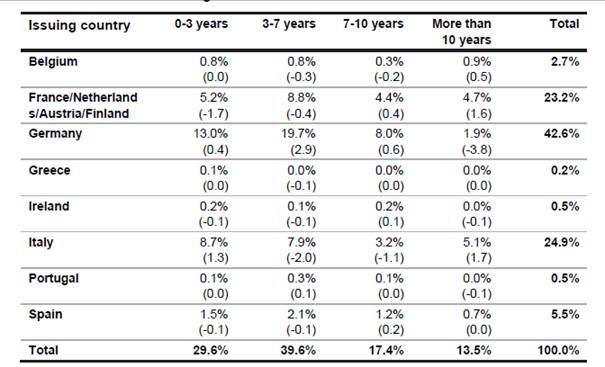
1863 As is apparent from Annex 16 to UniCredit’s application, from which the diagram set out in the preceding paragraph is extracted, such a transaction would lead to – in the words of that bank – ‘implied spreads’ being formed on the basis of an extrapolation from an estimated bid-ask spread (taken from the MTS data) applied to a purchase or sale price actually used by that bank.
1864 As the Commission noted in footnote 1449 to the contested decision, such a trade would entail data of a different nature (estimated bid-ask spread and actual purchase or selling prices) and also from different sources (MTS and UniCredit) being compared, whereas the forming of the bid-ask spread used in the contested decision and based solely on the BGN data makes it possible to compare data of the same nature and from the same source.
1865 Furthermore, in view of the information provided by UniCredit and the Commission, the reliability of the MTS data cannot be regarded as greater than that of the BGN data.
1866 Indeed, as the Commission noted in footnote 1449 to the contested decision and as UniCredit acknowledged in footnote 86 to the application, the MTS data ‘sometimes result in negative implied spreads’.
1867 The accounting for transactions which generated such ‘negative implied spreads’ would result in a reduction in that bank’s activity even though the related transactions are part of UniCredit’s actual activity. Moreover, simply excluding such transactions could not compensate for the weaknesses inherent in the use of the MTS data, since that would lead to the activities of the banks concerned not being taken fully into consideration.
1868 In the same footnote of its application, UniCredit also accepted that ‘negative implied spreads’ could be explained by ‘timing lags between when a trade actually occurred and when it [was] booked in [that bank’s] system, i.e. the MTS mid-price [was] not always exactly contemporaneous to when the trade actually occurred’.
1869 Given the volatility of the EGB market, in which, according to UniCredit, ‘prices change from second to second both upwards and downwards’, such timing lags do not guarantee the reliability of bid-ask spreads calculated using the MTS data, which can therefore be both undervalued and overvalued.
1870 Second, it is apparent from UniCredit’s reply to a question put by the Court that, for each of the 4 965 trades that took place between 9 September and 28 November 2011, the Commission should have matched those trades with the MTS data, as a result of which it would have been possible, by using coding software, to determine the mid-price of the EGB concerned at the exact time of each trade and, subsequently, the ‘implied actual spread’ of the prices of each of its 4 965 trades.
1871 In order to do so and in the light of the figures submitted to the Court by UniCredit, the Commission should have cross-checked two sets of raw data, the first of which related to the transactions carried out by that bank and contained 556 304 entries, and the second of which contained the MTS data, which consisted of 531 files each containing sometimes more than 40 million entries and the total weight of which was approximately 1.2 TB.
1872 However, the Commission cannot reasonably be required to process such a mass of data without being placed under a disproportionate administrative burden (see paragraph 1849 above). Moreover, even if the Commission was in a position to deal with those raw data, it is clear that they were not sent to it during the administrative procedure by UniCredit.
1873 UniCredit merely submitted a paper, setting out the conclusions but not attaching its body of data, an omission which it cannot subsequently attempt to remedy by criticising the Commission for not having asked it to send that body of data.
1874 Therefore, in the comparative exercise which the Commission had to carry out in order to determine the best available figures which the Commission was to use for the purpose of calculating the proxy, the Commission did not err in not acting on UniCredit’s invitation – which, moreover, is insufficiently documented – to use the MTS data.
1875 Furthermore, in so far as UBS claims that the Commission failed to take account of the specific features of the management of EGB portfolios when defining the methodology for calculating the adjustment factor or when using the BGN data (see paragraph 1773 above), it is clear that that bank has not established which alternative methodology – other than the use of the ‘net value traded’ or the ‘adjusted net value traded’, which the Commission rightly rejected (see paragraph 1800 above) – or what available data would have been better able to take account of those specific features.
1876 Similarly, that bank cannot call into question the methodology used by the Commission by confining itself to submitting that, in the part of the contested decision in which it responds to the arguments raised by the banks concerned during the administrative procedure, the Commission did not prove certain factual allegations, such as those by which it considered that ‘seeking liquidity, holding or offloading open positions in the market [was] embedded in the bid prices and ask prices that traders [would] submit to their clients’ or that, ‘if accepting a customer order would put his/her portfolio beyond his authorised risk limits, a trader [could] also refuse to quote’ (see recital 854 of the contested decision).
1877 In the light of all of the foregoing, the Commission was entitled to adopt the methodology used to calculate the adjustment factor for each of the banks concerned and, to that end, use the BGN data in respect of which it was entitled to take the view that, for the period of each bank’s participation in the infringement at issue, they constituted the ‘best available figures’.
1878 For the same reasons, UBS likewise cannot reasonably maintain that the methodology adopted by the Commission is imprecise and arbitrary.
1879 Accordingly, the second limb of UBS’s first plea and its fourth and fifth pleas, the second to fourth limbs of UniCredit’s seventh plea and the second to fourth limbs of Nomura’s sixth plea must be rejected as unfounded.
– The objections raised by UniCredit and Nomura alleging errors in the determination of the proxy specific to certain banks
1880 In their actions, UniCredit and Nomura objected to the methodology used by the Commission for the determination of the proxy and its general application, which were rejected in paragraphs 1762 to 1879 above.
1881 Those banks also raised objections more specifically relating to the determination of the proxy – calculated by multiplying the annualised notional amounts specific to each bank concerned by the adjustment factor that is also specific to each of them – which was applied to those banks and will be examined in paragraphs 1885 to 1960 below.
1882 Concerning the determination of the notional amounts (see recitals 816 to 819 of the contested decision), UniCredit claims that the Commission discriminated against it by taking into account, for UniCredit as for the other banks concerned, the notional amounts traded only on the secondary market.
1883 UniCredit and Nomura also criticise the Commission for having annualised the notional amounts applied to them, even though they participated in the infringement at issue for less than one year.
1884 As regards the determination of the adjustment factor applied to Nomura and, more specifically, the weighting of the 32 categories of representative EGBs specific to that bank and used to determine its final bid-ask spread (see recitals 825 to 830 of the contested decision), that bank criticises the Commission for not having used the exact weighting of those 32 categories of EGBs, even though Nomura had provided it to the Commission.
– UniCredit’s objection alleging breach of the principle of non-discrimination owing to the use, for UniCredit as for the other banks concerned, of the annualised notional amounts relating only to the secondary market
1885 In the first and fifth limbs of its seventh plea, UniCredit argues that, by basing the proxy for all the banks concerned only on ‘the value of sales on the notional amounts of EGB traded by each [bank concerned] on the secondary market during the relevant period of individual involvement, as this [was] the activity that all [the banks concerned] had in common and [because] it [avoided] the risk of the same revenue being counted twice as part of the fining calculation’ (see recital 816 of the contested decision), the Commission discriminated against it.
1886 In so far as the infringement at issue centred on the primary market in EGBs, UniCredit ‘did not participate in [the infringement at issue] with respect to primary trading’ and primary market trading was not taken into account with respect to any of the other banks concerned, the Commission should have used only the amounts traded on the primary market. By failing to do so, the Commission sanctioned UniCredit for the entirety of its participation in the infringement at issue, whereas the other banks concerned were sanctioned for only part of their participation in that infringement.
1887 In that regard, the Commission’s decision, in recital 816 of the contested decision, to use, as the basis for calculating the proxy for all of the banks concerned, the notional amounts traded only on the secondary market in EGBs does not, however, reveal any discriminatory treatment of UniCredit.
1888 First, UniCredit is wrong to claim that it did not participate in the infringement at issue with respect to the primary market or that that infringement centred on the primary market in EGBs.
1889 In recital 861 of the contested decision, the Commission did indeed state, for the purpose of determining the gravity factor for the infringement at issue applied to UniCredit, that that bank had not been active on the primary market.
1890 However, it cannot be inferred from that recital – which is unrelated to the determination of the proxy – that the Commission considered that UniCredit had not participated in the entirety of the single and continuous infringement found in the contested decision.
1891 On the contrary, it is clear from the operative part of the contested decision that UniCredit is found liable for the entirety of the infringement at issue and that that infringement relates to the entire EGB market, and not exclusively the primary market for EGBs.
1892 In addition, in recitals 45 to 50 of the contested decision, the Commission rightly emphasised the relationship between the primary and secondary market in EGBs and the fact that information relating to one was of interest to the other and vice versa (see paragraphs 465 to 486 and 597 to 614 above).
1893 Thus, even without being active on the primary market, UniCredit, through the information that it exchanged with the traders from the other banks concerned, contributed to the functioning of, and benefited from, the entirety of the infringement at issue, as the Commission observed in recital 479 of the contested decision.
1894 Second, the ground relied on by the Commission in recital 816 of the contested decision fully justifies its decision not to use the notional amounts traded by the banks concerned on the primary market in EGBs, or to include them in the notional amounts relied on in respect of the banks concerned, with the exception of UniCredit.
1895 Since the activity of the banks concerned operating on the primary market involves purchasing EGBs in order to sell them quickly on the secondary market (see recital 37 of the contested decision), the accounting of the notional amounts purchased from State issuers on the primary market was unnecessary – and even a source of bias – in order to determine the extent of the activity of those banks.
1896 Third, UniCredit’s specific situation was taken into account by the Commission at other stages of the calculation of the fine imposed on it (see, to that effect, judgment of 13 September 2013, Total Raffinage Marketing v Commission, T‑566/08, EU:T:2013:423, paragraph 454).
1897 In recitals 861 and 868 of the contested decision, the Commission thus applied to that bank a gravity factor and an additional amount both fixed at 17%, one percentage point lower than the rates applied to the other banks concerned.
1898 In the light of the foregoing, the first and fifth limbs of UniCredit’s seventh plea must be rejected as unfounded.
1899 Furthermore, in so far as UniCredit might argue, in the context of those first and fifth limbs, that its situation was not properly taken into consideration in the determination of the gravity factor and the additional amount imposed as a deterrent, those objections will be examined, respectively, in paragraphs 1976 to 2003 and 2004 to 2035 below.
– The objections raised by UniCredit and Nomura based on the annualisation of the notional amounts traded
1900 UniCredit, in its eighth plea and Nomura, in the fifth limb of its sixth plea taken together with the second limb of its seventh plea, submit that the Commission made errors of assessment or breached the principle of equal treatment and the principle that penalties must be specific to the offender and offence by annualising the notional amounts they traded with counterparties located in the EEA during their respective periods of participation in the infringement at issue, namely from 9 September to 28 November 2011 and from 18 January to 28 November 2011.
1901 That annualisation of the notional amounts traded by the banks concerned did have the effect of smoothing out the notional amounts traded by the banks which had participated in the infringement at issue for longer than one year, but also had the effect of artificially inflating the notional amounts used in respect of UniCredit and Nomura and, therefore, of overestimating their relative weight in that infringement.
1902 In that regard, UniCredit states that, during its period of participation in the infringement at issue, the volume of EGBs traded – particularly Italian EGBs which represented the bulk of its trades – was particularly high and the EGB market was subject to very high volatility, involving significantly higher bid-ask spreads than in normal market conditions. As a result, UniCredit received by far the worst treatment of the banks concerned, which is ‘manifestly unreasonable and unfit’. Consequently, the Commission should have compared data relating to trading activities over the same period for all the banks concerned, namely the last year of the infringement at issue, or the total duration of that infringement.
1903 For similar reasons, Nomura submits that the Commission should have used the notional amounts actually traded by that bank throughout 2011.
1904 At the outset, it should be noted that neither UniCredit nor Nomura criticise the Commission for not having applied, for the purpose of determining the notional amounts to be taken into consideration for the calculation of the proxy, point 13 of the Guidelines, under which the Commission normally uses the sales made by the undertaking during the last full business year of its participation in the infringement at issue.
1905 That decision on the part of the Commission was fully justified in the present case for the reasons set out in recital 819 of the contested decision and confirmed by the arguments put forward by UniCredit and Nomura, namely, first, that ‘the time period of individual involvement [was] different for most [of the banks concerned], and sometimes relatively short’, and, second, that ‘the bid-ask spread over the infringement period’ was highly volatile.
1906 Ultimately, UniCredit and Nomura criticise only the fact that, in order to take account of those circumstances and despite the fact that their respective periods of participation in the infringement at issue was less than a full year, the Commission annualised the notional amounts which they traded during the full calendar months of their periods of participation in the infringement at issue, namely, October 2011 and February to October 2011, respectively (Table 1 of Annex 2 to the contested decision), as the Commission did in relation to the other banks concerned.
1907 However, that decision – which forms part of defining the methodology for calculating the fine in respect of which, as already pointed out in paragraphs 1754 and 1777 above, the Commission has a broad discretion – does not reveal any manifest error of assessment or error of law on the part of the Commission.
1908 The circumstances referred to in paragraph 1905 above justify the Commission annualising the notional amounts traded by all the banks concerned, in accordance with the methodology set out in recital 819 of the contested decision pursuant to which it divided the total notional amounts traded by each bank concerned during the period of individual involvement in the cartel by the number of months of participation and subsequently multiplied this monthly average by 12.
1909 First, annualising the notional amounts traded makes it possible to smooth out the significant annual variations that the EGB market experienced throughout the infringement at issue and to which the banks concerned that participated in that infringement were subject, and at the same time takes into account the full activity of those banks, including that of 2011, which both the Commission as well as UniCredit and Nomura consider to be a year marked by a high volatility on the EGB market linked to the sovereign debt crisis.
1910 Second, in so far as the annualisation of the notional amounts traded was applied to all the banks concerned, it reflects the relative weight of each bank in the infringement at issue, as required by the case-law applicable to the value of sales (see, to that effect, judgment of 12 November 2014, Guardian Industries and Guardian Europe v Commission, C‑580/12 P, EU:C:2014:2363, paragraph 63) and which applies equally in relation to the proxy.
1911 Since the annualised notional amounts of each bank concerned constitute the first of the two elements taken into consideration in calculating the proxy specific to each of those banks, they enable the relationship existing between the proxies applied to each bank concerned and, ultimately, the fines imposed on them, to be maintained.
1912 Those two conclusions are not called into question by the arguments put forward by UniCredit and Nomura.
1913 First, UniCredit and Nomura cannot reasonably maintain that annualising their periods of participation in the infringement at issue of one and nine full calendar months, respectively, led the Commission to inflate artificially, and therefore wrongly, the notional amounts used in respect of those banks.
1914 While it is true that that annualisation entailed extrapolating to one year the activities of UniCredit and Nomura during their one and nine full calendar months of participation in the infringement at issue, it was made necessary by the principles governing the calculation of fines under the Guidelines and at the same time led the Commission to apply a value that was directly proportional to the actual activity of those banks during their respective periods of participation in the infringement at issue.
1915 First, annualising the notional amounts traded by UniCredit and Nomura was made necessary by the principles governing the calculation of fines under the Guidelines, since the Guidelines require a value of sales or a proxy to be determined on an annual basis, which those banks do not dispute, particularly in view of the alternative calculation methods they propose.
1916 Consequently, the Commission could not use only the notional amounts traded by those two banks during their respective periods of participation in the infringement at issue, both of which were less than one year.
1917 Second, the annualisation of the notional amounts traded by UniCredit and Nomura meant that the Commission used a value strictly proportional to the actual activity of those banks during their respective periods of participation in the infringement at issue, since it is the result of a simple division of the notional amounts traded by those two banks during their respective periods of infringement by the number of full calendar months of their participation in the infringement at issue (one full calendar month for UniCredit and nine full calendar months for Nomura), subsequently multiplied by 12, to provide an annual basis.
1918 As a result and due to the fact that the notional amounts were annualised for all the banks concerned, the Commission also ensured that the relative weight of each bank in the infringement at issue and the extent of their respective involvement were respected.
1919 While the annualisation of the notional amounts of UniCredit and Nomura might have led the Commission to apply higher amounts to those banks than the notional amounts they actually traded in 2011, that circumstance does not call into question the fact that the annualised notional amounts used by the Commission are strictly proportional to the notional amounts actually traded by those banks during their respective periods of participation in the infringement at issue.
1920 That circumstance is simply the consequence of the fact that, during their respective periods of participation in the infringement at issue, the EGB market was more volatile than in the months of 2011 when they were not participating in it.
1921 Similarly, the fact that the annualised notional amounts used for UniCredit and Nomura are, according to those banks, significantly higher compared to those used for the other banks which participated in the infringement at issue for longer or had larger market shares is merely a consequence of the fact that UniCredit and Nomura participated in the infringement at issue only during 2011, namely during a period when the EGB market was most volatile and, therefore, during a period when trades in EGBs and bid-ask spreads for EGBs were proportionally highest.
1922 Second, UniCredit and Nomura cannot reasonably maintain that, in order to observe the principle of equal treatment and the principle that penalties must be specific to the offender and the offence, the Commission should have applied, as regards UniCredit, the notional amounts of the last year of the infringement at issue or of the entire period of the infringement at issue and, as regards Nomura, the notional amounts traded during the whole of 2011.
1923 First, it follows from the principles governing the Guidelines, applicable in the present case, and, in particular, from points 5 and 6 thereof, that, like the value of sales, the proxy is to be calculated by taking into consideration transactions to which the infringement relates.
1924 This means that the Commission cannot take into account activities carried out by the undertaking in question which do not come within the scope of the alleged cartel (see, to that effect, judgments of 7 September 2016, Pilkington Group and Others v Commission, C‑101/15 P, EU:C:2016:631, paragraph 19 and the case-law cited, and of 25 March 2021, Lundbeck v Commission, C‑591/16 P, EU:C:2021:243, paragraph 187 and the case-law cited).
1925 Taking into account the periods referred to by UniCredit and Nomura might certainly be more favourable to those banks, but it would mean using transactions that took place outside their respective periods of participation in the infringement at issue as a basis for calculating the proxy applied to those banks.
1926 Second, it is settled case-law that, to the extent to which reliance is to be placed on the activities of the undertakings involved in the same infringement for the purpose of determining the proportions between the fines to be imposed, the period to be taken into consideration must be ascertained in such a way that the resulting turnovers are as comparable as possible and, consequently, an individual undertaking cannot compel the Commission to rely, in its case, upon a period different from that used for the other undertakings, unless it proves that, for reasons peculiar to it, the activity which it carried out during the latter period does not reflect its true size and economic power or the scale of the infringement which it committed (see, to that effect, judgment of 29 September 2021, Tokin v Commission, T‑343/18, EU:T:2021:636, paragraph 100 and the case-law cited).
1927 In the present case, UniCredit and Nomura have not furnished such proof.
1928 On the contrary, it has been found in paragraphs 1915 to 1918 above that the Commission used annualised notional amounts with respect to all the banks concerned and that the notional amounts used for UniCredit and Nomura were strictly proportional to the notional amounts traded during the one and nine full calendar months of their respective periods of participation in the infringement at issue and reflected the relative extent of their involvement in it.
1929 In the light of the foregoing, UniCredit’s eighth plea and the fifth limb of Nomura’s sixth plea and the second limb of its seventh plea must be rejected as unfounded.
– Nomura’s objection based on the weighting of the 32 categories of EGBs traded by Nomura
1930 In the second argument in the fifth limb of its sixth plea, Nomura claims that the Commission made an error of assessment in refusing, for the purpose of determining the weighting of the 32 categories of EGBs used to calculate the adjustment factor, to use the exact data which Nomura provided during the administrative procedure.
1931 As already recalled in paragraphs 1716 to 1724 above, the Commission determined an adjustment factor specific to each bank concerned by using half of its final bid-ask spread, calculated by using the simple average of its daily bid-ask spreads, which themselves were calculated, for each working day of the participation of each bank concerned in the infringement at issue, by using the weighted average of the daily bid-ask spread level of 32 categories of representative EGBs to which specific weights were assigned for each bank.
1932 In order to determine the weighting of each of those 32 categories of representative EGBs in the activities of each bank concerned throughout its period of participation in the infringement at issue, the Commission requested, during the administrative procedure, that each bank provide it with two sets of data, namely, first, the actual volume of EGBs traded per issuing State (regardless of maturity) and, second, the actual volume of EGBs traded per maturity range (regardless of issuer).
1933 By crossing those two sets of data, the Commission determined a weighting of the 32 categories of EGBs specific to each bank concerned.
1934 It thus applied the following weighting with regard to Nomura (Annex 2 to the contested decision, Table 2):
1935 During the administrative procedure, Nomura sent the Commission the two sets of data referred to in paragraph 1932 above so as to enable the Commission to calculate the weighting of each of the 32 categories of representative EGBs with regard to Nomura. It was also the only bank to send the Commission, unprompted, the exact volumes that it had traded throughout its period of participation in the infringement at issue for each of the 32 categories of representative EGBs, thus providing the exact weighting of those 32 categories of EGBs.
1936 Those data – in respect of which the Commission does not dispute the completeness and reliability but only that they constitute the best available figures – reveal the following differences:
1937 Notwithstanding the fact that Nomura sent the Commission its exact data, the Commission used, in the contested decision, the estimated data referred to in paragraph 1934 above, on the ground that the crossing, for each bank concerned, of the actual volume of EGBs traded per issuing State and the actual volume of EGBs traded per maturity had to be considered the best approach based on the data provided by the banks (see recitals 848 and 849 of the contested decision).
1938 In recital 850 of the contested decision, the Commission also emphasised the need to ‘adopt an approach that was appropriate for all [banks concerned] taking account of the information in its possession’ and the fact that, ‘absent objective differences in the … respective situations [of the banks concerned], [it could not] apply different methodologies for different [banks concerned]’.
1939 In its defence and in its written reply to a question put by the Court, first, the Commission argued that using the exact data provided by Nomura would have led it to breach the principle of equal treatment between the different banks penalised in the contested decision. Secondly, it maintains that, even if it could have adopted a more granular approach in relation to that bank, its calculation of the relative weights still accurately reflected the breakdown of Nomura’s trading activity and was thus a valid methodology for the period of that bank’s infringement.
1940 It is therefore necessary to examine whether the Commission was entitled to refuse to take into account the exact data provided by Nomura.
1941 In that regard, it has already been pointed out in paragraph 1783 above that, even when the Commission decides to depart from the methodology set out in point 13 of the Guidelines, it cannot depart from the guiding principles or underlying logic of those guidelines.
1942 In particular, it must ensure that the best available figures are taken into consideration and that partial figures are used only where the figures made available by an undertaking are incomplete or not reliable.
1943 Those requirements apply all the more rigorously where the methodology used by the Commission has led it to apply an adjustment factor higher than 99% to notional amounts of several hundred billion euros (see, by analogy, judgment of 24 September 2019, HSBC Holdings and Others v Commission, T‑105/17, EU:T:2019:675, paragraph 328).
1944 In the present case, the Commission does not dispute that the data provided by Nomura was complete and reliable and therefore accurately represented that bank’s trading activity for the period of its participation in the infringement at issue.
1945 It is also apparent from the table referred to in paragraph 1936 above that the weighting of the 32 categories of representative EGBs applied by the Commission to Nomura differs significantly, for certain of those categories, from that bank’s actual trading activity.
1946 Thus, as regards German EGBs with a maturity of 3 to 7 years, there is a difference of 2.9 percentage points, the Commission having found that those EGBs represented 16.8% of all the notional amounts traded by Nomura (approximately EUR 74.9 billion), whereas they actually represented 19.7% (approximately EUR 87.9 billion).
1947 Similarly, as regards Italian EGBs with a maturity of 3 to 7 years, there is a difference of 2 percentage points, the Commission having found that those EGBs represented 9.9% of all the notional amounts traded by Nomura (approximately EUR 44.2 billion), whereas they actually represented 7.9% (approximately EUR 35.2 billion).
1948 It follows that, at least for certain categories of representative EGBs constituting a significant proportion of Nomura’s trading activity (namely more than 27%), the weighting applied by the Commission to that bank differed significantly from that calculated on the basis of the trading activity actually carried out by that bank.
1949 Consequently, in view of the fact that Nomura provided complete and reliable figures relating to the distribution of its trading activity between the 32 categories of representative EGBs chosen by the Commission, the weighting applied by the Commission, in Table 2 of Annex 2 to the contested decision, could not constitute the ‘best available figures’ for the purpose of calculating the proxy.
1950 That conclusion is confirmed by the fact that the Commission’s decision not to use the weighting of the 32 categories of representative EGBs as derived from the data provided by Nomura during the administrative procedure – and which accurately represented that bank’s trading activity for the period of its participation in the infringement at issue – means that the fine imposed on that bank differs by more than EUR 3.927 million, being approximately 3% of the amount of the fine.
1951 According to the calculations made by the Commission in response to a question put by the Court, the taking into consideration of Nomura’s actual activity for the purpose of determining the weighting of the 32 categories of representative EGBs used in respect of that bank entails a reduction in the proxy applied to that bank from EUR 392 646 351 to EUR 380 747 977 and thus a reduction in the fine imposed on it from EUR 129 573 000 to EUR 125 646 000.
1952 Accordingly, the Commission cannot reasonably maintain that the weighting of the 32 categories of representative EGBs used in the contested decision in relation to Nomura ‘still accurately reflect[ed] the breakdown of [that bank’s] trades’.
1953 Moreover, the Commission’s use of the data provided by Nomura would not have compromised the methodology developed by the Commission to determine the proxy.
1954 Unlike, for example, the method for calculating the notional amounts traded by each bank concerned, the method for calculating the daily bid-ask spreads and the final bid-ask spread, or the choice of the 32 categories of representative EGBs, which apply to all the banks penalised and form the basis of the methodology adopted by the Commission, the use of Nomura’s data relating to the weighting of those 32 categories of EGBs in its trading activity is merely one way of implementing that methodology, which does not alter its substance, but is only capable of increasing – at that bank’s reasoned request – its accuracy.
1955 Moreover, it may be observed that the Commission itself acknowledged that it ‘could have adopted a more granular approach’, thus showing that the use of the exact data provided by Nomura did not compromise the methodology adopted by the Commission.
1956 Lastly, the Commission’s use of the exact data provided by Nomura would not have breached the principle of equal treatment.
1957 During the administrative procedure, Nomura was the only bank to provide the Commission, unprompted and voluntarily, with precise data relating to the weighting of the 32 categories of representative EGBs chosen by the Commission, distinguishing it from all the other banks.
1958 For that reason, the Commission was not required, under the principle of equal treatment, to apply a weighting to Nomura that was simply estimated, when it had an exact weighting provided by Nomura.
1959 Therefore, the Commission was wrong to refuse to make use of the exact data provided by Nomura during the administrative procedure.
1960 In the light of the foregoing, the second argument in the fifth limb of Nomura’s sixth plea must be upheld.
(ii) The pleas alleging errors in the determination of the gravity factor applied to UniCredit and Nomura
1961 After determining the proxy applied to each of the banks concerned, the Commission stated, in recitals 859 to 863 of the contested decision, that the infringement at issue required it to set a gravity factor of 18% of that proxy for the banks concerned (points 20 and 23 of the Guidelines).
1962 That rate was justified by the fact that the conduct in question ‘amounted to price-fixing arrangements, collusive exchanges of information, market sharing and customer allocation’, which were ‘among the most harmful restrictions of competition’. The Commission also stated that they permeated the whole EGB industry (that is to say, the primary market as well as the secondary market), covered the entire EEA and related to products used for raising public funding at the time of a serious financial crisis, when financial institutions, including some involved in the infringement at issue, had to be rescued.
1963 However, given that the UniCredit trader was not active on the primary market for EBGs, the Commission reduced the gravity factor applied to that bank to 17% (see recital 861 of the contested decision).
1964 In their respective ninth pleas, UniCredit and Nomura claim that the Commission made various errors in the determination of the gravity factor applied to them.
– The first and second limbs of Nomura’s ninth plea, alleging errors of assessment in setting the gravity factor for the infringement at issue at 18%
1965 In the first and second limbs of its ninth plea, Nomura argues that the Commission made errors of assessment in setting the gravity factor for the infringement at issue at 18% of the proxy.
1966 According to Nomura, the Commission was wrong to take the view, in recitals 859 and 863 of the contested decision, that the conduct at issue amounted to price-fixing arrangements, market sharing and customer allocation, when that characterisation had not previously been adopted in that decision and even though that conduct amounted to information exchange only capable of affecting price.
1967 Moreover, in the light of the Commission’s previous decision-making practice, the conduct at issue should be regarded as serious and not as ‘the most harmful’, therefore justifying a gravity factor of 15% of the proxy. In that regard, Nomura also argues that the conduct at issue did not involve the manipulation of a financial benchmark and was carried out by banks with a low market share, which makes it highly unlikely that the limited number of discussions at issue could have had any material impact on the EGB sector or on public funding.
1968 At the outset, it should be noted that Nomura’s objection referred to in paragraph 1966 above is based on a misreading of the contested decision, which expressly states that the conduct at issue amounted to price fixing, market sharing and customer allocation, in particular in recitals 499, 532, 535 and 568.
1969 As to the remainder, it is settled case-law and apparent from point 23 of the Guidelines that horizontal cartels leading to price fixing or customer allocation reveal, by their very nature, a particular degree of harm to competition (see, to that effect, judgments of 30 June 1966, LTM, 56/65, EU:C:1966:38, page 359; of 20 November 2008, Beef Industry Development Society and Barry Brothers, C‑209/07, EU:C:2008:643, paragraphs 17 and 33; of 11 September 2014, CB v Commission, C‑67/13 P, EU:C:2014:2204, paragraph 51; of 16 July 2015, ING Pensii, C‑172/14, EU:C:2015:484, paragraph 32; and of 23 January 2018, F. Hoffmann-La Roche and Others, C‑179/16, EU:C:2018:25, paragraph 78; of 30 January 2020, Generics (UK) and Others, C‑307/18, EU:C:2020:52, paragraph 67; and of 21 December 2023, European Superleague Company, C‑333/21, EU:C:2023:1011, paragraphs 162 and 163).
1970 Accordingly, the finding that the infringement at issue took the form of such conduct alone enabled the Commission to consider that that infringement ‘was among the most harmful restrictions of competition’. That justified a gravity factor being applied to that conduct at the upper end of the range provided for in point 21 of the Guidelines, set at 18%.
1971 The fact, also noted by the Commission, that the conduct at issue covered the entire EEA and related to products used for raising public funding at the time of a serious financial crisis justified the choice of that gravity factor all the more.
1972 Accordingly, the Commission did not make an error of assessment in applying a gravity factor for the infringement at issue set at 18% of the proxy.
1973 That conclusion cannot be called into question by Nomura’s argument based on the Commission’s practice in previous decisions, which, in any event and as stated in paragraph 1618 above, does not serve as a legal framework for the fines imposed in competition matters.
1974 Nor can it be called into question by the argument that the conduct at issue had no ‘material impact’ due to the low market share of the banks concerned, since, as pointed out in paragraph 1970 above, the gravity factor applied by the Commission is, in any event, fully justified by the factors referred to in recital 859 of the contested decision (see, by analogy, judgment of 16 July 2020, Nexans France and Nexans v Commission, C‑606/18 P, EU:C:2020:571, paragraph 105).
1975 In the light of the foregoing, the first and second limb of Nomura’s ninth plea must be rejected as unfounded in so far as they object to the gravity factor for the infringement at issue being set at 18%.
– UniCredit’s ninth plea and the first, second and third limbs of Nomura’s ninth plea, alleging errors of assessment and breaches of the principle that penalties must be specific to the offender and the offence, the principle of proportionality and the principle of equal treatment, in the setting of the gravity factor applied to them
1976 UniCredit, in its ninth plea, and Nomura, in the second and third limbs of its ninth plea, claim that the Commission failed to take sufficient account of their limited participation in the infringement at issue in setting the gravity factor applied to them.
1977 UniCredit submits that the Commission breached the principle that the penalty must be specific to the offender and the offence and the principle of proportionality by not reducing the gravity factor applied to it by more than one percentage point, even though it did not participate in all aspects of the infringement at issue and played a minor role in the aspects in which it did participate.
1978 Nomura argues that the Commission made errors of assessment by not taking sufficient account of the fact that it participated in only 34 discussions relating to only 9 of the 17 Member States of the then euro area, it was a primary dealer for only 10 of those 17 Member States, its market share in the primary market for EGBs was low and the conduct at issue did not affect its performance during auctions. The Commission also breached the principle of equal treatment inasmuch as Nomura did not benefit from a reduction of its gravity factor by one percentage point as UniCredit did, even though its involvement in the infringement at issue was comparable to that of UniCredit.
1979 As UniCredit has observed, it is settled case-law that, where an infringement has been committed by several undertakings, the relative gravity of the participation of each undertaking must be examined for the purpose of determining the amount of the fines to be imposed on them (see, to that effect, judgment of 8 July 1999, Hercules Chemicals v Commission, C‑51/92 P, EU:C:1999:357, paragraph 110 and the case-law cited).
1980 It is also apparent from the Guidelines, and from the case-law, that a distinction must be drawn between, on the one hand, the assessment of the objective gravity of the infringement concerned, carried out by way of the gravity factor provided for in points 20 to 23 of the Guidelines, and, on the other hand, the assessment of the relative gravity of the participation in that infringement of the undertaking on which the penalty is to be imposed, carried out by way of the adjustments to the basic amount provided for in points 27 to 31 of those guidelines (see, to that effect, judgment of 15 July 2015, voestalpine and voestalpine Wire Rod Austria v Commission, T‑418/10, EU:T:2015:516, paragraph 414 and the case-law cited).
1981 That distinction does not rule out the possibility that, as in the present case, the Commission may apply a lower gravity factor to an undertaking participating in a cartel than to other undertakings, in particular where, in the context of a single and continuous infringement, that undertaking had no role in the implementation of certain parts of that infringement (see, to that effect, judgment of 15 July 2015, voestalpine and voestalpine Wire Rod Austria v Commission, T‑418/10, EU:T:2015:516, paragraph 415).
1982 In the present case, it has been found in paragraphs 1969 to 1974 above that the Commission was entitled to set the gravity factor for the infringement at issue at 18% of the proxy.
1983 Accordingly, it is necessary to examine whether, in the light of the evidence put forward by UniCredit and Nomura, the Commission should have applied a lower gravity factor than that applied to them in the contested decision.
1984 As regards UniCredit in the first place, it must be borne in mind that the gravity factor applied to UniCredit was reduced by one percentage point as compared to that applied to the other banks so as to take account of the fact that its trader was not active on the primary market.
1985 That reduction – which led to a gravity factor not of 18% but of 17% of its proxy being applied – constitutes a fair taking into account of UniCredit’s situation.
1986 While it is true that, not being a primary dealer, UniCredit was not able to benefit directly from the anticompetitive conduct concerning the primary market, the fact remains that not only was its trader involved in anticompetitive conduct concerning the secondary market coming within Category 4, but that trader was also connected to the CODS & CHIPS chatroom on which he actively participated in discussions concerning both the secondary market and the primary market.
1987 As a result, UniCredit contributed to the functioning of the infringement at issue as a whole and, given the interest in the disclosure of commercially sensitive information relating to the primary market for secondary market trading (see recital 50 of the contested decision), confirmed by ESMA (see paragraphs 566 and 601 above), it was able to benefit from the information exchanged for its activity on the secondary market.
1988 Moreover, during its period of participation in the infringement at issue, UniCredit participated in all of the discussions that took place between the banks concerned and were legitimately relied on by the Commission. Therefore, the limited number of discussions relied on against it is merely the direct consequence of the reduced duration of its participation in the infringement at issue, which was reflected in the duration multiplier (see recitals 864 to 866 of the contested decision). That is also the case in relation to its lack of participation in the DBAC chatroom, which ceased being used by the traders of the banks concerned prior to the beginning of UniCredit’s participation in the infringement at issue.
1989 Lastly, the facts alleged by UniCredit to the effect that it was not aware of its trader’s conduct or that it promptly let him go are irrelevant, since, as found in paragraph 305 above, that bank could be held liable for the conduct of its employee and his dismissal was not, in any event, on grounds of his participation in the infringement at issue, but, as UniCredit stated, was because of the ‘material and unjustifiable losses’ made by him.
1990 As regards, in the second place, Nomura, a gravity factor of 18% of its proxy was applied, a rate which also constitutes a fair taking into account of its situation.
1991 First, the Commission cannot be accused of any error of assessment of Nomura’s situation in that regard.
1992 During its period of participation in the infringement at issue, Nomura participated in all of the discussions that took place between the banks concerned and that were legitimately relied on by the Commission. Therefore, the number of discussions relied on against it – which Nomura regards as low, but which nevertheless amounts to 31 – is merely the direct consequence of the duration of its participation in the infringement at issue, which was reflected in the duration multiplier (see recitals 864 to 866 of the contested decision).
1993 Similarly, the fact that Nomura was active only on the primary market for certain EGBs, or was a small player on that market, cannot change the gravity factor applied to it, since the Commission rightly considered that the infringement at issue covered all EGBs and that the lesser activity alleged by that bank was taken into consideration in the determination of its proxy, which reflects the economic importance of its activity to which the infringement at issue directly or indirectly relates.
1994 Lastly, as regards the fact that Nomura’s participation in the infringement at issue did not, according to Nomura, affect its performance during auctions, it is clear that the information exchanged in relation to the primary market was also relevant to its trading activities on the secondary market (see recital 50 of the contested decision, confirmed by ESMA, as is apparent from paragraph 566 above), which was not taken into account in the economic analysis submitted by that bank in support of its claims.
1995 Second, Nomura cannot meaningfully rely on a breach of the principle of equal treatment on account of the fact that a higher gravity factor was applied to it than to UniCredit.
1996 Contrary to that bank’s submission, its involvement in the infringement at issue is not comparable to that of UniCredit and therefore did not justify a gravity factor of 17% being applied to it.
1997 While, like UniCredit, it participated in all of the discussions that took place during its period of participation in the infringement at issue, Nomura was nevertheless active on both the primary market and the secondary market for EGBs and was therefore in a position to benefit directly and fully from the information obtained in the discussions in which it participated, unlike UniCredit.
1998 The fact that, according to Nomura, one of its traders was not authorised to trade prior to 4 March 2011 does not call that conclusion into question.
1999 First, as the Commission stated in recital 768 of the contested decision, the fact that the Nomura trader obtained renewed access to the CODS & CHIPS chatroom establishes the interest of the traders from the other banks in reinstating him in their discussions and enabled that trader to obtain access to the anticompetitive discussions which took place prior to the renewal of his authorisation to trade and to participate actively in those discussions.
2000 Secondly, unlike in relation to UniCredit, the Commission has not indicated that it was unable to establish that the Nomura trader had passed on the information obtained to colleagues active on either the primary or secondary market, contrary to what that bank suggests in paragraph 229.2 of its application.
2001 Furthermore, unless otherwise substantiated, Nomura’s mere assertion that ‘insofar as [it] has been able to determine, [its trader] did not in fact execute any trades of EGB until 9 March 2011’ cannot be taken into consideration.
2002 Accordingly, the gravity factor applied to Nomura does not reveal any error of assessment or breach of the principle of equal treatment on the part of the Commission.
2003 In the light of the foregoing, UniCredit’s ninth plea and the first and second limbs of Nomura’s ninth plea, in so far as they concern the failure to take into account the gravity of that bank’s participation in the infringement at issue, and the third limb of that plea, must be rejected as unfounded.
(iii) The first limb of UniCredit’s tenth plea, alleging breach of the principle that the penalty must be specific to the offender and the offence and of the principle of proportionality in the determination of the rate of the additional amount imposed as a deterrent
2004 In the first limb of its tenth plea, put forward in the alternative, UniCredit claims that the Commission breached the principle that penalties must be specific to the offender and the offence and the principle of proportionality, by applying, for the purpose of determining the basic amount of its fine, a rate of 17% of the proxy for the purposes of the additional amount, in accordance with point 25 of the Guidelines.
2005 Since the duration multiplier (point 24 of the Guidelines) does not apply in the calculation of the additional amount (point 25 of the Guidelines), that decision resulted in the Commission applying an additional amount of EUR 59 522 445 to UniCredit, representing approximately 600% of the variable component of the basic amount of that bank’s fine, referred to in recital 867 of the contested decision, whereas it represents approximately 120% of that of Nomura, approximately 63% of that of Portigon and approximately 20% of those of RBS and UBS. However, a significantly lower percentage should have been used for UniCredit in view of its lesser involvement in the infringement at issue.
2006 In the alternative, and for the same reasons, UniCredit submits that the Commission erred in not making use of point 37 of the Guidelines in order significantly to adjust the additional amount.
2007 In the further alternative and again for the same reasons, UniCredit submits that the Commission should have set the additional amount at the minimum provided for by point 25 of the Guidelines, namely 15%.
2008 As regards, in the first place, the principal line of argument raised by UniCredit, it should be borne in mind, as regards its claim alleging breach of the principle that penalties must be specific to the offender and the offence, that, in the context of calculating the amount of fines imposed under Article 23(2) of Regulation No 1/2003, differentiated treatment of the undertakings concerned is inherent in the exercise of the Commission’s powers under that provision. In exercising its discretion, the Commission is required to fit the penalty to the individual conduct and specific characteristics of the undertakings concerned in order to ensure that, in each case, the EU competition rules are fully effective (see judgment of 7 June 2007, Britannia Alloys & Chemicals v Commission, C‑76/06 P, EU:C:2007:326, paragraph 44 and the case-law cited).
2009 Furthermore, in order to comply with the principle that penalties must be specific to the offender and the offence, it is sufficient that the final amount of the fine reflects the differences in the situation of the various participants, without there being any need for the Commission to differentiate the treatment of the participants at each stage of the calculation of the amount of the fine (judgment of 13 September 2013, Total Raffinage Marketing v Commission, T‑566/08, EU:T:2013:423, paragraph 454).
2010 It follows that the mere fact that the Commission adopts, with regard to one of the banks concerned, an additional amount which, in relative value, constitutes a significantly higher proportion of the variable amount of the basic amount of the fine in question than for the other banks concerned cannot, in itself, establish a breach of the principle that the penalty must be specific to the offender and the offence with regard to UniCredit.
2011 Moreover, in the present case, such a breach is all the less proven since, first, point 25 of the Guidelines provides that the additional amount, which reflects the characteristics of the practices of all the participants and not the individual situation of each of them (see, to that effect, judgment of 11 July 2019, Silver Plastics and Johannes Reifenhäuser v Commission, T‑582/15, not published, EU:T:2019:497, paragraph 338 and the case-law cited), is calculated ‘irrespective of the duration of the undertaking’s participation in the infringement’, in order, in particular, to deter undertakings from infringing competition law, even if only for a short period (judgment of 7 November 2019, Campine and Campine Recycling v Commission, T‑240/17, not published, EU:T:2019:778, paragraph 346).
2012 Consequently, and in the absence of any challenge by UniCredit to the validity of point 25 of the Guidelines which the Commission expressly applied, there was no need for the Commission to take into account, in that regard, the duration of UniCredit’s participation in the infringement at issue.
2013 Second, notwithstanding the case-law referred to in paragraph 2011 above, it is clear that, in recital 868 of the contested decision, the Commission applied a specific additional amount of 17% of the proxy to UniCredit and not 18% as for all the other banks concerned, in order to take account of the fact that ‘[UniCredit’s] trader was only active on the secondary market’.
2014 Consequently, UniCredit is wrong to claim that the Commission failed to take account of UniCredit’s specific situation and therefore breached the principle that penalties must be specific to the offender and the offence.
2015 That bank is also wrong to rely on a breach of the principle of proportionality by reason of the specific rate of 17% of the proxy applied to it as an additional amount.
2016 First, in the light of the wording of point 25 of the Guidelines, none of the factors outlined by that bank supports the conclusion that the Commission should have refrained from imposing an additional amount on UniCredit.
2017 As the Commission correctly observed in recital 871 of the contested decision, the infringement at issue took the form of agreements and concerted practices between competitors and therefore of a cartel, whose gravity and harmfulness to competition justify the imposition of a penalty intended to deter other undertakings from engaging in the same or similar conduct.
2018 In the latter regard, contrary to UniCredit’s contention, the Commission was entitled to take into account, in recital 872 of the contested decision, the fact that the financial sector had already been the scene of similar anticompetitive conduct, even if that bank had not taken part in it.
2019 The pursuit of a deterrent effect does not solely concern the undertakings specifically named by the decision imposing fines but also seeks to encourage undertakings of similar size and resources to refrain from participating in similar infringements of the competition rules (see judgment of 5 December 2013, Caffaro v Commission, C‑447/11 P, EU:C:2013:797, paragraph 37; see also, to that effect, judgment of 17 December 2014, Pilkington Group and Others v Commission, T‑72/09, not published, EU:T:2014:1094, paragraph 302 and the case-law cited).
2020 Second, UniCredit cannot reasonably claim that the additional amount of 17% of the proxy applied by the Commission exceeds what is appropriate and should have been set at the lower end of the range of 15% to 25% of the value of sales referred to in point 25 of the Guidelines.
2021 An additional amount of 17% of the proxy could, correctly, be considered by the Commission to be commensurate with, first, the gravity and inherent harmfulness to competition of the conduct at issue and the need to deter its repetition in a sector where previous similar infringements had recently been found and, second, the fact that UniCredit was active only on one of the two markets concerned by the infringement at issue.
2022 Similarly, the specific characteristics of UniCredit’s participation in the infringement at issue could not justify the Commission applying an additional amount set at less than 17% of the proxy.
2023 First of all, a percentage of 17% of the proxy is already at the lower end of the range referred to in point 25 of the Guidelines.
2024 Next, the fact that UniCredit was active only on the secondary market or participated in the infringement at issue only for a short period could not justify a reduction of more than one percentage point compared to the additional amount imposed on the other banks concerned.
2025 Contrary to UniCredit’s contention, the discussions in which it participated were just as serious or harmful to competition as those which took place before the beginning of its participation in the infringement at issue and justify the Commission finding it necessary to deter the banks concerned as well as other financial market participants from repeating the infringement.
2026 Accordingly, applying a percentage of less than 17% to UniCredit would have raised questions as to the Commission’s compliance with its duty to make a consistent and objectively justified assessment of the gravity of the infringement at issue in which UniCredit and the other banks concerned participated, a duty which also contributes to compliance with the principle of proportionality (see, to that effect, judgment of 29 September 2021, Tokin v Commission, T‑343/18, EU:T:2021:636, paragraph 63 and the case-law cited).
2027 Lastly, the fact that the rate of 17% applied to UniCredit results in an additional amount representing approximately 600% of the variable basic amount of the fine imposed on it, or more than 85% of the final amount of that fine, is irrelevant, since that rate is the correct application of the methodology set out by the Commission in point 25 of the Guidelines, read in conjunction with Section A thereof, the validity of which UniCredit does not challenge.
2028 Furthermore, if UniCredit intended to criticise the Commission not for the rate of the additional amount applied to it, but for the fact that that rate was applied to an annualised proxy even though it had participated in the infringement at issue for only two months, it was for UniCredit to state that expressly in its application and to challenge the validity of point 25 of the Guidelines, which makes provision to that effect.
2029 However, it is clear that UniCredit has not substantiated its criticism other than by making comparisons with the additional amounts applied to the other banks concerned and expressed as percentages of the variable basic amount.
2030 Consequently, and without prejudice to the assessment to be made by the Court in the exercise of its unlimited jurisdiction, the Commission did not breach the principle that penalties must be specific to the offender and the offence or the principle of proportionality in implementing its Guidelines by imposing on UniCredit an additional amount of 17% of the proxy as a deterrent.
2031 As regards, in the second place, UniCredit’s complaints put forward in the alternative, it must be observed, first, that the Commission cannot be required to adjust the amount of fines under point 37 of the Guidelines systematically. Thus, point 37 does not apply when it is not necessary to depart from the general methodology provided for by those guidelines and is applied only when it has been found that the general methodology is not suitable and a departure from it must be made, in so far as the particularities of a given case so require (see, to that effect, judgment of 18 October 2023, Clairant and Clairant International v Commission, T‑590/20, EU:T:2023:650, paragraph 158).
2032 In the present case, as is apparent from recitals 808 and 809 of the contested decision, the Commission did not consider it necessary to depart from the methodology laid down in the Guidelines, except as regards, first, the determination of the proxy and, second – which UniCredit does not point out – as regards the calculation of the duration multiplier applied to that bank, which was set at 0.17, whereas point 24 of the Guidelines provides that ‘periods of less than six months will be counted as half a year’, which should have led the Commission to use a multiplier of 0.5.
2033 In addition, it follows from paragraphs 2008 to 2030 above that UniCredit’s arguments alleging breach of the principle that penalties must be specific to the offender and the offence and the principle of proportionality in the determination of the additional amount provided for in point 25 of the Guidelines have been rejected, thus demonstrating that the particularities of the case did not justify departing from that point.
2034 Accordingly, UniCredit is not justified in criticising the Commission for not having substantially reduced the rate of the additional amount under either point 37 or, in the alternative, point 25 of the Guidelines.
2035 In the light of the foregoing, the first limb of UniCredit’s tenth plea must be rejected.
(3) The second limb of UniCredit’s tenth plea and Nomura’s tenth plea, alleging errors in the adjustment of the basic amount of the fines imposed on those banks
2036 In recitals 874 to 889 of the contested decision, the Commission examined whether it was appropriate to take into account any mitigating or aggravating circumstances in relation to the banks concerned.
2037 In that regard, it refused to grant UniCredit the benefit of a mitigating circumstance based on its substantially limited participation in the infringement at issue, essentially on the ground that the conduct of the UniCredit trader was not fundamentally different from that of the other traders and the fact that that trader was on probation and active only on the secondary market had been taken into account in calculating the gravity factor (see recitals 881 to 884 of the contested decision).
2038 It also refused to grant Nomura the benefit of the same mitigating circumstance, essentially on the ground that Nomura ‘was involved to some extent in every category of the conduct described’ (see recitals 876 to 878 of the contested decision).
2039 UniCredit, in the second limb of its tenth plea, and Nomura, in its tenth plea, criticise the Commission for refusing to grant them the benefit of the mitigating circumstance referred to in the third indent of point 29 of the Guidelines.
2040 UniCredit maintains that its participation in the infringement at issue was marginal and ancillary, since it was active only on the secondary market through a trader who was on probation and dismissed six months after joining that bank, and also because its trader had not participated in the discussions that took place in the DBAC chatroom. Moreover, the significant difference between the duration of UniCredit’s participation and that of the other banks, the limited number of discussions in which the UniCredit trader participated and the modest reduction of the amount of its fine resulting from the reduction to 17% of the gravity factor and the additional amount applied to it should have justified granting it the benefit of the mitigating circumstance provided for in the third indent of point 29 of the Guidelines.
2041 In the same vein, Nomura argues that its participation in the infringement at issue was substantially limited. At most, it participated in 34 discussions, none of the discussions classified in Categories 1, 4(ii) or 4(iii) and in few of those classified in Category 4(i). In addition, it did not act as instigator. Lastly, its traders were not active on the EGB market prior to 9 March 2011, or prior to 5 April 2011.
2042 In that regard, it should be noted, as the Commission did in recital 877 of the contested decision, that the benefit of the mitigating circumstance provided for in the third indent of point 29 of the Guidelines presupposes not only that the involvement of the undertaking claiming it is substantially limited, but also that that undertaking shows that it actually avoided applying the offending agreement in question. Moreover, that same provision states that the mere fact that an undertaking participated in an infringement for a shorter duration than others will not be regarded as a mitigating circumstance.
2043 UniCredit and Nomura have not established that they avoided applying the offending agreement.
2044 In addition, it must be stated that, despite the limited number of discussions on which the Commission reasonably relied against them, UniCredit and Nomura took part in all of the discussions that took place during their respective periods of participation in the infringement at issue.
2045 Accordingly, the limited number of discussions in which UniCredit and Nomura participated is linked solely to the reduced duration of the participation of those banks in the infringement at issue, a circumstance which, as recalled in paragraph 2042 above, does not entitle them to benefit from the mitigating circumstance provided for in the third indent of point 29 of the Guidelines.
2046 Consequently, UniCredit and Nomura cannot meaningfully criticise the Commission for not granting them the benefit of the mitigating circumstance provided for in the third indent of point 29 of the Guidelines.
2047 That conclusion is not called into question by the other arguments raised by UniCredit and Nomura.
2048 As regards, in the first place, UniCredit’s arguments, it should be stated, first, that the fact that the trader from that bank who was involved in the infringement at issue was on probation during the infringement period and was dismissed six months after the start of the probation period has no bearing on the intensity of that bank’s participation in the infringement at issue, since UniCredit must be held liable for that trader’s conduct, as found in paragraph 305 above.
2049 Second, the fact that the UniCredit trader did not participate in the discussions in the DBAC chatroom is irrelevant, since that lack of participation is due to the simple fact that the last discussion which took place in that chatroom, on 8 July 2011, predates the start of UniCredit’s participation in the infringement at issue, on 26 September 2011.
2050 Third, the fact that UniCredit considers that the specific features of its participation in the infringement at issue were insufficiently taken into consideration at the stage of determining the gravity factor and the additional amount cannot require the Commission to grant UniCredit the benefit of a mitigating circumstance the conditions for which it manifestly does not fulfil.
2051 As regards, in the second place, Nomura’s arguments, it should be noted, first, that the fact that that bank did not participate in conduct coming within Category 1 – as the Commission conceded by acknowledging at the hearing that the discussions of 28 September and 2 November 2011 did not come within that category – is irrelevant, as is the fact that it participated in none of the discussions coming within Category 4(ii) or Category 4(iii) and in few of those coming within Category 4(i).
2052 First of all, as is apparent from recital 382 of the contested decision, the categories identified by the Commission were drawn up for analytical purposes in order to identify one single and continuous infringement with an anticompetitive object and not as many infringements of Article 101 TFEU as there are categories referred to in that recital. Next, those categories are intertwined and partially overlapping, which means that a discussion may come within several categories, as is the case with 10 of the 31 discussions relied on against Nomura and the discussions of 28 September and 2 November 2011, wrongly classed in Category 1. Lastly, it should be noted that, in any event, the Commission criticised Nomura for 17 discussions classed in Category 4, which, moreover, it did not classify in one or other of the subcategories, contrary to Nomura’s contention.
2053 Second, that the third indent of point 28 of the Guidelines provides that the fact that an undertaking plays the role of instigator enables the Commission to increase the basic amount of the fine as an aggravating circumstance does not mean that Nomura’s exclusively passive or ‘follow-my-leader’ role, assuming it to be established in the present case, constitutes a mitigating circumstance, within the meaning of point 29 of those guidelines, entitling that undertaking to a reduction in the basic amount of the fine.
2054 In that regard, it should also be noted that, although the exclusively passive or ‘follow-my-leader’ role of an undertaking constituted a mitigating circumstance under the first indent of point 3 of the Guidelines on the method of setting fines imposed pursuant to Article 15(2) of Regulation No 17 and Article 65(5) [CS] (OJ 1998 C 9, p. 3), that is no longer the case under the Guidelines (judgment of 16 September 2013, Dornbracht v Commission, T‑386/10, EU:T:2013:450, paragraph 194).
2055 Third, Nomura cannot reasonably argue that the Commission should have taken account of the fact that it had not been active on the EGB market prior to 9 March 2011, or before 5 April 2011, since the Commission was entitled to find that that bank’s participation in the infringement at issue had begun on 18 January 2011, as may be seen in paragraph 1351 above.
2056 In the light of the foregoing, the second limb of UniCredit’s tenth plea and Nomura’s tenth plea must be rejected as unfounded.
(d) The consequences of the Commission’s error as regards the beginning of UniCredit’s participation in the infringement at issue for the legality of the fine imposed on UniCredit
2057 Notwithstanding the lack of any argument raised by UniCredit as to the impact of the duration of its participation in the infringement at issue on the calculation of the basic amount of its fine, it is necessary to examine the consequences of the Commission’s error as regards the start of that bank’s participation in the infringement at issue, which was erroneously set at 9 September 2011.
2058 As found in paragraph 1302 above, that start date must be set at 26 September 2011, meaning that UniCredit participated in the infringement at issue from 26 September to 28 November 2011.
2059 Such a deferral, which admittedly entails a reduction of 17 calendar days in the duration of UniCredit’s participation in the infringement at issue, has no impact on the duration multiplier (point 24 of the Guidelines) of 0.17 applied to that bank.
2060 It is apparent from recitals 864 and 865 of the contested decision that that duration multiplier had been calculated ‘on the basis of the number of full months of participation in the infringement’, understood as meaning that the full month is calculated ‘as from the start date, discounting any days exceeding the last full month. For example, for an infringement [which took place] between 4 January 2007 and 28 November 2011, the duration multiplier is calculated on the basis of full months from 4 January 2007’.
2061 Even after deducting the 17 days taken into account by the Commission in error, the duration of UniCredit’s participation in the infringement at issue remains longer than two full months.
2062 That finding justifies the duration multiplier of 0.17 applied by the Commission.
2063 Nevertheless, in view of the method of calculating the proxy, which resulted in the Commission calculating the adjustment factor by taking into account the daily bid-ask spread for each day of the participation of the banks concerned in the infringement at issue, the adjustment factor and, therefore, the proxy applied to UniCredit now take into account the 17 days which fall outside its period of participation in the infringement at issue.
2064 The final bid-ask spread for UniCredit should no longer be calculated on the basis of 57 daily bid-ask spreads, but now on the basis of 46 daily bid-ask spreads.
2065 That is the reason why, at the hearing, the General Court asked the Commission to recalculate the fine imposed on UniCredit should the start date of that bank’s participation in the infringement at issue be deferred to 26 September 2011.
2066 In response to that question, the Commission stated that the reduction in the duration of UniCredit’s participation in the infringement at issue resulted in an increase in its adjustment factor (from 0.084% to 0.086%) and, consequently, the proxy (from EUR 350 132 029 to EUR 358 468 506), the variable part of the basic amount (from EUR 9 920 407 to EUR 10 156 608) and the additional amount imposed as a deterrent (from EUR 59 522 445 to EUR 60 939 646) and, ultimately, the fine to be imposed on it (from EUR 69 442 000 to EUR 71 096 000).
2067 Accordingly, the Commission must be found to have erred in calculating the fine imposed on UniCredit.
(e) Conclusions on the pleas raised by UBS, UniCredit and Nomura alleging a failure to state reasons, infringement of the rights of the defence and errors in the determination of their respective fines
2068 It follows from the foregoing, first, that all of the pleas raised by UBS, all of which are directed against the amount of the fine imposed on it, must be rejected.
2069 Second, despite the rejection of UniCredit’s seventh to tenth pleas, the General Court must draw the appropriate conclusions for the fine imposed on UniCredit from the partial upholding of its sixth plea (see paragraphs 1257 and 1258 above), in so far as it concerns the start date of its participation in the infringement at issue, and find that that fine is incorrect.
2070 Third, on account of the fact that the second argument in the fifth limb of Nomura’s sixth plea – alleging that, for the purpose of calculating the adjustment factor, the Commission refused to use the exact weighting of the EGBs traded by that bank as provided during the administrative procedure – has been accepted, it must be held that the fine imposed on Nomura is incorrect.
7. Portigon’s second plea, alleging breach of the principles of consistency and of unity of the legal order
2071 By its second plea, Portigon argues that the Commission breached the principles of consistency and of unity of the legal order, which require the Commission to avoid contradictions and inconsistencies between its assessment under the law on State aid and its assessment under Articles 101 and 102 TFEU, since both areas belong to the unified law on competition.
2072 More specifically, according to Portigon, Commission Decision 2013/245/EU of 20 December 2011 on the State aid implemented by Germany for the restructuring of WestLB AG (OJ 2013 L 148, p. 1), now Portigon, lays down a liquidation plan for that bank and determines its equity up to the amount necessary for its liquidation and to cover its liabilities. However, the contested decision exposes that bank to actions for damages, which would constitute an additional financial burden capable of causing its insolvency, thereby jeopardising the plan established in Decision 2013/245.
2073 In accordance with case-law, the Commission must, as a matter of principle, avoid inconsistencies that might arise in the implementation of the various provisions of EU law (see judgment of 31 January 2001, RJB Mining v Commission, T‑156/98, EU:T:2001:29, paragraph 112 and the case-law cited). That obligation on the part of the Commission to ensure that the provisions of the FEU Treaty relating to State aid are applied consistently with other provisions of that treaty is all the more necessary where those other provisions also pursue the objective of undistorted competition in the internal market (judgment of 15 June 1993, Matra v Commission, C‑225/91, EU:C:1993:239, paragraph 42).
2074 In the present case, however, there is no inconsistency or contradiction between Decision 2013/245, which merely authorises the implementation by the Federal Republic of Germany of State aid for the restructuring of Portigon in accordance with the commitments given by that Member State, and the contested decision, by which the Commission found that certain conduct relied on against Portigon constituted agreements or concerted practices prohibited by Article 101 TFEU.
2075 Furthermore, the Commission cannot be deprived of the possibility of finding an infringement of the EU competition rules solely on the ground that its decision might increase Portigon’s liabilities or affect its economic viability by putting it at risk of actions for damages on account of the anticompetitive conduct found in that decision, and, therefore, of changing the accounting situation taken into account by the Commission in order to declare the State aid granted to that bank at the time of Decision 2013/245 compatible.
2076 If it were otherwise, that would undermine the full effectiveness of Article 101 TFEU and, in particular, the practical effect of the prohibition laid down in paragraph 1 of that provision, by denying or, at the very least making it more difficult to exercise, the right of every person to seek compensation for loss caused to him or her by a contract or by conduct liable to restrict or distort competition (see, to that effect, judgment of 6 October 2021, Sumal, C‑882/19, EU:C:2021:800, paragraphs 33 to 37 and the case-law cited).
2077 In addition, it should be noted that the case-law relied on by Portigon is intended solely to prevent a decision declaring State aid compatible with the internal market, such as Decision 2013/245, from placing the recipient of that State aid in a position to contravene other provisions of the FEU Treaty, in particular Articles 101 and 102 (see, to that effect, judgment of 15 June 1993, Matra v Commission, C‑225/91, EU:C:1993:239, paragraphs 41 to 45). In the present case, that is clearly not the position with the contested decision. On the contrary, it contributes to the full effectiveness of Article 101 TFEU, as observed in paragraph 2076 above.
2078 Similarly, Portigon cannot meaningfully rely on the principle of the unity of the legal order in order to call into question the legality of the contested decision.
2079 That principle, which is a general principle of interpretation of EU law (see, to that effect, judgment of 21 June 2022, Ligue des droits humains, C‑817/19, EU:C:2022:491, paragraph 86), merely requires an EU act to be interpreted, as far as possible, in such a way as not to affect its validity and in conformity with primary EU law as a whole (judgment of 21 June 2022, Ligue des droits humains, C‑817/19, EU:C:2022:491, paragraph 86; see also, to that effect, judgment of 9 March 2006, Werhof, C‑499/04, EU:C:2006:168, paragraph 32).
2080 Even if, by invoking the principle of the unity of the legal order, Portigon is seeking to challenge the legality of the contested decision in the light of other rules of secondary or primary law, it must be pointed out that it has not identified such rules and that all the other pleas raised by that bank have been rejected in the present action.
2081 Consequently, Portigon’s argument alleging breach of the principle of the unity of the legal order must also be rejected.
2082 Accordingly, the second plea raised by Portigon must be rejected as unfounded.
8. Portigon’s third plea, alleging that the Commission failed to exercise its discretion
2083 By its third plea, Portigon argues that, in failing to examine and respond to its arguments relating to the fact that, by adopting the contested decision, the Commission jeopardised the liquidation plan approved by Decision 2013/245 and therefore breached the principle of consistency and the principle of the unity of the legal order, the Commission failed to fulfil its obligation to exercise its discretion, as required by the judgment of 10 July 2012, Smurfit Kappa Group v Commission (T‑304/08, EU:T:2012:351).
2084 In its reply, Portigon also argues that the Commission abused its discretion by considering it preferable to find that Portigon participated in the infringement at issue rather than closing the administrative procedure brought against it.
2085 In so far as the present plea alleges, in essence, a failure to state reasons for the contested decision, resulting from the fact that the Commission did not respond to Portigon’s arguments relating to the risks of a contradiction between the contested decision and Decision 2013/245, it must be borne in mind that the Commission is not obliged to adopt a position on all the arguments relied on by the parties concerned, but that it is sufficient if it sets out the facts and the legal considerations having decisive importance in the context of the decision (judgment of 27 April 2023, Casa Regina Apostolorum della Pia Società delle Figlie di San Paolo v Commission, C‑492/21 P, not published, EU:C:2023:354, paragraph 49).
2086 In particular, it is not required to define its position on matters which are manifestly irrelevant or insignificant or plainly of secondary importance (see judgment of 28 October 2020, Pirelli & C. v Commission, C‑611/18 P, not published, EU:C:2020:868, paragraph 46 and the case-law cited).
2087 In the present case, it is true that, in the contested decision, the Commission did not refer to the arguments raised on several occasions by Portigon during the administrative procedure relating to the conflict between the contested decision and Decision 2013/245, nor did it respond to those arguments.
2088 Nevertheless, it is clear that that alleged conflict does not constitute a legal consideration of decisive importance in the context of the contested decision, since it was not capable of depriving the Commission of the possibility of finding that Portigon participated in the infringement at issue, as is apparent from paragraphs 2071 to 2082 above.
2089 Consequently, the Commission was not required, in order to state the reasons for the contested decision to the requisite legal standard, to adopt a position on Portigon’s arguments relating to that possible conflict between the contested decision and Decision 2013/245.
2090 Accordingly, the fact that the Commission did not adopt a position, however regrettable that may appear in the eyes of Portigon, likewise cannot, in itself, be regarded as a refusal on the part of the Commission to exercise its discretion.
2091 Moreover, in the present case, the Commission’s silence on the line of argument put forward on several occasions by Portigon during the administrative procedure that the procedure initiated against it should be discontinued, viewed in conjunction with the Commission’s decision to find, in full knowledge of the facts, that that bank participated in the infringement at issue, demonstrates the exercise by the Commission of its discretion.
2092 In that regard, the fact that the Commission did not draw the conclusions from Portigon’s situation that Portigon sought cannot in any respect constitute evidence of the Commission’s failure to exercise its discretion, still less an argument capable of calling into question the legality of the contested decision.
2093 Lastly, in so far as the present plea also alleges that the Commission abused its discretion by choosing to find in the contested decision that Portigon had participated in the infringement at issue and not to close the administrative procedure initiated against that bank without making such a finding, it must be held that that argument is inadmissible. First, it was raised by Portigon only at the stage of its reply and, second, in view of its subject matter, it cannot be regarded as expanding its argument that the Commission failed to exercise its discretion.
2094 In any event, Portigon has not explained how, for the same reasons and concerning the same choice made by the Commission to find against it in respect of the infringement at issue, the Commission could be criticised both for not having exercised its discretion and for having abused it.
2095 Consequently, Portigon’s third plea must be rejected.
9. Natixis’s fourth plea, alleging that Article 3 of the contested decision is unlawful
2096 Natixis argues that the Commission did not have the power, in Article 3 of the contested decision, to require it to bring the infringement at issue to an end after finding that Natixis had ceased to participate in that infringement before the adoption of the contested decision. In addition, it claims that it was neither necessary nor appropriate to make such an order so as to prevent future infringements of competition law.
2097 As regards the first paragraph of Article 3 of the contested decision, by which the Commission requires the undertakings listed in Article 1 of that decision immediately to bring to an end the infringements referred to in Article 1 in so far as they have not already done so, suffice it to note that Natixis is not concerned by that order since, on the basis of the evidence available to it, the Commission found that that bank’s participation in the infringement had ended on 6 August 2009.
2098 Concerning the second paragraph of Article 3 of the contested decision, by which the Commission requires the undertakings listed in Article 1 of that decision to refrain from repeating any act or conduct described in that Article 1, and from any act or conduct having the same or similar object or effect, it should be borne in mind that the application of Article 7(1) of Regulation No 1/2003 may include a prohibition on continuing certain activities, practices or situations which have been found to be unlawful, but also a prohibition on adopting similar future conduct. Such obligations on undertakings must not, however, exceed the limits of what is appropriate and necessary to achieve the aim pursued. Furthermore, the Commission’s power to issue orders is to be applied according to the nature of the infringement found (see judgment of 28 April 2010, Gütermann and Zwicky v Commission, T‑456/05 and T‑457/05, EU:T:2010:168, paragraph 63 and the case-law cited).
2099 In the present case, by ordering Natixis to refrain from repeating any act or conduct described in Article 1 of the contested decision and from any act or conduct having the same or similar object or effect, the Commission did not exceed the powers conferred on it by Article 7(1) of Regulation No 1/2003 (see, by analogy, judgment of 28 April 2010, Gütermann and Zwicky v Commission, T‑456/05 and T‑457/05, EU:T:2010:168, paragraph 65).
2100 The Commission rightly found that Natixis, together with the other banks concerned, infringed Article 101 TFEU and Article 53 of the EEA Agreement by participating in a single and continuous infringement regarding EGBs covering the entire EEA, which, in its action, Natixis did not dispute.
2101 In those circumstances, by ordering Natixis to refrain in the future from repeating any act or conduct described in Article 1 of the contested decision and from any act or conduct having the same or similar object or effect, the Commission merely set out the consequences which flow, as regards the future conduct of that bank, from the finding in Article 1, thus ruling out any reversal of the burden of proof and any breach of the principle of the presumption of innocence.
2102 Therefore, it cannot be held that the Commission exceeded the powers conferred on it by Article 7(1) of Regulation No 1/2003 or that the obligations imposed on Natixis by the second paragraph of Article 3 of the contested decision exceed the limits of what is appropriate and necessary in order to prevent the occurrence of acts forming part of the infringements found or any conduct having the same or similar object or effect.
2103 In the light of the foregoing, Natixis’s fourth plea must be rejected as unfounded.
10. Conclusion on the pleas for annulment of the contested decision
2104 It follows from all of the foregoing that all of the pleas raised by the banks on which the Commission did not impose a fine, namely Natixis, BofA and Portigon, are rejected.
2105 Accordingly, the actions brought by Natixis in Case T‑449/21, by BofA in Case T‑456/21 and by Portigon in Case T‑462/21 must be dismissed in their entirety.
2106 As regards the banks on which the Commission imposed a fine, first, it also follows from the foregoing that all of the pleas raised by UBS are rejected and that that bank’s first head of claim must therefore be dismissed.
2107 Second, it follows from the examination of UniCredit’s second plea that its participation in the single and continuous infringement found in the contested decision is established only for the period from 26 September to 28 November 2011 and that the Commission therefore erred when it found, in the seventh indent of Article 1 of that decision, that UniCredit participated in a single and continuous infringement from 9 September 2011.
2108 Consequently, as is apparent from paragraph 2067 above, the Commission erred in setting, in the fifth indent of Article 2 of the contested decision, the amount of the fine imposed on UniCredit at EUR 69 442 000.
2109 It follows that UniCredit’s first head of claim must be upheld in part and that, first, the seventh indent of Article 1 of the contested decision must be annulled in so far as, in that provision, the Commission found that UniCredit participated in a single and continuous infringement from 9 September 2011 and, second, the fifth indent of Article 2 of that decision must be annulled in so far as it sets the amount of the fine imposed on UniCredit at EUR 69 442 000.
2110 Third, it follows from the examination of the second argument in the fifth limb of Nomura’s sixth plea that the Commission was wrong to refuse to use, for the purpose of calculating the adjustment factor, the exact weighting of the EGBs traded by Nomura during the administrative procedure and that, consequently, the Commission erred in setting, in the second indent of Article 2 of the contested decision, the amount of the fine imposed on Nomura at EUR 129 573 000.
2111 It follows that the second indent of Article 2 of the contested decision must be annulled in so far as it sets the amount of the fine imposed on Nomura at EUR 129 573 000.
D. The claims brought by UBS, UniCredit and Nomura for the exercise of unlimited jurisdiction
2112 Since the illegalities found in Cases T‑453/21 and T‑455/21 have an impact on the amount of the fines imposed on UniCredit and Nomura and those banks have requested that the Court exercise its unlimited jurisdiction with regard to them, it is necessary to reassess the amount of their respective fines.
2113 As regards UBS, whose fine is not vitiated by any illegality, the Court must also exercise its unlimited jurisdiction, since that bank has requested a reduction in the amount of the fine imposed on it.
2114 When they exercise their unlimited jurisdiction provided for in Article 261 TFEU and Article 31 of Regulation No 1/2003, the EU Courts are empowered, in addition to carrying out a mere review of the legality of the penalty, to substitute their own appraisal in relation to the determination of the amount of that penalty for that of the Commission, which adopted the measure in which that amount was initially fixed (see judgment of 21 January 2016, Galp Energía España and Others v Commission, C‑603/13 P, EU:C:2016:38, paragraph 75 and the case-law cited) and, consequently, to cancel, reduce or increase the fine imposed.
2115 In order to determine the amount of the fine imposed on an undertaking in the exercise of its unlimited jurisdiction, it is for the EU judicature to assess for itself the circumstances of the case and the nature of the infringement in question. That exercise involves, in accordance with Article 23(3) of Regulation No 1/2003, taking into consideration, with respect to each undertaking penalised, the seriousness and duration of the infringement concerned, in compliance with the principles of, inter alia, adequate reasoning, proportionality, the individualisation of penalties and equal treatment, without the EU judicature being bound by the indicative rules defined by the Commission in its guidelines, even where the latter may give guidance to the EU Courts (see, to that effect, judgment of 21 January 2016, Galp Energía España and Others v Commission, C‑603/13 P, EU:C:2016:38, paragraphs 89 and 90).
1. The form of order sought by UBS
2116 As is apparent from paragraph 2106 above, the General Court has found that none of the five pleas raised by UBS, all directed against the fine imposed on it by the contested decision, was well founded.
2117 However, there is nothing to support a finding that the fine lawfully imposed by the Commission should be reduced by the General Court, in the exercise of its unlimited jurisdiction, by at least 65% of its initial amount, as requested by UBS.
2118 In that regard, UBS cannot meaningfully rely on the fact that the fine imposed on it should be reduced by EUR 32 000 000 corresponding to a correction for the difference between the end-of-day spreads derived from the BGN data and the intra-day spreads.
2119 The economic analysis on which UBS relies for that purpose is not capable of justifying such a correction, since that analysis does not provide data representative of the spreads existing at the time of its participation in the infringement at issue, namely during the sovereign debt crisis.
2120 First, it refers to average intra-day spreads, calculated on the basis of EGBs issued by only three issuing Member States (Belgium, France and Germany). Second, those averages were calculated on the basis of data relating to years well after the period of UBS’s participation in the infringement at issue, namely 2018, 2019 and 2021.
2121 UBS likewise cannot reasonably claim a reduction of EUR 24 600 000 on account of the need to calculate the weights of the 32 categories of EGBs on a monthly basis.
2122 Even if a monthly calculation might be more favourable to UBS, it has already been found, in paragraph 1835 above, that the Commission’s methodological choice to use constant weights remained within the limits of the discretion that the Commission has in developing its methodology for calculating the proxy. Moreover, that methodology was applied to all the banks concerned. In addition, even in the exercise by the Court of its unlimited jurisdiction, it would be neither consistent with the principle of equal treatment nor reasonable to alter the methodology, legitimately adopted by the Commission and endorsed by the Court, by replacing the constant weights of the 32 categories of representative EGBs used by the Commission with 58 separate sets of monthly weights specific to UBS, resulting in not 32 but 1 856 weights being applied to that bank.
2123 Lastly, UBS cannot reasonably claim that a correction should be made so that the adjustment factor is set at less than 50% of its final bid-ask spread, such correction being, moreover, unspecified.
2124 As is apparent from footnote 1408 to the contested decision, that rate of 50% can be explained as follows:
‘Although, conceptually, the revenues made by the bond trader amount to the full bid-ask spread when considering the two transactions together, it follows that, when one considers each of the two transactions individually, the revenues amount to the notional amount multiplied by half the bid-ask spread.’
2125 Using a rate lower than 50% would lead, for each purchase transaction and for each sale transaction, to part of the spread obtained by UBS not being taken into account, even though the final bid-ask spread for that bank obtained from the BGN data was considered, in paragraph 1877 above, to be based on the ‘best available figures’.
2126 Accordingly, the amount of the fine imposed on UBS must be maintained at EUR 172 378 000.
2. The form of order sought by UniCredit
2127 In paragraphs 1302 and 2107 above, the Court found that the Commission had erred in taking 9 September 2011 as the start date of UniCredit’s participation in the infringement at issue, which meant that that date was set at 26 September 2011.
2128 Nevertheless, subject to the implications of that finding on the duration of that bank’s participation in the infringement at issue and on the adjustment factor and therefore on the calculation of the proxy (see paragraph 2069 above), the Court rejected as unfounded the objections raised by UniCredit against the other elements relating to the determination of the amount of the fine imposed on it, and in particular those relating to the methodology adopted by the Commission and its general application.
2129 In that context, the Court again considers that, in the exercise of its unlimited jurisdiction, it is entitled to adopt the legally well-founded assessments made by the Commission in recitals 810 to 863 of the contested decision.
2130 However, first, it is for the Court to determine whether, in the light of the methodology for calculating the proxy, the reduction in the duration of UniCredit’s participation in the infringement at issue requires the proxy applied to that bank to be adjusted.
2131 In that regard, it has already been noted in paragraphs 2065 and 2066 above that, in response to a question put by the Court, the Commission recalculated the proxy to take account of a possible reduction in the duration of UniCredit’s participation in the infringement at issue and that that calculation resulted in the Commission calculating an adjustment factor no longer of 0.084%, but of 0.086%, and, accordingly, a proxy no longer of EUR 350 132 029, but of EUR 358 468 506.
2132 Such an increase, the arithmetical accuracy of which UniCredit expressly states that it does not dispute, is explained by the fact that, despite the reduction in the duration of that bank’s participation in the infringement at issue, the new period taken into account covers the period when the sovereign debt crisis was most intense.
2133 The Court therefore considers that an adjustment factor of 0.086% and, consequently, in the absence of any change in the notional amounts applicable to that bank, a proxy of EUR 358 468 506, should be applied to UniCredit.
2134 Second, given that UniCredit’s ninth plea has been rejected, the Court considers that a gravity factor of 17% should be applied to that bank.
2135 Third, in the absence of any challenge by UniCredit to the duration multiplier of 0.17 applied to it and in the light of paragraphs 2057 to 2062 above, the Court considers that that multiplier can be retained.
2136 Fourth, as regards the additional amount imposed as a deterrent, set by the Commission at EUR 59 522 445, it should be borne in mind, first, that that amount was disputed by UniCredit only in so far as the application of a rate of 17% of the proxy or the Commission’s refusal to make use of point 37 of the Guidelines led to an additional amount being imposed on UniCredit that was proportionally higher than that applied to the other banks and, second, that that argument was rejected in paragraphs 2008 to 2035 above.
2137 However, it is apparent from case-law that, although the fines imposed on undertakings for infringement of EU competition rules must not only be punitive, but must also have a deterrent effect (see, to that effect, judgments of 10 April 2014, Commission v Siemens Österreich and Others and Siemens Transmission & Distribution and Others v Commission, C‑231/11 P to C‑233/11 P, EU:C:2014:256, paragraph 59, and of 10 April 2014, Areva and Others v Commission, C‑247/11 P and C‑253/11 P, EU:C:2014:257, paragraph 132), they cannot be excessive (see, to that effect, judgment of 12 December 2012, Novácke chemické závody v Commission, T‑352/09, EU:T:2012:673, paragraph 46 and the case-law cited).
2138 Annualising the proxy relating to the two-month period of UniCredit’s participation in the infringement at issue for the purpose of calculating the additional amount imposed as a deterrent in respect of that bank would lead to a final fine of EUR 71 096 000 being imposed, which is excessive.
2139 Consequently, in view of the reduced duration of UniCredit’s participation in the infringement at issue, the gravity of that infringement, the market-making activities carried out by that bank, the context of the financial crisis in which that infringement occurred, and also the need to ensure that the penalty for that infringement has a deterrent effect, the Court considers that a fine of EUR 65 000 000 constitutes a fair penalty for UniCredit’s conduct (see, by analogy, judgment of 5 October 2011, Romana Tabacchi v Commission, T‑11/06, EU:T:2011:560, paragraph 285).
2140 The amount of the fine imposed on UniCredit is therefore set at EUR 65 000 000.
3. The form of order sought by Nomura
2141 In paragraphs 1959 and 1960 above, the Court found that the Commission had erred in refusing to make use of the precise data provided during the administrative procedure by Nomura for the purpose of determining the weighting, specific to that bank, of the 32 categories of EGBs and that the second argument in the fifth limb of Nomura’s sixth plea should therefore be upheld.
2142 Nevertheless, subject to the implications of that finding on the calculation of the adjustment factor and therefore of the proxy, the Court rejected as unfounded that bank’s criticisms of other aspects of the determination of the amount of the fine imposed on it, and in particular those relating to the methodology adopted by the Commission and its general application.
2143 In that context, the Court considers that, in the exercise of its unlimited jurisdiction, it is entitled to adopt the legally well-founded assessments made by the Commission in recitals 810 to 872 and 874 to 878 of the contested decision.
2144 It is therefore necessary to examine the implications of the Commission’s error, recalled in paragraph 2141 above, on the final amount of the fine to be imposed on Nomura.
2145 In that regard, as pointed out in paragraph 1951 above, it is apparent from the calculations made by the Commission in response to a question put by the Court that using exact weighting data for the 32 categories of EGBs relating to Nomura would lead to a reduction in the proxy applied to that bank from EUR 392 646 351 to EUR 380 747 977.
2146 Consequently, notwithstanding Nomura’s repeated objections as regards the scope of the infringement at issue and the data used by the Commission, all of which have already been rejected, a basic amount of EUR 125 646 000 should be retained.
2147 That basic amount need not be adjusted to take account of the Commission’s errors as to the anticompetitive nature of the discussions of 18 May, 22 June and 4 October 2011 (see paragraph 798 above), since they have no impact on the duration of that bank’s participation in the infringement at issue.
2148 In those circumstances and in so far as there are no mitigating or aggravating circumstances to be taken into account with regard to Nomura, the fine imposed on that bank is set at EUR 125 646 000.
IV. Costs
2149 Under Article 134(1) of the Rules of Procedure, the unsuccessful party is to be ordered to pay the costs if they have been applied for in the successful party’s pleadings.
2150 Since UBS, Natixis, BofA and Portigon have been unsuccessful in all of their claims, they must be ordered to pay the costs in Cases T‑441/21, T‑449/21, T‑456/21 and T‑462/21, respectively, in accordance with the form of order sought by the Commission.
2151 Since UniCredit and Nomura have been unsuccessful in almost all of their claims, they must also be ordered to pay the costs in Cases T‑453/21 and T‑455/21, respectively, in accordance with the form of order sought by the Commission.
On those grounds,
THE GENERAL COURT (Fifth Chamber, Extended Composition)
hereby:
1. Joins Cases T‑441/21, T‑449/21, T‑453/21, T‑455/21, T‑456/21 and T‑462/21 for the purposes of the judgment;
2. In Case T‑441/21:
– Dismisses the action;
– Orders UBS Group AG and UBS AG to pay the costs.
3. In Case T‑449/21:
– Dismisses the action;
– Orders Natixis to pay the costs.
4. In Case T‑453/21:
– Annuls the seventh indent of Article 1 of Commission Decision C(2021) 3489 final of 20 May 2021 relating to a proceeding under Article 101 TFEU and Article 53 of the EEA Agreement (Case AT.40324 – European Government Bonds) in so far as it finds that UniCredit SpA and UniCredit Bank AG participated in the infringement from 9 September to 28 November 2011, and not from 26 September to 28 November 2011;
– Annuls the fifth indent of Article 2 of Decision C(2021) 3489 final in so far as it sets the amount of the fine for which UniCredit and UniCredit Bank are jointly and severally liable at EUR 69 442 000;
– Sets the amount of the fine for which UniCredit and UniCredit Bank are jointly and severally liable at EUR 65 000 000;
– Dismisses the action as to the remainder;
– Orders UniCredit and UniCredit Bank to pay the costs.
5. In Case T‑455/21:
– Annuls the second indent of Article 2 of Decision C(2021) 3489 final in so far as it sets the amount of the fine for which Nomura International plc and Nomura Holdings, Inc. are jointly and severally liable at EUR 129 573 000;
– Sets the amount of the fine for which Nomura International and Nomura Holdings are jointly and severally liable at EUR 125 646 000;
– Dismisses the action as to the remainder;
– Orders Nomura International and Nomura Holdings to pay the costs.
6. In Case T‑456/21:
– Dismisses the action;
– Orders Bank of America N.A. and Bank of America Corporation to pay the costs.
7. In Case T‑462/21:
– Dismisses the action;
– Orders Portigon AG to pay the costs.
Papasavvas | Svenningsen | Mac Eochaidh |
Martín y Pérez de Nanclares |
| Stancu |
Delivered in open court in Luxembourg on 26 March 2025.
V. Di Bucci |
| S. Papasavvas |
Registrar |
| President |
Table of contents
I. Background to the dispute
A. The EGB sector
1. Issuance on the primary market
2. Trading on the secondary market
(a) Price formation of EGBs on the secondary market
(b) Participants on the secondary market
B. The administrative proceeding which gave rise to the contested decision
C. The contested decision
1. The finding of the infringement at issue
2. The imposition of fines
3. The operative part
II. Forms of order sought
III. Law
A. The applications for the omission of certain data vis-à-vis the public
B. The object of the infringement found in the contested decision
C. The applicants’ claims for annulment
1. The objections alleging infringements of the rights of the defence and an inadequate statement of reasons relating to the identification or presentation of the conduct at issue
(a) The objections alleging infringements of Nomura’s, BofA’s and Portigon’s rights of defence
(1) BofA’s objection alleging infringement of its rights of defence owing to the substantial difference between the evidence relied on against it in the Statement of Objections and in the contested decision
(2) The objections raised by Nomura, BofA and Portigon alleging infringement of their rights of defence due to the presentation of the conduct at issue in the Statement of Objections and in the Letter of Facts
(3) Portigon’s objection alleging infringement of its rights of defence due to the fact that the Commission sent a Letter of Facts instead of a supplementary Statement of Objections
(4) BofA’s objection alleging breach of its rights of defence due to the failure to mention in the Statement of Objections five discussions referred to in the contested decision
(b) The objections raised by Nomura, BofA and Portigon alleging infringements of the obligation to state reasons due to the presentation of the conduct at issue in the contested decision
2. The pleas alleging that the Commission erred in holding UniCredit, Nomura and Portigon liable for the conduct of their traders
3. The pleas alleging errors as to the classification of the conduct at issue as a ‘single and continuous infringement’ and as to whether that infringement can be attributed to the banks concerned over a certain period of time
(a) Preliminary observations
(b) The criticisms put forward by UniCredit, Nomura and Portigon relating to the existence of anticompetitive agreements and/or concerted practices
(1) The content of the discussions not specifically disputed by UniCredit, Nomura and Portigon
(2) The anticompetitive nature of the discussions not specifically disputed by UniCredit, Nomura and Portigon
(i) The existence of exchanges of commercially sensitive information
– The exchange of non-public information which the traders could not already have known
– The subject, accuracy and timeliness of the information exchanged
(ii) The value of the commercially sensitive information exchanged, and the advantage conferred on the recipients of that information
(iii) The arguments put forward by UniCredit and Nomura in relation to all of the discussions referred to in the contested decision
– The alleged excessive reliance on leniency statements
– The alleged public nature or the alleged lack of value of one or more types of information exchanged
– Nomura’s arguments alleging infringement of essential procedural requirements in respect of the aggregation of distinct categories of conduct
(iv) Conclusion
(3) The anticompetitive nature of the discussions specifically disputed by Nomura, UniCredit and Portigon
(i) Preliminary observations on the admissibility of certain arguments put forward by Nomura
(ii) The discussions specifically disputed by UniCredit and Nomura
– The two discussions of 18 January 2011
– The discussion of 26 January 2011
– The discussion of 3 February 2011
– The discussion of 25 February 2011
– The discussion of 5 April 2011
– The discussion of 12 April 2011
– The discussion of 3 May 2011
– The discussion of 5 May 2011
– The discussions of 18 May and 22 June 2011
– The discussion of 7 July 2011
– The discussion of 26 September 2011
– The discussion of 28 September 2011
– The discussion of 4 October 2011
– The discussion of 12 October 2011
– The discussion of 19 October 2011
– The discussion of 2 November 2011
– The discussion of 3 November 2011
– The discussion of 28 November 2011
– Conclusion on the discussions specifically disputed by UniCredit and Nomura
(iii) The discussions specifically disputed by Portigon
– Certain excerpts from the discussion of 20 October 2009
– A sequence of messages from the discussion of 21 October 2009
– The discussion of 6 November 2009
– Certain excerpts from the discussion of 14 January 2010
– Certain excerpts from the discussion of 15 February 2010
– Two messages sent in the course of the discussion of 22 February 2010
– An excerpt from the discussion of 9 September 2010
– A sequence of messages from the discussion of 17 November 2010
– The discussions of 18 January 2011
– The discussion of 6 April 2011
– A sequence of messages from the discussion of 11 April 2011
– The discussion of 12 April 2011
– A sequence of messages from the discussion of 18 May 2011
– Conclusion on the discussions disputed by Portigon
(c) The objections raised by Nomura, BofA, Portigon and UniCredit as to the existence of a single infringement
(1) The objections raised by Nomura, BofA and Portigon to the definition of the single anticompetitive aim
(2) The arguments raised by Nomura and Portigon in their respective fourth pleas, alleging errors as to the existence of a common plan in pursuit of a single anticompetitive aim
(i) Whether EGBs are homogeneous
(ii) The individuals involved
(iii) The other arguments put forward by Nomura
(iv) Conclusion
(3) The first plea in law raised by BofA, alleging, in essence, that the DBAC chatroom did not pursue the same aim as the CODS & CHIPS chatroom
(i) The fact that the BofA trader was deliberately excluded from the DBAC chatroom and was harmed by the conduct put into effect in that chatroom
(ii) The objective elements to which the contested decision refers
(iii) The lack of awareness of the exchanges that took place outside the CODS & CHIPS chatroom
(4) The second plea relied upon by UniCredit alleging, in essence, that the single infringement was focused on the primary market
(5) Conclusion on the existence of a single infringement
(d) The objections raised by Nomura and Portigon to the continuous nature of the infringement
(1) Nomura’s arguments
(2) Portigon’s arguments
(e) Whether liability for the single and continuous infringement can be attributed to UniCredit, Nomura and Portigon
(1) The setting of the starting point of UniCredit’s participation in the infringement at issue at 9 September 2011
(2) The participation of UniCredit, Nomura and Portigon in the infringement at issue and the continuous nature of that participation
(i) UniCredit’s participation in the infringement
(ii) Nomura’s participation in the infringement at issue and the continuous nature of that participation
– Nomura’s intentional contribution to the infringement at issue
– The continuous nature of Nomura’s participation in the infringement at issue
(iii) Portigon’s participation in the infringement at issue and the continuous nature of that participation
– Portigon’s intentional contribution to the infringement at issue
– The continuous nature of Portigon’s participation in the infringement at issue
(3) The end date of Portigon’s participation in the infringement at issue
(4) Nomura’s arguments alleging breach of the principle of equal treatment
(f) Conclusion on the single and continuous nature of the infringement at issue and the participation of UniCredit, Nomura, BofA and Portigon therein
4. The pleas alleging errors in the characterisation of the infringement at issue as a ‘restriction by object’
(a) The concept of ‘restriction by object’
(b) The characterisation of the single and continuous infringement at issue as a ‘restriction by object’
(1) Preliminary observations
(i) The criticisms alleging errors in the classification of the discussions at issue in the context of the characterisation of the infringement at issue as a ‘restriction by object’
(ii) The calling into question of the constituent elements of the single and continuous infringement at issue, in the context of the characterisation of the infringement at issue as a ‘restriction by object’
(iii) The Commission’s overall assessment of the single and continuous infringement at issue, in the context of the characterisation of that infringement as a ‘restriction by object’
(2) The objections raised by UniCredit and Nomura relating to the assessment of the economic context of the infringement at issue
(i) UniCredit’s criticisms of the failure to assess the economic context of the infringement at issue
(ii) The criticisms of UniCredit and Nomura relating to the incorrect assessment of the economic context of the infringement at issue
(3) The claims of UniCredit, Nomura and Portigon alleging that the conduct at issue was insufficiently harmful to competition
(4) The claims of UniCredit, Nomura and Portigon alleging that the conduct at issue had no effect
(5) Conclusion on the characterisation of the single and continuous infringement at issue as a ‘restriction by object’
5. The pleas in law alleging errors in the finding that the Commission had a legitimate interest in finding the infringement at issue with regard to Natixis, BofA and Portigon
(a) The pleas in law alleging infringement of Article 7(1) of Regulation No 1/2003, in that the Commission failed to demonstrate a legitimate interest in finding the infringement at issue with regard to Portigon, Natixis and BofA
(1) Portigon’s sixth plea, alleging that the Commission wrongly failed to demonstrate a legitimate interest in finding the infringement at issue with regard to Portigon
(2) The pleas alleging that the Commission had no legitimate interest in finding the infringement at issue with regard to Natixis and BofA.
(i) The first limb of Natixis’ third plea, alleging infringement of the obligation to state reasons
(ii) The first plea and the second part of Natixis’ third plea and BofA’s second plea, alleging that the reasons justifying the Commission’s legitimate interest in finding the infringement at issue with regard to Natixis and BofA are unfounded
(b) The pleas alleging infringement of Natixis’ and BofA’s rights of defence vitiating the fourth reason stated in recital 784 of the contested decision
6. The pleas raised by UBS, UniCredit and Nomura alleging a failure to state reasons, infringement of the rights of the defence and errors in the determination of their respective fines
(a) The pleas alleging infringement of UBS’s and Nomura’s rights of defence in the determination of their respective fines
(b) The pleas raised by UBS, UniCredit and Nomura alleging a failure to state reasons in the calculation of the fines imposed on them
(c) The pleas alleging errors in the determination of the amounts of the fines imposed on UBS, UniCredit and Nomura
(1) The first limb of UBS’s second plea, alleging that the basic amount of the fine was not determined in accordance with the Guidelines
(2) The pleas alleging errors in the determination of the basic amounts of the fines imposed on UBS, UniCredit and Nomura
(i) The pleas alleging errors in the determination of the proxy
– The claims made by UBS, UniCredit and Nomura that the proxies applied to them bear no correlation to their economic activity
– UBS’s claim that the Commission was required to apply the methodology for determining turnover laid down by Directive 86/635
– The pleas raised by UBS, UniCredit and Nomura alleging errors in the methodology for calculating the proxy and in its general implementation
– The objections raised by UniCredit and Nomura alleging errors in the determination of the proxy specific to certain banks
(ii) The pleas alleging errors in the determination of the gravity factor applied to UniCredit and Nomura
– The first and second limbs of Nomura’s ninth plea, alleging errors of assessment in setting the gravity factor for the infringement at issue at 18%
– UniCredit’s ninth plea and the first, second and third limbs of Nomura’s ninth plea, alleging errors of assessment and breaches of the principle that penalties must be specific to the offender and the offence, the principle of proportionality and the principle of equal treatment, in the setting of the gravity factor applied to them
(iii) The first limb of UniCredit’s tenth plea, alleging breach of the principle that the penalty must be specific to the offender and the offence and of the principle of proportionality in the determination of the rate of the additional amount imposed as a deterrent
(3) The second limb of UniCredit’s tenth plea and Nomura’s tenth plea, alleging errors in the adjustment of the basic amount of the fines imposed on those banks
(d) The consequences of the Commission’s error as regards the beginning of UniCredit’s participation in the infringement at issue for the legality of the fine imposed on UniCredit
(e) Conclusions on the pleas raised by UBS, UniCredit and Nomura alleging a failure to state reasons, infringement of the rights of the defence and errors in the determination of their respective fines
7. Portigon’s second plea, alleging breach of the principles of consistency and of unity of the legal order
8. Portigon’s third plea, alleging that the Commission failed to exercise its discretion
9. Natixis’s fourth plea, alleging that Article 3 of the contested decision is unlawful
10. Conclusion on the pleas for annulment of the contested decision
D. The claims brought by UBS, UniCredit and Nomura for the exercise of unlimited jurisdiction
1. The form of order sought by UBS
2. The form of order sought by UniCredit
3. The form of order sought by Nomura
IV. Costs